Good Men Still Exist; They Just Don’t Make the Headlines as Easily

“The handy thing about being a father is that the historic standard has been set so pitifully low.” -Michael Chabon, Manhood for Amateurs

Yes, everyone is well aware that despite all the good men in history who have left a good name for themselves (along with plenty of quotable quotes, with many of them being strong military leaders or respected writers), there are enough deadbeats, scoundrels, and cads to cast a negative connotation on the word “man”.  Women are expected to be saints and givers; sadly, men are expected to be… well, not a lot is expected of men anymore.  But not all good men are long gone.

In the aftermath of Father’s Day last week, the Internet was full of freshly published articles about the modern man, father, and husband.  Two in particular really got my attention.  The first one reviewed the history of TV dads from Leave It to Beaver, to Married with Children, to Parenthood.  It brought out the fact that in the 1950’s, dads were too perfect, in the 1990’s they were often portrayed as bumbling idiots, and now in the 2010’s, TV dads have finally began to look more like real dads.  See http://today.msnbc.msn.com/id/37758834/ns/today-entertainment/.  (Though I would argue that the 1980’s were good to TV dads…)

The other article that really got me thinking was one I found on Stuff Christians Like, http://stuffchristianslike.net/2010/06/the-wild-difference-between-a-mothers-day-sermon-and-a-fathers-day-sermon/, which explained how many fathers in Christian churches feel miserable on Father’s Day Sunday because the sermon is about how men need to step up to the plate and be better fathers, while the Mother’s Day sermon provides nothing but praise for women.

I definitely see how good men often don’t get the praise they deserve.  Like Zack Morris once said on Saved by the Bell when Jessie declared that all men are jerks, “Hey, don’t judge us by our worst specimens.”  What can we do to enhance the minority of men who are truly good fathers, husbands, and hard-working citizens?

My guess is to call them out on their goodness when you see it.  It seems that if we as a culture began to celebrate the men who are doing right, it would be more of an incentive for those who are just half-way doing it, seeing there is praise and appreciation for being a “good man”.  But when the goal is simply to be better than Charlie Sheen (both the actual person and his fictionalized character on the totally lame yet successful sitcom Three and Half Men), there’s a certain lack of motivation to become a better man.

In an age where stereotypes of men who are drug to church by their wives end up jumping in a 15 passenger van for a weekend trip to their nearest major sports arena to learn from a former NFL player at a Promise Keepers conference that they should spend more time with their kids instead of watching sports games and that they should share the household responsibilities with their wives and stop looking at pornography on their home computers, then they go back home a changed man for a month, then repeat the process each following year, there are still plenty of men in America who actually already are indulging themselves in being the husbands and fathers they need to be.  There are actually good men in America who don’t have to be reminded to be good.  Because they are already aware of the reward in being a respected man who lives for his family, not himself.

Celebrate the good men in your life.  They may instantly brush aside your compliments or seem embarrassed when you do, but inside it means the world to them.  Of course with good men being the coveted gem in a parking lot full of gravels, my guess is, you already do.

Screen Door on an Open Mind

I think, therefore I am open-minded.

Before, I always thought that being open-minded meant I would personally accept any new idea that came along, so I distanced myself from the phrase. “Open-minded” was a description for a person with no backbone, so flaky regarding their worldview that they would accept anything fully; never really being able to believe in any certain deity whom they could actually know personally, because being open-minded meant they believed “God is in the trees and the wind and the animals and in all of us”.

But somewhere in between never adopting solid personal beliefs and being so unchangeably stubborn because “this is the way it’s always been done and I ain’t changin’ now” is a balance. I’ve come to realize that while there are certain things I am rock solid on, there are other aspects that I was wrong or misinformed about before. For example, in recent years regarding the relationship between my religious and political beliefs, I have definitely become more conservative on certain issues and more liberal on others. Yet I still know what I stand for.

Being open-minded means living a paradox. It means a person has confirmed the Big Stuff (a moral code, religion, etc.) but is open to the millions of things that don’t necessarily go against what is set in stone. And while people everyday are still sorting out the Big Stuff, there should come a certain point for everyone where they actually decide on something. It’s a necessary rite of passage that makes us who we are.

Speaking of a word that many often keep a distance from: faith. It’s amazing how there’s no escaping from needing to have faith in something. Whether it’s faith in no god, a god, science, tradition or “don’t know, don’t care”, people make their decision even in their indecision.

I have figured out the Big Stuff for me. Other than that, I’m learning the rest everyday. The door of my mind is open, though the screen in front of it is secured in place.

“If you don’t stand for something, you’ll fall for anything.” –traditional proverb

dad from day one: Proud Papa

Twenty weeks.

*Did you hear about this blog from American Baby magazine?  If so, click here to get to the main page (table of contents) for “dad from day one”.  There’s a whole lot more where this come from…

During the closing credits of my favorite movie of all time, I Love You, Man, Barry (Jon Favreau) finds out his wife Denise (Jamie Pressly) is pregnant after she vomits on him at the wedding reception.  With puke on his shirt, he says to her, “Please, try to make it a boy.”  Barry is a Type A jerk, inhabiting every memory and idea of a typical beer-guzzling frat boy.  So of course, having a boy (instead of a girl) would be very important to him.

Being that I’m nothing like that character in the movie, instead being much more like the main character, Peter Klaven (Paul Rudd), I had just always assumed I would have all daughters.  Here’s the picture I had in my head of my future family: Me, wifey, three daughters, and two Cockapoos (or Labradoodles).

It just makes more sense that a guy who has no interest (or talent whatsoever) in sports or hunting (or anything proving I’m man enough by showing my “game face”), but instead has always been enthralled in everything artistic (drawing, entertaining, acting, singing, songwriting, writing) would somehow automatically make a better father to daughters instead of sons.  So that’s part of the reason I was so authentically surprised to learn that our baby is a boy.  Like somehow I deserved a son less because I’m not a certain macho stereotype I’ve memorized from three decades of watching sitcoms and movies.

And now, I have to admit, there’s a part of me that can’t help but laugh that without any preconceived hopes or crossed fingers, I get what every man secretly hopes for- a son.  There’s an unspoken concept (at least in my mind) that raising a son is a rite of passage for a man.  A coveted elective course, a special honorary badge, an engraved trophy so easily received- to be a father to a son.  A chance not so much to relive my own life, but to enhance another future man with all the life experience and knowledge I’ve learned the hard way.

The movie I Love You, Man is built around the fact that male friendships and bonds don’t often come so easily.  By a man having a son, he is automatically given that opportunity- to nurture a male the way every boy and man craves to be taught and directed.  What I lack in knowledge of fixing cars and football statistics and home repairs, I can make up for in teaching healthy communication skills and anything that falls under that categories of “literary”, “artistic”, “psychological”, and “entertainment”.

In other words, I have a feeling I will be raising  the likeness of a future Jewish comedic actor, maybe the next Joseph Gordon-Levitt, the next Shia LaBeouf, the next James Franco…

A well-rounded people-person who is confident in who he is, that’s who I predict he will become.  Who knows?  Maybe he’ll be a quiet, mild-mannered, studious, future accountant.  But with a dad as quirky and Hawaiian-shirt-wearing as me, I just don’t think he has a chance of being anything like Clark Kent.

Here’s what The Bump says about Week 20:

Baby’s digestive system is busy creating meconium (a tarry black substance made of swallowed amniotic fluid, digestive secretion and dead cells), which will fill the first diaper after birth. And, speaking of the diaper situation… baby’s genitals are now fully formed!

To return to the “dad from day one” main page, click here.

All pictures with the “JHP” logo were taken by Joe Hendricks Photography:

Blog- www.photojoeblog.com

Website- www.joehendricks.com

The Modern Day Tower of Babel, Perhaps (The Internet and Online Social Networks)

If twenty years ago someone had tried to describe to us what the Internet was and how drastically it would change our lives, we would be as lost someone trying to watch LOST for the first time starting with Season 4. In 1993, Time magazine did a cover story about predictions of future technology involving the way people would share information. Vaguely, they were seeing a glimpse of the World Wide Web. But the way they presented it was more like a form of cable TV that would have at least 500 channels.

Instead, a year later in 1994 my 8th grade science teacher Bill Martin showed our class this weird way he could use the classroom phone line and his computer to talk to other scientists across the country, instantly. That was my introduction to the Internet. Three years later, the Internet became less of a weird thing that I could only observe from a distance, as some of my friends with Internet let me aimlessly wander through thousands of websites at their house. By 2000, I had my own hotmail account and my own daily access to the Internet.

But even ten years ago, the Internet was much more primal. For casual users like me, all I really did was catch up with distant family and friends through e-mail and use MSN’s search to look at websites that had trivia about the ‘80’s. And I didn’t know any better; I thought it was awesome.

Now in 2010, life on the Internet is completely different. More concise. When I need a good picture, I’ve got Google Images. When I need knowledge on any subject, I’ve got Wikipedia. When I need a video clip, I’ve got YouTube. And to keep in daily contact with family, friends, and people I had one class with in college and barely remember, there is facebook. Those four websites ARE the Internet to me.

The building of the Tower of Babel has for some reason always interested me: After Noah and his immediate family survived the world-wide flood, and waited almost a year inside the ark for the water to recede from the land, they were told by God to “fill the Earth” and for the first time ever, to kill and eat animals (the first ten generations of people were vegetarians). In other words, move to a new land and have large families to repopulate the world (Genesis 9).

Instead, within a few hundred years most of these people were still living in the same area they started in. They said, “Come, let us build for ourselves a city, and a tower whose top will reach into heaven, and let us make for ourselves a name, otherwise we will be scattered abroad over the face of the whole earth.” Then, in an act that reminds me of myself as a 10 year-old boy dragging a rake through a giant ant bed, God decided to “confuse” the language of the people (Genesis 11). From there, it appears to me that the people of each of the same language regrouped and moved to a new land, eventually forming new countries, as God originally wanted to them to do.

Several thousands of years later, mankind has successfully filled the Earth. We now have almost 7,000 different languages, while English is arguably the most universal. But with the capabilities and practicality of the Internet, we have formed an abstract, intangible form of the Tower of Babel. Technically. Sort of. Maybe. It’s at least got me thinking.

Every time I’ve seen any sort of worldwide system of anything in the Bible, it’s always been a bad thing. When mankind finds a way to harness too much knowledge and/or power, God doesn’t like it- as people tend to depend more on each other and themselves. From Adam and Eve’s eyes being opened to the knowledge of good and evil in Genesis, to the end of the world involving the mysterious “mark of the beast” (some sort of universal personal ID providing a way for people to pay for goods and services) in Revelation.

Then again, what better way for the fortunate to bless the less fortunate then by using the communication of the Internet to give and set up help for the needy.

Maybe I’m the stoic eccentric man holding the sign with the phrase “THE END IS NEAR”. Or maybe it’s just a coincidence. But I still love technology.

dad from day one: The Gender of the Baby

“Sadie, Chloe, Sammy, or Max, chillin’ in a baby sack.  Tristan, Evan, Lily, Zoey, or Jack…” -Candy Butchers, “Let’s Have a Baby”

Nineteen weeks.

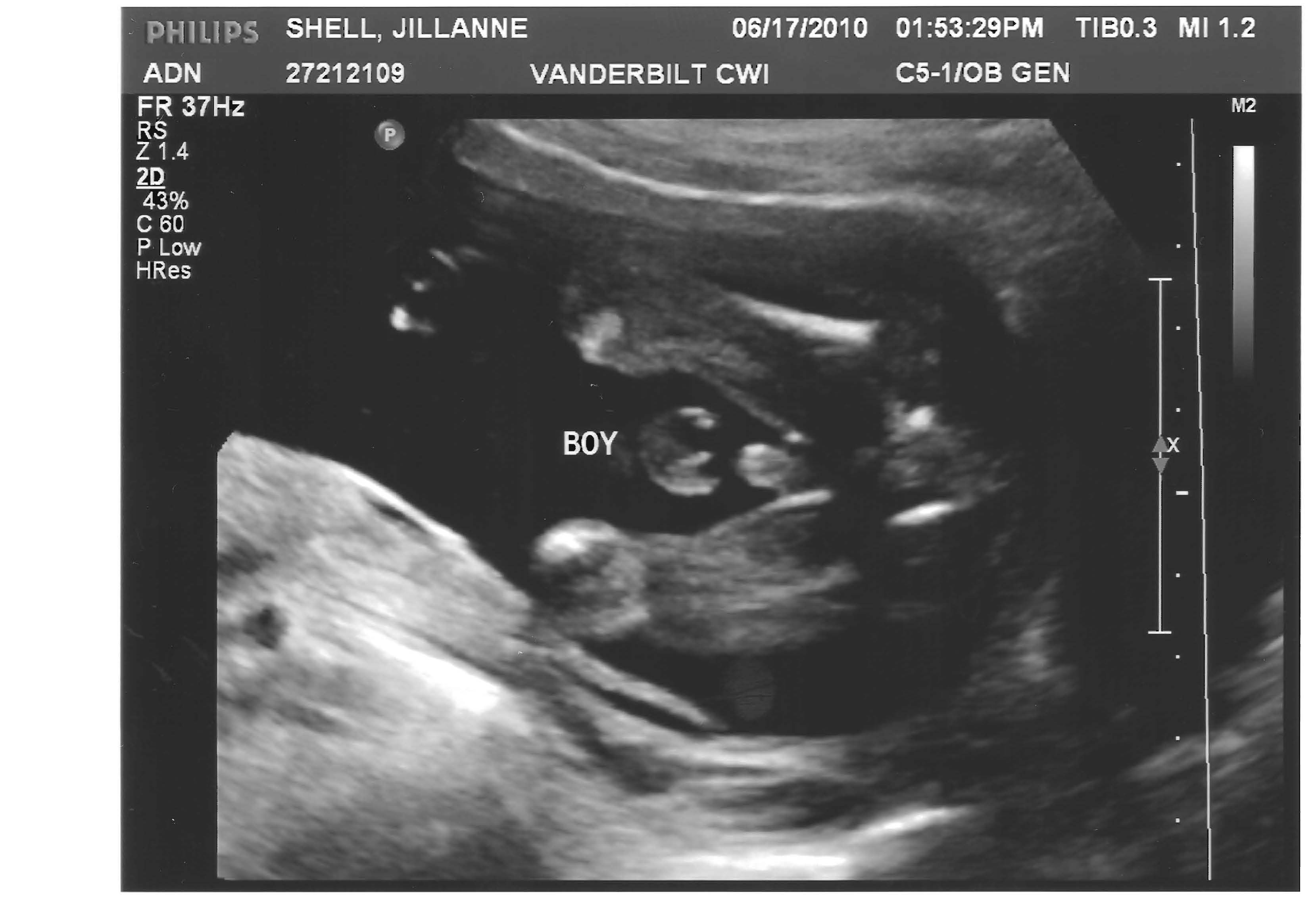
After my grandmother’s dream and my wife’s co-worker’s psychic’s prediction of it being a girl, it was pretty obvious to us what the gender of our baby would be.  I drove down to the appointment yesterday full of excitement, knowing that I could finally tell everyone that our intuition was correct once I would get the official confirmation.

Several anxious moments passed as the nurse showed us pictures our  our baby, then finally she asked us, “Do you want to know what it is?”

Laughing, full of confidence, we told her that we were quite sure already, but yes, tell us for sure.

“You’re having a boy.”

I wish I had a YouTube clip of our reaction.  “WHAT?!  NO WAY!  ARE YOU SERIOUS?!”  Etc., etc.  All exclaimed while hysterically laughing.

Not that it mattered either way to us.  I just don’t think I’ve ever been more surprised in my life.  I wish there was a way to type in a “laughing font” to better show my tone here.  I’m so happy!  We’re having a boy!

This is an “under the scrotum” shot.

Of course now it’s time to answer the other question: What are you naming him?

First name: Jack

Middle name: William

Last name: Shell

Here’s how we came up with the name:

He will go by “Jack”, which is my dad’s name.

Which is an alternate version of John, which is Hebrew (Jewish) for “God’s grace”.  Which just sounds like a cool name.  It’s simple, not too popular, and easy to spell and say.  And Jack also happens to be the name of the lead character of the best show ever made, LOST (played by Matthew Fox, who is also part Italian.)

Plus, my wife’s name is Jill… so it’ll be “Jack and Jill”.

His middle name, William, (my wife’s dad’s name) is German and loosely translates as “protector”.

His last name, Shell, (originally spelled “Schel” at some point in American history) is German and loosely translates to “loud and noisy”.

That being said, Jack William Shell is a Jewish-German-German name which fully translates as “God’s gracious gift of loud and noisy protection.”  I’m already picturing a little boy wearing a pot on top of his head, running around the house, banging a pan with a wooden spoon, being “loud and noisy”.

Most importantly, Baby Jack is healthy, thank God!

Jack, the boy.  Who knew?

All pictures with the “JHP” logo were taken by Joe Hendricks Photography:

Blog- www.photojoeblog.com

Website- www.joehendricks.com