LOST Recap: Finale- “The End”

I loved it.  Absolutely.  And I believe it was the best, and really, only way, to end the show.  But it just took me 24 hours after watching to understand why.

The entire show was just about Jack Shephard.  Everything else, including the island and its ability to heal people and time travel, the Smoke Monster, the Dharma Initiative, the Others, Jack’s friends, Jack’s enemies, the light in the cave… All of it were the parts of Jack’s life that ultimately mattered to his existence.

In the likeness of the movie Vanilla Sky, when you’re dead, it’s all over- so why focus on the character’s earthly life after they die?  But the writers of LOST took that concept to a new level by acknowledging that all the mysteries, actions, heartaches, and triumphs all boil down to one thing- the people that were involved in your life.

Even Vincent the dog’s best purpose on the island was to comfort Jack as he died.

I definitely plan to write much more in the near future answering the remaining questions about LOST: Why was The Man in Black never given a name?  Who was the first protector of the island?  Did it really matter that Desmond and/or Locke typed the code every 108 minutes?  What was really accomplished by Juliet sacrificing her life by detonating the bomb in 1977?

But as for today, I think it’s more important to focus exactly what happened in the finale.  The most begging question is what’s up with the flash-sideways?

The first time we saw the characters of LOST in the finale season, they were on the plane.  Note there were never flash-forwards or flash-backs during the flash-sideways, indicating no past or future in that timeline.  They weren’t reincarnated, having to live their lives all over again, in this version with the island being sunk.  The alt-reality was simply an “acknowledge your dead and that your life mattered” precursor to the afterlife, often referred to as “purgatory” or “the waiting room”; it started with the plane ride.

Keeping in mind that life on the island (and “the real world”) continued after Jack died, that Hurley and Ben served as the island’s protectors for the rest of their lives, that Claire, Kate, Sawyer, Richard, Miles, and Frank all left the island and lived normal lives back in the United States or wherever they chose to re-establish their lives… they all still died at some point.  Most of them of old age, living to be in their 70’s.

And once they died, before going to Heaven, they were reunited, having the blessing remembering how they mattered to each other.  And since time, in essence, doesn’t exist in the afterlife, they all met at the same time, since it didn’t matter that Jack died 40 years before most of them did.

But because Jack was the main character of the show, the show stopped with his earthly death.  The rest of the living characters lived their rest of their lives and eventually died, the show just didn’t continue to follow their earthly lives.

So when Jack died in 2007 (three years after originally crashing on the island), and (say, for example) that Kate died in 2051, they met at the same time in “the waiting room”.  (Because time doesn’t exist after earthly life ends.)  Then they went on to Heaven with the rest in the church.  (And Ben went once he was ready.)

The writers were clever to utilize a nearly universal belief that there is some sort of life after death.  The episode was quite saturated in Christianity (which was a smart idea since most of America identifies with some version of it), yet didn’t write off other popular international religious beliefs, thanks to the “major six religions of the world” stained glass window in the church.  The point wasn’t to depict any religion’s specific teaching on the afterlife as specifically accurate, but to instead play and expound on our perceived general ideas on life after death and the importance of the people in our lifetime after we die.

I don’t see how LOST could have ended any other way.  Yes, technically “all our questions” were not answered.  But it involves using our imaginations and clues from the show to fill in the blanks, as we as Losties have been doing the whole time.  It will bring me much joy to take matters into my own hands by filling in these blanks with many more LOST posts to come.

Comments welcome.

(They will most likely be spun off into a new post if they are interesting, insightful, or raise a good question; or instantly deleted if they are full of nerd spite: “NO!  You’re wrong!  What really happened was…  Looks like you never thought of that while trying to make your weak point, did you?…”).

http://today.msnbc.msn.com/id/37320802/ns/today-entertainment/

dad from day one: What Does a Real Baby Do?

Fifteen weeks.

My expectations of what it will be like for my wife and I to have a real baby are pretty limited.  When I try to imagine it, I can only think about a few things: the baby crying, the baby being hungry, feeding the baby, the baby wanting to be held, holding the baby, the baby pooping, changing the baby’s diapers, the baby sleeping, us wishing we could sleep.

And aside from the 80’s sitcom stereotypes, I of course am well aware, thanks to everyone who has ever been a parent and given me any advice: There’s nothing in the world more rewarding than being a parent.

In November I will begin to feel like a real parent (once the kid is born).  Until then I won’t really truly be able to understand or fathom this most rewarding thing in the world.

It’s funny to think that eventually we won’t be comparing our baby to the size of a certain fruit.  (This week our baby is the size of a naval orange.) Eventually, our baby will be the size of a baby.  Interesting thought.

Excerpt from “the bump.com”, regarding week 15:

“Continuing the march towards normal proportions, baby’s legs now outmeasure the arms. And, finally, all four limbs have functional joints. Your fetus is squirming and wiggling like crazy down in the womb, though you probably still can’t feel the movements.”

All pictures with the “JHP” logo were taken by Joe Hendricks Photography:

Blog- www.photojoeblog.com

Website- www.joehendricks.com

http://community.thebump.com/cs/ks/blogs/nb_checklists/pages/how-big-is-baby.aspx?r=0&MsdVisit=1

Adventures in Thailand: Monk Footprints and Bed Bugs

Planes, Trains, and Automobiles.  The Thai version.

After recently revisiting some memories from the summer of 2004 in Thailand, I must have tapped in to some sort of parallel between my life now and my life at age 24, because there is some therapeutic and natural about replaying those stories out loud (or by typing them out and reading them).

It all started a few days ago when my friend and former  college roommate Josh Taylor sent me a text message asking what the best phone number to reach me was.  A few texts later, I was jogging his memory (and mine) with a reference to “monk footprints”…

During our week long vacation from teaching at Bangkok’s Global English School (all schools had a mandatory closing for a week due to the International AIDS Conference being held in Bangkok that year), Josh and I decided to take an excursion to Chiang Mai and Koh Samui by overnight train, motorcycle, and plain.

In our overnight train ride to Chiang Mai (Thailand’s 2nd largest city) up in the North, our seats converted into beds for the night.  Right across isle from us on the train was a middle-aged Buddhist monk, dressed in his drab orange robe, marked with animal tattoos all over his head (to fend off evil spirits).   Despite the loud bangs and rumbles off the tracks throughout the 12 hour ride, the monk’s constant religious chants were a bit distracting (and kinda creepy).

But when in Thailand, you learn just to go with it.

As nighttime approached, the train attendants came through the isles to transform our seats into beds.  The monk headed to the restroom.  When he returned, he used Josh’s bunk bed (which was on the bottom) as a stepping stone to get up on his top bunk.  He wore no shoes.  His bare feet, which were caked with dirt, left “monk footprints” on Josh’s white bed sheets.  Moist, mud-infused footprints.

Therefore, the phrase “monk footprints” will always be a legendary term between Josh and I.

When we arrived in Chiang Mai early the next morning, we rented “motorcycles” (a loose term in Thailand, as it basically often means a glorified moped) by paying $4 a day and handing over our American driver’s licenses as a security deposit (which does seem a bit risky; turns out, a few weeks later I spent two weeks in South Korea with my sister and my passport was stolen).  After a day of exploring (and getting a little lost) the city, getting curious about what the Chiang Dao Cave was as well as what the “live monkey shows” were all about.

Because the school in Bangkok we were teaching at is a Christian school, we were able to have it arranged that we could sleep in a church in Chiang Mai for free.  Can’t argue with a free shower and bed for a few nights.  Of course, the shower water was ice cold (which isn’t a horrible thing in a country with a climate similar to Miami).  And as for the sleeping arrangements: two plastic sleeping bags on a cold, slick cement floor on the second floor in a building with no air conditioning and a garage door as the main entrance.

The best part though, was the fact it was impossible to stay asleep for more than twenty minutes at a time.  Not because of the heat alone, but because of the tiny little biting ants from whom we evidently were invading their space.

And yet I count all of these as fond memories.  Backpacking through Thailand for me was a rite of passage.  An adventure that will always be part of me.  Maybe one day when I become a rich, successful author with a book on the New York Times Best Seller List, I can manage to find the money and time off to go back.

Until then, Thailand remains a magical, mysterious place that sometimes I think of as a dream world in a parallel universe that only exists in my mind.

A billboard we saw at a bus stop there- a Thai clothing company switched the “A” and “E” of Abercrombie to make their “own brand” of clothing.

Josh having a random Thai meal on the train before his seat was converted into his bed.

Josh having a random Thai meal on the train before his seat was converted into his bed.

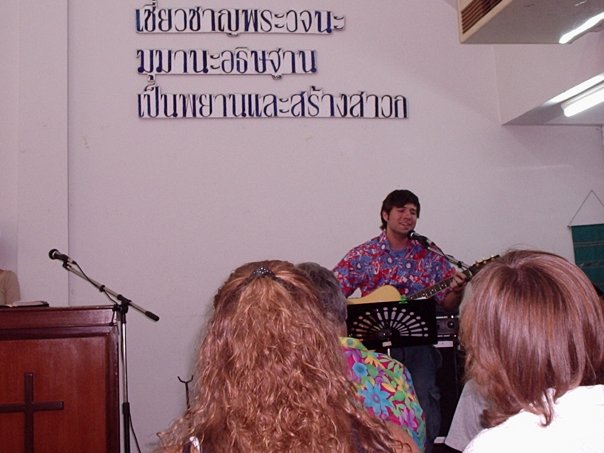
Me playing a song at the Thai church we camped out at.

Adventures in Thailand: Live Monkey Show

Everybody’s got something to hide, except me and my monkey.

After our curiosity was peaked from seeing several signs for “live monkey shows” while driving motorcycles through the mountain city of Chiang Mai, Thailand (during the summer of 2004), my college roommate Josh and I decided to drive further up the mountain to put ourselves in a vulnerable situation: to venture into whatever a live monkey show was, up in an isolated village where we were indeed the only “white people”  (or “farang”, as the Thai natives called us, which simply translates “foreigner”) for possibly hundreds of miles.

The anticipation rose in my mind like the dust on the unpaved road leading the site, having just turned at a hand-painted wooden sign with a picture of a monkey putting his hand in a jar with the words “LIVE MONKEY SHOW”.  I imagined a sort of a toned-down Floridian Sea World time of venue, with possibly even a hundred people in the audience with us, as was the case with the live elephant show we saw (where the elephants played soccer and painted pictures).

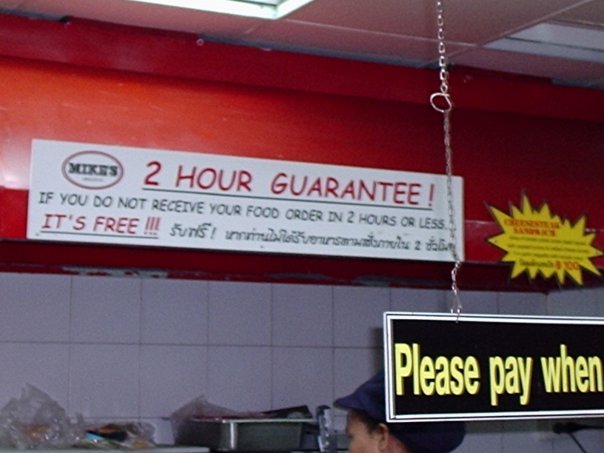
We cautiously marched up to the front window.  With the ticket girl basically speaking no English whatsoever, she called out the manager to help answer the question, “How much does this cost?”  We were expecting around $5 per person, based on the elephant show price we paid earlier.  Instead, he grunts to us, “Ten dollars per person”.  While that may not seem like a lot in America, that’s more like fifty dollars in the U.S.

I began walking away, only half-way caring about seeing the show, partly out of the mindset: “What are we getting ourselves into, anyway?”  Josh stayed behind as the Thai man was eager to negotiate a better price.  It worked.  We got in for $4 per person.

We hesitantly paid our dues and asked if we were late or early for the next show.  The man’s response: “On time.  Show begin soon.”  He smiled.  We walk in.

Cement bleachers.  Enough seating for about 5o people.  And there was only one other person sitting there with us in the audience.  A Thai guy.

We looked around for signs of activity.  About twenty feet in front of us (we were setting about halfway towards the back of the venue) was the flat cement “stage” and a Thai girl standing, happy to be there, looking at us.  By the time I had the chance to say to Josh, “So we must be pretty early, huh?”, the other audience member began walking up to the stage.

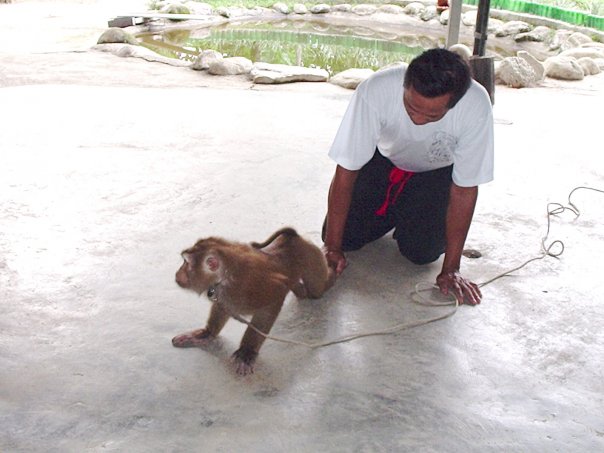
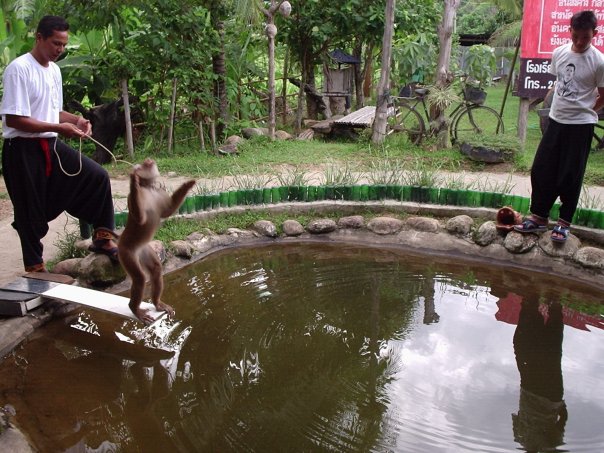
The Thai girl simply said, “Welcome… to live monkey show.”  Then the Thai guy who was just moments ago a fellow audience member, was indeed the show’s leader.  He brought out a monkey.  An impressively trained monkey, who did push-ups, sit-ups, could find the hidden key in one of five cups turned upside down and rearranged, and who dove off a small diving board into a miniature pool of water to find a coin, sometimes while blind-folded.

Of course, to make sure it would become a memory we would not forget, we both had the chance to become “volunteers” to help in the act.  It’s the only time I’ve ever had a monkey in my lap.  Fortunately, he didn’t bite me.

After forty-five minutes of live monkey antics, the show was over.  We knew this when the Thai girl walked back up to the stage and said, “Thank you” and did her Thai bow to us.  Then she walked back to the ticket booth, returning to her other job.

So that’s a Thai live monkey show.  The Thai guy who runs the place serves as an audience member and ring leader, and the Thai girl is the ticket booth operator and announcer.  And a trained monkey with a metal shackle on his foot is the star of the show.  And evidently, two white guys sitting in the bleachers constitutes as a full audience.

When does the live monkey show begin?

As soon as you show up.


Like It, Love It, Gotta Have It Vs. I’ve Already Got One, Thanks

Fighting the urge to the live by the new American motto: If it ain’t broke, get another one anyway.

I can almost remember a time when I was a kid, where it was normal to really really want something for a long time and then when I would finally get it, my heart was content.  The newly obtained item gave my heart rest, and I was happy, as any kid should be.  Whether it was a new Nintendo game like Super Mario Bros. 2, or a bicycle, or a rare Ninja Turtle action figure like Splinter, April O’Neil, or Ray Fillet, I got what I had wanted for so long.  And funny enough, I never wanted a replacement after I received my prized possession.

But somewhere along the way, whether or not we can blame it on “typical capitalist American behavior” or the mindset of Generation X (I just barely made the cut- it’s anyone born between 1961 and 1981), it became normal to want a “new one” though the old one still works just fine.  Maybe just an innocent desire to keep things fresh.  Or maybe a potentially dangerous pattern.

My Italian grandfather was one of the most influential people of my lifetime.  Having grown up in an orphanage in Kenosha, Wisconsin (his mother died when he was young, and there were 12 kids in the family), he lived a minimalist lifestyle, only spending his money on his few children and grandchildren.  Hardly ever buying a new (used) car, new clothes, or new furniture.  Never buying anything name brand.

This way of thinking definitely shows up in my everyday life.  My wife jokes that I have more clothes and shoes than she does.  And it’s true.  Because I don’t get rid of them unless they’re literally rotted.  Like my old red running shoes I have delegated to only use for walking and riding my mountain bike on my lunch break.

It’s true that I own over twenty pairs of shoes that still look less than a year old.  But most of them are indeed at least ten years old, in actuality.  Because I have certain shoes I wear only if I know I will be outside or if there’s a chance of  rain that day.  Those are my “outside shoes”.  By wearing them instead of my “inside shoes”, it keeps my newer shoes looking new.

While I’ll never be as frugal as my grandfather (who when my mom was a little girl, reused dried out paper towels multiple times before throwing them away) I subconsciously try to imitate his lifestyle.

I can’t see myself ever buying a brand new car, knowing that it loses thousands of dollars in value as soon as the first owner drives it off the lot.  And I can’t see buying a different car until my current one costs more to repair than it does to actually buy another used one.

Not that buying a new car is any kind of moral issue, or that going on a shopping spree for a new wardrobe is necessarily evil, though it’s probably not a wise decision if it involves a credit card (I’m a Dave Ramsey fanatic).  But for some of us, that strand of “gotta get a new one” serves as toxic acid in our DNA.

It gets tiring hearing of men leaving their wives for another woman.  That’s definitely a familiar theme this year already in the media.  And while some could say, “What does to me if matter if Tiger Woods or Jesse James cheats on his wife?  Why is that national news?”  Because it does matter.

Not because we’re nosey.  But because in some sense, the reflection of the lifestyles of celebrities causes a subconscious call-to-response for the rest of us:  “Hey look, it’s normal, he did it.”

We have to either say, “No way, that’s not for me.  No thanks!”  Or “Well, maybe that’s not so bad…”

It shouldn’t be that hard to be happy with what we’ve already got, even if it’s not perfect.  And really, that’s a mindset that is often difficult to accept and adopt: Near-perfect is as perfect as life can really get.

Is the grass really greener on the other side?  Yes, of course it is.  But the irony is this: You’re already standing on the other side.  Somebody’s else’s “other side”.

You’re already standing on the greener grass.