Being that I spend most of my lunch breaks at Borders, over the past year I have been acquiring a small library of discounted books. One of my purchases off the “five dollar clearance rack” was a huge colorful book on Feng Shui. While I have yet to spend much time really learning these ancient Chinese secrets, I did scan through a few chapters. One of the concepts of Feng Shui that I did pick up on warned against long uninterrupted straights, whether the layout of the house is based on one basic hallway or the driveway to the house has no turns. Without turns and interruptions along a straight path, one might “fall out of the house and out of their own yard”. That’s considered “bad Feng Shui”.
If you are able to grasp that concept for the most part (which I think for some strange reason I can), then maybe you can understand my recent perspective on how having Baby Jack relates back to Feng Shui, if nothing else, in my own sleep-deprived head. Recently, some of my cosmic insecurities have been heavily resolved as I realize that by being a parent, I am forever in the middle of a generation, no longer the tail end. I am no longer the tree itself, but instead one of the branches on someone else’s family tree. No longer am I a coastal state like Rhode Island or South Carolina, exposed the possibility of breaking off in the Atlantic Ocean, only separated by a few thousand miles from giant Africa; instead, I am now landlocked Kansas. Like sitting in the middle of the third row seat in a 15 passenger van on a church mission trip to Mexico; like no longer being on the outer edge in a herd of zebras escaping from a hungry lion, so am I.
As a parent, I now feel more Feng Shui. I will not “fall out” out the universe into outer space without it being immediately noticed. Because I am no longer simply a husband; I am a father. And being a father doesn’t simply hold importance in the direct care of my son, but also in an undeniable eternal sense. Baby Jack is not just simply a cute little Bambino. He is a spiritual being who I am responsible for.
I am no longer an island of any kind. More than ever before, I am needed and necessary in this world. What I do from this point has potentially everlasting outcomes. I won’t look back on my life when I’m an old man and think, “I lived such an empty life.” Because I will always be linked back to my son. So cosmic, man.
“These moments, they can never last; like a sad old man with his photographs keeps wishing for the things he can not change.”
Regarding immediate life in the home front and finding a method to the madness, my wife and I are starting to get things figured out. When Jack needs a diaper change, I put in his pacifier, “shush” him, and place my right hand over his chest while my wife handles the dirty business, delicately cleaning around his healing circumcised penis and belly button (similar to playing the Operation board game by Milton Bradley). Regarding sleep schedules, my wife has come up with this gracious plan: On weeknights, I sleep in the guest bedroom on a futon bed from midnight until 6 AM for 6 hours of uninterrupted sleep, then I get ready to leave for work. When I arrive home 12 hours later, I do whatever my wife needs me to, including but not limited to rocking him, holding him, and helping with the feedings. But during the weekends, I pretty much just take naps when I can.
Yes, this is my new normal. I look at the situation for my wife and I as “baby boot camp”. We are being broken down to the point now where we see two hour naps as a valuable prize, as sleep becomes the new currency in life. Though so many people have told us the “sleep when the baby sleeps” rule, he inconveniently sleeps between 4:30 and 8:00 PM, a time slot where I am always widest awake and eating dinner. Hopefully keeping him awake during this time will push back his schedule enough to ensure better sleep time for his parents.
I figure if we can make it through the difficulties of breastfeeding and learning to deal with sleep deprivation, we can officially handle all else that will come our way in raising him. So I remind myself that every good and present father has been through this too. I look at parenting as a necessary rite of passage for myself as a human being. It’s something I was meant to do in order to fully serve my purpose here on Earth; never really knowing all the positive chain-reacting side-effects that my influence on him will cause in the world. Deep.
In the Season One finaleof dad from day one, I promised an interesting plot twist. So here in this premier of Season Two, I’m letting everyone know my own meaning of the phrase “Sweet Home Alabama”.
As I explained in due date, a common trait of ‘80’s sitcoms was that a family was introduced to an outsider who suddenly moved in their home, therefore creating a new sense of “normal”. An exception was Just the Ten of Us, where the Lubbock family moved from the state of New York (the setting of Growing Pains, which it was a spin-off from) to California. Dad from day one will be combining both of those plot devices: the newcomer and the new setting. Next Saturday morning, December 4th (on the 4th day of Hanukkah- for any Jewish readers out there) we will pack up our PT Cruiser and Element for the 2 ½ trip (not counting baby delays) from Nashville, TN to the small mountain/valley town of Fort Payne, AL (pop. 14,000 not including illegal immigrants) where I was raised.
Something that makes this really interesting is when I am asked: “So do you have a job lined up?” Nope. That’s part of the reason we are so briskly making the Hometown Migration– so I can search full time for a new job during the whole month of December while living off leftover paychecks and savings. Despite having nearly five years of career experience involving sales, doing trade shows, hiring, and training, I am not naïve to think that a new job will magically appear the week we move to Alabama.
However, I have this belief that as a follower of Jesus Christ, God knows I will make a lot of noise and commotion honoring Him before and after He answers my prayer. And since I believe that glorifying God in all things is the ultimate meaning of life, I am confident that at the right time, God will provide for me so that I can provide for my family. As Jesus put it, when a child asks his father for bread or fish to eat, his father doesn’t give him a stone or a serpent instead. I love that example.
In Fort Payne, we will be living less than three miles from not only my parents but also my sister and her husband. We know that this quiet town will not only be the right place for Baby Jack to grow up, but also the most practical place for my wife and I to care for him- to be able to watch him grow up slowly, as compared to seeing him only a couple of hours a day in a big city life. There is no mall in Fort Payne; only a Super Wal-Mart. There are oddly no Italian restaurants, which will be difficult for Baby Jack, my wife, and myself who all happen to be a quarter Italian and need marinara sauce and garlic bread in order to function properly. And sadly, for my wife, there is no Starbucks: I think the nearest one is about an hour away.
A lifestyle without malls, Italian restaurants, and Starbucks is precisely what the three of us need. Because despite leaving all those so-called conveniences behind, we will be able to slow down the pace of life to the speed it needs to be. My wife and I are extremely happy about the move. In a sitcom it’s pretty normal for each new season to bring about new characters on the show. New characters, new city, new plotlines, here we come.
There is only one person who directly assured me back before we knew the gender of our baby that he would be a boy. That was Tommy Huong, a Vietnamese co-worker who had already predicted the gender and birthday of another coworker (he has evidently memorized the 12 year patterns of the Chinese calendar). So last Friday (the day after the due date) when someone at work suggested we all do a “baby pool” to predict when Baby Jack would actually be born, a better idea instantly surfaced:Go ask Tommy!
I ventured over to his desk and as he turned around it was as if he already knew why I was there, being that he was too far away to have heard the recent conversation. “When was the due date?” he asked me. “Yesterday,” I answered. Tommy turned to his calendar and without any hesitation, placed his finger on Tuesday, November 16th. “Tuesday, he will be born Tuesday.”
So we enjoyed the weekend. Then I worked a full day on Monday. That night around 8:45, my wife said I should finish the last two episodes of Dexter on the disc from Netflix so we could mail it off the next day- and so I have could time to watch my new favorite show before our schedules became forever changed. I watched my two 50 minute episodes of Dexter, walked to the bedroom in perfect time to hear my wife proclaim, “I think I’m in labor.” And she was.
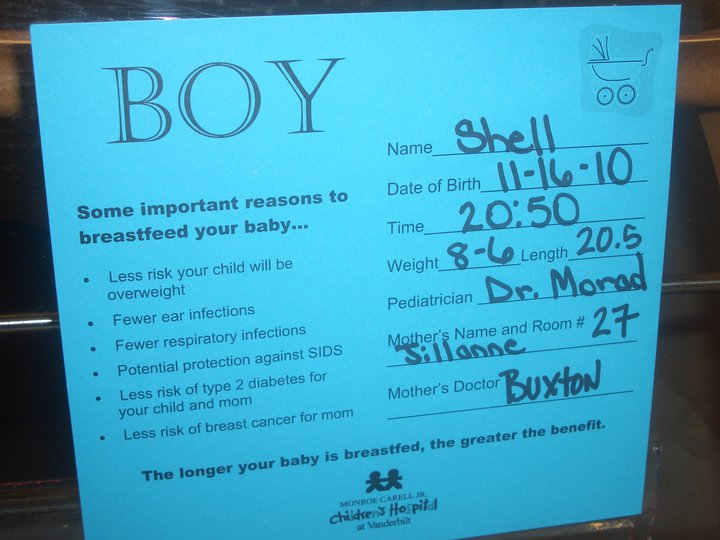
From 10:30 Monday night until 5:11 Tuesday morning, she labored at the house. Then we drove in the rain to the hospital; a 40 minute ride. After laboring for 12 hours without any pain medications, she then pushed for four more additional hours while not furthering past the 8 centimeters mark (and 100% effaced). By that point, it became clear that after making it that far, she no longer had the strength to push without some outside help. So my wife chose to get an epidural. Because ultimately, we wanted to do everything we could do to avoid major surgery.
But even after several hours of the epidural, it took everything she had to push our baby out. In fact, if it weren’t also for the diligence and determination of the midwives to honor our request of avoiding a C-section, cutting the baby out of my wife’s stomach would have been the only option. But the midwives tried every trick in the book, and finally, it worked. In the end, Baby Jack turned out to be one big Bambino. The first words my wife said when she saw him coming out was, “You’re a big baby! How did you fit inside of me?!”
I realize that the expected Hallmark way to portray the first time I held Jack is to say that I cried, as the emotions surrounding the miracle of life flushed through me. But for the fact all my emotions were exhausted from helping my wife suffer through over 22 hours of labor, here’s what I thought instead: “You’re darker than us! If anyone should be Mario, it’s you!”
I’ll explain. A few months ago I told the story of how the name my parents gave me while my mom was still pregnant with me was Mario. My mom is half Italian and half Mexican, and therefore, dark skinned. The name Mario would not only have represented my dark skin, but also cover both my Italian and Mexican heritage. But as soon as I was born, my pasty skin and seemingly American features brought cause for a name change. Therefore, a few hours after I was born, I was named Nicholas- a less ethnic name that still points to some kind of a foreign background.
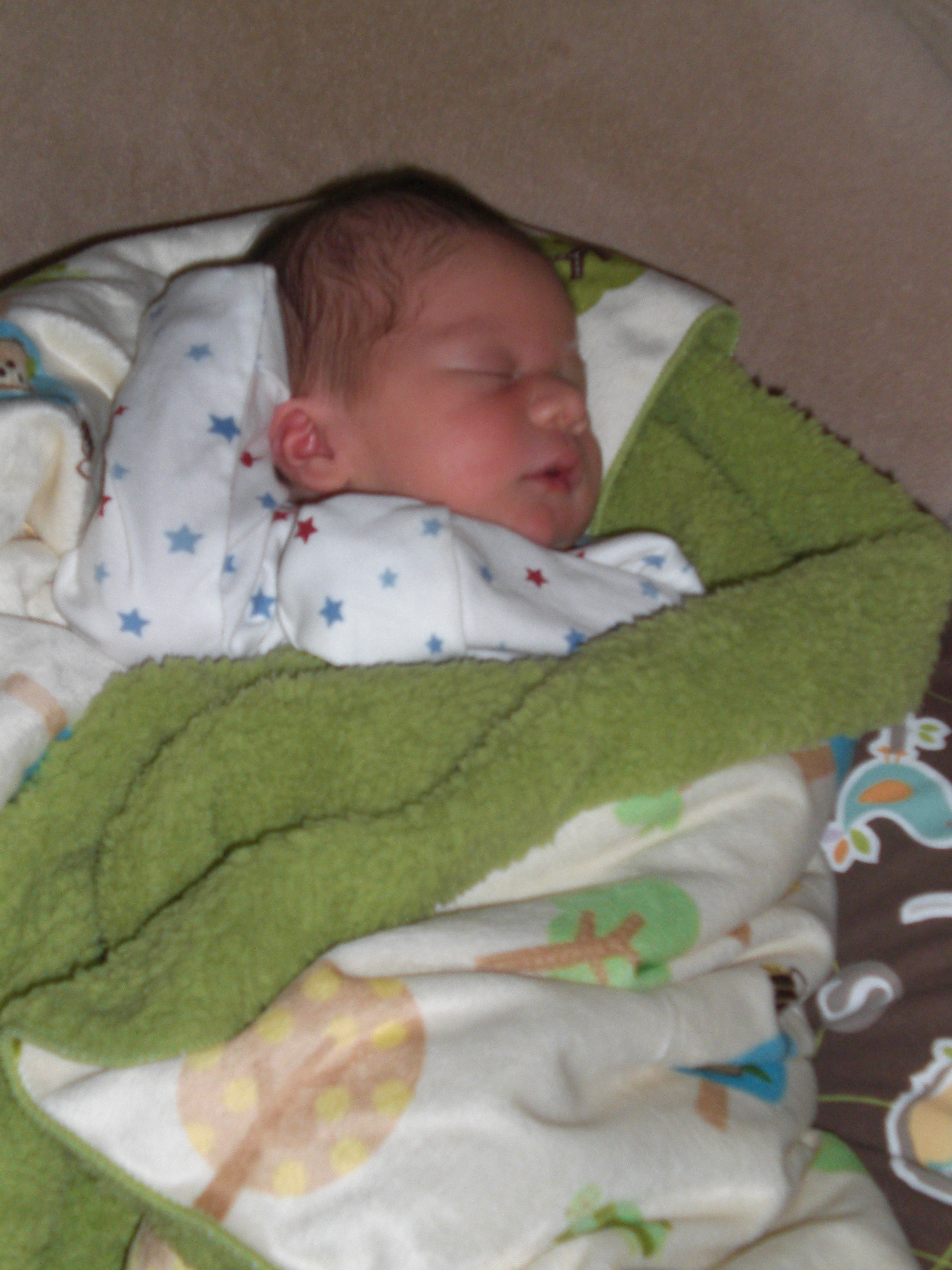
So 29 years later as I held my own son for the first time, I had the opposite reaction from the one my mom had when I was born. Because as of now, Baby Jack doesn’t necessarily especially look like my wife or me, but instead what I would imagine Super Mario would have looked like when he was first born. One of Jack’s noticeable features his full head of black hair. I think he has “Gerber baby” lips. And as I have already studied his profile multiple times, it’s safe to say he has an Italian nose- which I am so proud of!
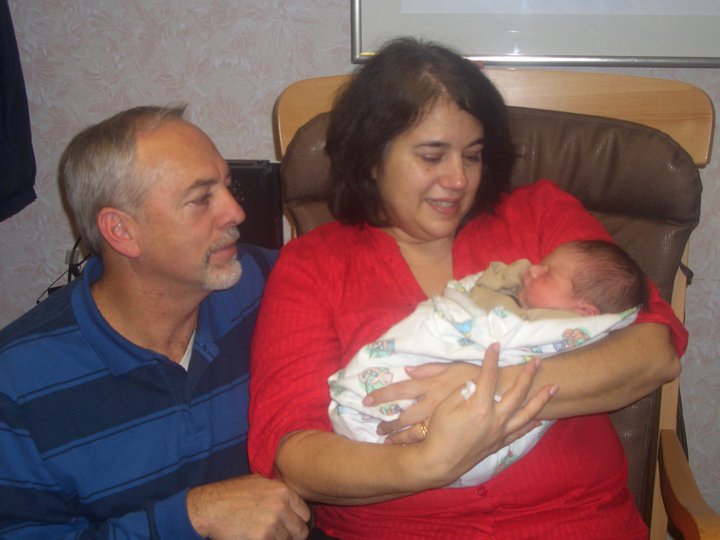
My parents holding their first grandchild for the first time.
Right before we were released from the hospital, Jack was circumcised. I felt really bad for him, yet at the same time realized that I don’t remember my own circumcision. It’s still sad to think about him having to go through that though. He’s holding up just fine and so is his mommy, despite a drawn out entrance into this world. God has answered all of our prayers for his and my wife’s safety and health; we are so grateful for that. The pediatrician at the hospital told us that she checked him from head to toe and couldn’t find anything that needing fixing or reason for caution or concern.
Jack is a cool baby, if I do say so myself. He’s pretty low maintenance- he just wants to be held all the time. But I’m guessing we won’t have trouble working that out. Thanks for following dad from dad one, so far. If life is a sitcom, this is the season finale. The new season premieres next week where I am promising an interesting new plot twist…
Don’t ask me how, but all week my wife and I have had the theme song to the ‘80’s sitcom Mr. Belvedere stuck in our heads. In the mindset of “if you can’t beat ‘em, join ‘em”, we downloaded the song as our ringtones for when we call each other. That has caused me to revisit some of my most favorite theme songs from these sitcoms that served as the backdrop of my childhood. A very interesting trait that many of these TV shows had in common with each other (and accordingly, the lyrics to their theme songs) is that premise was that an outsider moved into the household, therefore throwing normalcy out of whack. Which totally relates to what’s going through my head right now about our upcoming new addition, a baby boy. (In order to qualify, the sitcom had to actually start in the 1980’s; Diff’rent Strokes, Mork and Mindy, and The Facts of Life don’t qualify since since they premiered in the ’70’s.)
For example, here’s a sitcom that had it all, yet could have only existed in the 1980’s: An all-American family, laugh tracks, and an Alien puppet. Of course, I’m referring to Alf. While the song had no words (instead it sounded like what would happen if you pressed the “demo” button on a $200 Casio keyboard in 1988), the thought of a little creature running around the floor chasing cats loosely translates having a baby boy. For Family Matters, the intended outsider was Estelle Winslow who moved in with her son Carl’s family, though unexpectedly the true outsider instead became Steve Urkle (intended only as a guest star) instead a few episodes into the first season.
In Mr. Belvedere, a British butler moves in with an American family living in Philadelphia: “Sometimes things get turned around and no one’s spared… There’s a change in the status quo. Preparing for our new arrival. We might just live the good life yet…”
Another prime example is from one of my favorite sitcoms ever, which happens to have my favorite TV show theme song ever. In Perfect Strangers, city slicker Larry Appleton is thrown for a curve when his distant cousin Balki moves from his mysterious Mediterranean village to live with Larry in Chicago: “Sometimes the world looks perfect- nothing to rearrange. Sometimes you just get a feeling that you need some kind of change…”
In Full House, it was Joey and Uncle Jesse who mixed things up by moving in with the Tanner family: “What ever happened to predictability?”
There was CBS’s version of Diff’rent Strokes: Webster. As a kid, I actually liked Webster more than Arnold: “Til there was you…”
The next two sitcoms both premiered in 1984 and featured an Italian-American who moved into the household as a “manny”. Who’s the Boss? contains my 2nd favorite theme song ever and often caused me to believe that Tony Danza was my uncle: “You might awaken to a brand new life around the bend…”
Even though I never watched it, I know it was a big deal to a lot of people- Charles in Charge: “New boy in the neighborhood…”
You’re welcome… for being led into a world of nostalgia. It’s pretty much a fact that you’ll be struggling to get one of those songs out of your head for the rest of the day. So being such a sentimental guy as I am, I’ve been thinking about the current events that are going on right now. That way I can tell Jack what was going on around the time he was born:
Interestingly, on November 5th, the movie Due Date hit theatres. Daylight Savings was two days later; meaning that when it’s that time again to set back the clocks every year, it will almost be time for Jack’s birthday. Conan O’Brien’s new show premiered this week (November 8th) and sure enough on last night’s episode during the monologue Conan pointed out that it was exactly nine months ago that his gig at The Tonight Show ended; so if because two people felt sad for Conan losing his job they decided to “get frisky” to be happy again, their child would be born this week. Good call.
It will also be pretty neat that I will be able to show Jack the November 2010 issue of American Baby, in which in his birth was anticipated. He is not making his debut unannounced; that’s for sure. Today, November 11th, is not only Jack’s due date but it’s also my dad’s birthday, whose name is also Jack. So even though he won’t have the same exact birthday as my dad, their birthdays will always be close.
Of all the pregnancy advice I’ve been given, the one thing no one warned me about is this: For first time moms, it’s normal and expected to not delivery until a full week after the due date. So if you or your wife are approaching your due date, don’t do like I did and get all psyched, thinking the water is going to break at any moment. Because then everyone is constantly asking for and expecting baby news, but sure enough, the baby is unaware of his due date. He’s coming out when he’s good and ready.
I have to remind myself that my baby is not a Hot Pocket, with an exact predetermined time of two minutes in the microwave. In fact, that would be pretty weird if he truly was born right near the due date. We went to the doctor today. Thank God, Baby Jack has still got a strong heartbeat and is in a good position. He’s turned the correct way and everything. But as far as when he gets here, I’m sure it will be the moment that I (and everyone else) least expects it. He’s a sneaky little guy.
All pictures with the “JHP” logo were taken by Joe Hendricks Photography: