Review Of “This powerful video may change the way you think about healthy eating” (With New Infographic: Food Isn’t Food Anymore- The Frightening World Of Fillers)

There is currently a video going viral which shows in reverse, how a 32 year-old man got to the point of having a heart attack.

This powerful video may change the way you think about healthy eating

Most likely you have seen about 4 or 5 of your Facebook friends share it this week; you’ll probably recognize it by this picture to the left along with the caption:

This video may change the way you think about healthy eating.

While it apparently is not yet on YouTube, you can watch the one minute and 41 second video here.

It shows all the lifestyle choices that led to his condition; like choosing not to get out and exercise, as well as regularly eating fast food and processed food.

Ultimately, this man’s unhealthy/inactive lifestyle began with his parents when he was just a baby; as the “twist ending” reveals. Therefore, this video is targeting parents.

I feel it was very well done.

Something I really appreciate about the video is that it ends with an offer to actually help anyone who is interested in learning how to make healthier choices, by directing them to the strong4life.com.

The website helps educuate viewers on how to make healthy decisions and changes in life. I respect that.

Sure, we all know fast food is a poor choice, but what should we eat instead? The website addresses that.

I think there might be a public misconception about families like mine, who shun fast food and eat a plant-based diet instead: that we are secretly going hungry or are even unhealthy.

Well, I can assure you we are not hungry, nor passing out because of weakness, nor in the hospital due to lack of nutrients, including protein.

Instead of focusing on dairy, we focus on nuts and seeds. Avocados make a great plant-based cheese substitute for many meals.

Nor are we lacking protein because of the beans and dark leafy vegetables we eat.

Granted, it doesn’t take being a vegan or vegetarian to recognize the importance of dramatically cutting back on animal-based food products and replacing them with plant-based foods.

My perception is that we live in a “paradoxed” society.

As a whole, we choose convenience and taste over health.

To make matters worse, the media that so much of America subconsciously pays attention to (beauty magazines, commercials, headline-making celebrities etc.) sends a mixed message:

“Beauty is on the inside…but you have to be thin to get people to like you, so buy this product to become like this thin person. But remember, all sizes are beautiful.”

Nowhere in that mixed message does it mention actually being healthy. Instead, the focus is on size and beauty.

Or at best, the focus is on calories- which is, in my opinion, illegitimate.

It’s actually good thing to eat a banana (despite the sugar) and cashews (despite the fat), because calories don’t account for the difference between good fat (from plants) and bad fat (from animals), as well as good sugar (from unprocessed fruit) and bad sugar (from processed foods).

That’s why I am passionate to educate open-minded people on what actually makes them healthy.

Feel free to contact me personally and privately with any questions about this. I know what I am talking about:

I used to be 35 pounds heavier, suffering from constant sinus issues and eczema.

Then I changed the way I think, eat, and live.

I began questioning where my food comes from, what’s in it, and what affect it has on my health.

Thanks for reading my blog today. I hope you found it interesting, unique, and relevant. Here is an infographic that shows some of the garbage that is in processed foods these days:

Food Fillers
Source: Healthcare-Management-Degree.net

Food Isn’t Food Anymore: The Frightening World of Fillers

The cost of food is lower than it ever has been before.

Food fillers are lowering the cost of meat — a cheeseburger now costs less than produce. But are these fillers helping us or hurting us?

What are food fillers?


    • Additives: Fillers help bulk up the weight of food. This helps lower food prices.


    • Fillers are mostly found in processed meats.


    • Meat fillers can lower the cost of meats by 10-30%


    • The average national cost for 1lb of 100% ground beef, which likely contains filler, is $3.808


  • The cost of organic ground beef is approximately $4.25/lb

While lowering the cost of food sounds like a great idea, what we’re putting in the food may be costing us.

Cellulose


    • Cellulose is a natural component found in corn and many plants used in the production of paper


    • Much of the cellulose used in food is derived from wood pulp
      Used in cereal, shredded cheese, salad dressing and ice cream


    • Humans can’t digest cellulose. Adding it to food makes for a no-calorie, nonfat filler


    • Cellulose appears in many high-fiber snacks and eating organic won’t help you avoid it.


  • Watch out for ingredients like microcrystalline cellulose (MCC), cellulose gel, cellulose gum or carboxymethyl cellulose

Soy


    • Soy derivatives can be found filling a variety of foods, from frozen yogurt to ground beef


    • “Vegetable proteins”


    • Soy can be found in almost 60% of the food sold in supermarkets


    • In ground meats, soy acts as a cheap filler, lowering both the price and quality of the meat


  • Soy contains high levels of phytic acid, an anti-nutrient that steals and eliminates important vitamins and minerals from the body

Olestra


    • Olestra is a fat substitute synthesized by Procter and Gamble


    • The human body can’t digest the big molecules it is made of, so the fat substitute contributes 0 calories when consumed


    • Introduced in the late 90′s by Frito-Lay and included in Fat Free Pringles


    • Products containing Olestra were originally required to warn customers of the risk of “loose stools”


    • Within 4 years of introduction, 15,000 people had called a hotline set up specifically to take adverse-reaction complaints


    • In 2003, the FDA removed the warning label requirement


  • Olestra appears to interfere with the body’s absorption of critical nutrients such as beta-carotene and lycopene

Carrageenan


    • Carrageenan is a gel extracted from seaweed


    • It’s used as a thickening agent and emulsifier


    • You can find it in dairy many dairy products such as cottage cheese, ice cream and chocolate milk, where it is used to keep the component from separating


    • It is also injected into raw chicken and other meat to make them retain water, making your meat appear bigger and better than it is


  • Seaweed doesn’t generally have adverse health effects, but carrageenan is widely used in meats as a way to trick the consumer

Potassium Bromate


    • Potassium bromate is a component that helps bread to rise quickly and puff up during baking


    • Bread dough is bound together by gluten molecules


    • In order for gluten to join to other gluten, it requires oxidation


    • Potassium bromate speeds up the oxidation process considerably


    • Bread made with potassium bromate ends up being fluffy, soft and unnaturally white


    • In 1982, Japanese researchers published the first study linking potassium bromate to thyroid and kidney cancer in mice


    • If bread is not baked long enough, or too much potassium bromate is added before baking, the amount in the end product can be much higher than recommended


    • The likelihood of consuming potassium bromate is increased in fast food


  • Potassium bromate is illegal in China, the European Union, Canada, Brazil and many other countries. It is legal in the U.S.

Even eating organic won’t eliminate these unwanted fillers from your diet.

Educate yourself on what you’re eating.
A good rule of thumb — the more ingredients are in a product, the less natural it is likely to be

food-fillers

Sources:


Healthy Parents: Dad’s Cancer-Fighting Breakfast

October 21, 2011 at 10:03 pm , by 

Eleven months.

After being the only odd man out in yet another fast food burger sack lunch feast in my department at the office; and hearing my other male coworkers complain about how hard it is to keep from gaining weight after turning 30; and becoming a dad, one of the guys turned to me and insincerely asked, “How do you do it, Nick?”

I’m not the kind of person to push my lifestyle onto others- they have to truly want to know. Because just like when a person asks how you are doing, they don’t always care to actually know the answer.

But the next day, that coworker privately asked me the same thing. As a 30 year-old dad of four sons and coming to work to sit behind a desk for forty hours a week, he had gained a bit of weight and had finally gotten to the point where he wanted to reverse his damning habits.

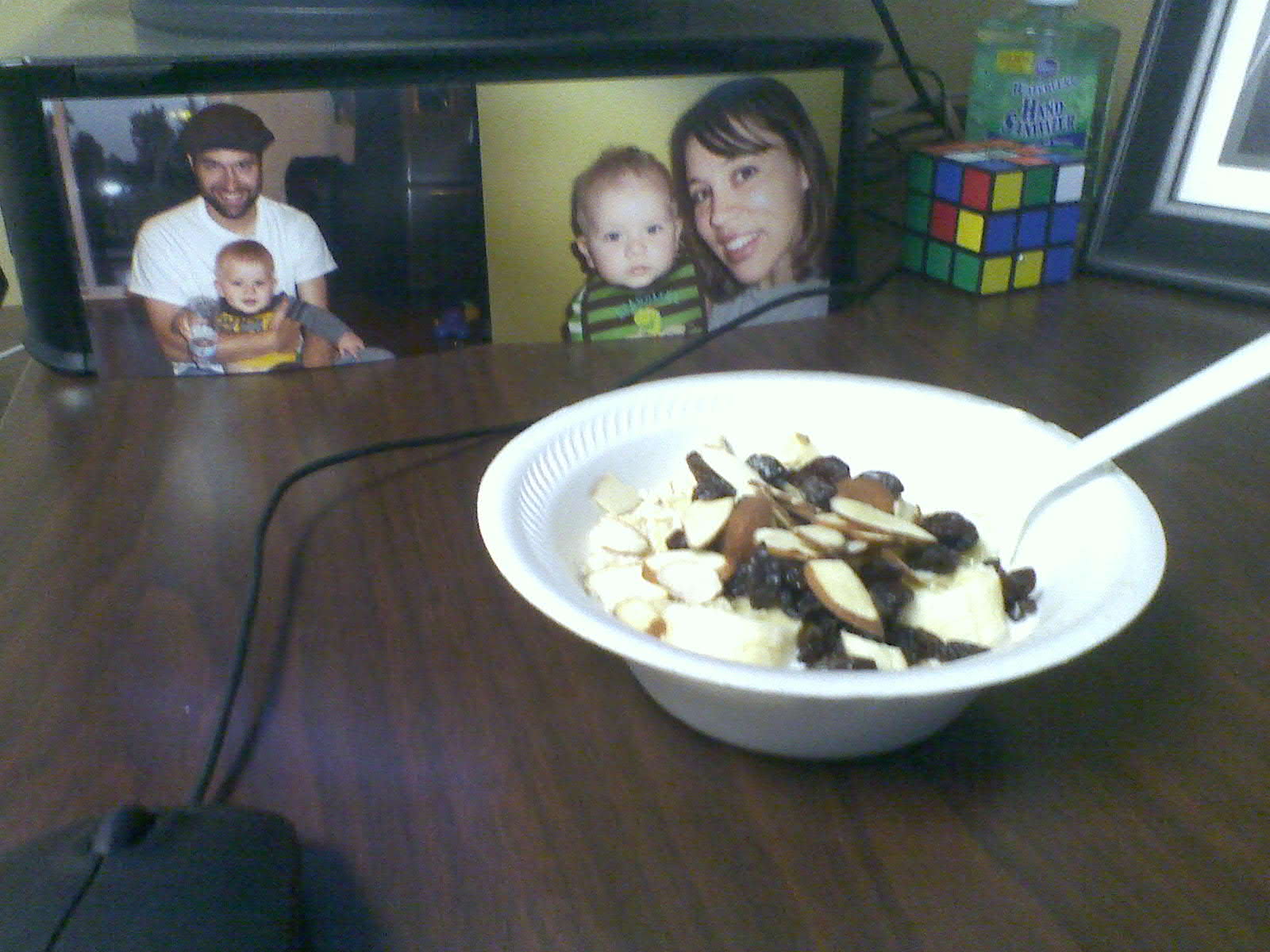
So I told him, “If you want to do this thing for real, then you must start by getting breakfast right on a daily basis-  everything else will fall into place much easier.” And at that point, I introduced him to “Nick Shell’s Swiss Oatmeal.”

In a breakfast world of sugary coffees, frosted pastries, and greasy meat-centric breakfast sandwiches served on white bread, it’s hard to find breakfast food that is both delicious and nutritious. But while on a business trip to Dallas a couple of years ago, I was introduced to Swiss oatmeal at The Corner Bakery Cafe near my hotel. Here’s my version of it:

Nick Shell’s Swiss Oatmeal

Serve cold.

1/2 cup of quick cook, plain oats (the kind you get for $1.29 in a canister)

1/2 cup of whole milk (milk fat is one of the good kind of fats)

1 banana (sliced)

1 tablespoon of unsweetened raisins

1 teaspoon of cinnamon

1 teaspoon of sliced almonds

1 teaspoon of honey

This perfect breakfast is packed full of fiber (oats, banana, raisins), good fats (whole milk, almonds) and natural sugar (banana, raisins, honey, whole milk). Pair it with some black coffee mixed with whole milk and a dash of honey to further keep you full until lunch time.

My coworker went during his lunch break and bought the necessary ingredients and has now converted to “Nick Shell’s Swiss Oatmeal” for breakfast. Predictably, he was skeptical of eating cold oatmeal. But once he tried it, he realized the coldness is part of the Swiss charm- plus, it’s less hassle because it doesn’t require an extra step of having to heat it up.

Switching to a healthy breakfast isn’t easy in our culture. As for me, I just had to do it “cold” turkey.

Passing the Mic:

Do you have a healthy breakfast idea to share with me?

Add a Comment

So Maybe I’m Allergic to Peanut Butter… in Large, Consistant Amounts

But not allergic to peanuts themselves.  Noted, I’m no doctor.

One of the darkest places in life for me is when I am throwing up- which only happens a few times each decade.  It’s that feeling of inescapable depression, like being a notches away from a sickly death- a hellish gravity so overwhelming that I tend to wonder if I will wake up as a ghost like Bruce Willis and not realize I’ve been dead the entire movie.  Usually I try to keep things a bit classier when I write, but in this case there is really no way around the fact that over the weekend I spent the hours from midnight until 4:30 AM constantly vomiting, only interrupted with sporadic periods of rest on the bathroom rug.  I understand that some people have never gotten food poisoning.  As for myself, I can easily think of my three worst occasions: The Central Park drive-thru in 1990, the shady Chinese buffet restaurant in 2007 (back when I still ate pork and shellfish), and the apple & peanut butter incident of 2010.

I don’t know; maybe getting food poisoning every couple of years is like getting stuck by lightening more than once in a lifetime.  Or maybe my digestive track is just ultra-sensitive to any food that is slightly less than proper and sanity.  But what I do know is that I am unable to digest slightly massive amounts of anything- even if it hasn’t been setting out in a Chinese buffet for three hours unattended. What clued me into my possible allergy to large, consistent amounts of peanut butter was my Reese’s Peanut Butter Cup overdose of 2003, when I consumed 36 of them in less than 24 hours: I had just came back from spending a summer in Thailand where both peanut butter and rich, American chocolate are rare finds.  I experienced a major depression for the following two days along with a mild rash on my left wrist for the next six months.

Last week my choice snack every day was an apple with three tablespoons of peanut butter. So good- and seemingly healthy.  But I guess by Day 6 of this treat, which I made my lazy dinner Friday night, was just enough peanut butter in a week’s amount of digestion to throw my digestive track into shock.  Because this was the first time that after I puked up all my food from that evening, I puked up a thick yellow substance, then a thick green substance, then blood- and that pattern repeated a few times before I finally fell asleep until late morning. Eventually though, every single trace of peanut butter was erased from my body. Now, a few days later, I was able to eat my first meal with meat (tilapia, okra, and salad), though my voice is raspy from all the ralphing and my ribs hurt any time I cough or sneeze.

To my understanding and according to my self-diagnosis, I have survived yet another case of food poisoning- and surprisingly this time it didn’t involve a restaurant, but instead a good snack.  I’ve eaten a lot of peanuts in a week’s time and never had anything like this happen.  There must be something about the simple process of smashing the peanuts to turn them into butter than makes them slightly toxic to me.  Sure, I didn’t experience any of the typical symptoms of peanut butter allergies like swelling, but I just think it that peanut butter is smart enough of a food to hurt people in its own sneaky ways.

Lesson learned: From now on I’ll go light on the PB.

Marketing Ads that Try to Convince You They are Selling Healthier Foods, Like Natural Cut Fries with Sea Salt

I am thoroughly amused by advertisements designed for morons. The “healthy” snack franchise Smoothie King wins a special prize in my book. Every morning as I’m driving to work I have to look at their lame sign with a weekly message for passers-by. Every year during the first week of May their marquee reads, “Slim down for summer with a healthy smoothie for dinner”.

Yes, because drinking a smoothie with more sugar than two sodas is going to help the situation. Like having a syrup-based smoothie instead of balanced dinner is going to magically melt the pounds away. Simply hilarious.

But this week’s sign literally made me laugh at loud in the car, looking like a crazy man when seen by the cars next to me at the red light: “Flu season? Not this year! -Immunity Boost”.

Are you Efron kiddin’ me? While Smoothie King’s Echinacea-based “immunity boost” in their smoothies has to do some good, it’s asinine to trust that this $2 shot of an herbal supplement in itself will prevent the flu. So lame.

I’m of the old school of belief that says to let nature just run its course. The more I am exposed to what’s out there, the more immunity my body builds.

While I do catch something more serious every five years like strep throat, in which I have no choice but to visit a doctor and get a prescription to fight it off, I’ve learned in my 28 ½ years that pretty much every week of October 14th, March 28th, and sometimes January 15th, I suffer from major allergic reactions. To the air, I guess. And usually when that happens, it turns into a mild form of sinusitis.

I have encountered this so many times that it’s just a part of life to me now. Being that I get around five sick days a year from my employer, I use them for the days of the year I have the most severe symptoms: migraines, toothaches, oversensitive skin, body aches, depression, lack of appetite, inability to focus, foggy short-term memory.

Since I have dealt with allergy and sinus issues most of my life, I know that what many people call being “sick”, I simply call a “bad allergy and sinus week”. Unless I have a lasting fever or am unable to swallow food and keep it down, I am not sick. And I’m definitely not wasting my time and money to go pay a doctor to give me a prescription to weaken my own body’s ability to fight off what I can become stronger by suffering through.

If I’m gonna be “sick”, I might as well enjoy three straight days of Netflix online streaming without the interruption of a doctor visit.

People are Often Motivated by the Exception to the Rule, Not the Normal Outcome


What sometimes positively motivates people and other times negatively distracts them from reality is a magical device called The Exception to the Rule. A person who is uninspired to quit smoking because their grand maw is 92 years old, who has been smoking since she was 14 and healthier than most 60 year olds. The Exception.

A man who lost 30 lbs in 10 days from doing the Atkins Diet or a married couple who made a profit of $300K their first year of selling real estate after applying what they learned from a DVD. They’re an Infomercial’s dream come true. Helping the rest of us to naively focus on the Exception, overlooking the caption at the bottom of the screen: “Results not typical”. No kidding.

We often look at other people of similar demographics to compare ourselves to. The 30 year-old president of a company. The Exception both inspires and disappoints us. It would be one thing if this was a true illusion. But it’s real. And that is the problem and the motivation.


Humans are wired to look for The Exception. That’s something I have learned from writing almost daily for 4 years. If I write 2 pages about how Southerners are not represented positively in movies and TV without it being part of the comic allure or exposure to a strange regional culture, then I have to point out the Exceptions like the movies Reality Bites and Big Fish and the TV shows like King of the Hill and The Andy Griffith Show.

If I don’t, readers become distracted by trying to find the Exception. So I point out the Exception myself in what I write, to show that the general Rule I am introducing does have its Exceptions, but still it is still the Rule.

There will always be the Exception. That’s a Rule with no Exceptions. And if there was an Exception to that Rule, that would be the Exception.