How to Know If Your Hairline is Receding

I remember when I was 19, asking the lady who cuts my hair if my hairline was starting to recede or not. She looked closely at my scalp, and confirmed:

“Yes, it is. See how this hair right here up front is shorter than the rest? That’s how you know.”

Like someone having just heard their own death sentence, I asked, “How much time do you think I have before it starts becoming obvious that I’m gradually losing my hair?”

(Because to a 19 year-old boy, the issue seems to hold that much weight.)

I took it like a man when she told me: “I’d say about 35. You’re probably safe until you are 35 years old.”

Vegans Don’t Get Enough Protein and the World is Still Flat

Being just 19 at the time, I remember what a scary thought it was to imagine that if she was wrong, since my receding hairline had definitely begun, that I could be a victim of early male pattern baldness before I was even in my mid-20s.

Fifteen years have passed since that day.

I’ve made it to age 34, just 7 months away from that fateful birthday when I turn 35. My genes have been good to me.

While I won’t make it to my 50s and still have a full head of hair and a “straight across hairline” like Brad Pitt or John Stamos, or Tony Danza in his 60s, I reached my goal of making it until at least the time I got married.

With all that being said, I now realize how it didn’t even matter anyway, as this video I made explains:

Life experience has taught me that hair loss is one of those things that guys allow themselves to worry about and even become preoccupied by.

Like worrying about your height. Or your size; I’m being discreet about that, in case you’re reading between the lines.

There are companies across the world who are eager to make money off you by selling you the false hope of giving you the “cure”.

They play on your emotions related to you losing your hair, or not being tall enough, or big enough (again, I’m being discreet); they will try to scare you with “the ladies agree size really does matter.”

That’s all garbage.

Are you a man who is sincere, hard-working, creative, caring, passionate, funny, and emotionally intelligent?

Those are the things that make you attractive and respectable and cool as a man.

It’s not about that other stuff.

Just imagine how liberated your mind can become once you accept this as truth, instead of the lies you allow yourself to believe.

I wish someone would have explained this to me when I was 19.

Why Family Friendly Daddy Blog is Unique

Dear Jack: Our Family’s Visit to Gentry’s Farm in Franklin, TN

It’s common knowledge there aren’t nearly as many daddy bloggers as there are mommy bloggers; but to take it a step further, I specialize in family friendliness in my documented male perspective of parenthood.

On my blog, I believe in keeping things upbeat, positive, constructive, and artistic; and in particular, void of profanity, violence, or innuendos.

Dear Jack: Our Family’s Visit to Gentry’s Farm in Franklin, TN

I want my blog to be an escape from negativity. I want to regularly expose my readers to a narrative featuring a traditional, loving, committed family.

Modern popular culture tries to sell us on this idea: “You don’t need a man in your life to raise a child or a family.”

Meanwhile, I instead see the invaluable importance of an involved husband and father.

Dear Jack: Our First Time to Carve Pumpkins

Billy Graham states it this way:

“A good father is one of the most unsung, unpraised, unnoticed, and yet one of the most valuable assets to our society.”

Therefore, those of us husbands and fathers who do sacrifice everything for our families, who I believe are the majority, not the exception to the rule, fly under the radar.

That’s because we’re not broadcasting our good deeds and our loyalty to our family. We have nothing to prove to the rest of the world. Our family is our world.

Dear Jack: We Rode in a Real Monster Truck at the Spring Hill Ham Festival!

Perhaps my role as a “family friendly daddy blogger” is to help celebrate fatherhood.

Most of my blog posts are weekly letters I write to my children. I enjoy, in real time, serving as their narrator; sharing picture collages to illustrate the stories I tell them about what is going on in their lives that week.

My goal is for my subtle stories to convey the message of the importance of family; and that the dad character is a crucial element in that formula.

Dear Holly or Logan: You’re Due on April 21, 2016

It used to bother me that the committed father and husband character on TV shows is typically either portrayed as a bumbling fool (Tim Allen of Home Improvement) or a widowed saint (Danny Tanner of Full House).

Apparently, the concept of an involved husband and father who is not a walking bio-hazard and whose wife is still alive is difficult to capture in a television program.

But that doesn’t bother me anymore. I can’t control that.

What I can control is my family friendly daddy blog and how I positively portray fatherhood to a sometimes skeptical world that tends to forget that we committed husbands and fathers really do exist; and that we aren’t such a rare breed after all.

Dear Jack: Family in a Camry- “Daddy Date”

Dear Jack: The Return of Popples, for the Children of the 80s’ Children

4 years, 11 months.

Dear Jack: The Return of Popples, for the Children of Eighties’ Children

Dear Jack,

Last Friday night during dinner, you initiated a conversation with Mommy and me:

“There’s these animals called ‘Pop Balls’, I think… but maybe they don’t make them anymore.”

It took me about two seconds to figure out what was going on. My assumptions were right:

Your teacher, Ms. Aimee, who is also an Eighties Child, like Mommy and me, had told you and your friends about Popples.

I shared the good news with you:

“Jack, I got a Popple when I was about your age. I got it for the Christmas after I turned 5. I’ll text Nonna and see if see if she can find it for you by the time we get to their house tonight.”

Without surprise, when we arrived later that night in Alabama, Nonna had my old purple Popple there waiting for you. (Thanks to Google, I just learned her name is Pretty Bit.)

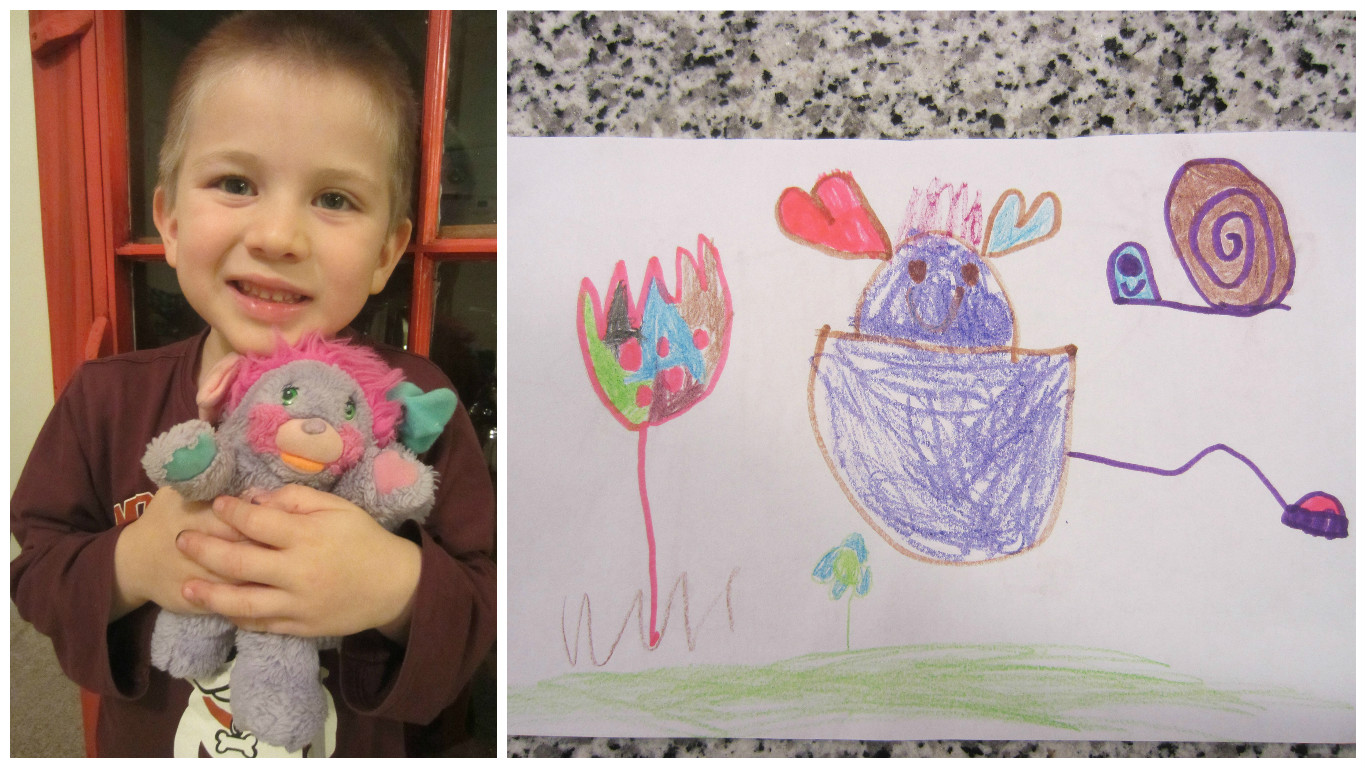
She has quickly become one of your favorite stuffed animals; as she was mine. There’s definitely a Transformer type of element involved, despite it looking so cute and cuddly.

You can now very easily transform your/my Popple back and forth from its ball-like state; something I struggled with when I was your age.

I was also quite impressed with your drawing you came home with on Tuesday of her. You are obviously very proud to own such a rare relic of American pop culture.

In what is a complete coincidence, because Ms. Aimee didn’t know this when she told you about Popples, but next Friday, Netflix is releasing their new original reboot of Popples.

There is a saying: History repeats itself.

That definitely is the case with Popples. And that’s not only because Popples are making a comeback for “the children of the Eighties’ children”. It’s specifically because you now own one of the original Popples; from 1986, nearly 30 years ago.

Love,

Daddy

Dear Holly or Logan: Your First Family Pictures, in the Womb

14 weeks.

Dear Holly or Logan: Your First Family Pictures, in the Womb

Dear Holly or Logan,

Last October, our family started a new family tradition. For about two months of each year, our family has matching ages.

Mommy and I were born within a year of each other, as were your Aunt Dana and Uncle Andrew, as were your brother Jack and your cousin Calla; and now, most recently, as will be you and your cousin Darla.

So the tradition is that during that 2 months of each calendar year, we take a picture together in Alabama where everyone else lives, to recognize this.

As you can see, your Aunt Dana is 8 months pregnant with your cousin Darla. Mommy is 14 weeks pregnant with you right now; nearly 3 months pregnant.

Dear Holly or Logan: Your First Family Pictures, in the Womb

The next time we’re all planning on being together is Thanksgiving weekend, which is about 2 weeks after your brother Jack’s 5th birthday.

But as for right now, Mommy and I are 34 years old, your Aunt Dana and Uncle Andrew are 31, your brother Jack and cousin Calla are 4, and you and your cousin Darla are still in the womb; which I labelled as “0” years old.

Your Aunt Dana is due with your cousin Darla on Thanksgiving Day. There’s a very good chance your cousin will have just been born by the time we arrive there for the holiday.

But at the same time, there’s even a chance we may not even meet Darla at all during Thanksgiving weekend; that is, if she is born a week past her due date, like your brother Jack was.

This week Mommy officially bought maternity clothes to accompany her body changing, as you grow inside the womb.

Hopefully, some of her nausea will cease as we enter the 2nd trimester.

As for you, you are having a party in there; rocking the boat for Mommy inside.

Love,

Daddy

IMG_3786

5 Reasons My Young Child “Misbehaves”: Tired, Hungry, Bored, Lonely, or Sick

Louis C.K. spanking quote

I am of the 20% of the American population, the minority, who does not believe in spanking in order to discipline my child.

With that being said, I always give a disclaimer when I write about this: I have no interest in judging other parents for their decisions. If anything, today’s post has more to do with defending my own unusual parenting style.

My theory is that it’s easy and natural as a parent, especially a new parent (which I no longer am), to assume your child is “misbehaving” when really they are needing your attention as a parent, but are incapable of explicitly communicating that to you.

I simplify the symptoms into 5 simple categories. When my child “misbehaves,” he is really just tired, hungry, bored, lonely, or sick.

As his dad, it’s my responsibility to recognize these as symptoms of a greater issue, instead of problems themselves.

Otherwise, I could allow myself to believe my child is misbehaving simply because he is “being a brat right now”.

It comes down to emotional intelligence. I’m a 34 and a half year-old man. I am good at communicating how I feel and at understanding emotions.

However, my son is a month away from being 5 years old, so he’s got about 3 decades less of communication experience and emotional control than I do.

I feel it would be unfair to my child to physically strike him simply because he is tired, or hungry, or bored, or lonely, or sick; blaming him for “misbehaving” when really, he’s in need of my parental provision.

So instead, whenever he is “acting up”, I ask myself this simple question:

“Is my child tired, hungry, bored, lonely, or sick?”

There has yet to be an instance where at least one of those symptoms was not the answer.

I remind myself, that again, my son typically is not going to simply state what the problem is:

“Daddy, the reason I am crying and refusing to sit still is because I didn’t take a long enough nap today at Pre-K. Therefore, the best solution is to put me to bed tonight sooner than usual.”

If I myself am tired, I recognize that fact and make plans to try to sleep; like yesterday, I used my lunch break at work to sleep in my car.

If I’m hungry, I eat. If I’m bored, I find a way to entertain myself. If I’m lonely, I engage someone in conversation. And if I’m not feeling well, I do something about it.

But imagine babies and young children, not being able to necessarily recognize those issues about themselves. They need their parents to recognize these issues and proactively handle, and even prevent, these from even happening.

With my 2nd child due to be born in April, I feel I will be better equipped with this knowledge than I was with my 1st child.

I feel I will be less frustrated because I will clearly understand that a newborn has no way, other than screaming and crying, that he or she is tired, hungry, bored, lonely, or sick; and is depending on me to be proactive enough to do something about it.

So instead of spanking my 4 year-old son, I follow these simple guidelines I learned from back when I was Parents.com’s official daddy blogger for those 3 years:

1. Ignore attention-seeking behavior.

2. Pay attention to good behavior.

3. Redirect your child.

4. Teach consequences that make sense.

5. Use time-outs for serious offenses.