Free Marriage Advice

In the past year and a half since I’ve been married, I have gained valuable knowledge, and therefore I live by it.  And now as I pass it on, it now becomes advice.

Back before my wife and I were even engaged, we decided to use Everybody Loves Raymond as the prime example of what our relationship would not end up like.  Because by default, maybe it would.  But through daily conscious effort and with an intentional mindset to be counter-cultural, I am convinced that marriage can be better than the mundane and miserable American stereotypes.

We subconsciously decided that if we were to model our marriage after a married couple from a sitcom, there were some better options out there.  The Huxtables from The Cosby Show.  The Keatons from Family Ties.  And the Seavers from Growing Pains.  Heck, even Mork and Mindy.

Though I hadn’t read a book since college, it was the months leading to our marriage that I suddenly became interested in soaking in as much advice and knowledge as I could from the professionals.  Books like For Men Only, For Women Only, Does This Dress Make Me Look Fat?, Yup Nope Maybe, and Men are Like Waffles-Women are Like Spaghetti.

I don’t know how men and women could begin to truly understand each other and point out the differences between them before these books came along.  But I was born in the right year, so I got to benefit from them.  The core of what I learned and what I’ve applied since reading them is this:

Men can really only focus on one task at a time; they are not multi-taskers.  They are problem-solvers.  What men want more than anything from their wives is to be respected (to be privately and publicly acknowledged as a good man, not a bumbling fool).

Women are multi-taskers.  They are better equipped to handle all the detailed parts in life that men to tend to neglect.  What women want more than anything from their husbands is to be loved (to feel cared for and understood, listened to, and to be reaffirmed of their beauty).

Being aware of these differences, my wife and I both understand that being wired differently, our wires will get crossed occasionally, leading to a classic misunderstanding involving hurt feelings and/or pride.  We know not to assume that either of us is wrong or right, because that’s what leads to an argument.  It’s not a contest, a game, or a battle; it’s a matter of getting on the same page.

We know not to raise our voices, not to be sarcastic, not to talk over the other person, not to interrupt, and not to leave the room as a means of escaping or trying to gain control by getting the upper hand.  We know to say “I feel and I think” instead of “you are or you did”.  And we always know to never say “you never” or “you always”.

Another thing we decided back when we were just dating was that we would become like those old couples we see sometimes that are still in love.  Not just still married, but still in love.  Being affectionate throughout the day is of upmost importance for us to become one of those old, sweet married couples.

“Just you wait, that’ll all change…” That is what I am told from the Nay Sayers.  The ones who say that I’ll stop randomly buying flowers for my wife once we are “out of the honeymoon stage”.  The ones who say that my wife and I will stop being affectionate once the kids come.  Once “life happens”.

I’m sorry that those people have settled for the Everybody Loves Raymond standard in their marriage.  I guess it works for them.  But I see it as a set-up for potential failure.

A couple years ago I heard my pastor say something I’ve never heard before.  In the countless couples he has counseled where one of the spouses cheated on the other in the marriage, he said that it’s almost never over sex, though sex is what makes it official.  Instead, it was about companionship.  Friendship.

The cheating spouse was not getting something from their marriage partner, so they found someone who would give them what they craved.

Often it’s attention.  Often it’s someone who will not make them feel judged.  Often it’s positive reinforcement.  Simply put, it’s someone who lets them know everyday they are special.

A healthy marriage means that the husband and wife never stop dating.  It means the honeymoon isn’t over, despite the year of the wedding.  It means that the wedding was the beginning, not the end, of true romance.

The Perfect Haircut for a Guy: A Modern Day James Dean Hairstyle

For a guy to talk about his own hairstyle is equally as taboo as one man telling another man how much he liked watching The Notebook.  But here’s the problem.  There are a lot of guys with awful hairstyles out there.  Combed-back, fluffy domes.  Chicken butt-heads.  Preacher-do’s.  The Weatherman.

But now finally, I’m willing to put my manhood on the line to present a simple, easy, and quick-to-fix hairstyle that most men can pull off.  Even for men with receding hairlines, this works.

I have been a man of many hairstyles in my 28.9 years.  From buzz cut, to faux hawk, to “the Ashton Kutcher”, to “the Sawyer from LOST”.  Maybe it’s because I’m so black-and-white of a person that since I couldn’t find the exact perimeters of a “perfect haircut”, my hairstyle was ever-evolving.  Always roaming, like the Incredible Hulk (TV version).

But it’s been a few months now, and I find myself getting the same haircut every 6 weeks.  That’s a new concept for me.  With easy to follow instructions, and pictures featuring yours truly, in shades (which plays down the “look at me/I’m on Twitter” persona that I try to avoid with a passion) I will help you obtain the perfect haircut you’ve always been looking for.

Getting the Haircut:

If possible, go to a barber.  (It’s not a real barber shop unless it has one of those red and white barber shop poles out front.)  A barber is more likely to do a cleaner job.  And I can’t explain it, but it’s somehow less awkward.  It’s just the classic way to do it.

Tell the barber you want a “2 guard on the sides and back” and “leave it one inch long on top”.  The barber will know automatically to “blend” the differences in length between the sides and the top.

For your sideburns, they should come down to the bottom of your “ear hole”.  Having sideburns (of the appropriate length) is a way of saying “I’ve got an edge, but not an obvious one”.  If your sideburns come down lower than the bottom of your ear lobes, you risk saying, “I wish I was in a rock band.”

The barber may automatically “texturize” your hair.  That means they are slightly making the length on top a little inconsistent to give it a bit of a messy look.  Don’t ask for the barber to texturize your hair.  That shows you know too much.  If the barber doesn’t automatically do it or ask you your preference, don’t worry about it.  It’s not that big of a deal.

On a side note, here’s the deal with shaving your face.  Don’t worry about shaving everyday.  Having a “barely there beard” is expected of the modern American man.  The formula is this:  Shave your face every 5 to 7 days, but shave your neck every 2 to 3 days.

Fixing Your Hair:

After getting out of the shower, carelessly dry your hair with a towel.  Mess it up as your dry it.  Do this until you hair is no longer wet.  I mean it.  You’re not going for “the wet look”.  That’s for douchebags, Italians on reality TV shows, and guys stuck in 1993.

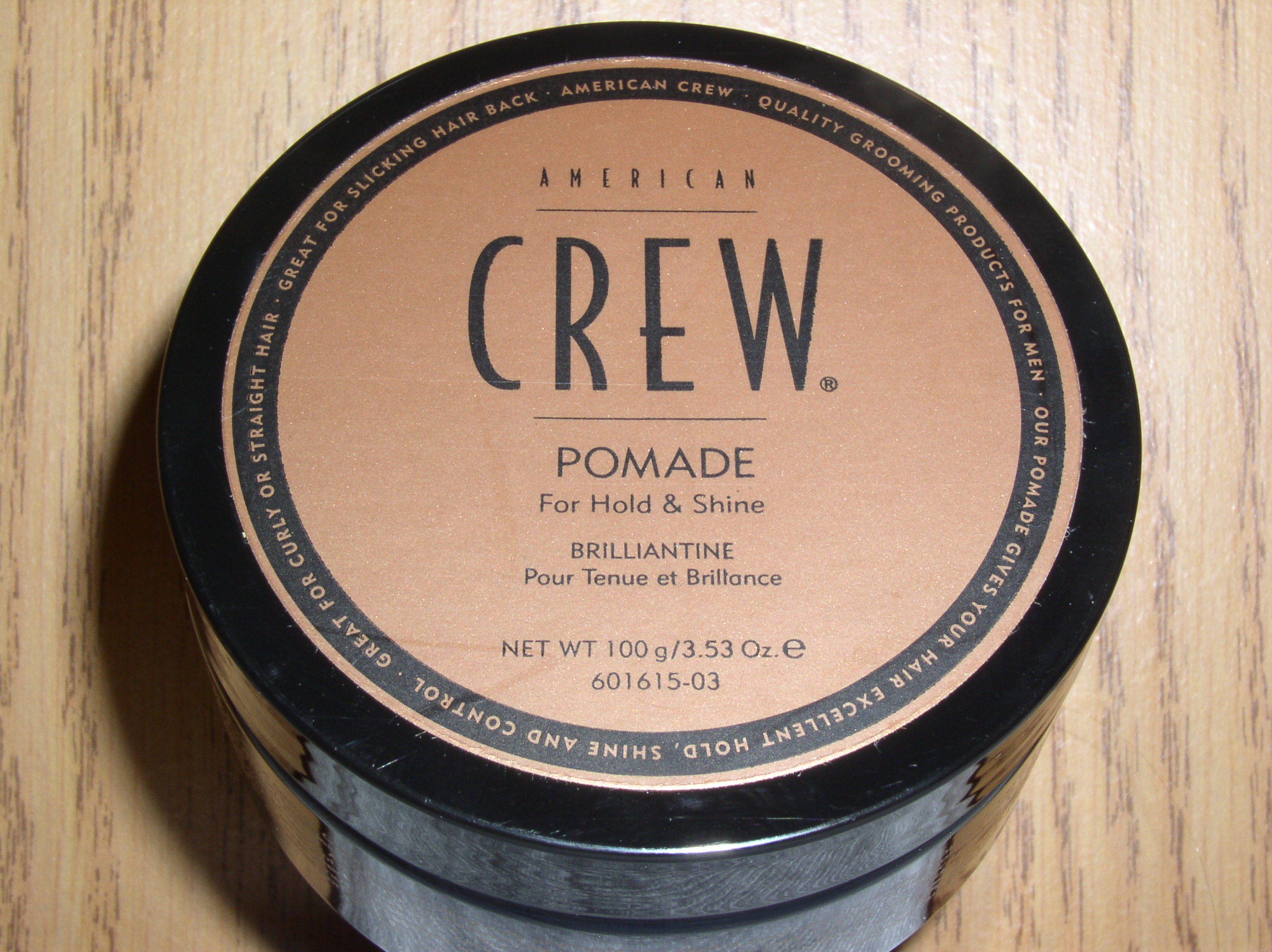
There is only one product on the market that I currently fully recommend.  It’s American Crew (Matte).  Costs around $13.  It’s not sticky and it smells manly.  Like a cedar tree.

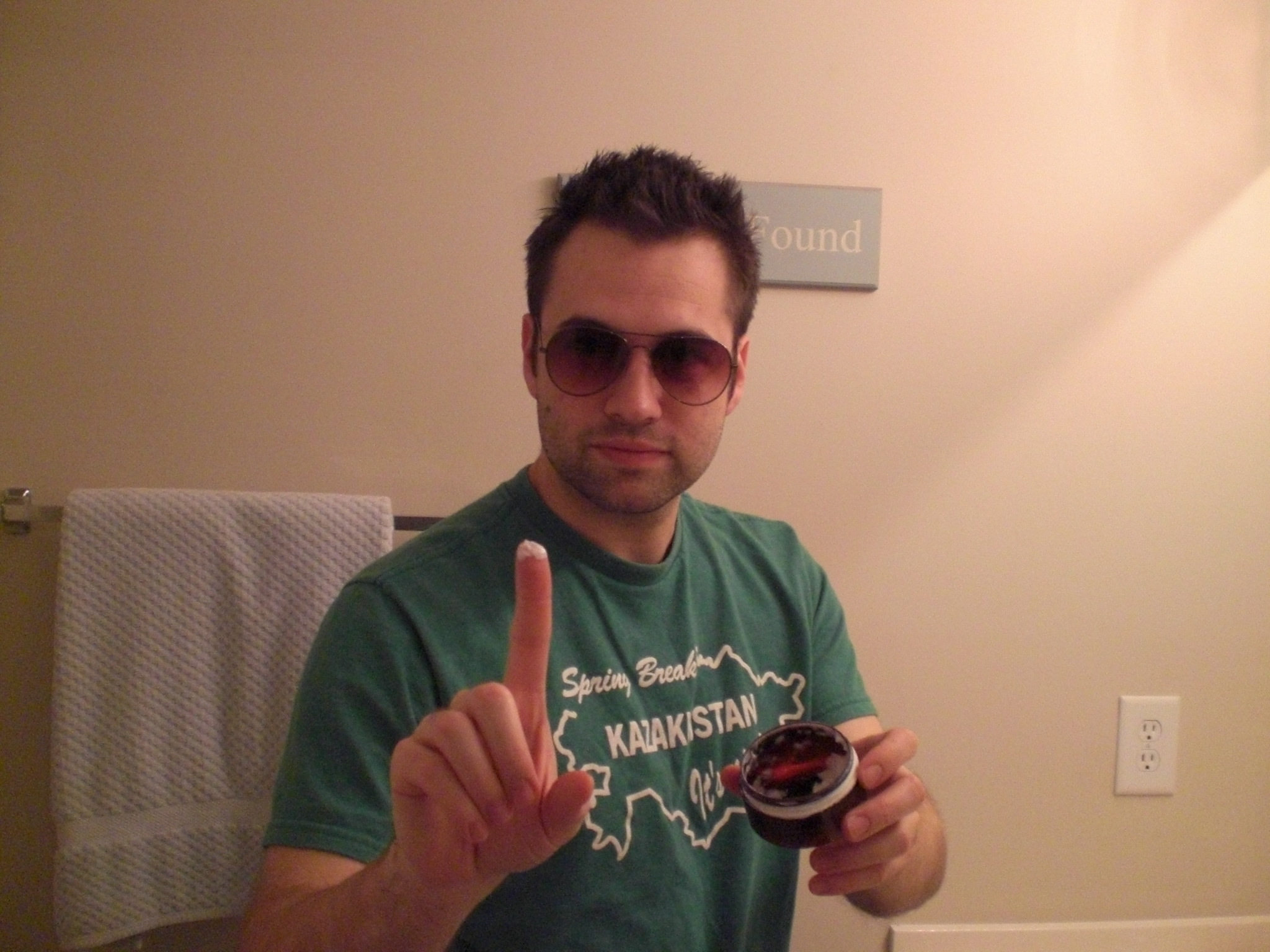
Dip your middle or pointer finger in the stuff, only getting enough to match the same size as a nickel.  Rub in the pomade (that American Crew stuff) all throughout your hair.  Make sure you don’t concentrate it into any particular area of your hair.  This should take less than 5 seconds.

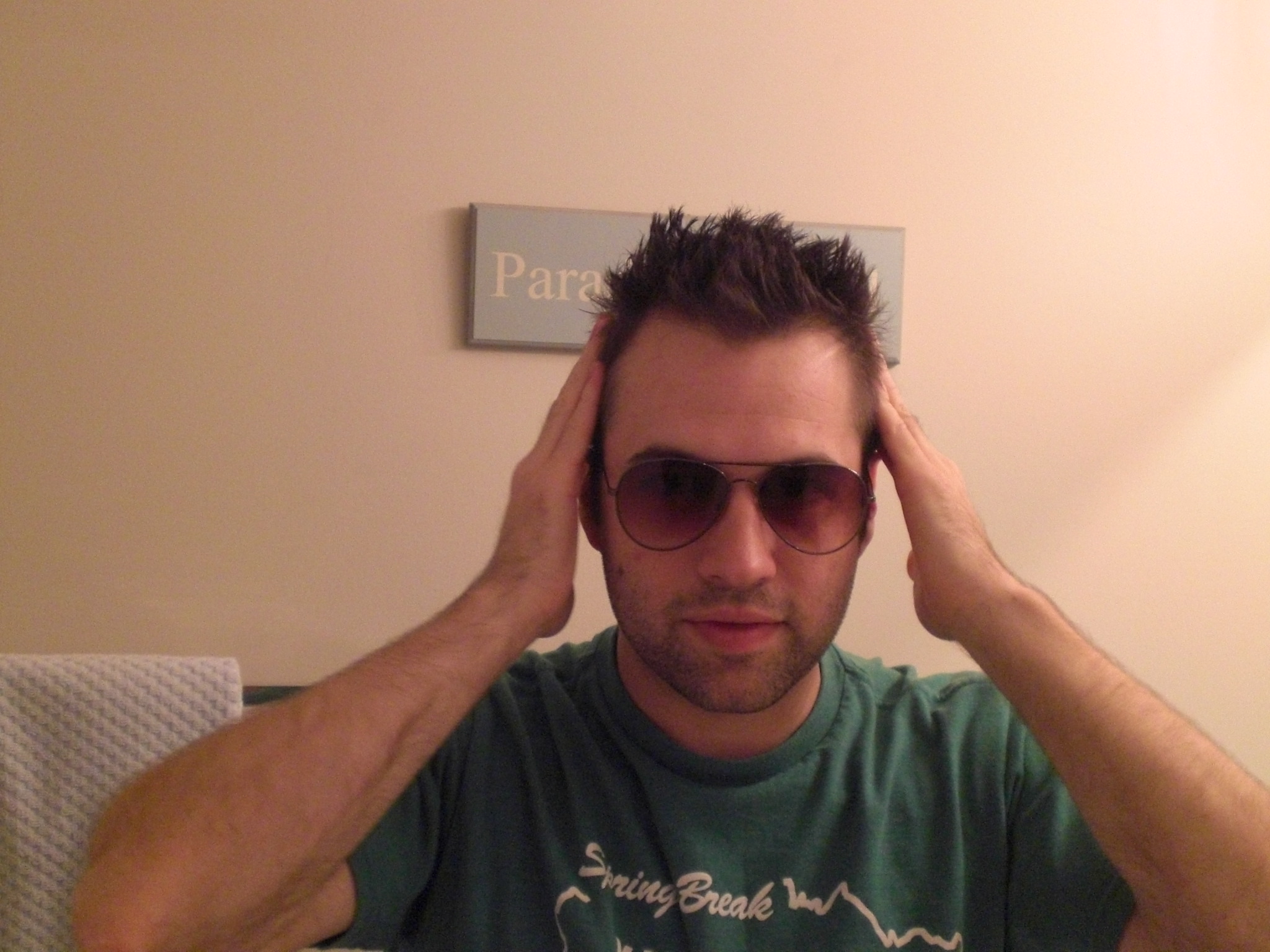
Next, using your right hand, run your fingers back across the top of your head, while keeping your fingers close enough together that it causes your hair to stand straight up, but not straight back.

Now, run your hands down the sides of your head and down the back.  You don’t want the side or back to stick straight out, causing your hair to form a diamond shape.  That’s a bad thing.

Almost there.

Reach back to the top of your head, and make sure that it’s not stick straight out.  You don’t want a chicken butt.

Last step.  Barely dip your finger back in the pomade.  Touch up the very front.  This part needs to be going straight up, not straight out.

Success.  You now have modern/classic hair that doesn’t move.  An updated James Dean.  Or a pre faux hawk.

While at first, this process may appear to be time consuming, I easily do it in less than a minute every morning.  You’ll master this thing within a week.

Most importantly, don’t tell anyone I told you this.  Men do not talk about their hairstyles.  I’m only doing this to help you.  Be cool.

Just walk away, like we weren’t even talking.  “Hey, what’s that over there?”  You get the idea.

Manspeak Table of Contents 

Volume -1: Boyspeak: http://wp.me/pxqBU-9d
Volume 0: Introduction http://wp.me/pxqBU-8G
Volume 1: Humor http://wp.me/pxqBU-1i
Volume 2: Heroism http://wp.me/pxqBU-1m
Volume 3: Filtration http://wp.me/pxqBU-1p
Volume 4: Stance http://wp.me/pxqBU-1s
Volume 5: Movement http://wp.me/pxqBU-1v
Volume 6: Law http://wp.me/pxqBU-3h
Volume 7: Bromance http://wp.me/pxqBU-3W
Volume 8: Relaxation http://wp.me/pxqBU-6a
Volume 9: Appearance http://wp.me/pxqBU-6f
Volume 10: Exploration http://wp.me/pxqBU-6O
Volume 11: Responsibility http://wp.me/pxqBU-8v
Volume 12: Transparency http://wp.me/pxqBU-8J
Volume 13: Composure http://wp.me/pxqBU-8N
Special Episode: The Bachelor Party http://wp.me/pxqBU-uY
Special Episode: The Perfect Haircut http://wp.me/pxqBU-xN


When History Becomes Folk Lore: At What Point Does Abraham Lincoln Become as Hard to Believe as Abraham of the Old Testament?


To some degree, when enough time goes by, the credibility and “realness” of a once-living person or actual event diminishes.  I was born 4 months after John Lennon died.  There’s no doubt in my mind he existed- I own most of the Beatles’ albums and my favorite song of his is “You’ve Got to Hide Your Love Away”.  However, I was never alive while he was.

But going all the way back to Abraham Lincoln, there’s less information available.  None of us were alive while he was.  Books are written every year about this interesting American hero, yet ultimately anything new we can learn about him is educated speculation.  He becomes more of a mystery as time goes by.  Did he truly derive from English Jews, as some believe?  Was he really 6’ 4”?  Despite his large stature, is it true that he had a high, squeaky voice as some historians have written?

Now go all the way back to over 2,000 years ago to the life of Jesus.  Even most atheists admit that he was a real person who actually lived.  What’s up for debate are his claims to deity and the miracles the Bible states that he performed.  If Christ had lived even 100 years ago, perhaps many people would find it easier to believe in his claims.

Go all the way back to King David and King Solomon.  The Bible records all kinds of details of their lives.  At what point in time do skeptics stop believing in historical accounts? How much does the religious association affect the credibility of their lives, when seen through the eyes of skeptics?

And if we truly rewound the history of time all the way to Adam and Eve, how many people would still be on board as far as believing they both were actual people, and not a symbolic duo representing the origins of mankind?

Time fades the mainstream belief of actual people and events, at least a little.  Once a person dies or a historical event occurs (September 11th, for example), the timer begins.  The more time goes by, the more romanticized or fantasized the person or the event becomes.  Whether or not there is written evidence.  Key example, the events of the Bible.  Or if a more recent event needs to be cited, the Holocaust.  It sickens me that there are people out there who doubt it actually happened.  Despite the video footage that is available.

For many skeptics of Christianity and the Bible, Adam & Eve and Jonah and The Tower of Babel are just moral stories.  Only as real as fairy tales.

I think the exception to the rule is the invention of video cameras.  It’s hard to deny the existence of something we can see and hear, despite it happening before our own lives began.  (Though as just mentioned, some deny the Holocaust.  And there are still plenty of old timers who believe that the 1969 moon landing was a hoax.)  But the historical content of my religious beliefs were not recorded on camera and can not be found on You Tube.

A hundred years from now, we won’t be here anymore.  And that is sad.  Our lives are most relevant to others while we are still alive.  Because a hundred years from now, what proof will be left of us other than our own ancestors?  What good will we be to some random stranger?

That train of thought leaves me with no option but to believe in a life after this.  Not only to believe in it, but to seek it out.  Not only to seek it out, but to know why exactly my religious beliefs are the most believable, the most secure, and most importantly, the only truth.  And by that point, it’s not simply a religious belief, it’s faith.

And one more thing… Now that you’ve read my take on history, why not read my perspective on being a dad?  That’s right- parenting from a dad’s point of view.  I have been documenting my thoughts as a dad since the week we found out my wife was pregnant.  I formally invite you now to read my “dad blog” by clicking on the link below:

dad from day one


Religious Views on Facebook Profiles

“You gave your life to Jesus Christ… and you were not the same after that.” – “Not the Same” by Ben Folds

It’s interesting to see what people list as their “religious views” on their facebook profiles if they are Christians. Some just simply list “Baptist” or “Protestant”. And many, in an effort to creatively avoid a label, list something like “saved by grace” or “in Christ alone”. And that’s cool.

I’m sure for others, summing it all down to one phrase can be difficult, especially for those who believe in God but not necessarily that Jesus is the only way to Heaven as the Bible teaches and as Jesus himself proclaimed. They are not Christians. But they are not atheists either.

For me, simply listing myself as a Christian is a struggle. Because “Christian” has become somewhat of a watered-down generic term, thanks to the way many non-Christians and non-Americans perceive Christians.

I’m quite familiar with the fact that often non-Christians see Christians as selfish hypocrites, as non-Christians often use some of our worst specimens (or those who claim Christianity) as the model for all of us.

And from a non-American perspective (especially non-Catholic and non-Protestant countries), everyone in America is a Christian. They see influential American pop stars and their famous lifestyles and assume that is Christianity. Britney Spears is suddenly the epitome of what all Christians stand for.

I am a Christian. And I don’t believe that I am better than any person in this world nor do I believe that Christians are better people than any other religious group of people. If anything, I feel quite inferior to most people on this earth. I strive for a more giving spirit, like the kind I see in those who have much less than I do.  I’ve got a long ways to go.

I belong to a Baptist church. That means my ultimate goal in life is to introduce others to Jesus as the only way true to eternal life, by showing them love and truth. And I believe that being baptized is an important outward symbol of the surrendering of my life to God, as Jesus did.

The Baptist denomination best resembles overall what I believe.

But there are some things about the Baptist culture I stray from. For example, I don’t oppose the reasonable consumption of alcohol or feel it’s taboo for a Christian to drink. Yet I share the all the same major spiritual doctrines as Baptists. Therefore I’m a little bit Presbyterian. (My wife and I were married in a Presbyterian church.)

http://wp.me/pxqBU-2I

http://wp.me/pxqBU-2L

And though as a Baptist I’m very aware that I can’t earn my salvation by anything I do on my own, I’m a little bit Catholic because I believe salvation in Christ is more than just saying a prayer for Jesus to save me and then saying “I got saved” and then going to church.

My faith does require “works” in order to prove my faith to be genuine and alive; by serving others- caring for the poor, helpless, lonely, and misunderstood. Because that’s what Jesus was all about.

And that’s something that perhaps has best been taught to me through some of the examples of some of the Catholic saints and missionaries I’ve heard and read about, the most obvious being Mother Teresa.

It troubles me that many Baptist churches are so good about making sure no one in the congregation leaves the service without being given the opportunity to “become a Christian” by saying “the sinner’s prayer”. But afterwards, these confused spiritual infants are often left without being nurtured through discipleship.

Not understanding that so much of their sought-after Heaven is just as much in this life as it is the next. And that it takes serving others to help bring Heaven to Earth.  I really like the way that over the centuries that Catholics have chosen some of the most humble servants as their legendary heroes. Of course I don’t pray to saints, but I’ve learned to admire and attempt to mimic their lifestyles.

I’m a little bit Jewish because I share the Old Testament with the Jews. The Old Testament actually makes up around 2/3’s of the Bible’s content. And of course I don’t eat pork or shellfish (or many other kinds of carnivores, predators, and “bottom feeder” animals) as God instructed the Jews in Leviticus 11.

http://wp.me/pxqBU-jO

I’m a little bit Seventh Day Adventist. They are the health nut freaks of Christianity. Most of them are vegetarians and avoid processed foods and the consumption of sugar (except in the form of whole fruits). Seventh Day Adventists also have a better understanding of resting “on the Sabbath”.  And statistics show they live around 7 years longer than the rest of us believers.

http://wp.me/pxqBU-sf

http://wp.me/pxqBU-q8

So that is my religious status.

When all that is thrown into a blender, arguably it could be said I am closest to being a Baptist who unofficially converted to Messianic Judaism.

Messianic Jews are of Hebrew heritage but unlike other Jews, they accept Jesus as the Messiah. And though I have still yet to prove that somewhere back in my Italian lineage there was a Jew in there (my Mexican grandmother is convinced that’s the case), a person without Hebrew heritage can still convert to become a Messianic Jew.

http://wp.me/pxqBU-i6

Maybe I should just list my religious views as “It’s Complicated”.

What Movie Rating Does Real Life Get? (G, PG, PG-13, R, or NC-17)

If your life was a movie, what would it be rated?

I recently watched a documentary questioning the secrecy and allusiveness of the MPAA movie rating system, called “This Film is Not Yet Rated”. While I’m not opposed to the American movie rating system because I see it as a decent way for parents to decide which movies are more suitable for their children, I also admit there is some humor in the way that movies are arbitrarily given ratings.

In general, more than one f-word grants an “R” rating. “Artistic or comic nudity” can land with “PG-13” or even “PG”, but if the nudity involves romantic or sexual content, then the movie will be an “R”. A panel of judges make a living off of making that call.

By now it’s pretty obvious that most studios want the majority of their films to be rated “PG-13” because more people will be able to see it. “PG” is for young kids and “R” weeds out the kids who are not smart enough to pay for one movie but walk into another.

The thing that most stood out to me from watching the documentary was this:

Compared to Europe, America has it backwards when it comes to sexuality and violence in movies. In Europe, sex scenes are portrayed in a more matter-of-fact/this-just-part-of-life manner. An absence of chiseled abs, large breasts, and steamy music. Not glamorized.

But when it comes to violence, Europe leaves a lot more to the imagination. They’re more offended by violence and less worried about sexual content.

In America, our movies are infiltrated by sex any time there’s a slight opportunity for it. But it’s so fake. Women have the sex drives of men. The atmosphere is perfect. The lighting is just right. And of course both participants have perfect bodies that could be (and often have been) featured partially nude on a health magazine cover. For me it’s just not believable.

Yet despite our obsession, compared to Europe, we’re much more offended by sex in movies. Culturally, America is a Christian nation. So we’re much more likely to be bothered or affected by heavy sexual content in a movie.

So we shy away from sex in movies, but indulge in violence. And not just grotesque stuff like the Saw movies.

We love war movies. We just do. Because there’s nothing more American than seeing the good guys kill the bad guys.

Like any James Bond movie for example. Loaded with countless murders by gunshots. Yet a lack of blood. Therefore, James Bond movies aren’t rated “R”, but “PG-13” instead.

The theory is that violent movies have this undertone that speak to teenage boys and young men: “Just imagine, if you fought in the U.S. military, you could be the one with the gun. Protecting our country. Killing and defeating the enemy.”

The regular presence of violence in American entertainment desensitizes us to it. The more we see it, the more we’re used to it. And it’s not really a moral issue to us.
While we may not be willing to be part of the firing squad that executes an American criminal convicted of murder and rape, our conscious doesn’t bother us as much about killing the enemy in a war who happened to be born in the wrong country with a dictator who is forcing him to fight against us. Yet he may have never killed or raped anyone. Until now, he could be just a another normal family man. But if he doesn’t fight for his corrupt political leader, his life will end anyway.

Both the sex and the violence are fake. We know this. But our conscience doesn’t really bother us about watching Saving Private Ryan or Band of Brothers (which neither really contain any sexual content).

I’ve noticed that Baptist preachers can mention Saving Private Ryan during a sermon to drive home a point and no one in the congregation thinks twice. We’ll overlook the vulgar language and bloody deaths in the name of war. Yes, it’s violent. But it’s war.

The point: Even Baptist preachers don’t mind violence, as long as it’s associated with war. I know this because I’ve been in the congregation enough to hear it. But if a movie was rated “R” for any other reason than war violence, it would be taboo for the preacher to admit he even saw the movie.

I get it. It makes sense.

America excuses violence. But has a tough time with the other stuff.

Now that I’ve established that America is okay with violence, I will quote Michael Tucker. He is the producer of the 2004 war documentary film, Gunner Palace, which shows the everyday lives of soldiers fighting in Iraq. This film is unique in that it received a “PG-13” rating, despite it’s 42 uses of the f-word and brutal violence and imagery. Tucker had to appeal the MPAA because of course they originally rated his film “R”:

“When a little girl was running down the road in South Vietnam, burnt by Napalm and she’s naked, is that PG? Is it PG-13? Is it R? You can’t rate reality.”

Great quote. I’ve seen the exact photograph he’s referring to. It’s awful. And I’ve seen even more hellish pictures from The Rape of Nanking during World War II, when Japan occupied China, raping all females and killing all men they could find in that city.

That can’t be rated. It’s so worse than “R”. Worse than NC-17. Yet those photographs can easily be found in Wikipedia or in any History section in a Borders or Barnes and Noble. It’s not fiction. It’s not art. It’s reality.

Michael Tucker is right: You can’t rate reality.

In the back of my mind I’ve always wondered what my life would be rated if it were a movie. The question is, how would my life not be rated “R”? Just considering an average workday. Even on a tame day, I know the language I hear around me would be rated “R”. As it definitely was in high school.

I guess I’ve always thought it’s ironic to hear a handful of f-words in a movie and know the movie is rated “R” because of the language itself. Hearing that language has become normal to me. Which of course defeats the whole idea of certain words being vulgar. When they’re common, they can’t truly be as vulgar as we let ourselves believe.

One of my biggest reasons not to use profanity is for that very reason. It just seems cliche to me. I can’t bring myself to do it.

Yet watching a movie than contains a few f-words is at least a little bit offensive and shocking. Why? Because it’s not in real life? Isn’t there a double standard somewhere in there?

Why, in real life, is it not a big deal to us?

Because it’s not real. Watching it happen to someone else in a movie makes it worse. It’s magnified. We pay closer attention. We’ll except it in real life, though.

It’s a funny thought.  To give a movie rating to real life.  Especially your own.

Related post by the same author:

Mixed Reviews  http://wp.me/pxqBU-2y

The Ball  http://wp.me/pxqBU-fv

And one more thing… Now that you’ve read my take on this, why not read my perspective on being a dad?  That’s right- parenting from a dad’s point of view.  I have been documenting my thoughts as a dad since the week we found out my wife was pregnant.  I formally invite you now to read my “dad blog” by clicking on the link below:

dad from day one