Must Not Mustache: Young White Men Can’t Be Taken Seriously with a Mustache

Why do none of my friends have a mustache?  I’d say a lot of it has to do with the fact that most of my friends are within 5 years of my age, meaning that I don’t know any 24 to 34 year olds who are mustachioed.  The mustache could quite possibly be a dying tradition, with the exception of cops.

Recently I saw an independent movie called Margot at the Wedding, starring Nicole Kidman and Jewish comedian Jack Black.  For the first 30 minutes of the movie, Jack Black has a mustache.  During that time, he apologetically explains to everyone that he recently had a beard but while he was shaving it off he thought it would be funny to just keep a mustache.  But eventually he shaves it because he doesn’t feel like he can be taken seriously by anyone.

Good point.

Can a man under the age of, let’s say, 40 years old be taken seriously if he has a mustache?

Yes.  But there are definite rules to making it work:

1)     Be a cop, as previously mentioned.  It just sort of goes with the job.  In fact, I don’t think I could take a cop seriously UNLESS he has a mustache.

OR

2)     Be an African American man.  I’ve never seen an African American man who didn’t look good with a mustache.  Will Smith is the epitome.  In fact, I remember on the show Scrubs when Donald Faison shaved his mustache, it bothered me.  Heck, African American men can even pull off the even riskier goatee without exception.  (See Chris Rock and/or Darius Rucker.)

It’s no coincidence that in the sitcom My Name is Earl that Earl Hickey had a mustache.  He was a white guy under 40 who was a loveable idiot.  To enhance his character trait of being out of touch of social expectations, he had to have a mustache.

What’s really interesting is that in a recent study, it was discovered that mustachioed men earn 8% per more money that bearded men, and 4% more than clean shaven men.  Not only that, but men with mustaches are more likely to hired during a job interview.

http://www.nbcnewyork.com/news/business/Study-More-Mustache–More-Money-63930997.html

So does that mean that I am being discriminated against by my own society?  A culture that refuses to take seriously white men with mustaches under 40?  Am I simply at a disadvantage until 11 years from now when I become of age?

I am missing out on a 4% to 8% salary increase over this.  Maybe it’s worth a shot to at least try.

(Looks to stage left, rubs chin for dramatic effect, then begins to plot a bad idea…)

Click here to see what happened next: Operation: Mustache (A Social Experiment)

And one more thing… Now that you’ve read my take on mustaches, why not read my perspective on being a dad?  That’s right- parenting from a dad’s point of view.  I have been documenting my thoughts as a dad since the week we found out my wife was pregnant.  I formally invite you now to read my “dad blog” by clicking on the link below:
dad from day one

Why the Word “Dutch” is So Confusing to Us English Speaking People

Who are the Dutch people?  What country do they come from?  Are they the same as the Danish?

It’s time to set the record straight.  The best way for me to learn this is to teach it.  So here it goes.  Let’s go Dutch.

The Dutch are an ethnic group of people who live all over the globe, yet 81% of the population of The Netherlands is Dutch.  So in essence, the Dutch home base is The Netherlands.  This is similar to the way that the homeland of the Jews (who are also referred to as Hebrews) is the nation of Israel, though just as many live in the U.S. as Israel itself.

However, unlike the Jews originating in Israel, the Dutch did not necessarily originate from The Netherlands; they have somewhat of a mysterious origin, like the Thai people who migrated from China.  In other words, Holland is the home base of the Dutch, not their homeland.

Here are some stats:

13.1 million Dutch people live in The Netherlands

5.1 million live in The United States

5 million live in South Africa

1 million live in Canada

In English, we use the word “Dutch” as both an adjective and a noun.  For example, it could be used to describe a pair of those weird wooden shoes or the Dutch people themselves.  However, in the Dutch language and most other language, there are separate words for the Dutch people and the Dutch adjective.  This is difficult to process because typically we’re used to adding an “s” on the end of word referring to the people group.  For example:  “I see a bunch of Italians eating Italian ice.”  But we don’t refer to Dutch people as “Dutches”.  We just call them Dutch.

To make it more confusing, the country of The Netherlands is commonly referred to as Holland, which is the unofficial name and generic for the country, because it only refers to the major part of a territory.  It’s like referring to Great Britain as England, though Great Britain is also made up of England, Scotland, Wales, and Northern Ireland.

It is also loosely similar to the way our country is the United States of America, yet our nation is often referred to as simply “America”.  Though Central Americans and South Americans are not referred to as “Americans” like we are.

In closing, anything Danish is referring to something from the nation of Denmark, and has nothing to do with anything Dutch.

Dutch recap:

The Dutch an ethnic group of people who have a home base in The Netherlands (which is also generically called Holland) and have nothing to do with the Danish people of Denmark.

You officially learned something today.  That’s one more wrinkle in your brain.  Oh, and, you’re welcome.

Mr. Daydream’s Personality Pyramid: Humorous, Philosophical, Analytical, Dramatic

It’s always funny to joke about other people having split personalities.  But the truth is, we have all split personalities.  It’d be kinda weird if we didn’t.

I’ve said before that I tend to “pull an Andy Bernard” in that I mirror personalities in order to better relate to people, which is found in the fundamental teachings of Dale Carnegie, the author of the famous book How to Win Friends and Influence People.  But that’s different than the idea of having split personalities because mimicking another person’s manner of speech and body movement doesn’t reflect my own true split personalities.

We all have at least a few different “default mode” personalities we fall back on, which direct and guide our choices of words and actions.  After a little bit of self-analysis, I have narrowed my own collection of personalities down to four main selections:

Humorous

Philosophical

Analytical

Dramatic

Humorous: I am starting with the one at the bottom of my “personality pyramid”, the one the general public sees the most.  The most unguarded.  It’s my surface personality that is appropriate for most situations which is found in everything I do, even serious tasks.  But not “Jim Carrey/get hit in the head with a frying pan” kind of humor, though.

A more subtle type usually delivered in “dead pan” style, where I don’t laugh at my own attempts at humor.  I don’t tell jokes; I translate real life situations into jokes by sliding in sarcastic commentary about them, adding in nostalgic and pop culture references whenever I can.

Right now one of my major comedic icons is actually Alec Baldwin, a man who used to specialize in drama.  To me, that’s the funniest kind of humor out there.  Like the stand-up styles of Conan O’Brien, Joe Rogan, Zach Galifianakis, and Doug Benson.  But not so dry to the point of David Letterman.

Philosophical: For a guy who has never smoked pot, the conversation topics I come up with would reflect otherwise.  There’s a theory out there that whenever a person is exposed to the psychoactive elements found in marijuana, their “third eye” opens up, causing them to see the world in a different perspective.  But I think I was born with my third eye open.  That would explain a lot, actually.

When a person asks me, “What’s up?” or “What’s new?” or “What’s going on?” or “Whatch ya think?”, they will most definitely get an answer.  Not, “oh, not much” or “same ole, same ole”.  Instead, they will hear that I am currently debating whether or not I would be able to carry out capital punishment myself or whether Batman or Superman is the better superhero.  My third eye absolutely effects what I say, therefore coming across as my “philosophical personality”.

Analytical: Despite seeing the world through an abstract lens, I actually see everything in terms of black and white, cut and dry, “either it is or it isn’t”.  There is a formula for everything.   There is definite right and wrong.  That’s the teacher side of me.  I like explaining things to people.

My analytical personality is the one that will spend countless hours searching which celebrities are Jewish or learning how to solve a Rubik’s Cube.  It’s my necessary inner dork.  It’s the part of me that has an elaborate system for keeping shoes looking new, despite being 8 years old, but I’ll have to get into that in a different post.

Dramatic: At the top of my personality pyramid is the one I reserve mainly just for close family and friends, because it is my personality that is engrained into my emotions.  This is not a personality that needs to be seen by the general public.  Its function is to manage the aspects of my life which are the most important to me.

My dramatic personality allows me to display necessary emotions where love is involved.  I do my best to confine my emotions to just the people I am closest to.  Otherwise, I could end up an emotional guy who wears my heart on my sleeve.  I am not afraid to be vulnerable enough to show my emotions, but I think it’s important to save them for the right situations and the right people.

So that’s how it works.  We are wired with different personalities equipped to suite the right situations and the right people.  The main four personalities that I named most likely do not correspond to hardly anyone else.  Everyone else in the world has their own combination of split personalities which they must decipher in order to better understand who they are.

We’re not crazy.  We just have split personalities.  Isn’t that crazy?

The First Steps on the Earth

I like to be where no man has gone before.

Ten years ago during the summer of 2000, I travelled to California for the first time in my life.  The plane landed in Sacramento (which ended up being the hometown of my wife, whom I would meet six years later), then I took a 3 hour bus ride north to Redding.  It was the token instance in my life where the airline sent my luggage to the wrong city.

Meaning that I, along with the group of ten or so others I was with, had to wait until the next day until our clothes and toiletries arrived.  Since that flight, I have always made a point not to bring on any luggage onto a plane other than my carry-on.  (I even spent an entire week in New Zealand in 2007 with just one bookbag of my belongings, which I was able to stuff into the overhead compartment for the flights.)

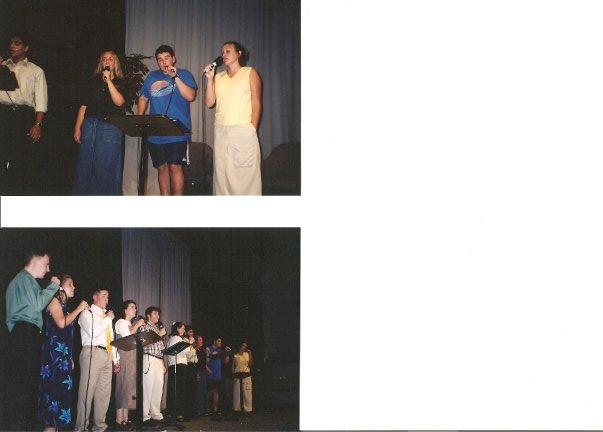
That summer, age 19, I was part of college singing group that got to spend two weeks out in the mountains of northern California as we performed songs at a summer camp and were the actual camp counselors as well.  Best I can remember, we thought we were pretty cool at the time.

Christi Soderberg, one of my friends from the group, always called me Peter Brady, because in an attempt to mock the college’s dress code, I “permed” my long shaggy hair, so that it would appear that my hair was short enough to be deemed acceptable (above the eyebrows, off the ears and collar).  And even after my hair eventually grew back straight, I was still Peter Brady.

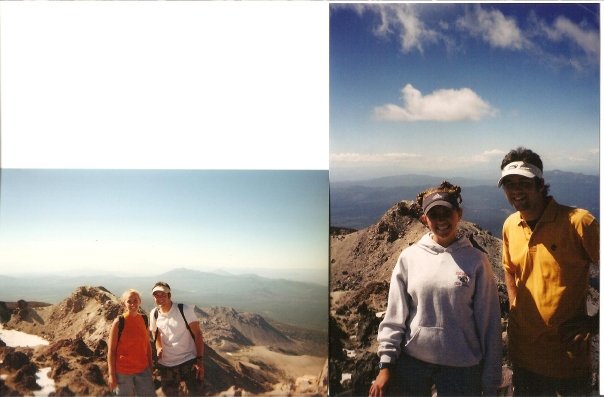
During the weekend between the two weeks of work we were rewarded with a hiking trip to the top of Mount Lassen, which is an active volcano that’s peak is 2,000 ft high.  Because the volcano is so steep, the only safe way to climb it is to hike around and up it, which takes a good two hours minimum.  We started at the bottom in the hot summer sun, but by the time we reached the top, we were marching in snow.

http://en.wikipedia.org/wiki/Mount_Lassen

It was definitely my kinda thing.  Spending a Saturday morning hiking a volcano, shimmying up and over to the most dangerous and scenic spot once I reached the top, finding some weird satellite-type device in the process and wondering how few people in the world have been at that exact spot. That’s something I often think about.

How many people have stepped on the exact spots of the Earth I am standing on right now?  How often (seldom is the better word) do I step on “unstepped” spots?  I try to visualize all the ground around me covered in blue footprints, seeing random spots that have never been stepped on.

I realize the Earth is really old and that billions of people have lived here during its lifetime, but surely sometimes I take the first step on certain corners of the world.

The Winter Olympics is coming to an end.  These athletes (and ice skaters, whom I watch mainly to see fall after they do a Triple Axel jump and also to make fun of their sequin-infused outfits) live for the opportunity to break the current record.  I’ll never know the high that Shaun White gets to experience as he flies through the air on his snowboard.  My only experience snowboarding was in Maggie Valley, NC back in 2001 and involved me constantly falling over every 4.3 seconds.

I’m not an athlete who finds freedom and thrills in breaking records of Olympic history.  Instead, I am an explorer who finds freedom and thrills in discovering new niches of the world.  I may not be able to discover something new, but I can discover something rare.  It’s nothing impressive, really, to the rest of most of the world.  But for me, I thrive on those places and those moments.  Then I can take snapshots of the scenic route.

Related Posts by the Same Author:

The Scenic Route http://wp.me/pxqBU-pL

Parks and Rec http://wp.me/pxqBU-jw

WOLBI Florida Ensemble 1999-2000

My friend Christi Mack and I at the top of Mount Lassen in 2000 and 2001

The Politics of Making Friends

Sometimes a friend is just that not into you.  As for myself, I live by The Orange Cat Theory.

In 1985, when I began preschool at Mother’s Day Out at the First Methodist Church of Fort Payne, I was introduced to the concept of friendship.  For the first time in my life, really.  Because from ages 0 to 4 all I really knew was family.  But now that I had been dropped off with kids my own age, I began to grasp was a society was.  Within this group of people were even closer groups of people.  Called friends.

The catch phrase of 1985, the thing I heard the most at preschool was this:  “I’ll be your best friend…”  If a classmate of mine wanted one of my cookies, wanted to hold my stuffed animal, wanted to cut ahead of me in line, I heard:

“I’ll be your best friend…”

What went through my head as a 4 ½ year old was, “What if I don’t want you to be my best friend?”  Did my classmates not assume I already had a best friend?  Should my true best friend lose their status with me on account of a cookie?  Did I look like the kind of kid who was “best friend deprived”?

Was it not enough that Alex Igou and I played with our toy fire engine trucks together during “free time?  And that Simon Millazzo and I always sat next to each other everyday as we waited for our moms to pick us up?  And what about the fact that I went over to Russell McElhaney’s house and saw the GI Joe fort his brother made in the backyard and that his mom was the first to introduce me to a delicious dessert called the “brownie”?

The promise to be my best friend was being held over me as a bribe, but I had no interest in taking it.  And this, in 1985, was my introduction to friendship.  Twenty-five years later, I don’t have acquaintances offering their conditional friendship.  Because I know, just like I did as a 4 year-old, friendship shouldn’t have to be conditional.

Yet I still see some complication in adult friendships.  When the relationship is perfectly mutual, 50/50, that’s when things come easy.  But looking back on my lifetime of friendships, even starting around age 10, I can think of several friendships where it wasn’t a 50/50 deal.

I was always the one going to their house; they wouldn’t come to mine.  I was always the one to call them; they wouldn’t call me.  I was always the one to set up plans; they didn’t include me in their own.  I took the initiative in the friendship.  And I never questioned the authenticity of us being friends.  Because it’s in my nature to be the initiator, the one who calls first, the planner.

But by high school, I realized that I felt I was having to “earn” certain friendships.  That I was having to prove myself good enough, or even more illogically, that I was cool enough for them.

It all goes back to the summer of 1988 when my mom took my sister and I to this lady’s house to both choose a pet cat for ourselves.  We got out of our Bronco II and went into the friendly woman’s kitchen, where we saw a litter of kittens.

For some reason I was always drawn to the orange cats (probably had something to do with Morris the Cat).  So I wanted the orange cat in the litter.  I stretched my arm to him.  The orange cat seemed indifferent towards me.  While that was happening, my mom must have noticed the white and brown spotted cat fighting for my attention:  “Nick, pick the cat that comes to you on his own.”  So I walked away with that cat.  I named him Gabriel.  He liked me.

Most importantly, from that day I learned a valuable lesson about relationships:  Choose to be close to the people that show the most interest in you.  Because that’s a sign of a good friend.  Choosing my friends this way has definitely paid off.

And sure enough, the few times I did spend effort on recruiting an “orange cat” for a friend (applies to romantic interests as well) it never worked out.  My Orange Cat Theory has proven true in my own life.  When it all comes down to it, Morris the Cat isn’t as cool as he thinks he is.

The Orange Cat Theory:

As opposed to choosing a relationship based on your own preconceived notions about someone who seems really cool but causes you to reach out to them, instead look around first to see if someone is reaching out for you.  Choose “the cat that comes to you on their own”, not the orange cat.