You Don’t Choose Your Family

It’s so obvious, yet I’ve never really given it much thought until now: You choose your spouse and you choose your friends… but you don’t choose your family.

That means you have to learn to appreciate all the quirks of your family members… as they have to learn to deal with yours!

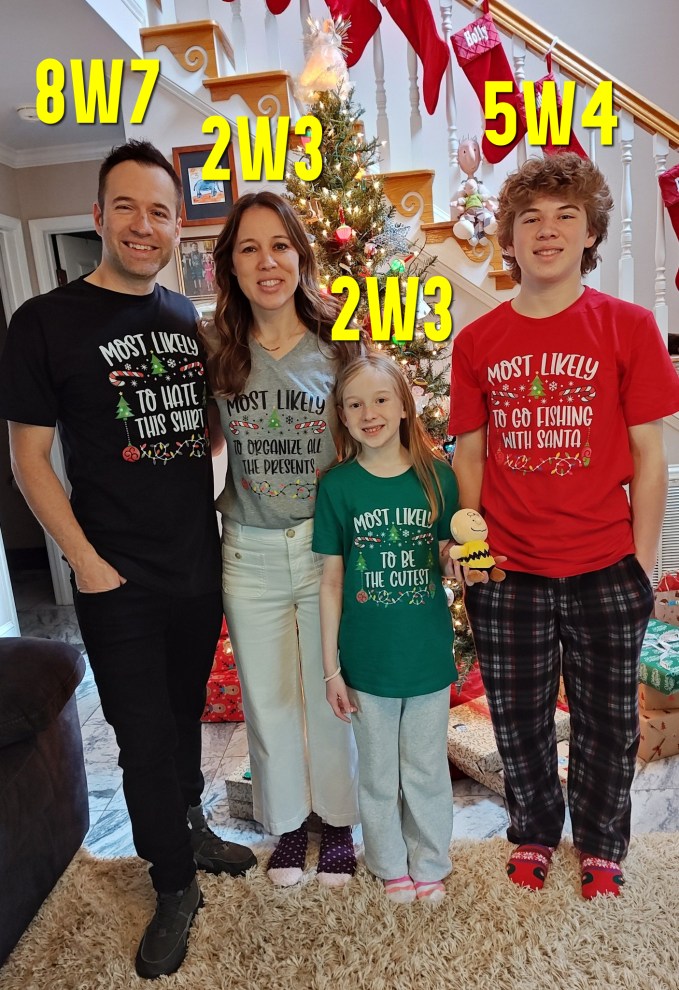
One of the trends you may remember from this past  Christmas was where families were posting their customized and personalized matching “Most Likely” t-shirts.

Thanks to my sister-in-law Jen, our family was able to participate in this fun trend. She was certainly accurate in choosing the most appropriate shirt for each member of our family.

That is interesting and fascinating to me:

People outside of your own immediate family can often pinpoint a particular fun character trait for each person… perhaps better than if you chose one for yourself.

My wife is the event planner of our family: “Mostly likely to organize the presents”. Our son is the curious, activity-based one: “Mostly likely to go fishing with Santa.” Our daughter is basically a personified kitten: “Most likely to be the cutest.”  And me… I don’t want to be told what to do, especially if it’s what everyone else is doing: “Most likely to hate this shirt.”

While my wife and I certainly did choose to spend our lives together, we didn’t fill out paperwork to choose our kids’ personalities… nor did they choose what their parents’ personalities would be like.

Especially due to the fact I am certified in Enneagram personality assessment, I see the potentially conflicting dynamics even more clearly than most people might.

I also can’t help but notice the obvious patterns in which people tend to choose their spouse and friends based on the person either A) being one of the Enneagram numbers next to their own or B) in their path of growth or stress.

For example, my wife is Enneagram 2 and I am Enneagram 8. When she is in stress mode, her personality morphs into an 8, which is my main number.
Similarly, when I am at my best, my personality morphs into hers: As an Enenagram 8, I act more like a 2.

In other words, we naturally understandly each other at our best and worst.

I also know several married couples who fit this dynamic where one spouse is Enneagram 6 and they are married to an Ennagram 9. Same concept: They become each other at either their best or worst.

When people don’t marry their “growth/stress” number in Enneagram, they tend to marry the number next to them. For example, it is pretty common for an Ennneagram 1 to be married to either an Enneagram 9 or an Enneagram 2: both of which are the numbers next to them.

These patterns exist in friendships as well: We naturally gravitate towards people who “get us”, though they are not just like us.

With all that being said, your kids may not conveniently happen to be your “Enneagram neighbor” or in your growth/stress path. That means it requires extra effort to understand them.

Or as I said earlier, you have to learn to appreciate all the quirks of your family members… as they have to learn to deal with yours.

I would theorize that this is why it is pretty common for employers, churches, and community groups to proclaim, “We’re all like a big family here!”

Translation: We didn’t necessarily choose each other individually, but we have figured out how to work with each other’s strengths and how to work around each other’s weaknesses.

It was only a year ago that I was finally able to be honest with myself, after hearing constantly unanimous feedback from family, friends, and coworkers who truly know me in real life… that my Enneagram number is 8… also known as “the challenger”.

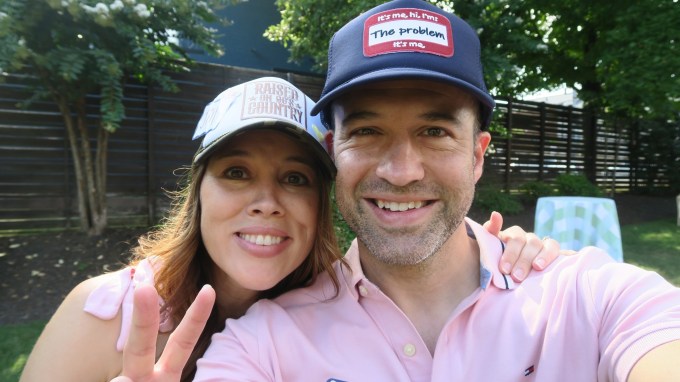
If you Google, “Which Enneagram is the hardest to live with?”, my number immediately is the one that comes up. I finally owned up to it and made it official at my wife’s work party where they featured a customizable hat bar. I borrowed the words of Taylor Swift for my hat:

“It’s me. Hi! I’m the problem. It’s me!”

So the next time you become accutely aware of another person’s quirks, just ask yourself, “Uh oh… what quirks of mine do other people have to deal with?”

I am the exception. I am perfectly normal in every way… obviously!


Being a Handsome Man Vs. Being a Hot Guy

And why it ultimately doesn’t matter anyway thanks to a little something called “charm”.

Recently I asked my facebook friends via my status update, this question:

Females, I need your input for something I’m writing: What is the difference between a guy who is “handsome” and a guy who is “hot, sexy, etc.”?

To summarize the similarities of the responses, with a man who is “hot” there is an attraction (mostly physical), whereas  with a man who is “handsome” is someone who simply is a good-looking guy, though there is not necessarily any kind of attraction there.  Of course the ironic thing about this can best be summed up by what my friend Holly Arnesen said:

“if i refer to a guy as handsome, it usually means that physically speaking he’s nicely put together, but doesn’t necessarily mean i’m attracted. hot and sexy usually has to do with more than what a guy looks like. like some women think intelligence is sexy so, they’ll go for a smart guy over one that they think is nicer to look at.  i once heard someone say, ‘men fall in love with women they are attracted to, and women are attracted to the men they fall in love with.’ i’m not a guy, but i’m pretty sure this tends to be way things go.”

What enticed me to walk up to my future wife on October 5, 2006 and talk to her the very first time I saw her from across a large crowded room was her appearance.  Though it wasn’t until four months later to the day, on our first date (I knew it was a date but she didn’t until it was over), that she actually thought of me in any kind of romantic way.  My physical looks were irrelevant to the equation up until the point I made it clear I was interested in her, given that I’d shared with her my personality and character prior to day that we crossed the line from being friends to dating.

Until we started dating, I was just another average-looking dude.  A forgettable face.  Perhaps the most memorable physical trait would have been my dark hair.  Based on the celebrities that people have told me I look like in the last couple of years (“Cory Matthews” from Boy Meets World, “Balki” from Perfect Strangers, “Ross” from Friends, as well as David Arquette and Paul Rudd), I evidently have the looks of a Jewish-American comedian, which all of those Nick Shell look-alikes are.  Men that are remembered not for their looks, but for their personalities and talent.  Are those men handsome?  Sure, why not.  It’s irrelevant either way.

Speaking of David Schwimmer, I don’t believe anyone could have played the part of Ross better.  But to be part of one of the most popular romantic American TV couples ever, he was a very ordinary looking guy.  Fans of Friends always think of Ross and Rachel fondly, though never once have I ever heard anyone comment good or bad on David Schwimmer’s looks.  But regarding Jennifer Aniston, it’s not that way at all. Her looks were so relevant she actually started a hairstyle craze in 1995 called “The Rachel”.

When my wife and I reminisce on when we first started dating, she always says, “You always had interesting stuff to say so I knew we’d never run out of things to talk about.”  It’s possible that’s what won her over.  My quirkiness.  Some people would call it my ability to “think some crazy crap up”.  Others more reverently refer to it as “thinking deeply”.   My lifelong habit of daydreaming during math and science class definitely paid off.  I charmed her.

So if a guy is simply average-looking, how can he improve his situation?  The “Makeover Week” on the TV show The Biggest Loser would tell us he would need to slim down, get his hair cut shorter, shave off his beard, and wear nicer clothes.  But I know my wife always prefers me to wear jeans, t-shirt, and a ball cap, and she never notices or cares whether I have a beard or not.  There’s really no official way for a schlub or average Joe to gain “handsomeness” or “sexiness” since that’s up to the girl they’re trying to attract.

And I think that’s why it’s a guy thing to not care as much about our appearance as females do.  Because unlike male birds (which are always more attractive and attention-grabbing than the females they attract), male humans know they can attract a woman who is out of their league looks-wise as long as they are funny enough, smart enough, rich enough, strong enough, sensitive enough, or whatever else it takes to charm their love interest.  From Doug Heffernan to Barney Rubble, charm certainly has its advantages.

The Naked in Public Dream: Subconsciously Feeling Vulnerable, Underprepared, or Inadequate

You’re not the only one.

I have a rare ability.  When in a dream that I don’t want to be in, I often can tell myself, “This is a stupid dream.  You don’t have to keep dreaming this.  Just wake up”. And I do.  I wake up.  Usually.

Waking myself up is the easy part; the hard thing to do is to realize it’s actually just a dream.  And there are two dreams in which I never seem to realize it’s all my imagination.  1) I’m back in high school or college and I’m about to graduate, then I realize I was scheduled for a class that I forgot about and never went to, meaning I can’t graduate on time.  2) I’m naked in public.

Of course, the classic “naked in public” dream is quite popular among the general population.  Supposedly the dream means the person feels vulnerable and may be afraid that everyone will see that person for their true self.

Do I feel vulnerable?  Do I feel afraid everyone will see me for my true self?

I guess if anyone might feel vulnerable it could be me, since I’ve been journaling my life on the Internet for five years now (first on MySpace, then on facebook, now on here).  That’s a vulnerable situation.  I could unintentionally offend a reader, or embarrass myself by exposing too much about my personal life.  But as far as I know, I am indeed exposing my true self to people.  If not, this whole website is a sham.

A whole website which generally 400 to 500 people a day visit.  If all my writings are written from the perspective of a person I wished I was, instead of who I really am, then I am impressed.  Because that means I am talented enough to write daily from a created character’s narrative perspective, not my own.  Like the plot of Fight Club, or the dumbed-down version: Secret Window.

While it’s easy to feel frantic in a “naked in public” dream, it’s also easy to laugh once you wake up.  Because from a logical point of view, like many dreams, the chances of the events of the dream ever happening are so impractical that they’re basically impossible.

The question I never asked myself in the naked in public dream is, most importantly, “how did I lose my clothes anyway?”

Often I am at my old elementary school (as a grown 29 year-old man).  Conveniently, no one else seems to care that I am naked, covering myself with whatever random object I can pick up off the ground.  And that’s supposed to mean that I don’t care about people seeing me for who I really am, including all my personalities.  That must be true, since I’ve written about that exact topic before in The Personality Pyramid, which is currently my 10th most popular post of the 310 on this site.

Seriously, it’s not easy to lose your close in a public place, and then have no one notice or care.  When I have these dreams, I’m not victim of violence.  I just simply flat out lost my clothes in public.

But I imagine that in real life if I ever took off my clothes (or they just took themselves off) in public, and couldn’t find new ones, I would gladly settle for one of those barrels with straps to go over my shoulders.  I always thought those looked cool.  The problem is, I only see them in caricatures or cartoons.

If I wanted to buy a wearable barrel with shoulder straps, where would I begin?

If I could get a barrel or normal clothes when naked in public, I would settle for a long black trench coat.  Because I would already be creepy for being irresponsible enough to lose my clothes in public, I might as play the full part.  Then I could only expose myself to people who deserved it:

People talking loudly in public on their Blue Tooths.

http://www.meaningofdreams.org/dream_themes/beingnakeddreams.htm

To Catch an Audience/The Center of Attention

It’s fun to pretend we’re psychologists. To think we’ve got someone figured out based on their OCD or their “middle child syndrome” or their relationship with their father. We can look at personality traits and family history as clues as to why a person thinks they way they do. And often when we do this, we can correctly analyze them. Without a psychology degree.

I am one of those people who likes to study personalities as hobby. Currently I am on my 2nd book written by Dr. Kevin Leman, who specializes in birth order and how it determines a person’s personality. While it is fascinating to learn about everyone else in this world, it’s also interesting to learn about myself. I want to know why I think and behave the way I do. What sets me apart from others in my unique perspectives?

Here is what I recently learned from Dr. Kevin Leman:

Some people need an audience.

That is me.

But here’s what sets me apart from the obnoxious “attention hogs” I’ve met throughout my life. Because of my drive to constantly accomplish something admirable through hard work to gain the approval of adults (a first-born burden), I only want to be the center of attention if I’ve earned it.


I know when to be quiet. I can easily go long periods of time without speaking. I do not speak in a group setting unless I have something relevant and worthy of saying. I, unlike many centers of attention, do not like the sound of my own voice. I am “a” center of attention, not “the” center of attention.

Looking back on my life, here are some of the things I’ve done to make sure I had an audience: In Elementary School, I created my own cartoon characters and stories as a kid (eventually getting published in the school newspaper in 4th grade), as well as headed up the Nickbob Ability Test (click here to find out what it is http://wp.me/pxqBU-r9). In high school I fronted an alternative rock band (and for what it’s worth we played out of state a few times). During college I taught elementary school and Junior High Sunday School, while recording three CD’s of music I wrote, playing small shows in the coffee shop circuit. And for the past 4 ½ years, I’ve been writing my “commentary on life” web posts. And of course, as mentioned in Stage Presence (http://wp.me/pxqBU-2m), I grew up being in plays and musicals.

There has always been an audience. My subconscious had made sure of this.

This past weekend as my wife and I were reminiscing how it was three years ago this month that I asked her on our first unofficial date, she said it was the fact that I always had something interesting to talk about that made her feel so comfortable with me. A lifetime in training of capturing an audience ultimately led to me meeting and marrying a girl I have always felt was out of my league. It paid off.

It’s always been hard for me to understand America’s fascination with sports and particularly a man’s ability to keep up with all that trivia about which teams played each other when and the scores and the names of the players. Another Jewish trait I have is that I’m not good at sports (and never cared about them). So I’ve channeled that energy into entertainment.

I have made myself an expert on 1983, the heights and ethnic background of celebrities, the meaning behind all lyrics of the Beatles, holistic and clean living, Intelligent Design, and Jews in American entertainment, just to name a few of my specialties. I always have “random conversation material” in the archives and in the works.

I was quite hesitant when I first tried to process that idea I have to be the center of attention. Because it makes me think of conversation hijackers, drama queens (and kings), and any person I’ve ever met whose whole demeanor screamed, “Look at me! Look at me!” People who appear needy.


I have to be found. That’s how I operate differently. People have to find me. They have to come to me. Because typically those are the exact people I want to entertain. Takes one to know one.

In a party, I’m never the real center of attention. I wander to the back corner of the room, next to the food, and recruit party guests for random conversation. I have this desire to be the alternative choice in entertainment.

In fact, there have been times where people have tried to elevate me to the center of attention position, and I have escaped it. I have to be able to think in my mind that I earn when I get. For example, in high school, one of my good friends Allison Hardin was planning a surprise birthday party and I found out about it. I found a way to keep it from ever happening. Because I strongly resist the idea of being the center of attention when it’s obvious that I am.

I don’t want to be the official man of the hour. It’s too much pressure. I function best in my ad-lib form. Recruit, entice, inform, motivate, entertain, and provoke thoughts in others. On my own terms. That is my niche.