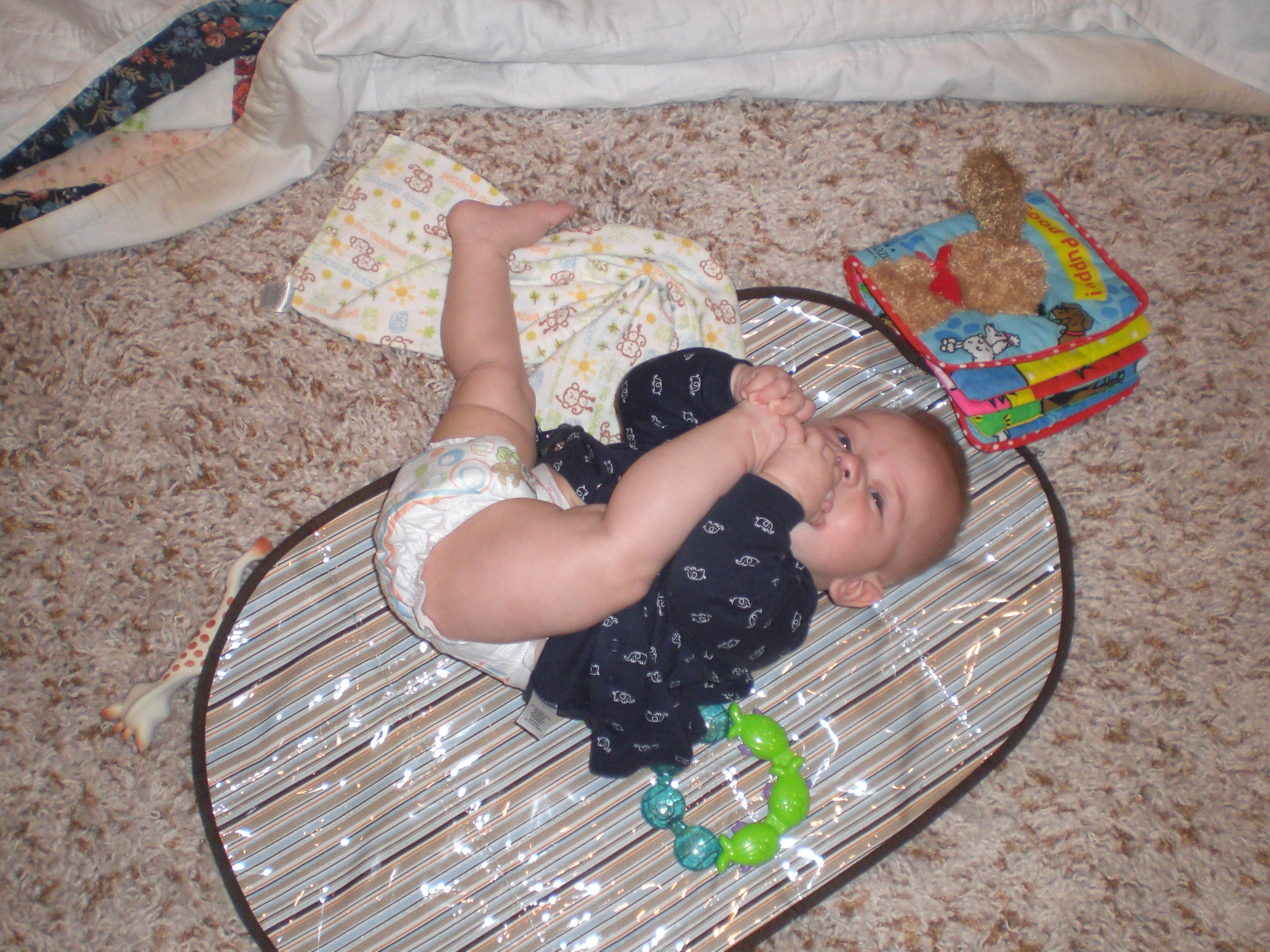
dad from day one: Insert Foot in Mouth

Week 25 (5 months).

If you are a regular reader of my “daddy blog”, then you know my writing style well enough to expect this to be a post about Jack being able to literally put his foot in his mouth- and by the end I will make mention that as he gets older he will metaphorically put his foot in his mouth by not knowing when to stop talking- as often is the case with guys.  So surely I will need to throw in a reference to John Mayer’s song, “My Stupid Mouth.”  But that would be too predictable.  So no metaphors this time around- this entry is simply about my son discovering his toes and sucking on them.  No “big picture” ideas today.

Jack has discovered his feet.  I don’t know if he realizes they are his feet, though. Like the way a dog chases its tail, providing hilarious entertainment for spectators, so is Jack’s love/hate relationship with his feet.  I’m assuming that he thinks his toes are little grub worms, and forgetting that the only “solid food” he is eating right now is crushed up oatmeal and bananas, not grub worms, he decides to attack his toes when they are not looking.  And might I add, he gets ’em every time!

His slobber is noticeably thick this days, so each time he bites his toes with his toothless gums, the end result somehow reminds me of every alien sci-fi movie I’ve never seen, yet still recognize the image for.  But aside from the humor of watching Jack sneak up and attack his toes, and aside from the grossness of it, is the surprising element of it: A baby, with the body proportions of the Michelin Man, is limber enough to easily stick  his foot to his mouth anytime he wants.

I completely admit that in the middle of typing that last sentence, I had to stick my foot to my mouth to see if I could do it too.  I can.  But not as effortless as Jack.

Bonus: Last week I was interviewed and quoted in a Mother’s Day article by Megan Mattes, on Parents.com.  Click here to see it.

dad from day one: Won’t Ever Be Lonely

Week 6.

Maybe somewhat surprisingly, I am a proud Country music fan- though I’m ultimately a Dave Matthews Band/Guster/John Mayer/Bruce Springsteen/Tom Petty kind of guy.  In the past few weeks, in the midst of leaving our lives behind in Nashville and entering uncertainty and a current status of “in between jobs” in Alabama, not having much to do but constantly search for jobs and take care of our baby, the lyrics to a Country song by Andy Griggs from 1999 keep coming to my mind: “I promise you now, you won’t ever be lonely.”  Though the song is obviously written from the perspective of a man in love with a woman, looking forward to spending the rest of his life with her, the lyrics now speak to me in a different way:

“You’re safe from the world wrapped in my arms and I’ll never let go.  Baby, here’s where it starts and I promise you now you won’t ever be lonely. Here’s a shoulder you can cry on and a love you can rely on.  For as long as I live
there will always be a place you belong.”

But while the words to this song obviously make perfect sense in the perspective of me speaking to my child, they actually are more relevant to me in this mindset: I won’t ever be lonely.  Not just him.  But I won’t ever be lonely.

I am better able to understand now why there are so many pregnant teenagers and why MTV’s 16 and Pregnant is such a popular show- because so many kids today are lonely. (I am under the crazy notion that a good number of pregnant teens and extremely young parents are not getting pregnant simply because of the careless lack of birth control, but instead because they subconsciously want to be have a baby in a attempt to be loved by someone.) So many daughters have never been told by their fathers that they are beautiful. So many sons have never heard their father tell them “I’m proud of you”.   Having a baby definitely changes the lonely factor in many ways.  Even if the 19 year-old father who works for minimum wage at the oil change place bales on her soon after the baby is born- at least that young mother will always have someone depending on her.

Granted, I haven’t been lonely in a long time.  But I can easily remember it.  It can be painful; literally.  Last week I watched a National Geographic documentary on solitary confinement where I learned that loneliness is processed in the same part of the brain as pain.  I can easily remember being 20 years old, feeling lost, out of place, an unmatched. I wondered for the next five years if I would be like the actor who played Mr. Belvedere, who never married or had children his whole life. But at age 25, my wife and I met each other and those heavy and desperate thoughts of loneliness haven’t entered my mind in over four years.

Now at age 29, I am the opposite of lonely.  I have a wonderful wife and a beautiful and hilarious baby son that I will always matter to.  And I have a feeling that the older our son Jack gets, the more attention and energy of mine that he will require.  At least until he reaches 7th grade and gets too cool for me.

Lyrics to Andy Griggs’ “You Won’t Ever Be Lonely”:

Life may not always go your way
And every once in awhile you might have a bad day
But I promise you now you won’t ever be lonely
The sky turns dark and everything goes wrong
Run to me and I’ll leave the light on
And I promise you now you won’t ever be lonely

For as long as I live
There will always be a place you belong
Here beside me
Heart and soul baby — you only
And I promise you now you won’t ever be lonely

It’s still gonna snow and it’s still gonna rain
The wind’s gonna blow on a cold winter day
And I promise you now you won’t ever be lonely
You’re safe from the world wrapped in my arms
And I’ll never let go
Baby, here’s where it starts
And I promise you now you won’t ever be lonely
Here’s a shoulder you can cry on
And a love you can rely on
For as long as I live
There will always be a place you belong

Here beside me
Heart and soul baby — you only
And I promise you now you won’t ever be lonely
No, no, you won’t ever be lonely

Predetermined and Preconceived Expectations (My Take on Encores, Bartering, and Who Pays for Dinner)

Yes, the title is redundant.  But there isn’t a more appropriate way to describe how ridiculous some of our modern traditions are.

Since the 7th grade, I have been to more concerts than I can count; starting from  when Christian rock music was still awesome (from 1992 to 1998) with now defunct bands like dc talk and Audio Adrenaline, to current favorites like Guster and John Mayer, to class acts like Michael Buble.  I love music and I love concerts.  (Yes, there are people who don’t actually like music at all.  They are the ones who say they like all music, including both rap and Country equally.)

After you’ve been to a few concerts, you become overaware of how virtually every concert will end:  After the “last song” is finished, the band hurries off the stage while saying “Good night (enter name of city where the concert is), you’ve been great!”  But the lights stay off in the auditorium or arena.  This gives the necessary opportunity for the audience to cheer “Encore!” or “We want more!” until the band predictably returns to the stage to perform a few more songs- where they typically include at least one acoustic version of one of their songs and also one of the band’s most notable songs they conveniently left out of the main set.

Fact: Encores are lame.  I say either [crap] or got off the pot.

In my mind, this concept clearly relates to the mostly un-American tradition of bartering.  During my first summer teaching English in Thailand, I paid full price for souvenirs.  If a price tag had said that an imposter Hard Rock Café: Bangkok t-shirt would cost me 7 or even 10 bucks, I paid it.  Because that sounded pretty reasonable to me.  But by the end of that first summer, as Thai friends starting accompanying me, I learned that the asking price was not meant to be taken seriously.  If the asking price was $10, the after-barter price was typically as low as $5 or even $3.50.

As an American, I had been used to finding my own way to negotiate prices in America: With coupons or Internet specials, or simply just “price shopping” until I found the store with the cheapest price.  I pride myself in never paying full price for anything if I can help it.  But in Thailand and in so many Third World and developing countries, there are no coupons or Internet specials.  Instead, you barter with the merchant.  Otherwise, you get hosed.

Granted, bartering does indeed exist in America.  Like when you buy a car, go to a garage sale, or buy something off of Craig’s List.  But typically it’s not worth my time to do business that way.  I’d rather spend my time finding the product somewhere else where the price is firm and already low.  Otherwise, I will not be an active consumer.

Fact: Bartering is lame.  Instead of getting involved with the predictable “buyer asks too low a price, seller asks too high a price” banter, I will simply find another way to buy the product.

Lastly in my trilogy of examples is the awkward game of “who’s paying for dinner?”  If I am going to buy someone’s dinner, I am very clear with them up front before we arrive at the restaurant: “I am taking you to dinner.  I really appreciate how you (I name the reason I am buying their meal, even if it’s as simple as thanking them for their general kindness and friendship).”  There is no guessing to be done.  I am buying their meal.

That means when the waiter comes by the table when it’s time to pay up and asks, “Will this be together or separate?” there is no grabbing for the bill by both me and the other person.  I don’t like the feeling that I owe someone for anything unless there’s a good reason for it.  So this whole idea that “you bought my meal this time, so I’ll buy yours next time”, it doesn’t work for me.  Because then I have that “IOU” hanging over my head.  Let’s make it simple.  If you want to buy my meal, tell me up front.  As I will do the same.  Otherwise, it’s assumed that we’re paying separately and the only bill anyone grabs for at the end is their own.

Fact: I can’t truly enjoy a meal if I think there’s a chance that I am expected in the least to grab the other person’s bill.

I live a simple life where clear-cut expectations make me happy.  This is my version of reality.


What Makes a Person “Cool”? (Being Subtle, Aware of Social Cues, and Having Something Exclusive)

I asked dozens of people in real life and on facebook in order to find the answer.

There are some things in life we recognize and encounter everyday, yet we don’t understand them.  For example, questions I constantly ask myself as I am writing each day are “is this funny?” and more importantly “is this interesting?” Both humor and being able to captivate a person’s attention are not really cut-and-dry, black-and-white issues, though I am definitely a cut-and-dry, black-and-white person.  It takes being very observant of social cues and even pop culture, at least in my experience, to make it work.  The difficulty and creativity in the search to be both funny and interesting is that both of those things are abstract, moving targets.

I am so overaware (it’s a made-up word but if I keep using it I think I can get it to catch on) and intrigued by marketing tools and methods.  For example, from now on, anytime you see an ad for a clock (not digital) or even just a new clock for sale in a store, you will be amazed at how many of the clocks show “10:10” as the time.  My guess is that “10:10” easily shows both arms of the clock and also it’s a time that many people are awake for both times each day, both morning and night.


Another interesting observation is how many African-American models wear purple in magazine ads and commercials on TV.  From JC Penny catalogs to The Princess and the Frog, purple is present.  Notice how few people of all other races were purple in ads.  I’m sure it’s because the color purple compliments darker skin tones much better than it does for lighter ones, and because purple is a color of royalty, which is a common theme in African-American culture- like the way bishops are often common in African-American churches.  And it may be stretching this concept, but the Disney movie The Lion King takes place in Africa, and as the title explains, it is a movie about a kingdom, even though it’s about animals instead of humans.

So keeping all these things in mind, I started thinking about an important and invisible factor in selling a product: being cool.  Apple computers are definitely cool, as is Steve Jobs who started and runs the company.  Is it because of those TV ads starring Justin Long, portraying PC’s as nerdy and Mac’s as hip?  I don’t think so.  Those ads just cleverly symbolized what many clued-in consumers were already aware of: Mac’s are cooler than PC’s.


Apple has always made their own rules, not being limited to the guidelines and expectations of other computer programs or even customers.  But they get away with it because Apple basically writes The Book of Cool when it comes to media technology: User-friendly computers that don’t really get viruses, iPods, iPhones, and iPads, all of which use a minimal number of buttons, and are so cool they don’t easily interact with other Apple products.


This being said, “coolness” is important in selling a product.  And that’s why marketing departments exist- to try and figure out, or at least convince people what is cool, so the product can be sold.  But the art of being cool doesn’t just apply to big companies and marketing teams, it also matters to us as individuals.  People are often drawn to other people who they think are cool; therefore being cool yourself may in turn attract other cool people.  I mean, some people are fine with regularly attending Star Wars conventions or sharing a house with 8 cats all named after cupcake flavors.  But just as that “uncool” example shows, even if we truly don’t care what other people think about us, being cool is definitely better than being uncool, if given the choice.

So what makes a person “cool”?  I’ve asked dozens of people both in real life and on facebook to find out the answer.  There were mainly just a few different answers, some being gender specific, some not:  Some males answered “money and material possessions” while some females answered “appearance and clothing”.  But the most reoccurring answer I received was “being confident to the point that the person truly doesn’t care about what other people think or say about them”.  Another similar answer that resonated well with me was “a cool person has something you don’t, even if it’s just confidence”.


Interestingly, the age of the people I asked made no difference to the kind of answer I got.  Not only do older people think that “confidence” defines being cool, but I also realized that being young isn’t a requirement in order to be cool.  I can think of three musicians who I’ve listened to my entire life who are still making music and for whom I’m still buying their albums and happen to all be currently right around 60 years old: Bruce Springsteen, Tom Petty, and Phil Collins. Age has nothing to do with being cool.  If anything, being young is a major disadvantage in being cool, since life experience is lacking.  Most teenagers only think they know what is cool, but many of them are trying so hard to be cool that they are not- which brings me to the first Rule of Being Cool.

The Rules of Being Cool


1) If you realize or acknowledge that you are cool, you either never were cool or are now no longer cool. Like John Mayer.  I will always love his music, but I refuse to think he’s cool anymore.  By the time he publicly started dating celebrities then disrespecting them later in magazines while making an arse of himself with prideful comments and talking about how much money he makes, it became official: John Mayer is aware that he’s cool, which officially disqualifies him for being cool.  I can’t totally discredit the guy, after all, he did pen the song “83” (I’ve been obsessed with the year 1983, since 1995) and it was one of his concerts that transformed a friendship into a dating relationship into a marriage into a family (the first date my wife and I went on was a John Mayer concert).  But John Mayer is officially disqualified from being cool.

2) You must be aware of social cues, but not become ruled by the expectations of other people. Obviously if a person doesn’t care whatsoever what people think, he could be rude, selfish, and only shower once a week.  But it takes more than not caring what people think and participating in personal hygiene, it takes being aware of the social expectations that actually matter: Like being friendly, positive, and simply passionate about things that are important, while not being self-centered, vain, or overly aggressive. Why?  Because a person who has these attributes I just listed in italics is a confident person.  When I meet a person who is constantly being negative and is generally condescending to others, I see a person who is unhappy, unfulfilled and desperate to find confidence; needless to say, that’s not a cool person.

3) You must have something that others inspire to have. Whether it’s wit, aggressiveness, style, a high income level, or personal character, just to name a few examples, we use other people as models for our lives.  Yes, being cool depends on who you ask, since it’s largely based on perception.  Yet still, confidence can always be found as the foundation of coolness.


And that’s it.  That’s how I define what makes a person cool.  From Zack Morris in the fictional world, to my own family and friends in the real world, I am blessed to know cool people.  Just as iron sharpens iron, so do cool people enhance each other’s coolness. Therefore, be cool to one another.

Unnecessary Bonus…

Ethnic Backgrounds of Celebrities Mentioned in This Post:

Steve Jobs (half Syrian, half English)

Justin Long (half Polish, Sicilian, English)

Phil Collins (English, Irish)

Bruce Springsteen (50% Italian, 37% Irish, 13% Dutch)

Tom Petty (English, 1/4 Native American Indian)

Henry Winkler as “The Fonz” (Jewish)

John Mayer (half Jewish, half German)

Mark-Paul Gosselaar (half Indonesian, half Dutch)


The Token Bad Guy: Osama bin Laden is Dead

From Ben Linus to bin Laden, evil has a name.

Now that President Obama announced that Osama bin Laden is officially dead, it makes me think about how there always how to be a “bad guy”, both locally and world-wide.

In Judd Apatow’s Jewish comedy (a franchise he has specialized in for the past decade, based on a strategic formula including Seth Rogen and/or Paul Rudd, a good dose of bromance, a classic soft rock soundtrack, mostly ad-lib dialogue, a heavy and almost dark dramatic element somewhere in the plot line, a running time of at least 2 hours and 15 minutes, an unpredictable ending but no “twist”, and constant references to reproductive organs) Funny People, there is a scene where Adam Sandler’s character is babysitting his ex-girlfriend’s two young daughters. As they play, one of the girls takes him captive like he’s a dragon, while the other has come to rescue him. He looks up at them and says to each one, “Are YOU the good guy or are YOU the good guy?”

While in cartoons and children’s own made-up playtime storylines the antagonist often takes pride in knowingly being evil, in real life the Bad Guy usually doesn’t realize that he’s the Bad Guy. It amazes me that there always has to be a handful of countries in the world that serve as a current Bad Country. It’s been England (watch the movie The Patriot about the Revolutionary War). It’s been Germany (the Nazi’s). It’s been Russia (watch Rocky IV) and still kinda is.

Why can’t the evil leader of a country think to himself: “Oh no! I’m ‘that guy’. I’m the bad person that’s causing problems with the rest of the world. I need to start with the man in the mirror and change my ways”. From what I’ve read about Adolph Hitler, in his own mind he simply was carrying out an ultimate version of Charles Darwin’s concept of “survival of the fittest”. He was only advancing what he saw as in the inevitable. He wasn’t a sadistic tyrant, not the way he saw it. He didn’t see himself as the Bad Guy.

From each holy war ever fought in history, down to the elementary school bully, the true villain is doing what is right according to his own view. The Bad Guy is dead wrong, yes. But he doesn’t see it that way.  While obviously I don’t have the potential to become a radical tyrannical leader of threatening foreign country, I still can find myself in a similar scenario as North Korean leader Kim Jong-Il, by simply being the Bad Guy on a much lesser scale in everyday situations and not realizing it. If only Bad Guys always realized they’re the Bad Guy… well, it might help a little.

“We’re never gonna win the world, we’re never gonna stop the war. We’re never gonna beat this if belief is what we’re fighting for.” -John Mayer (“Belief”)

*Some bad guys, like this one, may or may not repent of their evil ways in the end.