My Jewish Upbringing

“You’re just another face that I know from the TV show.  I have known you for so very long.  I feel you like a friend.”

– “Turn It On Again” by Genesis

When I was in 6th grade (1992-1993) my friend Chad Mathers was telling me about this funny TV show he had began watching called Seinfeld. He explained that the main character was Jewish. Then he said to me, “You’re Jewish, right? Your mom looks Jewish, so that means you are too.” I replied, “Yeah, I guess I’m Jewish.”

Most of my classmates knew my mom because she was a substitute teacher. And they knew by her physical traits she wasn’t just “American”. She was something ethnic. No one really knew exactly what nationality she was, though. Neither did I. Because I just never thought to question it as a kid.

In fact, I had every reason to believe I was Jewish. My mom was always using words like, “kosher”, “schnozzle”, “finagle”, and “hoopla”. (Though only those first two words are actually Jewish words.) And she always perfectly and naturally handled the family budget- she now works at a bank.

Her parents: My grandfather was 5’ 6”, dark-skinned, curly haired, and had the “schnozzle”. He never used the word “church”- instead he called it “tabernacle”.  The only kind of bread he ever had at his house was Jewish Rye.  He saved most of his money and when he rarely bought a new car, he paid for it in cash. My grandmother is 4” 8”, even darker-skinned, with long black hair. Neither of their accents helped- respectively Kenosha and Buffalo. Seemed Jewish to me.

Most Jews living in America have German last names, often including “sch”, “stein”, “berg”, and “man”. My last name, Shell, is German and was originally spelled “Schel”.

And my family has always been close. Every holiday and birthday was spent together. Meatballs were often a part of the meals. Only they weren’t Matzah balls.

My earliest memory of learning my true heritage was in 9th grade. Evidently it took that long for me to be self-aware enough to question my heritage.  It’s not that I actually thought I was Jewish before, it’s that I didn’t question it.  I just assumed.  But despite all the Jewish clues, I learned I wasn’t all that Jewish. My grandfather (Albert Metallo) was Southern-Italian and my grandmother (Lola Mendez) Central-Mexican. And on my dad’s side, German and English.

But after doing some in-depth some research, I learned there’s a good chance that too of my great-grandmothers were Jewish (Wiseman and Vite), not to mention a Green and an Ullman a little bit further back.
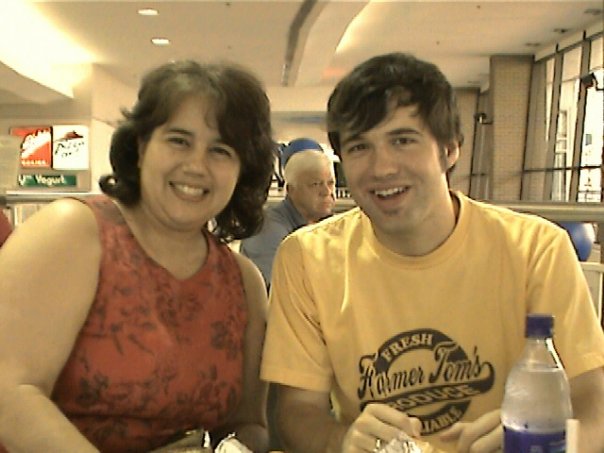
My mom and I in 2004

While I’m fully proud of my actual heritage, I feel more Jewish than I actually am. Thinking back on the last decade, the celebrities that people have said that I look like are all Jews: David Schwimmer, David Arquette, Paul Rudd, Zack Braff, and Ben Savage (from “Boy Meets World”). And I have played Jesus in more church skits and plays than any of my friends, because I always “looked the most Jewish.” I was the obvious choice.

And like the Genesis song “Turn It On Again” talks about, the characters I knew from the movies and TV shows (and even musicians) I watched growing up became like family to me, in a very cloudy, subconscious sort of way.  In particular, as I kid I thought I was Kevin Arnold (Fred Savage) from The Wonder Years.  And in talking to my sister in preparation for this post, I learned that she always thought that too.  We never knew that we both thought that until now.

The Three Stooges. Seinfeld. Friends. Pauly Shore. Bob Saget. Ben Stein. Howie Mandel. Dustin Diamond. Adam Sandler. Andy Samberg. Bob Dylan. Billy Joel. Just a few Jewish people who have surely influenced the culture of my life in some minutely tangible way.

Several years ago I stumbled across an obscure brand of wine that evidently has become my favorite.  The name caused me to think it was German.  But once I read the label carefully, I realized it is wine mainly used for Jewish services.  It’s Manischewitz brand, one of the nation’s leading brand of kosher products.

And this year I officially stopped eating pork and shellfish. Therefore the word “kosher” means something important to me. It means “hot dog I can eat”.

Some Jews actually have no Israeli blood, but they convert to the religion of Judaism. I sort of feel like that somehow. However, the only Jews that believe Jesus is the true son of God are the Messianic Jews.  Clearly put,  I feel like a Gentile (a person is not from the lineage of the nation of Israel) who has converted to Messianic Judaism. Yes, I’m a technical Messianic Jew.

John Mayer’s Battle Studies: The Newest Installment from the Half-Jewish, Tattoo-Sleeved Guitar God

There are certain male musicians who while they seemingly have a unisex audience, it’s mainly women who are openly proud fans. Key examples: Kenny Chesney and Keith Urban.

Then there are those male musicians who seemingly have a feminine audience, yet they also earn the genuine respect of men who recognize their talent despite their charm. Key examples: Michael Buble and Jason Mraz. But the epitome of this category is none other than the 6’ 3”, tattoo-sleeved, half-Jewish, Connecticut native, John Mayer.

His most romantic songs are typically my least favorite- “Your Body is a Wonderland” and “Come Back to Bed”. What draws me most to his music is a quality found in his lesser hits like “83” and “Something’s Missing”. Half nostalgic, half philosophical.

In reviewing any genre of entertainment, I can’t say any one thing is the best. I can only say what is my personal favorite. Because my favorite is simply an opinion; I am not qualified to declare what is best- that would go beyond a matter of opinion.

That being said, my favorite John Mayer album is his 2003 Heavier Things. It features the hits “Bigger than My Body”, “Daughters”, and “Clarity” (“ah whoo-ew… ah whoo-ew”). Along with its less featured songs “New Deep”, “Home Life”, “Split Screen Sadness” and “Wheel”.

The cover of this album itself perfectly captures the style and direction of the music. It represents a simple sense of timelessness, yet at the same time somehow reminds of me of Eric Clapton and/or Sting between 1988 and 1993.

I say that to say this. John Mayer’s newest album, Battle Studies, is a hybrid of two of my favorite things of his: 1) The album Heavier Things and 2) his very much underappreciated song “I Don’t Trust Myself with Loving You” from his 2006 album Continuum.

Very bluesy: “Fell down on my knees, asked the Lord for mercy, said ‘help me if you please’” (“Crossroads”).

Very jazzy: “Who says I can’t get stoned?” (“Who Says”)

Very soft rock: “I’ve got a hammer and a heart of glass- I gotta know right now which walls to smash” (War of My Life).

I decided half-way through this decade that John Mayer is incapable of releasing an album that isn’t good. I stand by that. Battle Studies is completely up to par with all his other recordings. But just like how Dave Matthews Band will never be able to top their Crash album, in my mind John Mayer will never be able to top Heavier Things.

Actually I see Battle Studies as a direct sequel (yet not necessarily a continuation) of Heavier Things. So in other words, I love it.

A year ago I posted a review of my favorite albums of 2008, and in a prophetic moment, I praised the then unknown song “People are Crazy” by Billy Currington. A few months later it was released as a single and went to #1.

Therefore, I will predict the soon-to-be hits from Battle Studies. The most obvious is the industrial-infused groovy tune “Assassins”. John has never sounded more like an African-American lead singer of an alternative rock band than he does in this song. Maybe it’s because this song has so many Michael Jackson qualities about it.


Like it was written with “Smooth Criminal”, “Dirty Diana” and “Give in to Me” in mind: “I work in the dead of night when the roads are quiet and no one is around… I’m an assassin and I had a job to do… Little did I know that girl was an assassin too.”

Another song destined to be a radio favorite is “Half of My Heart”. Perfect catchy melody. Perfect opening line: “I was born in the arms of imaginary friends.” Perfect choice of a female vocalist to do a song with: Taylor Swift.

The only downfall is that there’s not enough Taylor Swift in this song. She just does background vocals towards the end. Every time I hear it, I keep hoping the song has magically changed since the last time I heard it and that the song has become a true duet like the immaculately crafted “Lucky I’m in Love” by Jason Mraz with Colbie Caillat. Great song though: “Half of my heart is a shotgun wedding to a bride with a paper ring.”

Often when a musician or actor becomes a superstar, showing up in the tabloid magazines, the authenticity of their art suffers. Despite dating Jennifer Anniston and Jessica Simpson (to name a few) , his art hasn’t suffered (just his personal reputation). He’s still got the talent. Just as much as ever. Going beyond the rut of “the same three chords” compositions and “I miss you baby” lyrics.


And not that this takes away from his music at all, but this lifestyle definitely shows up in his song content. Like in “Perfectly Lonely”- “Had a little love but I spread it thin. Falling in her arms and out again. Made a bad name for my game ‘round town.” It’s also evident in the future hit which will inevitably be featured on several romantic comedy soundtracks, “Heartbreak Warfare”.

Gone is the charming, mysterious John Mayer from the beginning of the decade. Gone is the gentleman. Apathy and aimlessness are starting to show up in his attitude and lyrics. I don’t like his music any less because of it. But I do recognize the change.

Though this may actually be hurting him with his current single, “Who Says”, which is his lowest charting single, breaking his string of 5 consecutive Top 10 singles. This song much departs from his former classy charm, containing lyrics like this: “Call up a girl I used to know, fake love for an hour or so” and “I don’t remember you looking any better. Then again I don’t remember you”.

Not to mention the song’s constant references to marijuana use.


John Mayer is suffering from what I call “King Solomon Syndrome”. King Solomon had it all: Extreme wealth, fame, and wisdom. And 700 wives. And 300 concubines. But by the end of his life when he wrote the book of Ecclesiastes, he said it was all meaningless. None of it made him happy.

At least at an early age, John Mayer recognizes something’s missing.

Related Post by the Same Author:

John Mayer’s Stupid Mouth  http://wp.me/pxqBU-wz

And one more thing… Now that you’ve read my take on John Mayer, why not read my perspective on being a dad?  That’s right- parenting from a dad’s point of view.  I have been documenting my thoughts as a dad since the week we found out my wife was pregnant.  I formally invite you now to read my “dad blog” by clicking on the link below:

dad from day one

Jenny Slate Will Not Be Fired from SNL for F-Word Accident

That may not be official yet. It’s just my educated prediction.

I am a black-and-white kind of person. Either it is or it isn’t. That’s why the idea of censorship on national TV intrigues me. Because the rules of the game aren’t always in black-and-white. After all, there are actually no official guidelines regarding which words can and can not be used on TV- instead each network sets its own limits in an effort not to lose sponsors.

In a faux pas that wins the prize for irony, last night on the season premiere of Saturday Night Live there was a skit about “biker chicks” that made fun of them for having potty mouths, as the actors used the word “frickin'” as a form of self-censorship. New girl and Jewish comedian Jenny Slate, very early on in the skit, slipped the real word by mistake, puffing up her cheeks immediately after, as a sign of recognition of her accidental crime.


Instantly I was shocked by what I had just heard. Not offended, since the movies I choose to watch are loaded with “f-bombs”. Just very surprised, like a 2nd grader hearing the bully say a Bad Word, gasping that the Rule was just broken, wondering if anyone will “tell on” him to the teacher.

Knowing pretty well she said what I thought she said, this was confirmed right before the credits rolled at the end of the episode as fellow actor Seth Myers hugged her in a fashion that expressed, “Hey don’t worry about it- it was an accident. You’ll be fine.”

My favorite song my 8th grade year was “What’s the Frequency, Kenneth?” by REM. While a line of the chorus is “I never understood the frequency”, sang several times throughout the song, at the very end of the song for the final chorus the line changes to “I never understood, don’t f— with me.” I think I was the only person that caught it when in 1994 REM performed the song on Saturday Night Live. It went uncensored. The funny thing is, Comedy Central continues to air it as a rerun, still not editing it out.


Right now every article that has popped up on the Internet about this recent incident is going on to tell that in 1981 SNL actor Johnny Rocket was the first person to say the F-Word (unapologetically the moment he did it) on national television and that he was fired for it. And now the question is if  Jewish comedienne Jenny Slate will have the same fate. I have an answer.

No.

Last season SNL did a hilarious skit called “Sofa King”. That pushed the envelope for F-Word censorship more than anything they’ve done in the past. The skit was a fake commercial for a furniture store called Sofa King, in which the characters used the name of their store to describe how great everything is there. It took most people, including the audience, a minute or two to realize why the skit was even funny.

And once it clicked, it was genius. The actors were saying “sofa king” as a huge logo with the phrase popped up on the screen, but it phonetically sounds exactly like something else. It was a clever way to get around the censors while still saying the F-word multiple times. They totally got away with it. And what they did was completely intentional. And it wasn’t an issue with the censors. http://www.youtube.com/watch?v=P_NqXSbh5Ns


So to fire the new girl for an obvious accident during late night hours would simply gain too much negative publicity for NBC. Being that they are the #4 network, if anything this will improve ratings for SNL and the network itself. More people will be tuning in to find out who this Jenny Slate girl is, hoping she will slip up again.

Obviously, as hundreds of people right now are Googling and YouTubing the incident, they are clearly not offended by what happened. If they were, like so many were with the Justin Timberlake/Janet Jackson Super Bowl Fiasco, then it would be a different story.


While most people don’t approve of the word or use it on a regular basis, everyone slips at certain times. I know I have. Even if no one was around to hear it. Or even if I wasn’t on a live show on national TV.

This will turn out to be a fortunate accident for her. An instant transformation from New Girl to Jenny Slate, a name we now all know and recognize.

The Slip http://www.youtube.com/watch?v=NJOvVdl0DXU

The Hug http://www.youtube.com/watch?v=JoSmGfJCEAo


Christianity and Wine

Wine not?

Taboo is an interesting thing. As the opening line to the theme song of the classic inter-racial sitcom Diff’rent Strokes goes, “Now the world don’t move to the beat of just one drum: What might be right for you, might not be right for some.” From the society of a small family, to a town, to a nation, certain collective behavioral beliefs help unify a group of people to identify as one, bringing a sense of safety in numbers as well as vindication that their own viewpoint really is the best one.

As I researched for my epic “Beauty and Self-Worth aren’t the Real Issues, Lack of Will Power Is” last week, I learned some interesting things about food and drinks that are considered taboo by certain cultures. For example, throughout the centuries coffee has been banned by different countries (including our own) and religious groups (at one time Catholics and currently Mormons). Caffeine is an addictive drug and many people have seen coffee as a controlled substance, as it causes its consumers to become dependent on a drink that can change their demeanor simply by its consumption or lack of it, after the tolerance is built up.


It’s hard to imagine that drinking coffee (and other caffeine-laced beverages like tea and Red Bull) would be taboo to anyone. But considering its addictive qualities along with its mood-altering and heart rate changing abilities, it does have some similarities to alcohol, which is more easily condemned by religious groups. Muslims, Hindus, Rastafarians (though they encourage/require marijuana use), and Mormons are the most solid in their shunning of alcoholic beverages.

As for Protestant Christians, it’s namely Baptists and Methodists that have a stance of little to no tolerance for alcohol, often stated in their church by-laws. (Being that my hometown is almost completely represented by Baptists and Methodists, the sell or purchase of alcohol was illegal in the county until 2006.) However, because of their proximity to the Catholic Church, Episcopalians and Presbyterians tend not to look down on alcohol consumption.


Being Baptist my entire life, I always thought it was weird that Catholics actually drink wine during the service, in particular for the Lord’s Supper. Obviously Jesus and his disciples drank wine for the Last Supper, but we always used Welch’s grape juice (a company that got its start by offering non-alcoholic grape juice to the American Christians who saw drinking wine as sinful). After high school I moved away from my “dry” hometown and graduated from a one year (Baptist affiliated) Bible college in Florida then earned my English degree from Jerry Falwell’s (openly Baptist) Liberty University in Virginia, both saturated in an “alcohol is taboo and prohibited” culture.

Then I moved to Nashville.


An interesting crossbreed between churches and bars. A culture where drinking beer is in the same category as drinking soda. In other words, it’s just another beverage. Like in Europe. And I quickly learned that judgmental attitudes towards alcohol were nowhere to be found, even in Baptist circles. A person could actually sincerely love both Jesus and beer. In fact, last Fall my Sunday School class took a tour of Nashville’s own Yazoo Brewery as a fun activity.

When I finally accepted the fact that alcohol was no longer a moral issue to me, a revelation I had was this: Alcohol use does not necessarily equal alcohol abuse. Before, my mind saw any consumption of alcohol as an instant link to drunkenness and alcoholism. That is a stigma that has since been dissolved from my mind.

An interesting exception to the alcohol ban in Christian circles is best expressed in a quote I would always hear from my friends growing up: “My parents don’t drink, except for a little wine on their wedding anniversaries.” The alcoholic content of the average beer is around 5%. However, wine typically starts between 12 to 15%. Why was strong wine overlooked for special occasions but weak beer condemned?


There are several reasonable answers to this paradox, just like there are many understandable points on why certain religions prohibit alcohol. And because good cases can be made for both acceptance and rejection, it’s remains taboo for some and completely normal for others.

Ironically, the same parts of the Bible that caused me to believe alcohol consumption was wrong before, are now the same verses that give me confidence that for me, it’s no longer a moral issue. In fact, some of the best spiritual growth I’ve done in my entire life was during the time period that I figured this thing out for myself. Whereas before I was either too young to drink, banned by my college, or a part of a culture that shunned alcohol, the independence I found by sorting out my view on the issue helped me become aware of the spiritual side effect that a “no alcohol” lifestyle had on me: I was secretly judgmental of those Christians who drank.

But in the classic case of “if you can’t beat ’em, join ’em”, I realized that I had been treating the issue like some of the Jewish leaders did the law of Moses. They judged Jesus for healing sick people on the Sabbath. Even though the law more generically instructed the people to make the Sabbath day a time of rest and remembering God, the Jews stretched this and in their own interpretation added to the law, stating exactly how many steps a person could walk on the Sabbath, considering anything more than that to be work, therefore breaking the law of Moses. Judging the people by a higher standard of the law than God actually gave to the people.


I allowed myself to believe that the wine of the Bible was different than wine today. Because that excused Jesus of drinking it. And that helped me better accept the fact that Jesus’ first miracle was turning the water into wine at the wedding, and that he knew enough about wine that he might the good kind, and people at the wedding noticed it. But even if there was less alcohol content in the wine of Biblical times, it couldn’t have been much less. Jesus drank real wine. I finally stopped judging Jesus and others for it. And once I joined the crowd, not for reasons of peer pressure but because of personal conviction, I realized my walk with Christ matured.


Now I know that a person can have a daily personal relationship with Jesus, can read and study the Bible, can pray for others, and appreciate good wine and beer, because I have become that person. After daily praying for years that God would show me my flaws and my sins, my prayers were answered when I, in a sense, took real communion for the first time.

_________________________________________________________________________

Here are some excerpts from Paul’s letters to the church in the book of I Corinthians regarding eating food sacrificed to idols. These are the quotes that have bounced around in my head as I’ve established my own beliefs regarding food and drink:

“Or do you not know that your body is a temple of the Holy Spirit who is in you, whom you have from God, and that you are not from your own? For you have been bought with a price: therefore glorify God in your body. (6:19,20).”

“But take care that this liberty of yours does not somehow become a stumbling block to the weak (9:11).”

“For through your knowledge he who is weak is ruined, the brother for whose sake Christ died. And so by sinning against the brethren and wounding their conscience when it is weak, you sin against Christ (8:11,12).”

“Whether, then, you eat or you drink or whatever you do, do all to the glory of God. (10:31).”

Manspeak, Volume 3: Filtration

There is a widely accepted stigma that women talk more than men on a daily average basis: The urban legend says that women speak 20,000 words per day, while men only speak 7,000. It’s fun and easy to believe, yet almost all documented research shows that both genders speak around the same amount of words on a daily basis. What actually has been proven is that each gender tends to focus their speech on certain aspects- Men’s conversations are more information and task based, being more direct; women’s are more social based, encompassing more topics all at once.

Since men aren’t quite as in touch with their feelings and able to express themselves as easily and clearly (not to mention the fear of coming across as weak or too sensitive), men often are silent on issues that truly matter. The lack of a man’s words at times when they are most needed creates a canyon of unfinished business, causing some things to never begin and some to never end. While if he uses the wrong words, he may find himself at the bottom of that canyon.

Boy meets girl, man meets woman. Either way. Whether on the playground or randomly in line at a concert, a guy has to find a way to entice a girl with his words. From a cheesy pick-up line to a clever ice breaker. In almost every interview I’ve ever watched where a girl is asked what top 3 qualities she is looking for in a guy, more than looks, money, height, even religious beliefs, “he has to be able to make me laugh” seems to be the most reoccurring. And later down the road it’s the man that is expected to say those famous words, “Will you marry me?” A lot revolves around a man’s willingness to speak.

I find it interesting that God “spoke” the world into existence. Then one of the main jobs He gave Adam was to name to the animals. John the Baptist’s father lost the ability to speak until he named his son John. And it was Joseph that fulfilled predictions of the Old Testament when he named Jesus. When Jesus began healing people at age 30, he often simply spoke, and the sick were healed. He also caused the storm to stop by simply saying, “Peace, be still.” But what happens when a man doesn’t speak, or instead uses his words negatively?

A familiar concept is a grown man with no ambition, or a man who goes on to live a life of crime, because his father told him as a child, “You’ll never amount to anything. I wish you were never born.” Sounds like something from a melodramatic movie, but it happens everyday. And how many grown women look for love in all the wrong places, having a pattern of attracting men who don’t respect them, as they try to find a man to answer the question “do you love me?” because she never heard her father say the words “I love you”? A man’s words alone have the power to curse or bless his children. That’s powerful.

Last week I saw a Friends rerun where Joey starting acting more feminine because he got a female roommate. At one point in the episode Chandler senses Joey is upset and asks him what he did wrong. Joey responds with, “If you don’t know, I’m not going to tell you.” I laughed along with the pre-recorded audience because I recognized from watching a lifetime’s worth of sitcoms that it’s the man that has to constantly apologize for the stupid thing he said. And of course, he usually doesn’t know which specific stupid thing it was.

Joey’s next phrase: “It’s not what you said, it’s the way you said it.” Again, a token situation that is not at all foreign. A man’s words can get him in a lot of trouble. When a man speaks it tends to be more direct, specific, and matter-of-fact; it’s understandable that a man is more likely to hurt a woman by what he says, rather than the other way around. A woman tends to have a gentler, more discrete way of saying things.

As the half-Jewish actor Harry Connick, Jr. puts it in the movie P.S. I Love You, guys don’t really have a filter on what comes out of their mouths. They do, but it’s not too good. And I think this accounts for the term “dirty old man”. As men get older, the filter often works even less.

When I plow through another person unintentionally with my words, when there were words someone needed to hear me say that I didn’t say, and when I say something that is flat out wrong or invalid, I will use my words to sincerely apologize for my mistake. Better my apology when I mess up, than my silence, denial, or apathy.

“No filter in my head, what’s a boy to do? I guess he better find one soon.”
-John Mayer (“My Stupid Mouth”)

All pictures with the “JHP” logo were taken by Joe Hendricks Photography:

Blog- www.photojoeblog.com

Website- www.joehendricks.com