How to Be “Seriously” Funny

One of the things that has been defining my 40s has been to dive deep into the psychology of what makes all of us tick, as individuals. I love being able to explore and sort out the chaos of how amazingly different we are fundamentally are and how we live our lives because of and in spite of those differences.

As a curious experient last Fall, I went around asking people who know me well a very simple question, “Am I funny?”
In my own perception of myself, I am “low key hilarious”…. obviously! But I learned that when people think of me, “funny” is not the first word that comes to mind for anyone. Instead, the word tends to be “intense” or something close to it; like passionate or even… dramatic.

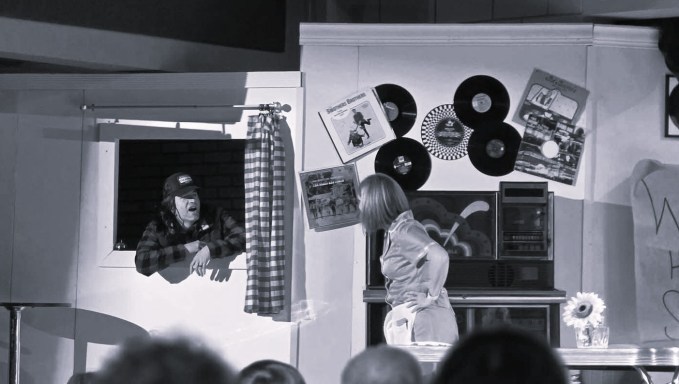
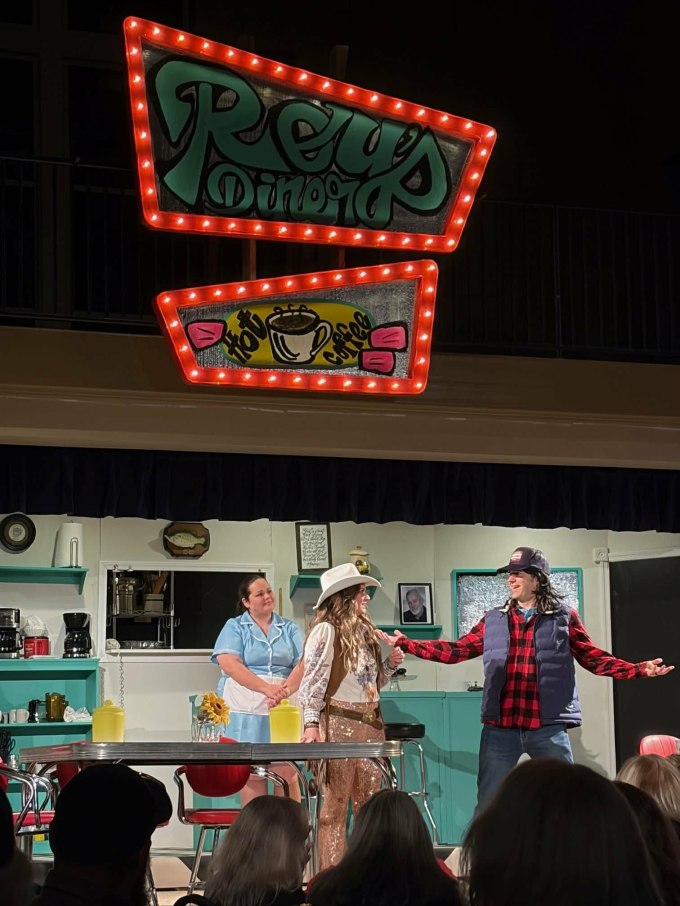
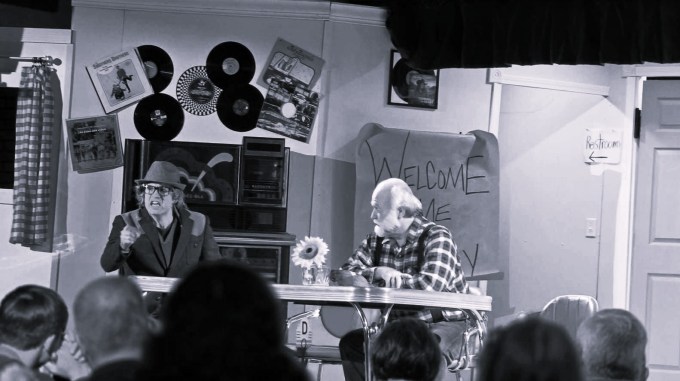
So it would not be a surprise to share that my biggest learning curve in bringing my two characters to life in the DeKalb County Children’s Advocacy Center play has been to… take myself less seriously?

“Jukebox Diner” is the definitition of what a comedy is- ultimately to the point where literally every single line spoken is either a set-up for a punchline, or it is the punchline. And if you’re not constantly laughing, it’s simply because you missed the joke.

I spent my Christmas vacation learning all my lines before our first practice. In the process, I did research on the psychological motives of both characters I would be playing:

-An overeager romantic who is on the search for his 4th wife, having just finished a brief stint in prison.

-A grumpy old man who is well-informed of what’s going on in town, thanks to regularly monitoring everyone’s posts on “the Facebook”.

It was important to me that the audience saw depth and developed a sense of empathy for them. But that changed the more we practiced as a group at rehearsals.

And now that we are nearing the end of our 7 performances, I have now completely gone full “cartoon mode” as I portray these characters in front of the audience each night. This AI description of comedy helps to put into words what I have learned over the past 2 months:

To understand the essence of comedy through absurdity, consider these key points…

  1. Exaggeration: Amplify ordinary situations to ridiculous extremes.
  2. Illogical Scenarios: Present scenarios that defy common sense or reality.
  3. Unexpected Twists: Introduce surprising outcomes that challenge expectations.
  4. Character Absurdity: Create characters with exaggerated traits or behaviors.
  5. Satire: Use absurdity to critique societal norms or behaviors humorously.
  6. Physical Comedy: Employ slapstick elements that highlight the absurdity of actions.

I tell myself backstage before each show begins: “You’ve got one job. Make people laugh.”

So the irony is not lost on me: By default, I am not seen as a “funny” person. It’s as if I see comedy through the lens of a person looking in from the outside.

Each night on stage, when I experiment by taking a slightly longer dramatic pause for the joke to land better, or when I experiment by ad-libbing a few more words to amplify the actual scripted line I am about to deliver, what I am actually doing is improving the comedy experience for the audience through analytics and logic.

That is a fascinating discovery: I have the skill of making people laugh, without necessarily being a naturally funny person.

Instead, I simply pour all of my intensity into comedy. And it works.
The Common Fascination with Ghosts and My Wonder of Why People are Afraid of Them

I ain’t afraid of no ghosts!

From Jesus’ disciples thinking that He was a ghost when He walked out on the water to their boat, to the tradition of people gathering around a campfire to hear a ghost story (in which one of the storyteller’s buddies is waiting in the woods to scream at the right cue), ghosts are a classic and preconceived idea.  The thing that gets me about ghosts is this: What are they actually going to do to you?


Yes, ghosts are spooky, creepy, and flat out scary in an old school kind of way.  But I can honestly say that I don’t know anyone in my life that has ever been injured, held hostage, or killed by a ghost.  In every ghost story I’ve ever heard, the worst thing about seeing a ghost is… well, seeing a ghost.  Even if ghosts existed, it’s no more threatening than paying $8 to go to a “spook house” and getting frightened for two seconds because a guy in a hockey mask jumps out at me with a plastic machete.  He can’t touch me, or hurt me.  At best, he’s just there for dramatic effect.

The fact that if ghosts existed they’re harmless is made obvious through the term itself “ghost stories”.  They’re stories.  Fiction.  They often involve a person who suffered a strange death in a house or in a field decades or centuries ago who can still be seen or heard on the right night.  Or like in the bed-and-breakfast where my wife and I stayed at out in Salem, Massachusetts, in which previous guests wrote in the sign-in book that they heard footsteps at night and heard the doorknob being jiggled.  Still though, even if that were true, I’m still here today telling the story.


A natural defensive response to this is someone telling me a “demon story”, which is totally different.  The movie Paranormal Activity is about a demon-possessed girl, not a ghost.  That’s part of the reason it’s so popular and so scary.  There’s a major difference between ghosts and demons, and a lot of people don’t realize that.  A ghost (or apparition) is the appearance of a person who has already lived and died.  A demon is an evil spirit which may inhabit a living person or animal.  (Surely a quick search on YouTube by typing in “actual exorcism” or “demon possessed person in Africa” is at least a little convincing.)

The New Testament is full of situations where people were possessed by a demon, so Jesus or His disciples casted the evil spirit out.  In particular, there was that one time where Jesus cast a multitude of demons out of a man into a herd of pigs, which immediately ran to the ocean and drowned themselves.  But even though I am aware of demonic presences in real life, I fully realize that the greatest concern of the satanic force is hinder me in my spiritual relationship with Jesus Christ and to prevent me from building up the Heavenly Kingdom.  Not to possess me.  Because they can’t- I’m already spoken for.


What truly scares me at night?  Being outside in the woods, knowing there could possibly be a mountain lion or a Copperhead snake that sneaks up on me.  (One of my current favorite TV shows is I Shouldn’t Be Alive, which comes on Wednesday nights on Animal Planet- I’m a little bit obsessed.)

A few times throughout my life I have been stuck in a heavy-feeling dream where I felt like something was oppressing me or weighing me down, where I even heard strange, slow motion voices that I can not distinguish. I tried to wake myself up, telling myself it was just a dream.  I tried to speak, but couldn’t.  Until I said, “Jesus! Save me, Jesus!” I immediately woke up to realize that I physically said those words out loud and that those spirits whispering in my ear or whatever they were doing had disappeared.

I take it I’m not a very well liked guy by the dark side of the invisible spiritual world, because never does a day go by where I don’t somehow publicly acknowledge that God is relevant in my life and that He is responsible for something good.  Instead of letting demonic forces trying to threaten my spiritual life, I do my best to live a lifestyle that hinders their mission. Some people are fascinated the possibility of seeing ghosts; I am fascinated by how through my relationship with Jesus Christ, I pose a threat to the wrong side of spiritual warfare.

“You believe that there is one God.  Good!  Even the demons believe that- and shudder.” -James 2:19


Major Nerds and Super Geeks: We Become Specialists in What We are Naturally Good At and Love to Do Anyway

In order to be cool these days, you have to embrace your inner dork.

By a college student’s junior year at a large university, there is no denying what he or she is majoring in.  Because by that point, there are certain undeniable quirks which have been weaved into the way they speak, how they spend their free time, or most importantly, who their friends are.  So when I chose the term “Major Nerds” as part of the title for this, it’s a play on words with a dual meaning like the classic TV show “Family Matters”.  It seemed to me that while in I was in college, a student became a nerd or a geek for whatever their college major was.

For me, the easiest ones to spot were the drama majors.  When a drama major walked into a room, they basically sang everything they said.  Their private conversations were never private; instead, everyone else in the room was an audience member for their traveling play production.  Of course they were also some of the most sincere and friendliest I knew in college.  Or were they just acting?  I guess I’ll never know.

I earned my degree from Liberty University, the largest Christian university in the world.  So it’s no surprise that in addition to every typical degree you could think of, they had a few peculiar options as well.  In particular, I’m thinking about the Worship majors.  These were the students planning a career in leading worship music at large churches… I guess.  Because every time you saw them, they were carrying a guitar playing “Shout to the Lord”, somewhat successfully drawing in a crowd of people singing along.

And if they weren’t doing that, they were inviting people to their “Night of Praise”: As part of their graduation requirements, the Worship majors had to entice an audience to come to a worship service in which the Worship major ran the thing.  For me, it was the most random thing someone could major in at our college.  I just couldn’t understand why a person would be willing to limit or brand themselves with such a specific degree.

What if after a few years of leading worship at a church, they decide they’d rather work in a bank?  And during the job interview, the employer says to them, “So, I see you have a college degree in… worship?”  And too, it’s just a weird concept to me that a person has to learn to worship God or lead others in worshipping God.  It makes sense, but also, like I told my friend James Campbell, whom I recently lost contact with because he evidently “quit” facebook: “Is that really something that you have to be taught?  Isn’t that comparable to having to take a class on ‘how to make love’?”

Then again, I’m not the one who feels I was called by God to work in the ministry.  So of course I can’t relate.  As for me, as if it wasn’t blatantly obvious, I was an English major.  To caricature us, I would say we were a strange hybrid: Decently liberal and very artistic on the inside, yet pretty conservative and sophisticated on the outside.  In other words, baby Literature professors in training.

Our heads were in the clouds, yet our feet were on the ground.  We were trained to dissect and diagram every situation into literary components; we were the Grammar Police to our dorm mates (see I am the Human Spell Check).  We were the only students who actually enjoyed writing papers.  In fact, I didn’t start out as an English major- I became one my junior year when I realized that if I enjoyed writing term papers, and all my friends came to me to proofread theirs, that maybe I should stop looking at some big dream of a career and just to what came easy to begin with.

And though those last two paragraphs about English majors were written in past tense, I can’t say that any of those characteristics about me have changed, simply because I graduated.  In fact, they’ve only increased in intensity.  In my office, I’m still the guy people come to when they need a letter written or an important e-mail proofread.  Obviously, I still enjoy writing- you know, hence the website and everything.

And really, that’s the way it works.  Most people end up majoring in whatever comes most natural for them anyway, for however they are wired.  Is it true that Finance and Accounting majors love working with numbers?  Sure, but it also comes easier for them then it would for me.  We all still like being challenged in our particular field.  When we can succeed in the difficult tasks of our specialty, it furthers us in becoming a locally recognized expert, equipped with knowledge and experience that impresses and possibly intimidates those who in different fields than we are.

I can tell you why the “k” in knife is silent and I can spell any word correctly without thinking about it, but I can’t do numbers.  I can’t do science.  Nor am I a computer whiz.  There are so many things I’m not good at and that I know little to nothing about.  But when it comes to the English language, literature, creative writing, and any kind of written communication in general, I’m your guy.  In other words, I was an English major nerd.  And always will be.

I use the word “nerd”, but I could say “expert”, or “go-to-guy”, or “whiz”, or even “buff”.  It’s all the same.  We all like to be good at something.  And when we can, we like to THE person for our niche.  Which often means we all have a bit of quirkiness attached to us.  Everyone’s at least a little weird.   Even the people we think who are the most normal.

Which Role Do You Play in Your Family?

As I a guy who doesn’t know anything about cars or building stuff, or even computers, or how to really fix anything, or sports (golf included), or politics, or business (investments and stock market crap), there aren’t seemingly many important roles left for me as a man in a family.

Sure, I can tell you which actors from Saved by the Bell are Jewish and which songs were hits in 1983 and how tall Albert Einstein was and I can solve a Rubik’s Cube in less than five minutes every time, but how does that fill any kind of necessary void in family dynamics?

I am a walking Wikipedia with an unforgettable memory of life events, sometimes nearing borderline Asperger’s.  So by default, what is my role in my family of six?  And to see the full picture, what are the roles of each member of my family? (My parents, my sister, her husband, and my wife.)

Me: The storyteller, the writer, the historian, and the event planner.  What drives me are memories.  Good memories take place because of events.  So I enjoy planning the family’s activities.

I tend to be the one in the family that decides what we will do with our time when we’re all together.  And if I didn’t have an agenda for everyone to follow, it’s possible we would all just sit around and do nothing.  It’s possible we wouldn’t know where to go to eat, and end up settling for something mediocre like Outback or Chili’s.

But I take the responsibility on myself for the six of us to decide where those memories (including potential funny stories and inside jokes) will take place.  And because “life happens” around food and entertainment and going to new places, my niche is being the one to set the backdrop for those events.

My role doesn’t fall into any of the typical manly stereotypes; I am the Montgomery Moose, the Desmond Hume, the John Cusack, the Pat Sajak.  The host, the MC of the evening, the narrator, the journalist of past, present, and future.  I just can’t fix anything.

My wife: The organized one, the teacher, the nurturer, the listener.

My dad: The mechanic, the electrician, the carpenter.

My mom: The financial expert, the chef, the encourager, the conversationalist.

My sister: The interior decorator, the helper, the initiator.

Her husband: The computer whiz, the tech expert, the sports enthusiast. 

Not that anyone can limit the talents and capabilities of their own family members down to just a few roles.  Because family members are not just stereotypes or TV characters.  They’re family.

What brought all this to mind is by watching the wonderfully crafted sitcom/drama Parenthood.  I love the dynamics of the family and how they all interact.  It hit me that the members of my family all have specific roles like the characters on that show.  And also, it seems the entertainment world is oversaturated with superheroes.

I just wanted to know what my “superpowers” are.  Now I know.

(And in case you’re still curious, Screech and Jessie were played Jewish actors, on the show Saved by the Bell.)

Would you, the random or regular reader, be willing to share with me your role and your family members’ roles in your family by leaving a comment below?  This isn’t a clever marketing ploy to boost my numbers or make this post seem more interesting.  I am just truly interested in this topic and want to know what other random family roles are out there. 

Medium and a Half: The Average and Normal Size?

Being average does not equate being normal.

My body must be disproportioned. Medium-sized anything fits a little too short and tight once it’s washed.  Anything that is a large-sized ends up being a little baggy even if it’s washed in hot water and dried on “high heat”.

When a long sleeve shirt fits me right, the sleeves are always a little bit too long and the bottom of the shirt is too short.  So there’s not much to tuck in.  That either means my arms are shorter than normal or my torso is longer than normal.  Or maybe a little bit of both.

And pants, those are always weird.  My pants size is 33×31.  I am the average American male height: 5’ 9”.  And my weight is normal for my height: around 160 pounds.  Yet it’s almost impossible to find my pants size when I buy pants.

I have to settle for either 34×30 or 33×34.  So my pants are either a bit too big around the waste and a little too short in the legs, or they’re too long.

If I’m so average-sized, why don’t clothing companies make clothes that fit me?

Conspiracy.

Storms off, stage left.  Pants dragging the ground.