Good Men Still Exist; They Just Don’t Make the Headlines as Easily

“The handy thing about being a father is that the historic standard has been set so pitifully low.” -Michael Chabon, Manhood for Amateurs

Yes, everyone is well aware that despite all the good men in history who have left a good name for themselves (along with plenty of quotable quotes, with many of them being strong military leaders or respected writers), there are enough deadbeats, scoundrels, and cads to cast a negative connotation on the word “man”.  Women are expected to be saints and givers; sadly, men are expected to be… well, not a lot is expected of men anymore.  But not all good men are long gone.

In the aftermath of Father’s Day last week, the Internet was full of freshly published articles about the modern man, father, and husband.  Two in particular really got my attention.  The first one reviewed the history of TV dads from Leave It to Beaver, to Married with Children, to Parenthood.  It brought out the fact that in the 1950’s, dads were too perfect, in the 1990’s they were often portrayed as bumbling idiots, and now in the 2010’s, TV dads have finally began to look more like real dads.  See http://today.msnbc.msn.com/id/37758834/ns/today-entertainment/.  (Though I would argue that the 1980’s were good to TV dads…)

The other article that really got me thinking was one I found on Stuff Christians Like, http://stuffchristianslike.net/2010/06/the-wild-difference-between-a-mothers-day-sermon-and-a-fathers-day-sermon/, which explained how many fathers in Christian churches feel miserable on Father’s Day Sunday because the sermon is about how men need to step up to the plate and be better fathers, while the Mother’s Day sermon provides nothing but praise for women.

I definitely see how good men often don’t get the praise they deserve.  Like Zack Morris once said on Saved by the Bell when Jessie declared that all men are jerks, “Hey, don’t judge us by our worst specimens.”  What can we do to enhance the minority of men who are truly good fathers, husbands, and hard-working citizens?

My guess is to call them out on their goodness when you see it.  It seems that if we as a culture began to celebrate the men who are doing right, it would be more of an incentive for those who are just half-way doing it, seeing there is praise and appreciation for being a “good man”.  But when the goal is simply to be better than Charlie Sheen (both the actual person and his fictionalized character on the totally lame yet successful sitcom Three and Half Men), there’s a certain lack of motivation to become a better man.

In an age where stereotypes of men who are drug to church by their wives end up jumping in a 15 passenger van for a weekend trip to their nearest major sports arena to learn from a former NFL player at a Promise Keepers conference that they should spend more time with their kids instead of watching sports games and that they should share the household responsibilities with their wives and stop looking at pornography on their home computers, then they go back home a changed man for a month, then repeat the process each following year, there are still plenty of men in America who actually already are indulging themselves in being the husbands and fathers they need to be.  There are actually good men in America who don’t have to be reminded to be good.  Because they are already aware of the reward in being a respected man who lives for his family, not himself.

Celebrate the good men in your life.  They may instantly brush aside your compliments or seem embarrassed when you do, but inside it means the world to them.  Of course with good men being the coveted gem in a parking lot full of gravels, my guess is, you already do.
The Awkward American Tradition of Tipping in Restaurants

Tipping isn’t a city in China…

There are certain events in life that I consider normal and common, incorrectly assuming everyone else participates in them with the same amount as passion as I do. In recent years I have been made aware that I am a “music buff”: I own well over 800 CD’s (not iTunes albums, but actual discs). As well as a “movie connoisseur”: I’m not a guy that can just sit down and enjoy a stupid movie like White Chicks. I will read multiple reviews on all the movies currently playing at the theatre, then choose the top 2 or 3 and see them all in one afternoon.


When it comes to restaurants, I’m no different in regards to my premeditated snobbery towards those eateries that are sub-par in my book. Instant disqualifiers for a restaurant: it has a drive-thru, it has an obvious theme, it’s noisy, it’s expensive for no good reason/prices aren’t listed on the menu, it’s all fried food, it’s a buffet, it’s Mexican, it’s Chinese, I have to pay to park, the actual menu is greasy, the waitress’s name is Flo, and I can see the cook smoking a cigarette as he’s cooking the food, to name a few.

If I could go back in time and influence the culture of American dining in restaurants, I would do whatever it takes in order to eliminate the social acceptance and expectance regarding food servers so that in 2009 I wouldn’t have to participate in the subconsciously awkward world of Tipping. Of all the things I don’t enjoy doing, evaluating another person’s work ability is at the top of that list. So I definitely don’t want to do it while I’m paying to eat. But even so, I pretty much just tip everyone the same percentage anyway.


During the summer of 2005 as I was saving up money to move to Nashville, I was a waiter at Western Sizzlin’ (the South’s version of The Sizzler) where I learned what all goes into serving a table of adults who act like bratty children. Hearing annoying quotes like, “This steak is still mooing at me…”, “I didn’t order pickles on my hamburger!”, and “You got any FRESH coffee?” were all part of my daily routine. (All spoken with Southern accents for dramatic effect.) That experience causes me to be especially appreciative of my waiter when I am out at a restaurant.

But now as the one being served, the whole experience of interacting with the waiter puts me into what I call Game Show Host Mode. I act like everything the waiter does is magic trick, like bringing the menu, then the drinks (as I usually rip off the restaurant by ordering free water), then taking my order, taking away the menu, etc. My response: raising my eyebrows, nodding my head, and smiling too much after each accomplished action. So over the top.


In most other situations if I acted that way, I would deserve a “Punch Me in the Face” sign more than Spencer Pratt or Dane Cook. But the environment of the restaurant and the relationship between me and the waiter excuses my overly grateful and easily amused behavior.

What if I didn’t have to feel like I’m treating my waiter like a kid, needing my exaggerated approval and acknowledgement on every little thing he does? Better yet, what if America was like most other countries in the world and just flat out didn’t associate tipping with restaurants? But ultimately, a country only has the customs that its culture allows and depends on. So when it all comes out in the wash, our society openly accepts the frivolous head game we call Tipping.


Karaoke: Why the Heart of Rock & Roll is Still Beating

I love authentic Japanese karaoke machines that are made in China.

Last Saturday at my wife’s Christmas work party, they had karaoke going on down in the basement. I really had no intentions on participating, but when I realized that it rated the performance based on timing and pitch, I cut in line to be next. Putting my money where my mouth was from the first installment (http://wp.me/pxqBU-9u), I chose to sing “The Heart of Rock & Roll” by Huey Lewis and the News”.

It’s simply common sense that a karaoke machine advanced enough to grade a singer’s performance would also have decent quality music tracks. But the blips and bleeps of a Gameboy would have been better and easier to follow. All I could hear was a keyboard and fake drums. Not to mention the lyrics were a little off. The lyrics prompter said “now the old boy may be a bit off rhythm” instead of “may be barely breathing”.

I got a “67” out of 100.

The guy after me sang “Lean on Me”. Instead of “I’m right up the road, I’ll share your load”, the prompter read, “I’m a friend that’s kind of thorough”. I love authentic Japanese karaoke machines made in China.

Something that kept me distracted and laughing was the background images on the screen. I’m used to just white words over a blue screen. This one had actual video footage of completely random and unrelated things.

I just loved watching a mother duck and her ducklings eat bread crumbs at a park while my wife sang “Crazy” by Patsy Cline. And seeing an aquarium full of exotic and butt-ugly fish swim around while my wife’s boss sang “Jingle Bells”. And my favorite: While a 9 year-old boy sang “Eye of the Tiger”, we all watched footage of a lonely Japanese girl looking mopey at various venues: restaurants, lakes, and subways.

There’s just no wrong way to do karaoke. Because there’s not a right way.

Why Do People Have to Smile When They Get Their Picture Taken?

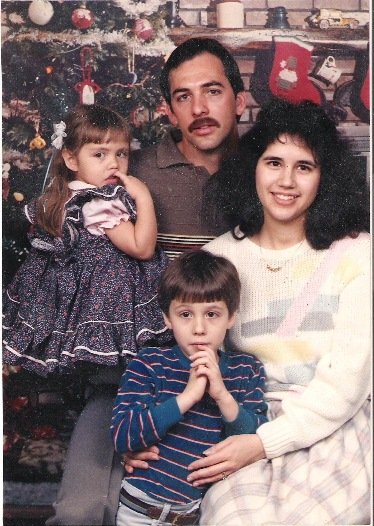
The Shell’s Christmas 1986

My sister and I weren’t good at getting portraits made when were young. I would cry because I was afraid I’d fall off the stand they put me on. And my sister would get mad at the photographer as he tried to make her laugh by waving a squeaky bunny at her.

In our house growing up, one of our family portraits hanging up in the hallway was our Christmas ‘86 picture where my sister was making a mean face at the camera. I looked sneaky and scared. My mom looked like everything was normal. And my dad looked like he was thinking, “Let’s just get this over with”. Classic.

So it was only natural after walking by that picture several times a day I would eventually ask my mom, “Why do we have to smile when we get our pictures taken?” Because all my life experience up until that point had only shown me it was a chore.

The concept of always smiling in pictures is at least a little bit goofy. While I’m sure I smile and laugh a lot during any given day, I couldn’t say that during the majority of my awaken hours I am smiling.

When a picture is taken, it is not to capture the image of a person how they are most of the time, but instead, to capture the image of a person at their best. It’s the same way that our memories tend to work, as well.

The Good Ole Days are good because we are choosing to remember them at their best. We subconsciously overlook the stressful, sad, annoying, and boring parts of the story.

We are left with only the good parts- The Good Ole Days. Like Lucky Charms cereal with just the marshmallows. So is the concept of smiling in pictures. Only the good parts are frozen in time.