Screen Door on an Open Mind

I think, therefore I am open-minded.

Before, I always thought that being open-minded meant I would personally accept any new idea that came along, so I distanced myself from the phrase. “Open-minded” was a description for a person with no backbone, so flaky regarding their worldview that they would accept anything fully; never really being able to believe in any certain deity whom they could actually know personally, because being open-minded meant they believed “God is in the trees and the wind and the animals and in all of us”.

But somewhere in between never adopting solid personal beliefs and being so unchangeably stubborn because “this is the way it’s always been done and I ain’t changin’ now” is a balance. I’ve come to realize that while there are certain things I am rock solid on, there are other aspects that I was wrong or misinformed about before. For example, in recent years regarding the relationship between my religious and political beliefs, I have definitely become more conservative on certain issues and more liberal on others. Yet I still know what I stand for.

Being open-minded means living a paradox. It means a person has confirmed the Big Stuff (a moral code, religion, etc.) but is open to the millions of things that don’t necessarily go against what is set in stone. And while people everyday are still sorting out the Big Stuff, there should come a certain point for everyone where they actually decide on something. It’s a necessary rite of passage that makes us who we are.

Speaking of a word that many often keep a distance from: faith. It’s amazing how there’s no escaping from needing to have faith in something. Whether it’s faith in no god, a god, science, tradition or “don’t know, don’t care”, people make their decision even in their indecision.

I have figured out the Big Stuff for me. Other than that, I’m learning the rest everyday. The door of my mind is open, though the screen in front of it is secured in place.

“If you don’t stand for something, you’ll fall for anything.” –traditional proverb

Nonfiction Rules; Fiction Drools (Why I Would Rather Allude to True Stories of My Own Life Than to Have to Create Characters and Story Lines)

Why make up a bunch of stuff to write about when the story is just sitting there, waiting to be told?

There are many times in life when I believe it’s important to work on my weaknesses until they become my strengths.  Like with the Rubik’s Cube, for example.  Other times, I just run the other way, knowing that the best option is just to stick with what I know best.  And so is the case with writing fiction; I’m not good at it, I don’t enjoy it, and I have no desire to try.  Seems like too much homework to me.  Granted, I very much admire/envy those who have the talent to write fiction.

I write nonfiction, instead, because it comes so naturally to me.  There’s no need to invent clever, yet deep characters- I already have all the ones I need.

The characters of my writings are usually you (both specifically and generically at the same time), friends, family, heroes, idiots, time, life itself, and myself.  The trickiest part of making this work is how I handle both the first and last subject I just named: you and me.

When I do actually use the word “you”, I try to avoid placing it next to the word “probably” because I don’t truly know anything “you probably” do, think, or are.  All I can do is portray things from my own perspective based on what I do, think, and am.  As for myself as a subject (the narrator and host), I’m careful not to make it obvious what a major role I play in the story.  I will quote French author Gustave Flaubert, “An author in his book must be like God in the universe, present everywhere and visible nowhere.”  It’s not about me; it’s about the story.  But the only way I can set the stage for common ground between “you” and me is by accenting the whole thing with my own life.  Like most album covers for the Steve Miller Band’s records where Steve Miller himself was M.I.A., if my face or image is attached or present, it’s almost better.  Let the art speak for itself.

I also love writing nonfiction because it’s pretty convenient how time can be manipulated; I am able to encompass the past, present, and future all in one.  Typically I start out the post with a story that already happened (past), linking it to who I am today (present day), and end it with how that sets the tone for how things will continue to be (future).

Writing nonfiction allows me to serve as my own psychologist, hopefully entertain others, and in a sense, to have the ability to travel through time.

The Modern Day Tower of Babel, Perhaps (The Internet and Online Social Networks)

If twenty years ago someone had tried to describe to us what the Internet was and how drastically it would change our lives, we would be as lost someone trying to watch LOST for the first time starting with Season 4. In 1993, Time magazine did a cover story about predictions of future technology involving the way people would share information. Vaguely, they were seeing a glimpse of the World Wide Web. But the way they presented it was more like a form of cable TV that would have at least 500 channels.

Instead, a year later in 1994 my 8th grade science teacher Bill Martin showed our class this weird way he could use the classroom phone line and his computer to talk to other scientists across the country, instantly. That was my introduction to the Internet. Three years later, the Internet became less of a weird thing that I could only observe from a distance, as some of my friends with Internet let me aimlessly wander through thousands of websites at their house. By 2000, I had my own hotmail account and my own daily access to the Internet.

But even ten years ago, the Internet was much more primal. For casual users like me, all I really did was catch up with distant family and friends through e-mail and use MSN’s search to look at websites that had trivia about the ‘80’s. And I didn’t know any better; I thought it was awesome.

Now in 2010, life on the Internet is completely different. More concise. When I need a good picture, I’ve got Google Images. When I need knowledge on any subject, I’ve got Wikipedia. When I need a video clip, I’ve got YouTube. And to keep in daily contact with family, friends, and people I had one class with in college and barely remember, there is facebook. Those four websites ARE the Internet to me.

The building of the Tower of Babel has for some reason always interested me: After Noah and his immediate family survived the world-wide flood, and waited almost a year inside the ark for the water to recede from the land, they were told by God to “fill the Earth” and for the first time ever, to kill and eat animals (the first ten generations of people were vegetarians). In other words, move to a new land and have large families to repopulate the world (Genesis 9).

Instead, within a few hundred years most of these people were still living in the same area they started in. They said, “Come, let us build for ourselves a city, and a tower whose top will reach into heaven, and let us make for ourselves a name, otherwise we will be scattered abroad over the face of the whole earth.” Then, in an act that reminds me of myself as a 10 year-old boy dragging a rake through a giant ant bed, God decided to “confuse” the language of the people (Genesis 11). From there, it appears to me that the people of each of the same language regrouped and moved to a new land, eventually forming new countries, as God originally wanted to them to do.

Several thousands of years later, mankind has successfully filled the Earth. We now have almost 7,000 different languages, while English is arguably the most universal. But with the capabilities and practicality of the Internet, we have formed an abstract, intangible form of the Tower of Babel. Technically. Sort of. Maybe. It’s at least got me thinking.

Every time I’ve seen any sort of worldwide system of anything in the Bible, it’s always been a bad thing. When mankind finds a way to harness too much knowledge and/or power, God doesn’t like it- as people tend to depend more on each other and themselves. From Adam and Eve’s eyes being opened to the knowledge of good and evil in Genesis, to the end of the world involving the mysterious “mark of the beast” (some sort of universal personal ID providing a way for people to pay for goods and services) in Revelation.

Then again, what better way for the fortunate to bless the less fortunate then by using the communication of the Internet to give and set up help for the needy.

Maybe I’m the stoic eccentric man holding the sign with the phrase “THE END IS NEAR”. Or maybe it’s just a coincidence. But I still love technology.

dad from day one: The Gender of the Baby

“Sadie, Chloe, Sammy, or Max, chillin’ in a baby sack.  Tristan, Evan, Lily, Zoey, or Jack…” -Candy Butchers, “Let’s Have a Baby”

Nineteen weeks.

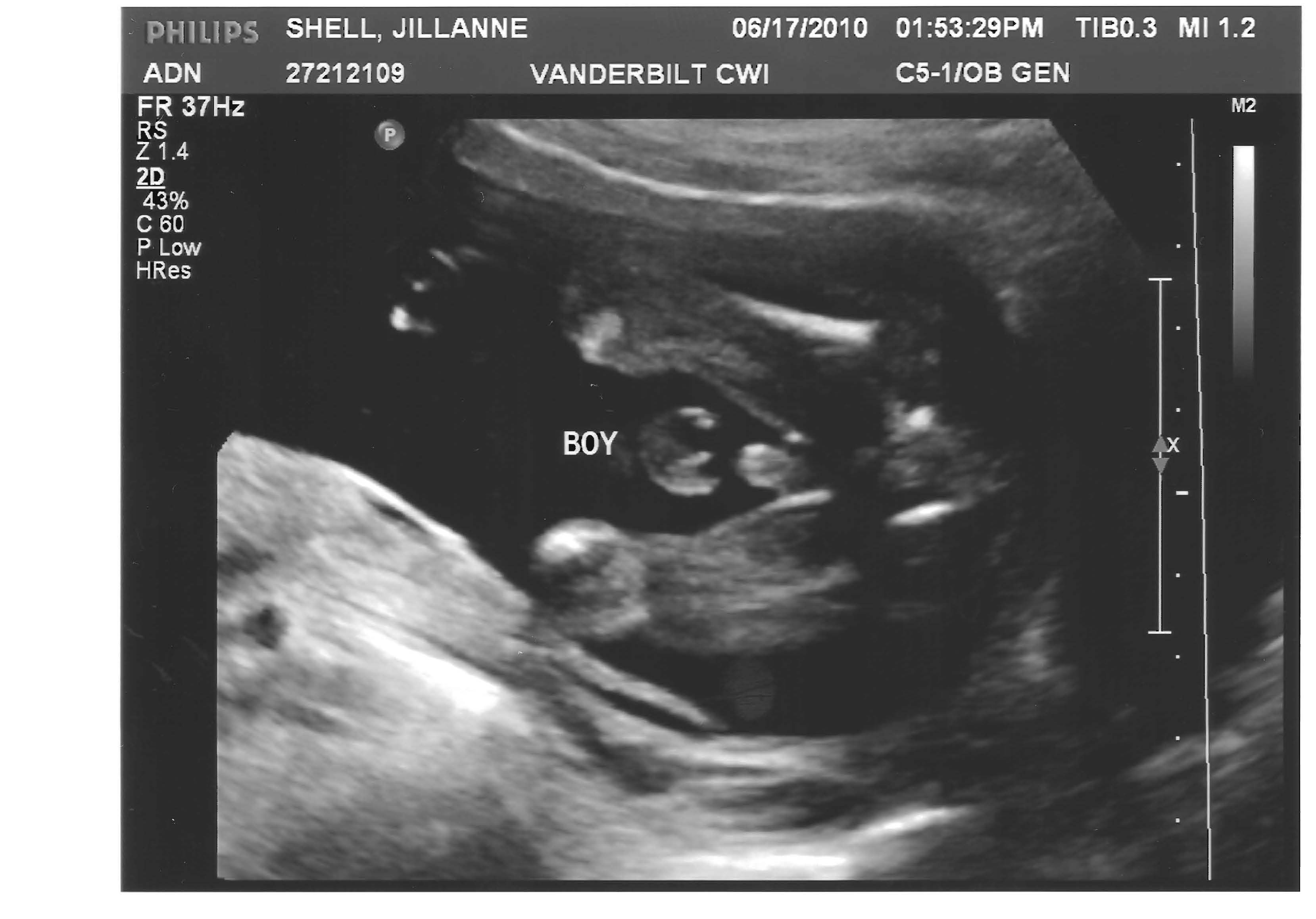
After my grandmother’s dream and my wife’s co-worker’s psychic’s prediction of it being a girl, it was pretty obvious to us what the gender of our baby would be.  I drove down to the appointment yesterday full of excitement, knowing that I could finally tell everyone that our intuition was correct once I would get the official confirmation.

Several anxious moments passed as the nurse showed us pictures our  our baby, then finally she asked us, “Do you want to know what it is?”

Laughing, full of confidence, we told her that we were quite sure already, but yes, tell us for sure.

“You’re having a boy.”

I wish I had a YouTube clip of our reaction.  “WHAT?!  NO WAY!  ARE YOU SERIOUS?!”  Etc., etc.  All exclaimed while hysterically laughing.

Not that it mattered either way to us.  I just don’t think I’ve ever been more surprised in my life.  I wish there was a way to type in a “laughing font” to better show my tone here.  I’m so happy!  We’re having a boy!

This is an “under the scrotum” shot.

Of course now it’s time to answer the other question: What are you naming him?

First name: Jack

Middle name: William

Last name: Shell

Here’s how we came up with the name:

He will go by “Jack”, which is my dad’s name.

Which is an alternate version of John, which is Hebrew (Jewish) for “God’s grace”.  Which just sounds like a cool name.  It’s simple, not too popular, and easy to spell and say.  And Jack also happens to be the name of the lead character of the best show ever made, LOST (played by Matthew Fox, who is also part Italian.)

Plus, my wife’s name is Jill… so it’ll be “Jack and Jill”.

His middle name, William, (my wife’s dad’s name) is German and loosely translates as “protector”.

His last name, Shell, (originally spelled “Schel” at some point in American history) is German and loosely translates to “loud and noisy”.

That being said, Jack William Shell is a Jewish-German-German name which fully translates as “God’s gracious gift of loud and noisy protection.”  I’m already picturing a little boy wearing a pot on top of his head, running around the house, banging a pan with a wooden spoon, being “loud and noisy”.

Most importantly, Baby Jack is healthy, thank God!

Jack, the boy.  Who knew?

All pictures with the “JHP” logo were taken by Joe Hendricks Photography:

Blog- www.photojoeblog.com

Website- www.joehendricks.com

When Our Life Expectations are Faster Than the Speed of God

Roll the dice.  Press the buzzer.  Time to play America’s favorite game.  “Solitaire: Life Expectations Edition”.

Life is often a difficult and careful balance of two extremes. Not any two certain extremes- each situation has its own.  But one in particular of these balances has proven consistently annoying: The balance of being a motivated, goal-oriented, hard-working American as well as living in accordance to God’s timing.

I have an agenda, a set plan, an order of events, a timeline by which I’m already behind on, according to me.  Yet on a yearly basis, I’m stalled by a classic answer to many of my prayers: “wait, it’s not time yet”.  And that’s what I call being faster than the speed of God.

Obviously, God, in all his power and lack of limitations can not be outrun.  But by pointing him to my calendar and its several missed and delayed events, I’m simply reminding God of my inability to keep up with him- since his calendar doesn’t simply just move forward; he’s in every moment of the past as well as the present and future.

When God misses my appointments for his involvement in my life expectations, it also serves as a reminder that man-schemed plans are often irrelevant in the face of God.  My life expectations are nothing more than an often-frustrating check-off list of a game that I am playing, involving other people at times, as my volunteers and spectators.

Graduate college and get a job.  Check.  Get married by age 27, which is the national average of American men when they get married.  Check.  Buy a house.  Check.  Have a baby by the time I’m 30.  Check (of course, Lord willing).

Good for me.  I’ve met some of my goals.  My American society-influenced landmarks.  Of course there are plenty more that I’m only beginning to scratch the surface of.  So by playing the rules of my own game, I lose.  Conveniently for me, though, I’ve still got the rest of my life to play this game, and accomplish these goals.  Yet still, the humbling truth is that this game still doesn’t matter to God.  His checklist for my life is much simpler, yet much more complicated.  And from everything I can tell, it mainly just revolves around loving other people.

As for the film based on my non-fiction book, Scenic Route Snapshots, starring James Franco, it’ll have to be postponed until 2013.  Because after all, I need to publish the book first.  And according to my calendar, that’s scheduled to happen next year.

And yet I return to the pointless game of Solitaire: Life Expectations edition.