To Become an Atheist or a Vegan: Which is More Difficult?

To Become an Atheist or a Vegan: Which is More Difficult?

One shared stereotype between atheists and vegans is that they bring up the topic within 5 minutes of meeting people. In theory, they both have extreme beliefs and lifestyles that many other Americans don’t feel comfortable with accepting.

Atheists deny the existence of God or any kind of higher spiritual power. Meanwhile, vegans deny the need to consume any animal products (meat, dairy, eggs) in order to be healthy.

Both extremes deny things that most people can’t live without: God or edible animal products.

It’s almost an impossible question; to ask, “Which is more difficult, to become an atheist or a vegan?”

(That’s of course assuming you’re not already an atheist or agnostic; or vegetarian or vegan.)

I think much of the difficulty in legitimately asking and answering this question in a public online forum is that it might be easier for the participants to become more focused on bashing each other’s beliefs than it is to actually simply answer the question I am proposing. Hopefully, that’s not the case…

If you live your entire life believing in God (or at least some kind of spiritual higher power), it seems it would be nearly impossible to just switch off that fundamental belief; especially knowing that to believe in God is to accept accountability for your life, once it ends; assuming there are eternal rewards and consequences, accordingly.

It seems that if you truly believe in God, even if you’re a “lapsed Catholic” or a “backslidden Baptist,” you still wouldn’t be able to declare there is no God; because in your heart, you still would believe there is.

In my mind, to choose becoming an atheist over a vegan means you are already heading down that path of non-belief; that you’re already quite skeptical of God, or at least of the general public’s view of what God is supposed to be like.

But my perception is, that is not how most people (at least here in America) are.

On the other hand, if you are used to eating meat, dairy, and eggs, you could switch to just eating veggies, fruit, grains, beans, nuts, and seeds. However, it would take much education to realize it could be done.

Most people still believe the myth that vegans don’t get enough protein. But I feel I’ve done a good job of busting that myth.

(Please read my related post: Vegans Don’t Get Enough Protein and the World is Still Flat.)

Look at me. I’ve been a vegan nearly 4 years now, and a vegetarian more than a year before that, and kosher (no pork/shellfish) for several years before that.

At 5’9”, 155 pounds, and age 34, I have remained in the perfect weight range. Notably, I am clearly not underweight.

To Become an Atheist or a Vegan: Which is More Difficult?

If I wasn’t getting enough protein, it would be pretty obvious.

Of course, my doctor confirms I am getting enough protein, as well as all other nutrients I need; and that I am “healthier than most 34 year-olds” he’s seen.

He even commented that he “wasn’t surprised” to learn in hindsight that I am a vegan; since I waited for him to assess my health before I broke the news about my plant-based lifestyle.

I say that not to brag, but to provide evidence that when you actually replace animal products with the proper plant sources of fat, protein, and iron, becoming a vegan is actually an intelligent and efficient option.

Plus, by being a vegan, by default, you consume less than 1% (basically 0%) of your daily allowance of cholesterol. You still consume a lot of fat, but virtually no cholesterol.

But in my experience, most people either A) don’t know this, B) don’t believe this, or C) don’t care.

Therefore, there are many people who believe in God but who are unable to bring themselves to believe that becoming a vegan is a sustainable lifestyle. They would have great difficulty in denying their belief that consuming animal products is necessary for proper nutrition.

That’s why I think it’s such a great, and difficult, question to answer.

Assuming you’re not already an atheist or agnostic, or vegetarian or vegan, which is more difficult, to become an atheist or a vegan?

I think I am the perfect person to propose this question.

That’s because I am not the stereotypical vegan. Most vegans, as this infographic below demonstrates, are liberal, non-religious females.

Meanwhile, I am a Libertarian (socially liberal, fiscally conservative), religious male.

For me personally, the answer is obviously simple: It’s easier to become a vegan, but impossible to become an atheist.

My faith is God is non-negotiable. Sure, I will go to my grave with questions I don’t understand about God, but to me, that’s what real faith is anyway.

And I’ve already been living the vegan lifestyle for nearly 4 years.

I’ve “been there, done that” when it comes to answer the vegan question.

But what do you think? What’s your answer?

Assuming you’re not already an atheist or agnostic, or vegetarian or vegan…

Which would be more difficult: To become an atheist or a vegan?

Which would be more difficult: To become an atheist or a vegan?

Dear Jack: You Spent Your Own Money on a Bag of Non-GMO Potato Chips

Dear Jack: You Spent Your Own Money on a Bag of Non-GMO, Organic Potato Chips

Being raised by two Dave Ramsey followers as parents, I’m sure to some degree, your version of reality might differ from some of your friends and classmates.

This past Saturday, we decided to drive down to one of the Portlandia-type parts of Nashville: 12 South. We had lunch at a place called Sloco; a sandwich shop that specializes in local ingredients.

After we picked out our vegan and vegetarian sandwiches, we each picked out a bag of non-GMO, potato chips; the only brand they carried was one I had never heard of: Deep River Snacks.

Near the end of the meal, you still had half of your bag of chips remaining, yet you asked Mommy and me for another bag.

You insisted, “But I want more for later. I really like these chips. They’re the best chips I’ve ever had.”

We explained to you that if you were willing to spend some of your remaining Christmas gift money on the chips, then that would be fine; but that we weren’t going to spend any more of our family’s budgeted food money on your extra bag of chips.

With little hesitation, you agreed. I walked you up to the counter and you purchased the chips: $1.62.

This sort of amazed me and Mommy.

It seems all you’ve ever spent your own money on has been stuffed animals and a few monster trucks.

But chips? Seriously, they were that good in your mind.

Unsurprisingly, that night for dinner you asked us if you could eat your 2nd bag of chips with your meal.

I figured if the chips really meant that much to you, how could I say no?

This story is so funny to me because I’ve never seen you so passionate about any food item.

And they were just plain chips. Just a few ingredients; potatoes, sunflower oil, sea salt.

Honestly, I’m proud that they were non-GMO (and kosher). That part is surely lost on you.

Good chips are good chips. And sometimes they’re apparently worth spending your own money on.

Love,

Daddy

3 Bits of Parenting Advice I Wish I Had Received Beforehand: Cry It Out Method, No Fruit Juice, Discipline without Spanking

Louis CK Spanking

When you are expecting your first child, by default you are bombarded by people giving you what they think is good advice, when in reality, it’s just nonsense:

“Make sure you get plenty of sleep now, because once the baby arrives,

you’ll be wishing you had more of it!”

Lame.

That doesn’t even make sense. Even if you sleep 12 hours every day leading up to when that baby arrives, that won’t change the fact you still will be deprived of sleep once the baby is born.

It’s not like the outdated concept of “rollover minutes” on your flip phone from 2003.

Now that my second child is due in April, I’m collecting my thoughts on how to prevent making the mistakes I did with my 1st child.

Last week one of my friends I grew up with, whose first child is due a week before my second child, asked me over Facebook if I had any tips for him.

And that, of course, inspired this blog post today.

I should give this disclaimer, though: All 3 of my tips today are unpopular with the majority.

However, I know that these three tips have led to me being a more efficient parent personally and have led to the making of a good kid.

Seriously, my 5 year-old soon is a good kid. He’s bright, he’s creative, he’s active, he’s funny, he’s well-behaved, and he’s healthy. And he doesn’t get in trouble at Pre-K.

I say those things not to brag, but to provide evidence that the parenting tips I am submitting today are personally effective; not just simply my opinion.

This blog post today is written for open-minded, soon-to-be first time parents, who I am grateful are taking the time to hear what I have to say, in an effort to proactively seek help.

1) Use the “cry it out” method. I have now just revealed that I am not an “attachment parent” or a “helicopter parent”. Unfortunately, my wife and I didn’t learn this lesson until our son was 7 months old.

Your baby is depending on you to learn when night time is and when he or she should be asleep for several hours at a time. By answering your baby’s cries each time during the middle of the night, it is actually counter-productive as it prevents your baby from getting the necessary rest he or she needs; as well as yours and your spouse’s.

Yes, it can be psychologically challenging as the parent to apply the “cry it out” method, at first. It can difficult to choose efficiency over emotion, but my child is proof that this method is not damaging to the child’s psyche.

2) Fruit juice is not a healthy drink option. Yes, fruit juice contains vitamins and is hydrating. However, it doesn’t contain the fiber from the fruit needed for digestion and to balance out the sugar. So what happens is your child gets an unhealthy sugar dose (and possibly excessive gas.)

My son gets a skin rash anytime he drinks juice. That’s what fully convinced me it’s not good for him. Even my son’s dentist, Dr. Snodgrass, quickly agreed with me when I mentioned it to him during my son’s visit first. The dentist immediately acknowledged he can always tell when a child regularly drinks juice, because their teeth typically aren’t as healthy.

So with that being said, obviously sports drinks (like Gatorade) and soda are nothing less than taboo in our household.

Instead, your child can get vitamins from actual fruit and vegetables found in fruit packets; plus I highly recommend buying a Baby Bullet, to provide your child with the right nutrition.

3) Discipline your child without spanking them. Your job as the parent is to provide certain things for your child that, on their own, they are not capable of understanding they need in the moment. They are depending on your lead for these things.

They need to know when to eat (hungry), when to sleep (tired), when to play (bored), when to engage in conversation (lonely), or when they are physically incapable of feeling well (sick).

Unfortunately, it’s only natural as a parent to, in the moment, forget about these things and instead, assume your child is “misbehaving”.

Five years into this, I now know to go off the check list when I am tempted to think my son is “misbehaving”. Each and every time, he’s either hungry, tired, bored, lonely, or sick. (I invented that check list, by the way.)

My role is to proactively provide for his needs, not to physically strike him for seeking negative attention for those symptoms.

Additionally, here are my 5 alternatives to spanking that I learned from when I blogged for Parents.com:

Ignore attention-seeking behavior; pay attention to good behavior; redirect your child; teach consequences that make sense; and use time-outs for serious offenses.

Consider that professional psychologists who have actually studied spanking have come to the same conclusion: Spanking is actually less effective. Even if it was only equally effective, why physically strike your child if you don’t have to?

For me it’s all about efficiency as a parent. It’s about working smart, not necessarily hard.

No need to make yourself a martyr if you know what’s really going on in your child’s brain.

If you are open-minded to my personally effective methods I have shared today, please feel free to comment so I can get back to you.

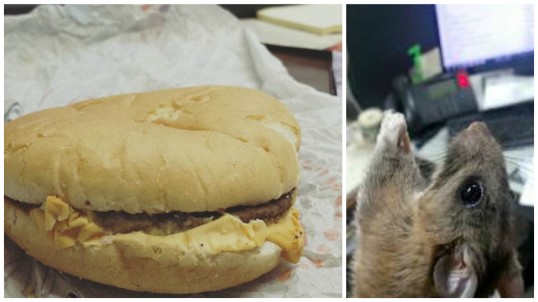
My Dad’s “Rat Burger” Story: A Rat Refused to Eat His McDonald’s Cheeseburger

Yesterday morning my dad, Jack Shell, posted an interesting little story on his Facebook page. I thought it was worth sharing here on my blog:

rat burger

“This is a McDonald’s cheeseburger I bought in November 2014. It has been in the original wrapper on a shelf in my office. The bread is hard and brittle but there is no mold, no smell, no deterioration. Rats and insects haven’t even touched it. I just killed a big rat in my office last week, too. I guess the rat didn’t recognize it to be food. Why should you? Remember this next time you are eating at McDonald’s.”

I suppose that my dad’s testimonial is not too shocking, considering most of us have already since Supersize Me at least once by now.

Apparently my dad decided to do a science experiment of his own. Even aside from the fact the rat didn’t find the cheeseburger and try to eat it, is the fact that nothing else in time between November 2014 and January 2016 tried to eat it either.

If nothing else, the meat itself should have attracted some kind of critter by the end of the week.

Plus, my dad mentioned nothing about a horrible smell that he, nor any other person that walked into his office, ever smelled for over a year. Because evidently, there was no horrible smell even though there should have been.

I think it’s impressive that McDonald’s is able to make a food product that A) is delicious to humans but B) is not attractive to insects or animals in the food chain whose job it is to take care of food lying around on the planet; while C) at the same time this same cheeseburger contains both meat and cheese but still does not smell horrible when left out for days, weeks, months, or even a year in just a room temperature building.

Should you have any doubt of the validity of my dad’s testimonial, it would be pretty easy to debunk. Just simply leave a McDonald’s cheeseburger in your office for over a year and then find out the results.

Granted, the fact that you could even make it more than just a few weeks would already prove my dad’s point.

Dear Jack: Baby Moses, as Portrayed by a Sour Patch Kid, Floating on a River of Jell-O

5 years, 1 month.

Dear Jack: Baby Moses, as Portrayed by a Sour Patch Kid

Mommy and I have noticed how exceptional the children’s program is at our church, The Church at Station Hill. As part of your class curriculum each Sunday morning, you all get to walk over to the craft room after the lesson, where I am always impressed by what new craft you make.

I love it that our church has a room set aside just for kids’ crafts; most of which are edible. It’s always interesting to walk by that room and peek in to see what you’ll be making each morning as we take you to your classroom.

This past Sunday as we were walking back to the car after church ended, you showed Mommy and me the newest one.

It was baby Moses floating down the river.

What made this craft a lot of fun, especially on a Sunday morning as I was now buckling you into your car seat, was that baby Moses was actually a Sour Patch Kid, floating on a river of Blue Jell-O.

As I drove home, with you and Mommy in the back seat, I could hear you enjoying eating your Sunday School craft:

“Mmm… baby Moses tastes good, he’s crunchy!”

I’m just glad that it was Moses floating down the river in a basket, and not baby Jesus in the manger. Because that would really seem weird. It would take the concept of Holy Communion to a different level.

An edible gingerbread house is fine, as his baby Moses floating down the river, but I think an edible manger scene might be a little too crafty.

But as for baby Moses, he floated down the river of your digestive track and you were happy I was letting you get away with eating candy so early in the day.

Needless to say, you definitely now know the story of baby Moses floating down the river.

Love,

Daddy