dad from day one: Insert Foot in Mouth

Week 25 (5 months).

If you are a regular reader of my “daddy blog”, then you know my writing style well enough to expect this to be a post about Jack being able to literally put his foot in his mouth- and by the end I will make mention that as he gets older he will metaphorically put his foot in his mouth by not knowing when to stop talking- as often is the case with guys.  So surely I will need to throw in a reference to John Mayer’s song, “My Stupid Mouth.”  But that would be too predictable.  So no metaphors this time around- this entry is simply about my son discovering his toes and sucking on them.  No “big picture” ideas today.
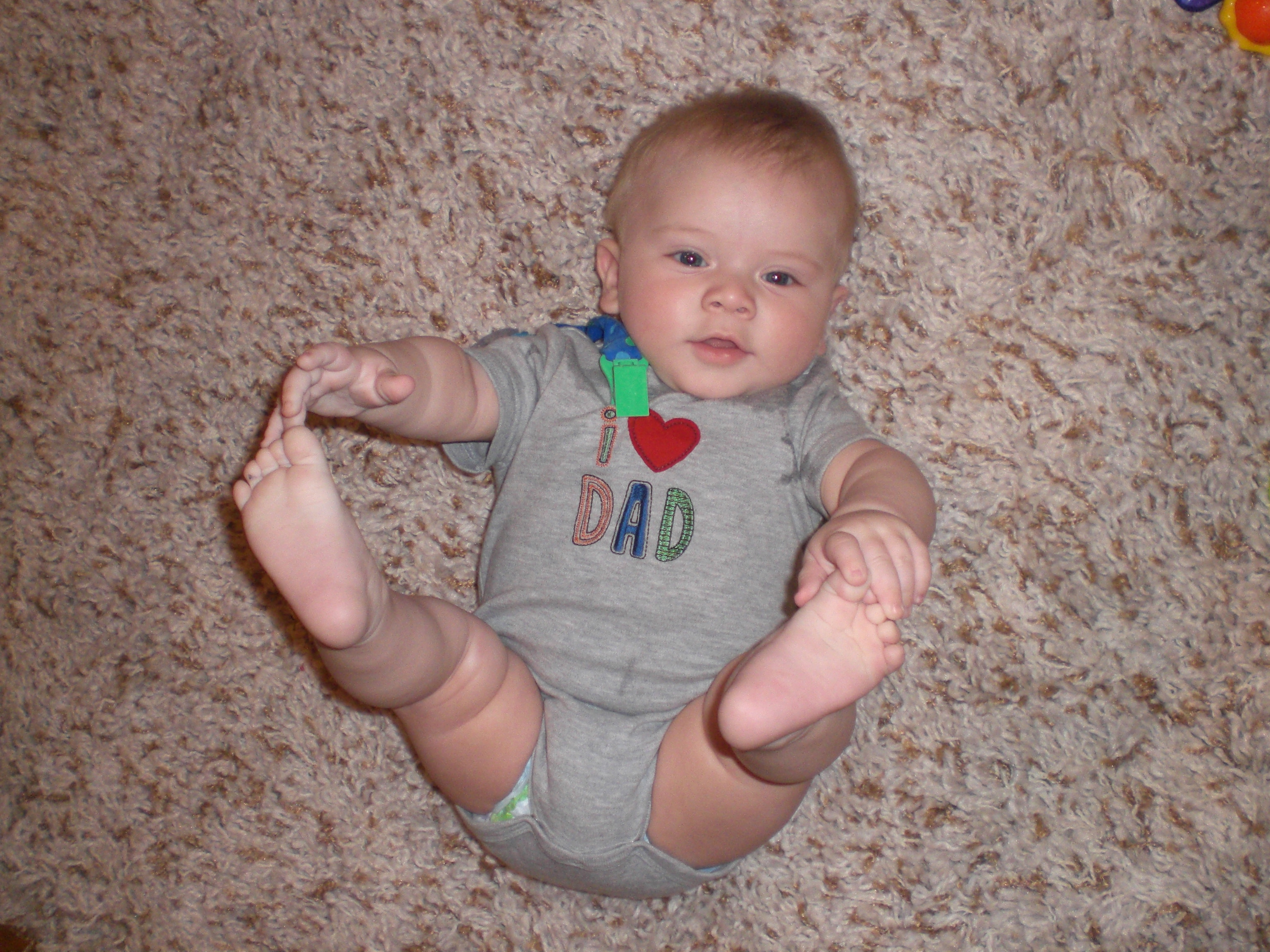
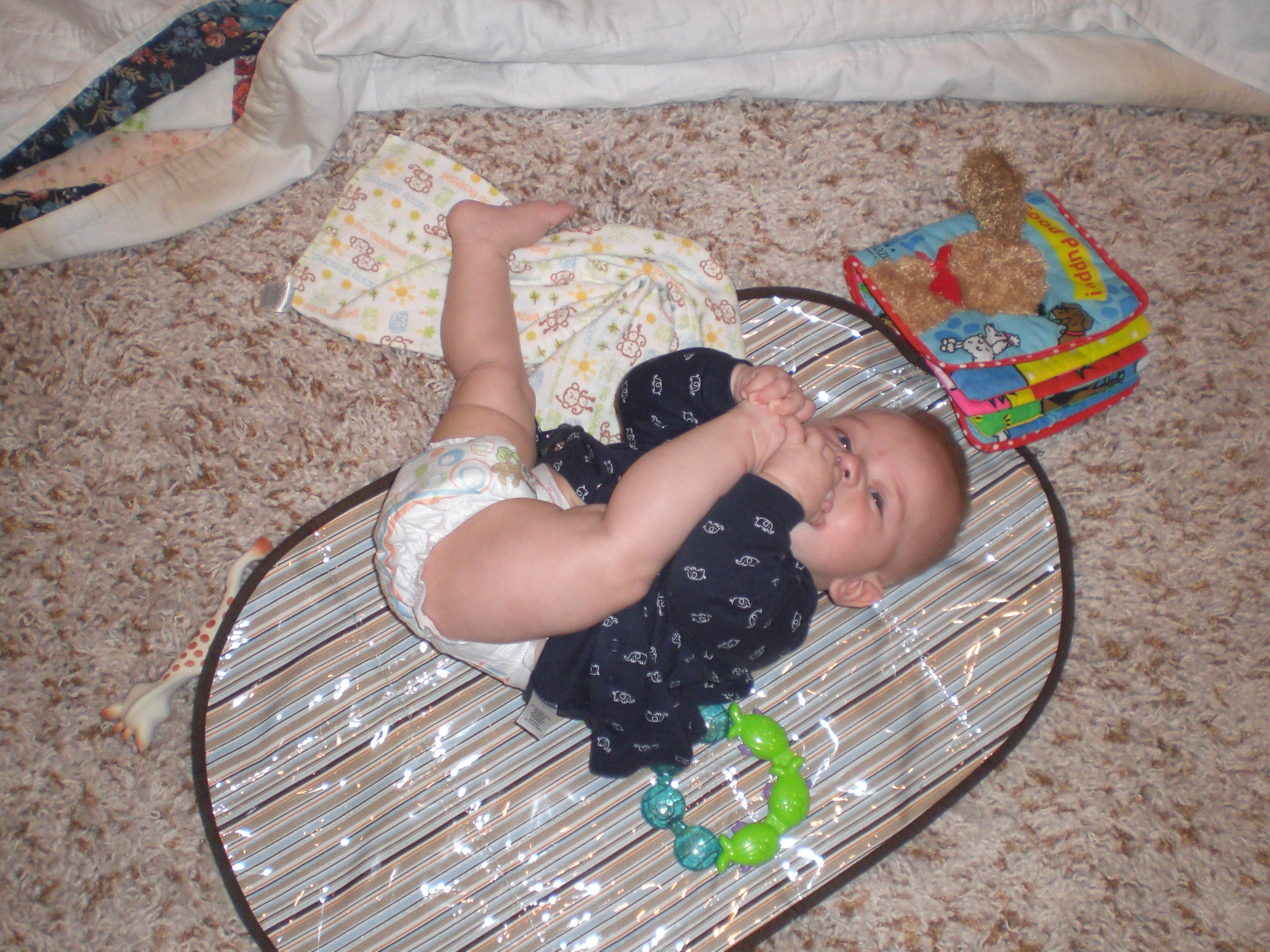
Jack has discovered his feet.  I don’t know if he realizes they are his feet, though. Like the way a dog chases its tail, providing hilarious entertainment for spectators, so is Jack’s love/hate relationship with his feet.  I’m assuming that he thinks his toes are little grub worms, and forgetting that the only “solid food” he is eating right now is crushed up oatmeal and bananas, not grub worms, he decides to attack his toes when they are not looking.  And might I add, he gets ’em every time!

His slobber is noticeably thick this days, so each time he bites his toes with his toothless gums, the end result somehow reminds me of every alien sci-fi movie I’ve never seen, yet still recognize the image for.  But aside from the humor of watching Jack sneak up and attack his toes, and aside from the grossness of it, is the surprising element of it: A baby, with the body proportions of the Michelin Man, is limber enough to easily stick  his foot to his mouth anytime he wants.

I completely admit that in the middle of typing that last sentence, I had to stick my foot to my mouth to see if I could do it too.  I can.  But not as effortless as Jack.

Bonus: Last week I was interviewed and quoted in a Mother’s Day article by Megan Mattes, on Parents.com.  Click here to see it.
Why Home Improvement is the Most Popular Least Jewish American Sitcom Ever

Are there any Jews in Home Improvement?  I don’t think so, Tim.

Did you know that May is officially Jewish American Heritage Month?  On April 20th, 2006 (my 25th birthday), President George W. Bush proclaimed that the month of May would be Jewish American Heritage Month from then on.  So this year for the 5th ever Jewish American Heritage month, I’ve decided to highlight America’s least Jewish sitcom ever, in order to contrast just how much Jewish people have affected our cherished American entertainment.

Obviously, the most Jewish American sitcom is Seinfeld.  And Second Place goes to Friends.  But on the opposite side of the spectrum, one might expect the least Jewish American to be an African-American sitcom- like The Cosby Show.  But of course, Lisa Bonet (who played Denise Huxtable) is half Jewish. Coincidentally, she was briefly married to Lenny Kravitz, who is also half Jewish and half black. Even more coincidental is the fact that Lenny Kravitz’s mother is Roxie Roker, who played Helen Willis on the sitcom The Jeffersons, who in the show was married to a white man, just like she was in real life (to a Russian Jew, Lenny’s father).

But other popular African-American sitcoms were still largely created and carried out by Jews.  Like Family Matters: no Jewish actors, but the show’s producers were: Thomas L. Miller and Robert L. Boyett.  Not to mention the fact that Family Matters was a spin-off of Perfect Strangers, a sitcom about two unlikely roommates and cousins, who in real life are Jewish.  So even if none of the actors in a sitcom are Jewish, you still have to consider the producers, the writers, and even the origin of the sitcom.

After much exhaustive research, I have discovered that the most watched yet least Jewish sitcom was definitely Home Improvement (1991-1999). None of the actors were Jewish.  Not Tim Allen (nothing about him is Jewish), not Jonathan Taylor Thomas who played Randy (physically he could almost pass as a Jew), not Taran Noah Smith who played Mark (Jewish sounding first and middle name), not Earl Hindman who played Wilson, nor Richard Karn who played Al.  The main creators/writers were not Jewish.  Home Improvement was not a spin-off of a Jewish influenced show.

There was a close call, however, in the casting of Tim’s Tool Time co-host. Originally, there was no “Al Boreland”, but instead, “Glen”, played by Stephen Tobolowsky, who was definitely Jewish. But his prior commitments caused him to lose out on the role.  Sure there were special guest stars that were Jewish, like Rodney Dangerfield and Penn & Teller (Teller, not Penn, is Jewish).  And Brad’s character briefly dated a character named Jessica Lutz (assumed Jewish because of the last name), though played by non-Jewish actress Michelle Williams. Lastly, one of the executive producers was Jewish; Elliot Shoenman, but he was only there from seasons 4 through 8.

But if it’s that much trouble to point out any Jewish influences on a sitcom as popular as Home Improvement, then I see no way around it: Home Improvement is the most popular least Jewish sitcom ever.  And making that discovery is one of the ways I can help celebrate Jewish American Heritage Month.  I’ll leave it to all the other bloggers to point out the more obvious, influential Jewish Americans like Albert Einstein and Mark Zuckerburg. As for me, I’m here to focus on the petty stuff.

Below are some more exciting and entertaining posts I have written about Jewish entertainers:

Movie Guy, at Your Service: The Social Network (Plus, Which Actors are Jewish)

The Ethnicity of the Cast of The Wonder Years (Plus, Who Did the Voice of Kevin Arnold as an Adult?)

The Ethnic Backgrounds of the Cast of Friends and Seinfeld (Yes, Most of Them are Jewish; Even Matthew Perry)

The Jewish Influence on American Entertainment

Why Bruce Springsteen’s “Born in the USA” is the Most Anti-Patriotic Song to Ever Be Loved by America as a Nationalistic Anthem

Like many Americans in my generation, I’m confused by what it means to be “patriotic.”

It’s interesting to sit back and watch while half of America cheers after hearing about the execution of Osama bin Laden then the rest of America chastises them for cheering the death of an enemy, as they misquote Martin Luther King, Jr.  The concept of being a patriotic American is surely much different than it was my for grandparents and their parents.  Being completely honest, I think a lot of us are actually confused about what it actually means to be “patriotic.”  Is it possible to be a proud American and to be proud of our military, yet to be ashamed of some of our nation’s foreign policies?

In May of 1984, country artist Lee Greenwood released “God Bless the USA”, the song many of us think is titled “Proud to Be an American.” The song truly embodied traditional patriotism; no doubt about it. Then just five months later on the day before Halloween, Bruce Springsteen released the song “Born the USA.” Maybe it was because radio listeners were still in a truly patriotic mood thanks to Mr. Greenwood, or maybe they were just blinded by the catchy, rockin’ beat of Mr. Springsteen’s song.  Either way, “Born in the USA” became a legendary hit;  though largely for the wrong reasons.

President Ronald Reagan even referred to Springsteen’s song in one of his speeches, believing “Born in the USA” embodied the message of the American theme of making dreams come true. However, Bruce Springsteen’s song was actually about the effects of the Vietnam War;  including the fact that often the American soldiers who came back from the war were not welcomed when they returned, not being seen as heroes like the war veterans from decades before.  In fact, I can’t help but wonder if some of the song’s lyrics would disqualify it from being played on the radio today, being that they are too “politically incorrect.”

I believe that 27 years later, “Born in the USA” perfectly captures the confusion of people like me, who want to be patriotic in the same way as my grandparents were, yet are so sick of the politics of politics.  I don’t want to be left to choose between traditional Republican or Democratic agendas.  I want another choice- one with a different policy on our economy, our constitutional rights, and how we handle international war as well as “the war on drugs”.

Like this Springsteen shirt below? Clear here to find the price for it on Amazon!


dad from day one: After the Storms Have Cleared

Week 24 (5 months).

Jack travels well.  And that makes life a lot easier for my wife and I.  He really didn’t mind camping out two nights without power, then traveling an hour to stay in Georgia for two nights to stay in a hotel suite with us along with his grandparents, aunt, and uncle.  For a couple of days, we lived amongst people who were instantly made homeless by last week’s tornados, like Pastor Sidney Ford, featured here in this story by ABC.  He was such a blessing to us and it was an honor to meet him.

For us, life is picking back up to its state of normalcy.  Our power came back on Sunday afternoon, and everyone in my family was able to return to work on Monday.  My employer (who is also my dad’s employer as well) is so gracious to us that they are paying our wages for last Thursday and Friday, when no one could come to work because the entire city was without power.  I am constantly aware of how blessed (by grace) and spared (by mercy) I am.

I’m not convinced I’m the kind of person who has to be reminded by a tragic event just how fortunate I am- who gets so caught up in the “hustle and bustle” of life that they “can’t see the forest for the trees.”  Because I make it one of my daily personal goals not to become distracted by life- by the chaos and unsettledness and not-knowingness that each day brings.  I’m not saying that’s easy.  Something life has taught me is that typically when I am the least happiest, it’s often because I am focusing too negatively inward and not enough positively outward.  My own mind and attitude are fortunately and unfortunately much stronger and influential than I often realize and give them credit for.

But Jack doesn’t have to worry about that kind of stuff yet.  As long as he’s fed, played with, has his diapers changed, and has assistance falling asleep, he’s just happy to be here.  He thinks everyday is a celebration just to be alive.  And I believe that is one of the many reasons that a baby brings so much joy to us adults.  Babies teach us so much without speaking any intelligible words.

Jack's new "puppy dog" face

Osama bin Laden is Dead and All I Can Think About are My (Still) Unresolved Convictions on Capital Punishment

It seems that this morning is an appropriate time to sort out my thoughts on concepts like “kill or be killed” and “deserving to die”.

Reading my Facebook friends’ comments the hour after Osama bin Laden was announced dead taught me two things: 1) They are glad someone finally caught him and killed him.  2) They are proud of our U.S. military for doing it.  As for myself, I feel the same way.  I also am somewhat comforted by the assumed concept that it’s morally okay to have wanted this man dead, and that we collectively as a nation do not feel any guilt for Osamba bin Laden’s death.

I would feel the same sense of relief knowing other antichrists were dead, had I lived in their era; the most obvious example being Adolph Hitler.  It’s my observation that while most American religious and political groups have no concrete collective agreements on capital punishment, it goes without saying that if a man is responsible for thousands of lives being lost in a war or political action which he led, then that man deserves to die.  And I agree.

What I am confused about isn’t whether or not we should want evil war tyrants dead.  The thing I have unresolved convictions about is the much smaller scale version of men like Osama bin Laden and Adolph Hitler.  What about serial killers who only kill 20 people, as opposed to 2 million?  How high does the body count have to get before the killer “deserves to die”?  Where is that conceptual line drawn that causes our American society to agree that a man needs to be killed?

I understand the inescapable concept of “kill or be killed”, as it applies to both war and self-defense.  What I find fascinating/confusing is knowing when it’s “okay” to kill a criminal, after he committed a horrible crime.  A month after a man killed and raped a dozen people, it is no longer self-defense or “kill or be killed”.   Once that murderer and rapist has been captured, can we kill him?  If not, would it be any different if he was a member of the enemy army in a war?

Probably, because it’s my observation that war justifies killing people who “deserve it”.  But when that same evil man who deserves to die is not fighting our nation as a whole, but instead is individually picking out individuals to kill and/or rape and he is not associated with al-Qaeda or Communism or a being a Nazi, we suddenly are reluctant to collectively agree to place them in the electric chair and remove them from our society to keep them from hurting anyone else.

Despite trying to understand my own beliefs and convictions on capital punishment and self-defense for over a year now, the death of Osama bin Laden doesn’t help much in removing the blurry haze clouding my mind on these issues. And maybe this is as clear as it will ever be in my head.  What do I believe?  I don’t know for sure.  What do you believe?

If this post was the least bit interesting or fascinating to you, I invite you to read its two prequels, by clicking on the titles below:

Capital Punishment, In Theory: Do You Support the Death Penalty Enough to Do It Yourself?

Self-Defense, In Theory