Dear Holly: You Hunted and Gathered Some “Baby Biscuits” for Breakfast Saturday Morning

1 year.

Dear Holly,

These are the days of you scouting underneath the kitchen table for any Cheerios you may have dropped earlier. You’re very good at finding them, by the way. And every time you discover a forsaken Cheerio, you proudly extend your little hand and pick it up like a crane machine lifting a toy out of the machine at Mellow Mushroom.

It is very obvious that at your school, you are learning to eat with your hands. I’ve noticed here recently that when I try to feed you veggie and fruit puree with the spoon, you’re starting to resist my help.

As if to sternly yet politely tell me, “Thank you, Daddy, for trying to help me eat dinner. But as you can see, I am actually able to feed myself…”

Often this leads to you cupping your hands to scoop the food out of the bowl. Yeah, it makes a mess, but I’m happy to see you attempt to be a girl her who can feed herself.

But you don’t simply snoop around for Cheerios to feed yourself, as I learned this past Saturday.

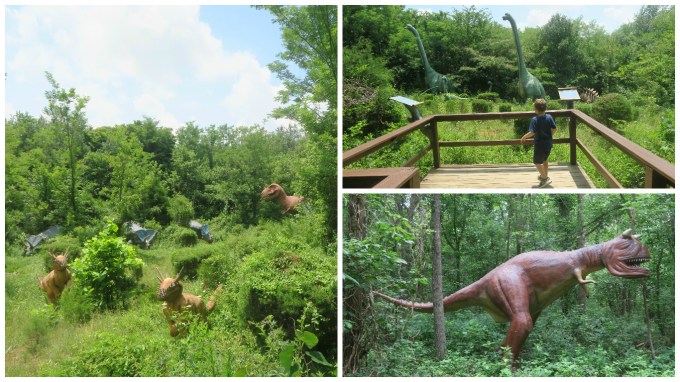
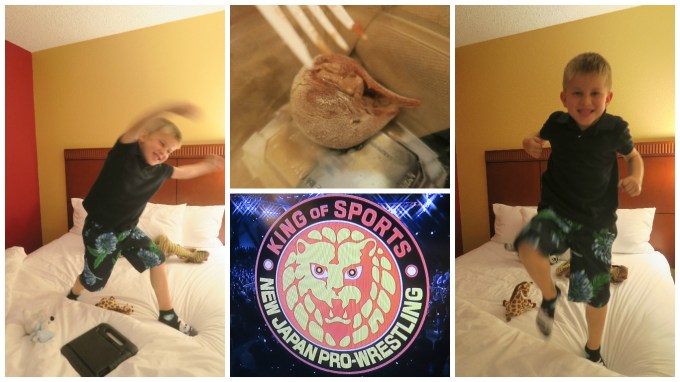
As Mommy was shopping for groceries at Kroger, you and I were upstairs in the bonus room with Jack, who was watching a dinosaur documentary on Netflix called Dinotasia.

For a while, you were content to just walk between the red footstool and the couch, as you braced yourself when necessary. You were so quiet, as to respect the fact your brother was in the zone as he learned more about dinosaurs.

Then I heard the rattling of a plastic wrapper for the non-GMO fig bars your brother eats: Nature’s Bakery Fig Bars. I didn’t think much of it. I just figured you liked manipulating the sound that an empty wrapper could make.

But then the rattling ceased, and I saw your little fist clenching one of the bars, and I saw how it was soggy on one end…

You had taken it upon yourself to find your own breakfast! I continued to watch you, and sure enough, you were able to successfully download the food you had found, just lying there.

Since you did such a good job finding and eating your own “baby biscuit”, I ran downstairs and got you a new pack of them.

Without surprise, you were able to chew and slobber your way through those baby biscuits as well, with just those two teeth on bottom and three coming in through the top.

Holly is a hunter-gatherer!

Love,

Daddy

Dear Jack: Your Unashamed Obsession with the Dinosaur Documentary, Dinotasia

  1. 6 and a half years.

Dear Jack,

Saturday morning as Mommy bought the groceries at Kroger, I stayed home with you and your sister, letting you pick something to watch on Netflix until Mommy got back.

We scrolled through the “Because You Watched Jurassic Park” suggestions and came across a seemingly appropriate selection: Dinotasia. As opposed to being a movie like you’re used to watching, it’s more of a documentary that shows what life was like for dinosaurs, featuring CGI cartoons, as opposed to interviews with paleontologists.

So I explained that to you before I clicked play, “This is a dinosaur documentary.”

As I assume all Kindergarten boys are, you are thoroughly obsessed with dinosaurs with the same degree of passion as you are with Pokemon characters.

Every night before bed, I read to you from your giant Dinosaurs book, as you learn the names and unique features of each dinosaur.

So by watching Dinotasia, you were able to correctly shout out, “Hey Daddy, that’s a Pachycephalosaurus!”

I know I’ve said this a lot before, but you really are a smart kid.

We were able to finish the documentary before Mommy got back with the groceries. And of course, you bombarded her when she came through the door, as you told her all about the dinosaur documentary we had just watched.

Then the next morning on Sunday, you woke up early to watch Dinotasia, a 2nd time; this time with Mommy.

Later that day, as we were leaving from church, Mommy asked you what you did in your group class, which includes some kids that are a bit older than you.

“I told them about the dinosaur documentary, Dinotasia. There was this older girl who thought I was only 3 years old and she didn’t think a 3 year-old could watch a documentary, but I told her I am in Kindergarten.”

We typically talk about what we value. You obviously value Dinotasia. I like having a son who proudly watches dinosaur documentaries.

Love,

Daddy

This is 36: A Symbol of Our Love for a Decade, Broken and Restored

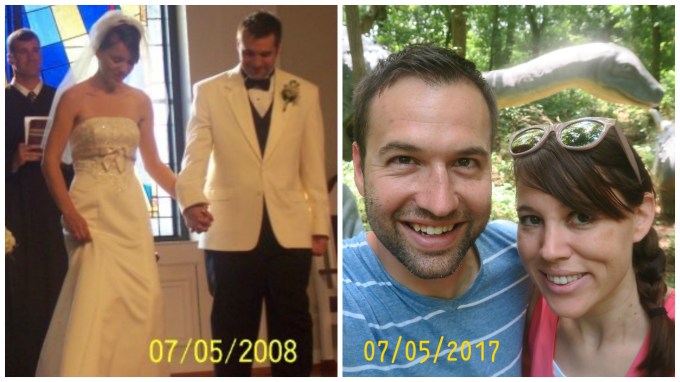
Travel back in time with me over a decade. On March 8, 2007, a month away from my 26th birthday, I walked into Kay Jewelers at the Cool Springs Mall in Franklin, Tennessee. A kind salesman, of Indian descent yet who spoke with an English accent, helped me find the perfect piece of jewelry.

I had only been dating this California girl for a month, but I felt compelled with all my being to spend $238 on a diamond bracelet as a gift to show her how serious I was about her.

It was simple: I knew she was the one. I knew that if she’d let me, I would promise the rest of my life to her.

This diamond bracelet would be followed by an engagement ring just 10 months later. But whereas the engagement ring (and wedding ring) would be taken off at times, like to wash the dishes and to get the rings cleaned, this special bracelet would ultimately never been taken off.

For the whole time we dated, then were engaged, then were newlyweds, then became parents the first time, then became parents the second time, then even saw our 2nd child turn a year-old and saw our 6 and a half year-old son prepare to graduate Kindergarten… my wife wore that diamond bracelet. For 10 years and 2 months.

And then, it snapped in two:

“Sad day—my heart bracelet broke after more than 10 years—I was playing with it on my wrist and then it snapped :(   My arm already feels naked.”

The very next day I journeyed back to the same Kay Jewelers and happened to immediately see the very same kind man from a decade before, as if time hadn’t even passed. He was impressed that I remembered him from a decade ago, but he was even more impressed how well the bracelet held up for over 10 years.

He began looking at the snapped bracelet through a special microscope, confused on why a silver bracelet had not turned at all after so long. Then he began typing on his computer, searching the records on my purchase from March 2007.

Then he explained, “I figured it out… This isn’t a silver bracelet… it’s white gold. The price for white gold has greatly increased in the past decade. There is no way you could purchase a bracelet like this, for what you paid for it back then. Just no way. This would go for at least $700 or $800 today. At least that much…”

What did I know about buying jewelry back in 2006, as a 25 year-old? Well, just that this classy diamond bracelet seemed to perfectly match the special girl I was buying it for. I definitely had no idea that the investment I was making back then would transcend beyond a symbol of my love for her- that the investment would also be financial, as well.

So two weeks ago, I paid the nice man at Kay Jewelers $42 to send off the bracelet to be repaired, and just a few days ago, I picked up the bracelet- good as new.

That bracelet, and what it symbolizes, holds so much personal value to both of us. I’m very glad to see it back on my wife’s wrist.

This is 36.

This is 36: The Face of a Dad Whose Family was All Asleep by 9 O’Clock Last Night

Bragging rights! Over here, everybody look at me…

Last night, my whole family was in bed and asleep by 9 o’clock. Seriously, are you not getting jealous reading this right now?

The dishes were done by 8:23 PM, by which time our son had fallen asleep. By that point, our daughter had been asleep for nearly an hour.

Forget Netflix. 

The parents just went straight to bed and instantly blacked out.

Glory!

No cries in the middle of the night from the baby. Since turning a year-old, our daughter has been doing a great job sleeping through the night without even waking up for a “shifting gears” cry around 10:50 PM; which is the time I am more likely to finally get to bed.

Perhaps her diet of more solid foods, and no more formula, is helping with that.

I say it’s a status symbol, as a parent at age 36, with a Kindergartner son and a 1 year-old daughter, to be able to fall asleep at 9 o’clock.

Contrast that to a year ago, when our daughter was too young for me to start applying my cruel and evil (yet extremely effective!) Cry It Out method.

Being able to sleep for over 8 hours, on a week night, is such a prize.

Because it’s not like my wife and I catch a break on the weekends. There’s no such thing as “sleeping in” for us. And once we’re up, we’re working all day long…

Between running errands, getting housework done, feeding the kids, entertaining the kids, and getting them to sleep for naps; plus feeding ourselves and cleaning the dishes… I would argue that we work at least equally as hard all day, as we do for our full-time jobs during the work week.

So yeah, it’s a pretty big deal for the whole family to be asleep by 9 o’clock on a Tuesday night.

This is 36.

“Does My Teenager Have Anxiety?” (Guest Post By Noah Smith with Wellness Voyager)

Photo By: Pixabay

It is normal for your teenager to feel a little apprehensive about making a speech in class or learning a new school schedule, but sometimes these feelings cross the line into an anxiety disorder. Put simply, anxiety is “the body’s reaction to stressful, dangerous, or unfamiliar situations.” However, for some children, the anxiety they feel is debilitating, and could affect their sleep, concentration, ability to talk to others, school performance, and enjoyment of activities. According to the National Institute of Mental Health, adolescent anxiety has a lifetime prevalence of 25.1 percent in children 13 to 18 years old. What’s worse, if it’s not properly addressed and treated in childhood, anxiety could lead to other mental health issues like depression or addiction down the road. It is important that you and your child are able to differentiate normal worries from anxiety.


Recognize the Signs

Anxiety disorders will vary from teenager to teenager, but symptoms typically include excessive fears and worries, a feeling of inner restlessness, and a tendency to be extremely wary and vigilant. Even if there is no reason for your child to feel anxious and they are in a safe, calm environment, they may still experience continued feelings of nervousness, stress, and restlessness. Anxiety can cause physical symptoms as well, such as muscle tension and cramps, stomachaches, headaches, trembling, hyperventilation, nausea, dizziness, shortness of breath, heart palpitations, and sweating.


Anxiety Has Types

Anxiety describes the body’s reaction to a particular situation, but anxiety can be broken down into six different types of anxiety disorders: generalized anxiety disorder (GAD), separation anxiety disorder, panic disorder, phobias, obsessive-compulsive disorder (OCD), and post-traumatic stress disorder (PTSD).

GAD is categorized by excessive worry about events or activities, with the feelings being present almost constantly and floating from one situation to the next, such as fear of poor school performance or worries about what others think of them. Separation anxiety is worry about being away from the child’s parents, with fears often situated around parents not returning as promised or fear that the parent will be harmed. Although this type of disorder is most common in young children, it may be experienced by adolescents in response to stressful life events such as a divorce or deployment. If your child experiences sudden and intense periods of anxiety that come on unexpectedly, they likely have panic disorder, and may experience intense symptoms such as trouble breathing or feeling boxed in.

Fears or anxieties that result from something specific such as bugs, heights, or public speaking are referred to as phobias, and won’t affect your child unless they are directly confronted with the fear. OCD is a condition involving recurrent thoughts, impulses, or images that are hard to control. Compulsions are the behaviors the child partakes in as a means of distressing, such as hand washing or redoing an action or activity over and over again. The last category of anxiety disorder, PTSD, is the re-experiencing of a traumatic event via recollections, dreams, or associations.


Ways to Help

If your child is willing to talk about his or her fears and anxieties, be sure to listen carefully and be respectful of the way your child is feeling. Try to help your child trace their anxiety to a specific situation, experience, or fear in order to help reduce the anxious feelings. Keep reminding them of times when they were initially anxious, such as when they attended their first overnight camp or took their first high school exam, and help them to recall how everything worked out and their anxious feelings subsided.

It is important to recognize that sometimes outside help will be necessary. If the anxiety and fears last over six months, the American Academy of Child and Adolescent Psychiatry (AACAP) recommends seeking professional advice via a doctor or teacher, who can then suggest an adolescent psychiatrist or other professional who specializes in the treatment of adolescent anxiety disorders. Continue encouraging your child to be open with you about their feelings, while simultaneously seeking treatment to help reduce the symptoms of anxiety and the effect it has on your child’s daily life.

Anxiety is a common phenomenon that most children experience at some point in their life, but be attentive to feelings and fears that become intense and affect your child detrimentally. Keep the lines of communication open with your child, and if you notice a change in your child’s behavior, talk with them about it or seek the help of a professional.


-This guest post was written by Noah Smith with Wellness Voyager