Some Picture Examples of the Weird Houses I Dream About

From “mirror mazes” to “crazy mansions”, it’s often the wacky building itself that is creepy with its peculiar layout, strange placement, and whatnot.

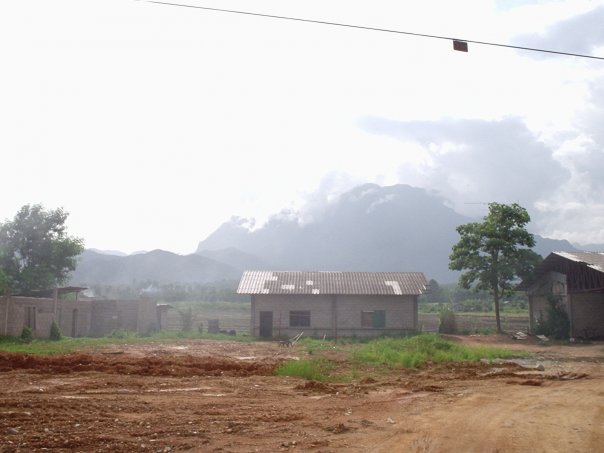
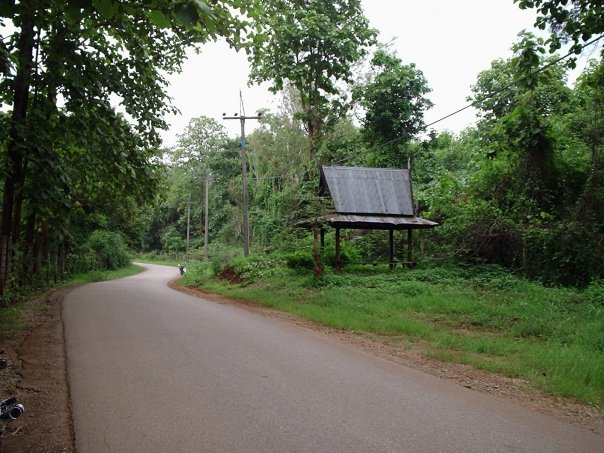
In between bad dreams and good dreams are the ones that are just plain weird.  And while all dreams we have are a least a little strange, some of them specifically can not be classified as negative or positive; for me, I’m specifically referring to the dreams where I’m at an odd location.  It could be a dream taking place in the Swiss Alps (I still remember a dream I had in the 10th grade where I was greeted by a mountain goat on the top of a mountain in Switzerland- it wasn’t significant in any way, but I will never forget the randomness of it) or a remote village in Thailand that I barely remember driving through on a motorcycle from back in 2004.

But I would have to say the most subtle weird dreams are where I am in an unusual house, where it is so odd it’s almost spooky.  Like when I dreamt that 250 townhouses in the development were all attached: The only way to get to mine in the middle of them all was to crawl through hundreds of other people’s living rooms and kitchens, because evidently there were no front and back doors on everyone’s townhouses anymore- just two hidden exit doors for the entire 250 connected homes.

When we think of “spook houses”, our minds often go to some cheesy place we pay $10 to visit around Halloween called Slaughter House! where ultimately a subpar Jason Voorhees, Freddy Krueger, and gorilla with a chainsaw (with no blade) jump out at us in the same quarter of a mile stretch.  To me, those obvious caricatures of villains are not scary, because they’re so predictable and anticipated.  Take away the men in costumes, the motorized mummies that pop out from the wall, and the eerie sounds effects streaming from an iPod somewhere.  What’s left is a building.  That, to me, is where the potential lies for spookiness.

And I’m not even taking this to the extreme of an old abandoned house that is rumored to have spirits and ghosts.  I simply mean that the place has a weird layout in which the exits are not obvious.  It’s the idea that I could be lost- and I guess for me, being lost in a strange place is still scary, despite the fact I’m no longer an 8 year-old boy.


If you’ve ever dined at a Buca di Beppo restaurant, you know exactly what I mean: all the kooky black-and-white photographs on the wall, the spumoni type colors of the interior of the walls, the random LP records glued to the ceiling featuring unheard of Italian singers from the 1950’s.  The place is a maze; the first couple of times I went to the restaurant, I got lost finding the restroom, but I had trouble finding the table where I was sitting.


Much less scary than the reality of demons dwelling in abandoned buildings or even the cheap thrills of popular Halloween spook houses, there will always be the kooky and creepy dreams where I’m in a weird house and I don’t know how I got there.  And as for Buca di Beppa- though their Italian food is good stuff, man, their restaurant buildings give me the heeby jeebies.

Being Exotic Can Actually Mean Looking Generically Foreign

“Since many white people look alike, they are desperate to find ways to have a distinctive look.” -Stuff White People Like, by Christian Lander

What is something that’s exotic?  To me it evidently always translated as “Hawaiian” or “Asian” or “tropical”.  But when I predictably spent two summers teaching English in Thailand in 2002 and 2003 as Christian Lander, author of Stuff White People Like, said I would (“This is when they venture to Thailand… Some do it to one-up the white people who only go to Europe,” and “White men love Asian women so much that they will go to extremes… like teaching English in Asia…”), I learned pretty quickly that over there, I was the magical, exotic one.

However, I was constantly confused with the few other “white people” in the province I worked in; more than several times being confused with a guy about three inches shorter than me who had blonde hair and blue eyes (and was Canadian).

So the irony is that while my “big nose that comes out of your face” (as some of my Thai students informed me of), “light colored hair” (which is actually dark brown), “white skin”, and “hairy body” (I guess I can’t argue about those last two) were different to the Thai people, I ultimately looked like every other white guy in the world.  Despite the exciting mysteriousness, being exotic also means looking generically foreign.

And despite the various shades of eye colors and hair colors that Caucasians can have, we are ultimately the minority skin color of the world.  On a global scale, “white people” are the minority; and to the majorities, we evidently all blend together, looking alike.

We most easily identify the physical differences of the people of our own race, whatever it is, since that’s the group of people we are most familiar with.  In the end, “exotic” becomes a pretty relative word.

http://stuffwhitepeoplelike.com/


Adventures in Thailand: Monk Footprints and Bed Bugs

Planes, Trains, and Automobiles.  The Thai version.

After recently revisiting some memories from the summer of 2004 in Thailand, I must have tapped in to some sort of parallel between my life now and my life at age 24, because there is some therapeutic and natural about replaying those stories out loud (or by typing them out and reading them).

It all started a few days ago when my friend and former  college roommate Josh Taylor sent me a text message asking what the best phone number to reach me was.  A few texts later, I was jogging his memory (and mine) with a reference to “monk footprints”…

During our week long vacation from teaching at Bangkok’s Global English School (all schools had a mandatory closing for a week due to the International AIDS Conference being held in Bangkok that year), Josh and I decided to take an excursion to Chiang Mai and Koh Samui by overnight train, motorcycle, and plain.

In our overnight train ride to Chiang Mai (Thailand’s 2nd largest city) up in the North, our seats converted into beds for the night.  Right across isle from us on the train was a middle-aged Buddhist monk, dressed in his drab orange robe, marked with animal tattoos all over his head (to fend off evil spirits).   Despite the loud bangs and rumbles off the tracks throughout the 12 hour ride, the monk’s constant religious chants were a bit distracting (and kinda creepy).

But when in Thailand, you learn just to go with it.

As nighttime approached, the train attendants came through the isles to transform our seats into beds.  The monk headed to the restroom.  When he returned, he used Josh’s bunk bed (which was on the bottom) as a stepping stone to get up on his top bunk.  He wore no shoes.  His bare feet, which were caked with dirt, left “monk footprints” on Josh’s white bed sheets.  Moist, mud-infused footprints.

Therefore, the phrase “monk footprints” will always be a legendary term between Josh and I.

When we arrived in Chiang Mai early the next morning, we rented “motorcycles” (a loose term in Thailand, as it basically often means a glorified moped) by paying $4 a day and handing over our American driver’s licenses as a security deposit (which does seem a bit risky; turns out, a few weeks later I spent two weeks in South Korea with my sister and my passport was stolen).  After a day of exploring (and getting a little lost) the city, getting curious about what the Chiang Dao Cave was as well as what the “live monkey shows” were all about.

Because the school in Bangkok we were teaching at is a Christian school, we were able to have it arranged that we could sleep in a church in Chiang Mai for free.  Can’t argue with a free shower and bed for a few nights.  Of course, the shower water was ice cold (which isn’t a horrible thing in a country with a climate similar to Miami).  And as for the sleeping arrangements: two plastic sleeping bags on a cold, slick cement floor on the second floor in a building with no air conditioning and a garage door as the main entrance.

The best part though, was the fact it was impossible to stay asleep for more than twenty minutes at a time.  Not because of the heat alone, but because of the tiny little biting ants from whom we evidently were invading their space.

And yet I count all of these as fond memories.  Backpacking through Thailand for me was a rite of passage.  An adventure that will always be part of me.  Maybe one day when I become a rich, successful author with a book on the New York Times Best Seller List, I can manage to find the money and time off to go back.

Until then, Thailand remains a magical, mysterious place that sometimes I think of as a dream world in a parallel universe that only exists in my mind.

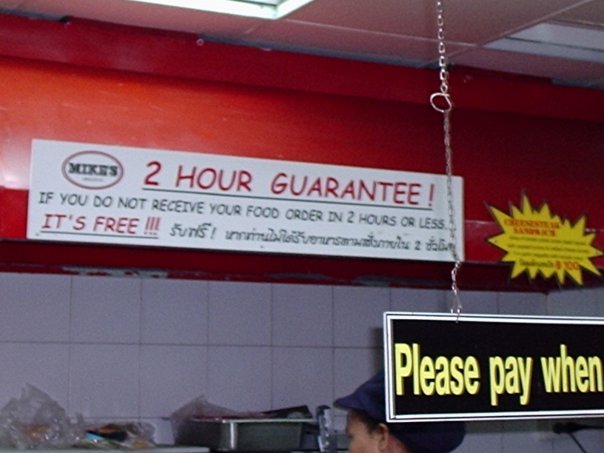
A billboard we saw at a bus stop there- a Thai clothing company switched the “A” and “E” of Abercrombie to make their “own brand” of clothing.

Josh having a random Thai meal on the train before his seat was converted into his bed.

Josh having a random Thai meal on the train before his seat was converted into his bed.

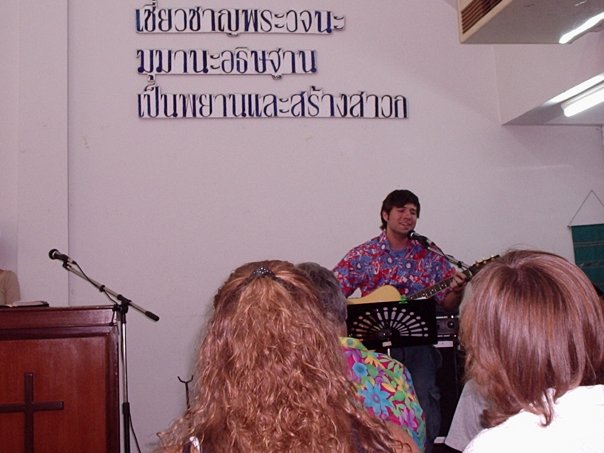
Me playing a song at the Thai church we camped out at.

Adventures in Thailand: Live Monkey Show

Everybody’s got something to hide, except me and my monkey.

After our curiosity was peaked from seeing several signs for “live monkey shows” while driving motorcycles through the mountain city of Chiang Mai, Thailand (during the summer of 2004), my college roommate Josh and I decided to drive further up the mountain to put ourselves in a vulnerable situation: to venture into whatever a live monkey show was, up in an isolated village where we were indeed the only “white people”  (or “farang”, as the Thai natives called us, which simply translates “foreigner”) for possibly hundreds of miles.

The anticipation rose in my mind like the dust on the unpaved road leading the site, having just turned at a hand-painted wooden sign with a picture of a monkey putting his hand in a jar with the words “LIVE MONKEY SHOW”.  I imagined a sort of a toned-down Floridian Sea World time of venue, with possibly even a hundred people in the audience with us, as was the case with the live elephant show we saw (where the elephants played soccer and painted pictures).

We cautiously marched up to the front window.  With the ticket girl basically speaking no English whatsoever, she called out the manager to help answer the question, “How much does this cost?”  We were expecting around $5 per person, based on the elephant show price we paid earlier.  Instead, he grunts to us, “Ten dollars per person”.  While that may not seem like a lot in America, that’s more like fifty dollars in the U.S.

I began walking away, only half-way caring about seeing the show, partly out of the mindset: “What are we getting ourselves into, anyway?”  Josh stayed behind as the Thai man was eager to negotiate a better price.  It worked.  We got in for $4 per person.

We hesitantly paid our dues and asked if we were late or early for the next show.  The man’s response: “On time.  Show begin soon.”  He smiled.  We walk in.

Cement bleachers.  Enough seating for about 5o people.  And there was only one other person sitting there with us in the audience.  A Thai guy.

We looked around for signs of activity.  About twenty feet in front of us (we were setting about halfway towards the back of the venue) was the flat cement “stage” and a Thai girl standing, happy to be there, looking at us.  By the time I had the chance to say to Josh, “So we must be pretty early, huh?”, the other audience member began walking up to the stage.

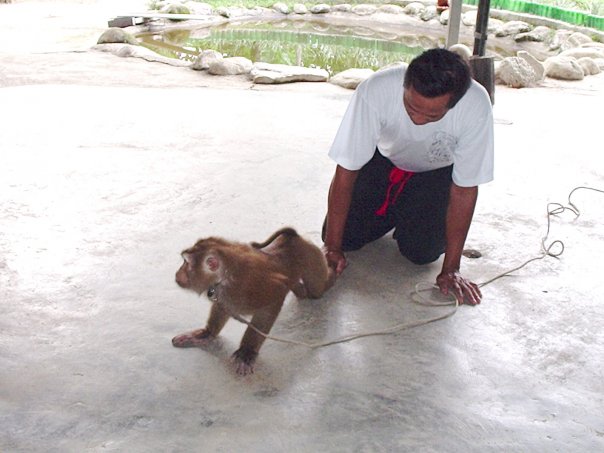
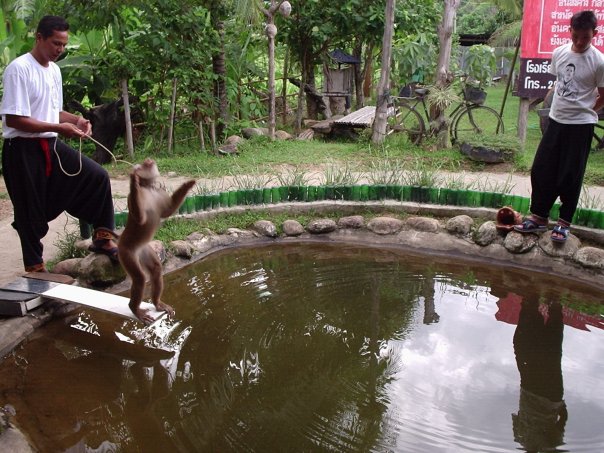
The Thai girl simply said, “Welcome… to live monkey show.”  Then the Thai guy who was just moments ago a fellow audience member, was indeed the show’s leader.  He brought out a monkey.  An impressively trained monkey, who did push-ups, sit-ups, could find the hidden key in one of five cups turned upside down and rearranged, and who dove off a small diving board into a miniature pool of water to find a coin, sometimes while blind-folded.

Of course, to make sure it would become a memory we would not forget, we both had the chance to become “volunteers” to help in the act.  It’s the only time I’ve ever had a monkey in my lap.  Fortunately, he didn’t bite me.

After forty-five minutes of live monkey antics, the show was over.  We knew this when the Thai girl walked back up to the stage and said, “Thank you” and did her Thai bow to us.  Then she walked back to the ticket booth, returning to her other job.

So that’s a Thai live monkey show.  The Thai guy who runs the place serves as an audience member and ring leader, and the Thai girl is the ticket booth operator and announcer.  And a trained monkey with a metal shackle on his foot is the star of the show.  And evidently, two white guys sitting in the bleachers constitutes as a full audience.

When does the live monkey show begin?

As soon as you show up.


Adventures in Thailand: Man Cave Time Machine

What’s the difference between 1) our memories of actually events and 2) our memories of old dreams?  In theory, not a lot.

The events that have taken place in real life can actually change the course of history and can produce tangible souvenirs such as photographs which can be taken to prove them in the future, whereas the events that occur in a dream do not really have the ability to do those things (though sometimes dreams do predict the future or inspire a person to “be a better person”).

Whether it’s a remembered actual event or a remembered dream, either way, it’s in the past now and it’s just a memory.

If we could take away the two exceptions, that actual events change the course of history and can produce tangible souvenirs whereas dreams don’t, how is a six year-old memory different than a six year-old dream?

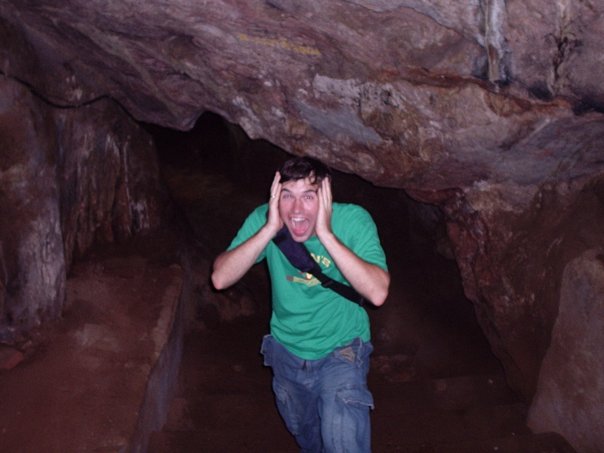
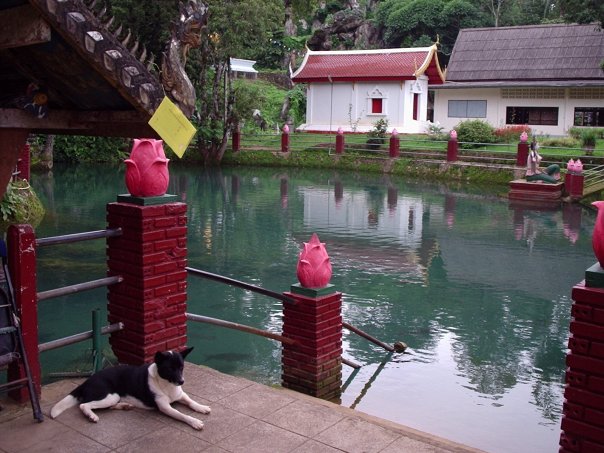
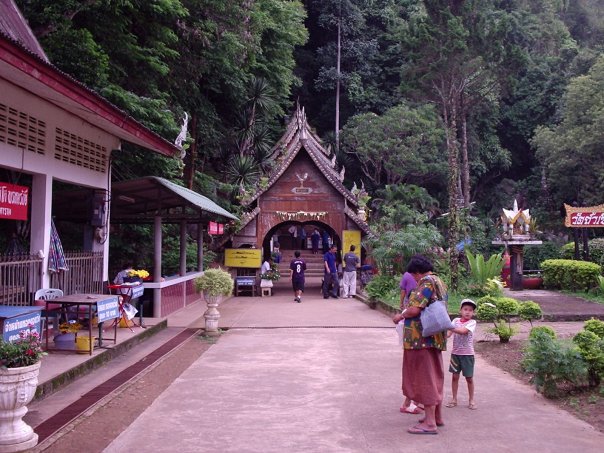
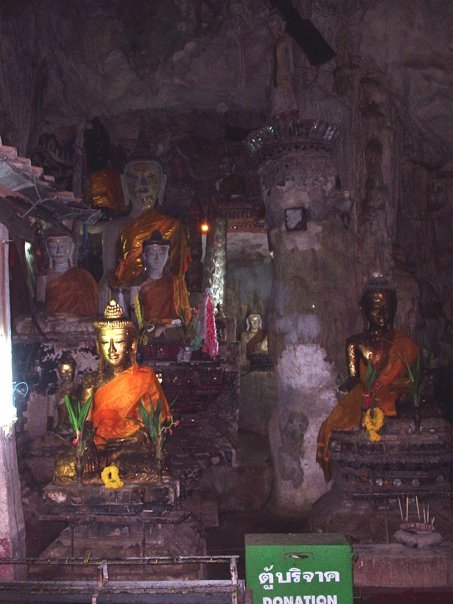
In the summer of 2004, my friend Josh and I rode “motorcycles” (they were more like mopeds) 40 miles outside of the mountain city of Chiang Mai in Thailand, in order to find an ancient cave where few tourists ever bothered to visit.  There were no signs in English once we got there.  No English-speaking guides.  All we knew it that it cost non-Thai people $4 to go into the cave and another dollar for a lantern to actually see around inside the place.

As we got to the back of the cave, our guide pointed behind him to what appeared to be a bottomless pit.  I picked up a rock on the cave floor and tossed it into the abyss and finally after about ten seconds, I faintly heard it hit the bottom.  I immediately imagined that centuries ago, prisoners were thrown down to the bottom only to be met by hungry lions.

There’s no doubt, Josh and I are some of the few American people to have visited the forsaken Chiang Dao Cave in Thailand.  Let’s assume that I don’t embed pictures of that event into this post and that nothing happened that day that changed the course of history (and it in deed, didn’t).

In theory, the events I told about in that Thai cave memory only actually happened because I said they did, a theory that I brought to life in Snail Trails.  Especially if Josh forgot about us going to that cave.  No souvenirs.  No life-changing actions.

So what if I only dreamed that event happened?  What if while I stayed in Chiang Mai I only drove by the signs for Chiang Dao Cave, but never took the time to visit it?  What if all I did was just dream that Josh and I actually went there?

How would that dream be any different than it really happening?

For another related post, here’s The Interstate to Memory Lane

my roommate Josh from Liberty University

the 2004 version of me either trapped in the actual Chiang Dao Cave or in a dream