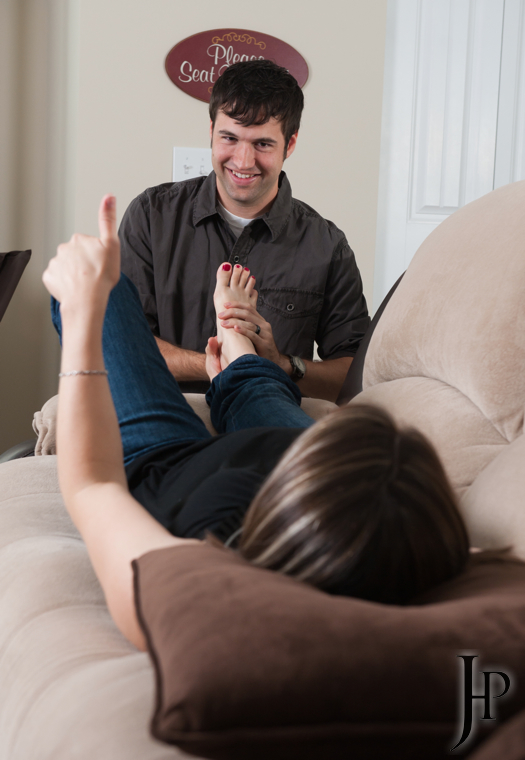
dad from day one: She’s Having a Baby

The word on the street is true.  And we couldn’t be any happier about it!

Three weeks ago my Mexican grandma (who has always been very religious-superstitious) called my sister, saying, “Do you have something to tell me?”

“No…”

“Are you sure?  You don’t have anything to tell me?”

“Nnnnno…”  (more hesitantly than the first time)

“I had a dream.  I had a dream where I saw your grandfather in Heaven and he was so happy.  He was pushing a baby stroller.”

In other words, my grandma assumed the wrong grandchild.  She also told my sister about another dream she had where she saw “the most beautiful little girl in a rocking chair”.  We’ll know in about eight more weeks whether or not that second dream is true.

Something I never realized about finding out you’re going to be a first time parent is that it has to stay a secret for a while.  Long enough to make sure it’s not a false alarm.  Long enough to confirm with a doctor.  Long enough to get a sonogram.

We’ve known for over a month now.  It’s a huge secret to keep from the entire world for that long.  What a relief!  Hey, we’re having a baby!

Expected arrival is on my dad’s 54th birthday:  November 11th.

Obviously I’ve got a lot more to say about it all and I will continue to encounter plenty more as time goes on.  Therefore, this is the first of many in my new series I call “dad from day one”.  While it seems pretty easy to find material out there for expectant moms, not so much for expectant dads.

Expectant dads don’t encounter physical changes, but they do experience psychological ones.  In this new series I will be journaling the whole process, from the time we found out we’re having a baby, until… well I can’t say until the baby is born because that’s only the beginning.  And speaking of the beginning, when is day one?

Was it the day of conception?  The day we found out?  Today, the day I’m publicly telling everyone I haven’t already told in person or on the phone?  I don’t know.  Day One is the beginning of this new person I am becoming.

In the likeness of a TV show I’ve never seen but heard good things about, How I Met Your Mother, another goal of “dad from day one” is to create an archive for this kid to come.  To show him or her what was going through my head during all this.

Eighteen years ago, I was given a blank journal by a classmate from school as a Christmas present.  Inspired by my favorite cartoon show at the time, Doug, I remember my first entry:

“Dear Journal, I will be writing everyday so that in the future when I have kids of my own one day…”
Then I stopped.  I embarrassed myself with the phrase “kids of my own one day” because it wasn’t the way I actually talked.  It just seemed too weird.  I threw the journal in the garbage.

Here I am 18 years later, seven months away from the big day.  About to have a “kid of my own”.  Let’s do this thing.

All pictures with the “JHP” logo were taken by Joe Hendricks Photography:

Blog- www.photojoeblog.com

Website- www.joehendricks.com

The Unholy Trinity of Food: Sugar, Fat, and Sodium Cause Obesity, Heart Disease, Cancer, Depression, Inactivity, and Hyperactivity

Sugar, fat, and sodium.  The three most rare food elements found in nature are the same three that have caused a national epidemic of obesity, heart disease, cancer, as well as allergies, depression, inactivity, and hyperactivity.

Given that these health problems have been steadily increasing since World War II, it only makes sense to return to the way people lived before the 1940’s.  In order to do that, we must take matters into our own hands and fight the Unholy Trinity, by simply avoiding this enemy as much as possible.  The members of the Unholy Trinity are none other than sugar, fat, and sodium.

Sugar:

Consider a time in history when food couldn’t be bought in boxes or bags.  A time when people cooked their own food based on ingredients they either grew themselves or traded at the local market.  Most likely, the people simply ate fruits, vegetables, whole grain bread, oats, and lastly, meat, as they could afford it.  And they drank water, wine, and beer.

Did they eat ice cream, cookies, and cakes?  Did they eat Nutrigrain cereal bars which are also loaded with sugar?  No.  While they could get their hands on sugar, which wasn’t necessarily easily obtainable, they mainly only cooked with sugar in very rare occasions.

Cavities were much rarer in those days.  A person’s intake of added sugar directly affects his or her ability to fight off cancer and disease.

Sugar is a drug that is so easy to get a hold of these days.  But it hasn’t always been that way.

Fat:

In order to eat foods high in fat, a person must have access to an animal that is either milked or killed for its meat.  We do, we just forget about how much trouble that is.  We just buy it from a store or restaurant.  Because we’re so far removed from livestock and farms, we don’t realize how easily we’re consuming animal products on a daily basis.

There is such an awareness of women’s breast cancer and finding a cure for it.  But my question is this:  For all the money we’ve already donated to research, what have we learned?  While it’s important to find a cure, what have we learned about prevention?  After all, it’s better to avoid getting breast cancer all together than to ever have to fight it.

Until there’s a cure, which I hope we find as soon as possible, there’s prevention.

The smartest thing to do is to look to the women who are not getting breast cancer:  Asian women living in Asian countries.  Specifically Japanese women. They are the least likely to get breast cancer.  Why?

Very low fat content in their diets. http://www.cancerproject.org/survival/cancer_facts/breast.php

Very high intake of chlorella, which is found in seaweed, which they eat regularly (namely in sushi). http://findarticles.com/p/articles/mi_m0NAH/is_1_29/ai_54062648/

Research over the decades has shown us that the #1 reason women get breast cancer is from a high fat content in their diet.  Unsurprisingly, American has the highest rate of breast cancer in the world.  Breast cancer is the 2nd most common cancer in America, and the 2nd most common cause of cancerous deaths.

Just in case we need more evidence of how to avoid breast cancer, when Japanese women move to America and adopt an American lifestyle and American diet, their immunity to breast cancer disappears.

So it’s a little ironic that from time to time M&M’s does a campaign where they donate a portion of the profit from their pink M&M’s to breast cancer research. The more M&M’s we buy (and eat), the more money that is spent to learn what we already know:  That the more fat in a diet a person has, the more likely a person is to get breast cancer.  And the more M&M’s a person eats, the more fat they are adding into their diet.

That actually makes me angry.

Sodium:

Let me ask myself a question:  In real life, how many times have I seen salt on its own in nature?  The answer:  Never.

Yet salt is everywhere and in everything.  Especially in appetizers at restaurants, frozen foods, canned soups, and all meat.

My boss got an app on his iPhone called My Fitness Pal.  It counts all his calories based on sugar, fat, and sodium to help him make sure he’s eating right.  He was eating perfectly.  Only lean, organic meats along with whole grains, fruits, and veggies.  Yet he kept going over his sodium.

I told him, “It’s from the meat.  Only eat meat in one of your three basic meals every day and see if that works.”

It did.  We eat too much meat.  And it’s giving us too much sodium, which leads to hardening of the arteries and heart disease.  But that’s a different post, and I haven’t finished it yet…

I have found that the best way to avoid fat and sodium is to avoid sugar.  Sugar is the easiest unholy member to get a hold of.  Because it’s even in wheat bread (unless it’s Ezekiel Bread).  To find food without added sugar, in most cases, means it’s a food with low fat and low sodium.  And a food without added sugar most likely means it’s not a processed food.

So ultimately, the bottom line is this: The best way to avoid the Unholy Trinity is to avoid processed foods– 1) anything that comes in a box or bag, 2) anything that has more than 6 ingredients (because more than that means those ingredients probably include either chemicals or one of the Unholy Trinity), and 3) anything that can last a long time in your pantry or fridge before it goes bad.

It’s a lot of trouble though.  To avoid sugar, fat, sodium, and processed foods.  To have to plan and prepare healthy meals ahead of time to avoid being tempted by convenience foods.

Is it worth it?  Is it worth the trouble to be healthy and avoid cancer and disease?

For a lot of people, it’s not.

healthnutshell: Ketchup Vs. Mustard

What’s so fancy about ketchup, anyway?  I have faith in mustard seeds.

My dad always said, “You are who your friends are or you soon will be.”  That is indeed the case with both ketchup and mustard.  Though they are as much as a pair as salt and pepper, they tend to attract different “friends”.  Bottom line: Ketchup is a bad influence, but mustard is a role model.

On occasion, I have no problem enjoying some good fries that I know actually came from whole potatoes from a reputable restaurant (meaning they don’t have a drive-thru there).  Same thing with a good juicy burger that is hand-pattied.  And when that happens, that means ketchup is involved.  Other than that, I don’t eat ketchup.

Because ketchup, in most cases, is paired with unhealthy foods that are either processed or fried.  For me, it’s sort of disgusting to think about what ketchup really is: tomato concentrate, vinegar, high fructose corn syrup, corn syrup, salt, “spice”, and onion powder.

Tomato concentrate is processed tomatoes.  Vinegar is okay.  High fructose corn syrup and corn syrup are both forms of processed sugar.  The rest of the ingredients are fine.

Ketchup is candy.  For a serving the size of one tablespoon, there are four grams of sugar.  But honestly, when I eat ketchup, I typically have a bit more than that.  For a typical serving of fries at a decent restaurant, it’s pretty easy to consume four tablespoons of ketchup with the fries alone.  That’s 12 grams of sugar, (one tablespoon of sugar) the equivalent to smoking one cigarette.

So my general rule of thumb is, I stay away from foods that are enhanced by ketchup.  Not only is ketchup really just candy sauce, but it attracts the wrong kinds of friends.  I don’t even keep ketchup in my fridge.

Mustard on the other hand is much more legit: Vinegar, water, mustard seeds, salt, turmeric, and paprika. None of those ingredients are processed.  In fact, there are actually health benefits of turmeric and paprika.

Turmeric– linked to possible benefits in arthritis, cancer, and Alzheimer’s, aids in digestion, is an anti-flammatory agent as well as an antibacterial agent

Paprika– rich in vitamin C (more than lemon juice) and high in antioxidants

Of course that doesn’t mean that I recommend eating a bottle of mustard a day in order to prevent diseases.  But compared side by side to ketchup, it’s pretty obvious that mustard is actually healthy to eat, whereas I can’t truly consider ketchup to be nutritious.

Mustard easily goes well with healthy foods.  People don’t put ketchup on a turkey sandwich on whole wheat bread.  That would be gross.  But mustard would be great.

Foods that go well with mustard- good.

Foods that go well with ketchup (or both ketchup and mustard)- watch out.

Choose this day whom you will follow, ketchup or mustard.

And one more thing… Now that you’ve read my take on ketchup, why not read my perspective on being a dad?  That’s right- parenting from a dad’s point of view.  I have been documenting my thoughts as a dad since the week we found out my wife was pregnant.  I formally invite you now to read my “dad blog” by clicking on the link below:

dad from day one

Operation: Mustache (A Social Experiment)

For three days, I had a mustache.  Life was different.

We as an American culture are quite familiar with movies where the protagonist disguises himself as something he’s not and is treated drastically different by society: 

In Tootsie (1982), a male actor in NYC pretends to be a Southern woman in order to get an acting gig on a soap opera.  In Soul Man (1986), a white guy pretends to be an African-American so he can get a college scholarship.  In Mrs. Doubtfire (1993), a San Francisco dad pretends to be an aged Scottish woman to spend more time with his kids after the divorce.  In I Now Pronounce You Chuck and Larry (2007), two straight firefighters pretend to be married homosexuals for the monetary benefits.

We recognize these situations as comedy.  After recently realizing on my own that men under the age of 40 (who are not cops) can not be taken seriously, I decided to prove my theory.  For 72 hours, I lived my life as a 28 year-old mustachioed man.  Here are the results.

At work, my male and female workers under 40 did nothing but crack jokes about my mustache and talked about what a creep I looked like: 

“I don’t think it’d be a good idea for you to go near a school with a bag of candy…”

 “Where’ s your Harley?”

 “When is your wife going to put her foot down about your mustache?”

“No offense, but you totally look like a pervert with that thing.”

 “Seriously, I can’t even look at you.  In fact, step away from me…  You’re kinda freaking me out!”

However, not surprisingly, the men in my office over 40 specifically and sincerely made a point to come up to me and tell me otherwise:

“Man, I like that mustache.  Looks good on you.”

 “How long did it take you to grow that?  I wish I could have one like that.”

Though I know nothing about babies, for some reason, they always like me.  Whenever I’m near a baby in public, I make funny faces at them and they always laugh.  But Tuesday night, I was standing in line at Blue Coast Burrito with my wife when I looked behind me and saw a mother holding a baby.  I did my usual thing.  The baby didn’t smile or laugh, instead, he looked confused.  His mother turned away from me. 

And lastly, at home, well, as my wife put it:  “I’m sorry, but I just can’t take you seriously with that thing.”  It really changed the dynamics.  She graciously let me do the mustache experiment, but was just as happy as I was to shave it off last night.

Based on my experiment, Operation: Mustache, a man under 40 can not be taken seriously.  I invite other qualified young men to participate in the same experiment, but I don’t recommend it.

Needless to say, I don’t plan to grow a mustache again until I’m at least 40.  Even then…

Read the prequel, Must Not Mustache  http://wp.me/pxqBU-D3

healthnutshell: What Exactly is a Doctor, Anyway?

Stupid question, but doctors should outlive their patients, right?

One of my favorite movies of all time is actually a documentary, Super Size Me.  As Morgan Spurlock goes on a 30 day fast food binge, he checks in with the three separate doctors to monitor his health.  But something I always thought about in the back of my mind when I saw one of the doctors in particular was “that doctor needs to go on a diet himself”.

Isn’t there something a bit off about that?  An unhealthy doctor?  A doctor who is in danger of a heart attack?  In my mind, a doctor is an expert on health.  Therefore, he should live out what he knows.

Consider a pastor of a church.  His career is over if he gets caught cheating on his wife (unlike certain celebrities who may lose their marriage over it, but not their careers…).  A pastor is held at a higher standard because of his profession.  Why aren’t doctors live by a higher standard as well?

Just like no one can take seriously a man under the age of 40 with a mustache, I can’t take seriously an unhealthy doctor.

I should find out what exactly a doctor is, according to Wikipedia:

A physician — also known as medical practitioner, doctor of medicine, medical doctor, or simply doctor — practices the ancient profession of medicine, which is concerned with maintaining or restoring human health through the study, diagnosis, and treatment of disease or injury.

What’s interesting in this definition is the lack of the word “prevention”.  So it’s a doctor’s job to maintain or restore human health, but not prevent a healthy person from becoming unhealthy.

According to the Wikipedia definition of a doctor and America’s general concept of them, doctors are there to help fix what is broken.  With medicine.

It’s no secret that doctors make money off of people sitting at home watching commercials targeted at unhealthy people who go to the doctor to buy the legal drugs they saw advertised.  I can remember a time, pre-1995, when I didn’t use to see commercials advertising for prescription drugs.  Doctors sell drugs, legally.  To people who, for the most part, were simply uneducated on how to live healthy in the first place.

If I break my nose, have strep throat, get a pregnant wife, or need to get “snipped”, I will go to the doctor.  If not, I do everything I can to avoid that place.  I definitely won’t go there to buy their new product.  I eat an apple a day, literally.

After suffering for years from a rare case of eczema, I did some research on Wikipedia to find out how to be relieved of the disease.  While no known medical cure exists, I followed the advice on Wikipedia and drastically changed my diet, and now, thank God, my skin cleared up on my hands.  Cost me no money and required no doctor’s visit.  Despite many people urging me to go for a visit.  I saved myself time and money.

Doctors are good.  They do their thing.  I do mine.  We already learned that a doctor’s job, according to Wikipedia, does not involve preventing the problem.  So I take it upon myself to do just that: prevent the problem.  So what do you call a person who does that?  I need a clever word for that.  Whatever it is, I am one.  And anyone can be one.

As if looming Diabetes and heart disease weren’t enough of a reason to live a life of prevention, consider a new study done on doctors in India, which is said to be true in America as well.  Their average lifespan is around 58 years old for doctors, while the general population lives to be closer to 70 yeas old:

“Stress, a sedentary lifestyle and lack of exercise were the main causes of death in these cases. [Doctors] tend to become obese and are under great stress… Most of them are hypertensive and diabetic. These conditions reduce their chances of living longer.”

Read the full article:

http://www.mumbaimirror.com/index.aspx?page=article&sectid=3&contentid=201002092010020901523931154144cbf


Typically, medical doctors have stressful jobs that keep them from spending much time with their families.  They don’t make time for exercise or plan healthy meals.  Doctors have easy access to antibiotics and other medical quick fixes.  And of course it’s not uncommon for a doctor to smoke.  Not that any of those traits are unique to just doctors; they actually all sound pretty familiar.

And that’s another reason why I choose to live like a nutritionist, not a doctor.  My role models?  Jillian Michaels, Bob Harper, and Dr. Huizenga (“Dr. H.” from The Biggest Loser.  Seventh Day Adventists.  Kosher diet abiding Jews.  My dad.

They are my doctors, with or without the M.D.