Which Role Do You Play in Your Family?

As I a guy who doesn’t know anything about cars or building stuff, or even computers, or how to really fix anything, or sports (golf included), or politics, or business (investments and stock market crap), there aren’t seemingly many important roles left for me as a man in a family.

Sure, I can tell you which actors from Saved by the Bell are Jewish and which songs were hits in 1983 and how tall Albert Einstein was and I can solve a Rubik’s Cube in less than five minutes every time, but how does that fill any kind of necessary void in family dynamics?

I am a walking Wikipedia with an unforgettable memory of life events, sometimes nearing borderline Asperger’s.  So by default, what is my role in my family of six?  And to see the full picture, what are the roles of each member of my family? (My parents, my sister, her husband, and my wife.)

Me: The storyteller, the writer, the historian, and the event planner.  What drives me are memories.  Good memories take place because of events.  So I enjoy planning the family’s activities.

I tend to be the one in the family that decides what we will do with our time when we’re all together.  And if I didn’t have an agenda for everyone to follow, it’s possible we would all just sit around and do nothing.  It’s possible we wouldn’t know where to go to eat, and end up settling for something mediocre like Outback or Chili’s.

But I take the responsibility on myself for the six of us to decide where those memories (including potential funny stories and inside jokes) will take place.  And because “life happens” around food and entertainment and going to new places, my niche is being the one to set the backdrop for those events.

My role doesn’t fall into any of the typical manly stereotypes; I am the Montgomery Moose, the Desmond Hume, the John Cusack, the Pat Sajak.  The host, the MC of the evening, the narrator, the journalist of past, present, and future.  I just can’t fix anything.

My wife: The organized one, the teacher, the nurturer, the listener.

My dad: The mechanic, the electrician, the carpenter.

My mom: The financial expert, the chef, the encourager, the conversationalist.

My sister: The interior decorator, the helper, the initiator.

Her husband: The computer whiz, the tech expert, the sports enthusiast. 

Not that anyone can limit the talents and capabilities of their own family members down to just a few roles.  Because family members are not just stereotypes or TV characters.  They’re family.

What brought all this to mind is by watching the wonderfully crafted sitcom/drama Parenthood.  I love the dynamics of the family and how they all interact.  It hit me that the members of my family all have specific roles like the characters on that show.  And also, it seems the entertainment world is oversaturated with superheroes.

I just wanted to know what my “superpowers” are.  Now I know.

(And in case you’re still curious, Screech and Jessie were played Jewish actors, on the show Saved by the Bell.)

Would you, the random or regular reader, be willing to share with me your role and your family members’ roles in your family by leaving a comment below?  This isn’t a clever marketing ploy to boost my numbers or make this post seem more interesting.  I am just truly interested in this topic and want to know what other random family roles are out there. 

Real Life Thoughts on Death and the Afterlife

 What if I was wrong this whole time?

At the times of my life where I have doubts about my faith, by default, a few things come to mind which always bring me back to security.  After all, it’s not so difficult to get distracted with thoughts like, “with all the different religions in the world, only one can be right…how do I know I picked the right one?”

I instantly remind myself that Christianity is the only religion where a person can not be a good enough of person on their own to earn eternal life: Aside from doing “good works” (helping those in need) a person has to become humble enough to rely on the grace of God to save them, through faith.

Both necessary elements of salvation (good works and God’s grace) are based in love.  Our love for all other people (which reflects our love for God) and God’s love for us.

If nothing else, the fact that Christianity is the only major religion in the world that requires love for it to work, that’s enough for me: We love God by loving other people; He loves us by showing us grace (undeserved blessings).

And while it may seem New Age, or like a medieval fairy tale, or even an idea as “out there” as something from the show LOST, I can’t deny that it’s impossible not to think about what happens when we die.  Especially when someone in real life, that I know personally, dies.

I don’t see how a person could go to a funeral and not seriously question what will happen when they themselves die.  It takes so much faith to say, “I belief when we die, we die” or “I’m a pretty good person, if there’s a heaven or an afterlife, I think I’ll make it”.  I don’t have enough faith to say that.

And since I have less faith, I instead believe in Christianity.  Because for me, it takes a lot of pressure off of me.  My good works aren’t the cause of my salvation; they’re the proof of it.  The rest, God’s has already taken care and is taking care of and will always take care of.

Worst case scenario: I’m wrong.  I live my entire life under the belief that a sinless Jewish man over 2,000 years ago somehow took on all the wrongdoings of every person in the world’s past and future by allowing Himself to die so that He could live with them in eternity, then came back to life to tell us to let everyone know that He loves them and that we should love others through our actions.

So I spend time studying an ancient holy book written by a bunch of (mainly) Jews, memorizing the highlights of it that stick out the most to me.  And instead of by instinct worrying about things I can’t control (like trying to sell my house), I pray about them in the best faith I have, knowing that God will be glorified through it.

And by doing my best to follow the teachings of that ancient book, I end up staying out of trouble, for the most part.  I eventually die and at my funeral people say that I was a good person and that I loved the Lord.

But in this worst case scenario, let’s say I was wrong about it all.  Let’s say that this life really is all there is- so I die and that’s it.  I have no consciousness or memory; I exist no more.  Like I was never born.

That worst case scenario is a risk I’m willing to take.

But aside from me thinking that Christianity is the best fit for me compared to other religions, aside from the fact that death itself makes me think about what happens when I die, there is the fact that life itself points me to a Creator.

And if there is a Creator who took the creative thought and the time to invent the universe and the people in it, there I want to know who He is.  And if I know who He is, I want Him to like me.  And if I want Him to like me, I’m gonna find a way to do it.

So I did.  And ultimately, all those “God-given” thoughts led me to becoming a Christian.

Christianity in a nut shell:

Ephesians 2:8-9: “For by grace you have been saved through faith, not that of yourselves, it is the gift of God; not as a result of works, that no one may boast. (Shows the importance of being humble enough through faith to accept God’s love for us through the sacrifice of Jesus.)

 Ephesians 2:10 “For we are His workmanship, created in Christ Jesus for good works, which God prepared beforehand so that we would walk in them.”  (Shows the importance of our love for other people through our good works, which mirrors God’s love for us and is proof that we love God.)

LOST Recap: Finale- “The End”

I loved it.  Absolutely.  And I believe it was the best, and really, only way, to end the show.  But it just took me 24 hours after watching to understand why.

The entire show was just about Jack Shephard.  Everything else, including the island and its ability to heal people and time travel, the Smoke Monster, the Dharma Initiative, the Others, Jack’s friends, Jack’s enemies, the light in the cave… All of it were the parts of Jack’s life that ultimately mattered to his existence.

In the likeness of the movie Vanilla Sky, when you’re dead, it’s all over- so why focus on the character’s earthly life after they die?  But the writers of LOST took that concept to a new level by acknowledging that all the mysteries, actions, heartaches, and triumphs all boil down to one thing- the people that were involved in your life.

Even Vincent the dog’s best purpose on the island was to comfort Jack as he died.

I definitely plan to write much more in the near future answering the remaining questions about LOST: Why was The Man in Black never given a name?  Who was the first protector of the island?  Did it really matter that Desmond and/or Locke typed the code every 108 minutes?  What was really accomplished by Juliet sacrificing her life by detonating the bomb in 1977?

But as for today, I think it’s more important to focus exactly what happened in the finale.  The most begging question is what’s up with the flash-sideways?

The first time we saw the characters of LOST in the finale season, they were on the plane.  Note there were never flash-forwards or flash-backs during the flash-sideways, indicating no past or future in that timeline.  They weren’t reincarnated, having to live their lives all over again, in this version with the island being sunk.  The alt-reality was simply an “acknowledge your dead and that your life mattered” precursor to the afterlife, often referred to as “purgatory” or “the waiting room”; it started with the plane ride.

Keeping in mind that life on the island (and “the real world”) continued after Jack died, that Hurley and Ben served as the island’s protectors for the rest of their lives, that Claire, Kate, Sawyer, Richard, Miles, and Frank all left the island and lived normal lives back in the United States or wherever they chose to re-establish their lives… they all still died at some point.  Most of them of old age, living to be in their 70’s.

And once they died, before going to Heaven, they were reunited, having the blessing remembering how they mattered to each other.  And since time, in essence, doesn’t exist in the afterlife, they all met at the same time, since it didn’t matter that Jack died 40 years before most of them did.

But because Jack was the main character of the show, the show stopped with his earthly death.  The rest of the living characters lived their rest of their lives and eventually died, the show just didn’t continue to follow their earthly lives.

So when Jack died in 2007 (three years after originally crashing on the island), and (say, for example) that Kate died in 2051, they met at the same time in “the waiting room”.  (Because time doesn’t exist after earthly life ends.)  Then they went on to Heaven with the rest in the church.  (And Ben went once he was ready.)

The writers were clever to utilize a nearly universal belief that there is some sort of life after death.  The episode was quite saturated in Christianity (which was a smart idea since most of America identifies with some version of it), yet didn’t write off other popular international religious beliefs, thanks to the “major six religions of the world” stained glass window in the church.  The point wasn’t to depict any religion’s specific teaching on the afterlife as specifically accurate, but to instead play and expound on our perceived general ideas on life after death and the importance of the people in our lifetime after we die.

I don’t see how LOST could have ended any other way.  Yes, technically “all our questions” were not answered.  But it involves using our imaginations and clues from the show to fill in the blanks, as we as Losties have been doing the whole time.  It will bring me much joy to take matters into my own hands by filling in these blanks with many more LOST posts to come.

Comments welcome.

(They will most likely be spun off into a new post if they are interesting, insightful, or raise a good question; or instantly deleted if they are full of nerd spite: “NO!  You’re wrong!  What really happened was…  Looks like you never thought of that while trying to make your weak point, did you?…”).

http://today.msnbc.msn.com/id/37320802/ns/today-entertainment/

Adventures in Thailand: Man Cave Time Machine

What’s the difference between 1) our memories of actually events and 2) our memories of old dreams?  In theory, not a lot.

The events that have taken place in real life can actually change the course of history and can produce tangible souvenirs such as photographs which can be taken to prove them in the future, whereas the events that occur in a dream do not really have the ability to do those things (though sometimes dreams do predict the future or inspire a person to “be a better person”).

Whether it’s a remembered actual event or a remembered dream, either way, it’s in the past now and it’s just a memory.

If we could take away the two exceptions, that actual events change the course of history and can produce tangible souvenirs whereas dreams don’t, how is a six year-old memory different than a six year-old dream?

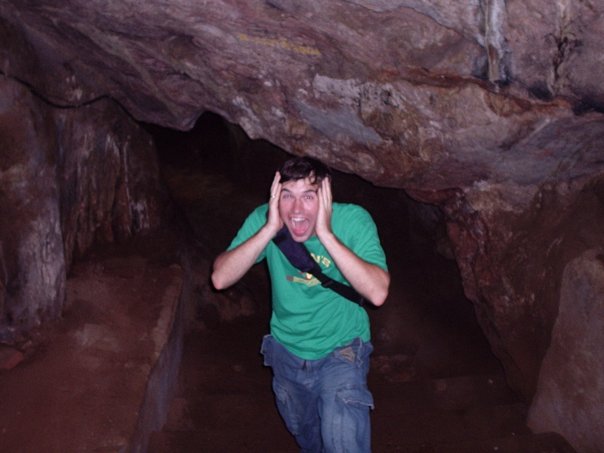
In the summer of 2004, my friend Josh and I rode “motorcycles” (they were more like mopeds) 40 miles outside of the mountain city of Chiang Mai in Thailand, in order to find an ancient cave where few tourists ever bothered to visit.  There were no signs in English once we got there.  No English-speaking guides.  All we knew it that it cost non-Thai people $4 to go into the cave and another dollar for a lantern to actually see around inside the place.

As we got to the back of the cave, our guide pointed behind him to what appeared to be a bottomless pit.  I picked up a rock on the cave floor and tossed it into the abyss and finally after about ten seconds, I faintly heard it hit the bottom.  I immediately imagined that centuries ago, prisoners were thrown down to the bottom only to be met by hungry lions.

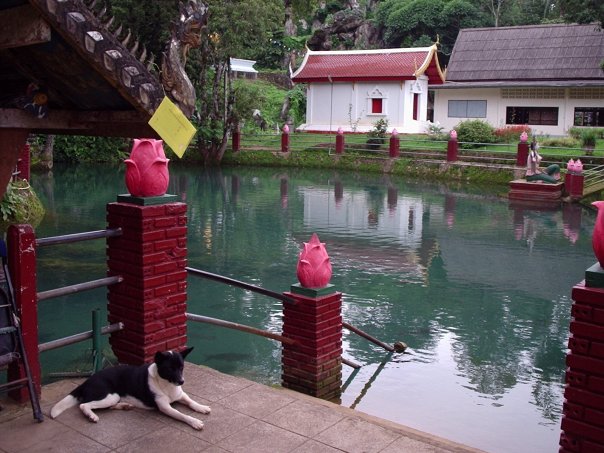
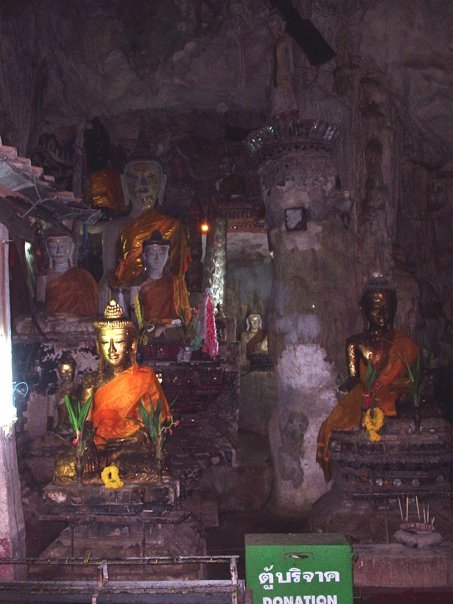
There’s no doubt, Josh and I are some of the few American people to have visited the forsaken Chiang Dao Cave in Thailand.  Let’s assume that I don’t embed pictures of that event into this post and that nothing happened that day that changed the course of history (and it in deed, didn’t).

In theory, the events I told about in that Thai cave memory only actually happened because I said they did, a theory that I brought to life in Snail Trails.  Especially if Josh forgot about us going to that cave.  No souvenirs.  No life-changing actions.

So what if I only dreamed that event happened?  What if while I stayed in Chiang Mai I only drove by the signs for Chiang Dao Cave, but never took the time to visit it?  What if all I did was just dream that Josh and I actually went there?

How would that dream be any different than it really happening?

For another related post, here’s The Interstate to Memory Lane

my roommate Josh from Liberty University

the 2004 version of me either trapped in the actual Chiang Dao Cave or in a dream

Russian Roulette with a Made in China Cap Gun

I’ve heard the phrase “we’re not promised tomorrow” enough throughout my lifetime that it’s become a cliché. And what else can I really do to truly “live my life” and “make the most of it”? My issue is that I’m too aware of how short and precious life is.

During the summer of 1998, right before my senior year of high school, I spent a few weeks at a music camp in which us kids stayed overnight in the dorms of the college at Snead State in Gadsden, AL. I wasn’t the kind of kid who looked for trouble when not supervised. So instead of sneaking out at night, one of the things us teenage boys did in that dorm was play Russian Roulette, with a toy cap gun that was made in China.

Because, what else would we do?

In other words, the seven of us staying in that hall gathered in one room around a toy gun that we loaded with its accompanying ammunition, the equivalent of Snap and Pops. It had a barrel just like a real gun and we would only place one “bullet” in at a time. Meaning that there was only a one-in-six chance that the toy gun would make a big “POP!” when the trigger was pulled.

We all took a turn, passing the toy gun to the next guy after we pressed it to our own temple and pulled the trigger. If it was just a “blank”, we stayed in the game. If it went off, we were out.

It was a very entertaining game. Actually addicting.

But at the same time, it made us nervous. Our hearts would speed up in the anticipation. All over a popping sound from a toy gun bought at a gas station.

Just a dumb game we played that summer. But for me, it brought some reality to the fact of how true that analogy is in every day life. I do everything possible to eat and drink healthy, to exercise regularly, and to reduce stress. Preventing disease and cancer is a lifestyle to me.

Yet, as people who smoke cigarettes and who regularly eat fast food and who don’t make an effort to exercise daily all tell me, “we all gotta go sometime”.

There are still car accidents. There are still those random deaths like an unexpected brain aneurisms, and I don’t even know that that is.

I am completely over-aware that every morning I wake up, it’s a game of Russian roulette. Maybe not a one-in-six chance of life ending. Maybe more like one-in-a-half-a-million.

But to me, I’m only alive another day because God let it happen. So really, it’s not a matter of any chances. Not one-in-an-anything.

And that truth is one of the most sobering, frightful, and yet grace-filled thoughts I can think of.