I Love You So Much That It Hurts

I can’t speak for most men, but there are certain emotions I really only feel thanks to my relationship with my wife and my kids.

Time is constantly passing and the future is never guaranteed. There’s both joy and sadness in watching my kids grow up a little bit more each day. There’s both joy and sadness in knowing I love my wife to the point I made a pact to grow old together with her, yet one of us is undeniably going to outlive the other.

Life is a gift and time is all we have. I love my wife and my kids so much that it hurts.

But… aside from these thoughts, my brain is not wired to think outside of a certain operating system.

Something I have learned this year after jokingly making my New Year’s Resolution to “be more vulnerable and connected to my emotions”, is that as a man, I mainly only operate using a few select emotions:

Joy, passion, creativity, assertiveness, and “chill”.

Accordingly, my subconscious directs me away from expressing or even feeling any of the vulnerable emotions like shame, fear and anxiety. Otherwise, I would take it as a personal attack that I am “associating myself with weakness”.

This year I had to come to terms with the fact that my personality is much more intense than most people’s. But after enough family members, friends, and coworkers all were describing me the same way, I began to accept that the way I operate is not necessarily the norm.

It has only been the past couple of months I have allowed myself to be “vulnerable” enough to embrace that I am the Challenger; known as Enneagram 8.

Or in Myers-Briggs, an ESTP.

Yes, I’m friendly. But I’m not a “nice guy”.

Yes, I’m a very social person. But I have strong personal boundaries.

No, I do not want to carpool with you. I want to leave when I want to leave.

No, we’re not going to split the check. I’m going to tell the waiter up front that these are on separate checks.

And while I do care to a certain extent that people like me, I am acutely aware that if everyone likes me, it’s probably a sign that I am doing something wrong- because I live by the fact that “you can’t make everyone happy”.

That’s what it’s like inside my head. Therefore, I am naturally surrounded by people who depend on me to be that strong personality for them.

To be clear, I don’t necessarily want to be in charge. Officially, I never hold that title. Instead, people often treat me like I am… so, I am.

Basically, I’m the official “no” guy. When others need a decision to be made, I’m the one who makes it okay to say no. I’ll make the call for them if they need me to.

In my experience, the person who says no typically is the person with the power. And if that’s me, I’m okay with it.

I now understand that I am fundamentally driven by the desire to have a sense of power and control- in other words, to never put myself in a vulnerable situation. To be “untouchable” and above reproach.

So while I myself may not have the capacity to easily access and feel certain emotions on my own, I am tethered to people I love who are able to show me what those emotions look like.

I am able to feel these vulnerable emotions, perhaps vicariously. In a way, my love for my wife and my children help me to experience life from more of a full “human” perspective.

Talking is Hard

Talking is hard.

And I feel like the rules are changing everyday.

I thought it was a good thing to compliment a person if it appears they have lost weight. But I have learned that may be implying the person didn’t already look good before. Or maybe they have a medical condition that is causing them to lose weight but their overall health is being negatively effected.

As for acknowledging a woman who appears to be pregnant? Nope. That baby has to be in her arms before I will even retroactively acknowledge she was ever pregnant.

I’ve learned to never assume two people are already married just because they have a kid together, or that they plan to get married just because they have been together a long time, or that they are still married just because they were married the last time I saw them a few years ago.

The thing is… I don’t care. I have no desire to pass judgment on anyone. I’m just trying to show that I am a caring and curious human being who is making an effort to connect with and validate another human being’s sense of reality.

Talking is hard.

I lived in Nashville for nearly 20 years. There was only one time when someone I knew passed away and I went to their funeral.

However, since moving back to my hometown here in Alabama last May, there has hardly been a month when I haven’t been at the funeral home for a visitation: Growing up in a town of 14,000 people, I pretty much indirectly know everyone. I want to show up for the people in my life who are going through the grieving process.

But I make a point to not really say anything at the visitation. I just hug the person who lost a loved one. The way I see it, there’s nothing I really can say that is going to make the situation better, other than making the effort to show up for them in that moment.

I hear other people give them classic funeral lines like, “Just imagine, they’re dancing on streets of gold with Jesus right now!” or “If you need anything, you just let me know.”

That’s totally fine that they say that. It’s just that as for me, I feel much more comfortable with a “less is more” approach in general, when trying to figure out what to say.

What I am learning as a default template is this: Let the other person talk, then ask a general question based on the specific information they give me.

From there, like a clever detective, I can determine the safest follow-up questions to ask, while still showing genuine interest in their life.

If they choose to share with me that they lost 30 pounds, I will immediately congratulate them on the discipline it took them to reach that amazing accomplishment.

If they choose to tell me they and their spouse are trying, yet struggling, to have a child, I will sincerely match the emotion of sadness, mixed with hope, that they are feeling.

I get it now: I know not to dismiss whatever emotion the person is experiencing; but instead, to embrace and validate it.

Like it says in the Bible, “Rejoice with those who rejoice; weep with those who weep.”

Perhaps for people with a personality like mine, it’s naturally easy to “choose joy”. But it’s not necessarily “positive vibes” that the other person needs that day. Maybe they need me to grieve with them in that moment or to acknowledge that it makes sense they would feel angry and confused.

We just want to help people feel better. And sometimes we can.

But sometimes what they need most is for us to symbolically hold up a mirror to the emotion they are feeling as to say, “Yes, you do feel this way right now. You need to experience this emotion to cope. I am here as a witness to what you are going through. I am a human being too, so based on my own personal life experiences, I can relate to you on some level in regards to this emotional state you are in.”

Ultimately, we are all on a journey of emotional intelligence and self-awareness. At some point, we have all been on the receiving end of a well-meaning person saying the wrong thing. And yes, we ourselves have also been the well-meaning person who told someone else the wrong thing.

Talking is hard.

I make an assumption that the other person is doing the best they can. Maybe their compliment of “you look great for your age” is just where they are in their limited understanding of how a successful compliment actually works.

It’s okay. We’re all trying.

For all I know, the way I attempted to tackle this challenging, complicated and confusing topic today was actually “too much”… or tone deaf… or politically incorrect.

That’s okay. Just like you, I’m figuring this all out as I go along, too.


I Jokingly Made a New Year’s Resolution… Turns Out, the Joke’s On Me!

When it comes to New Year’s Resolutions, my initial thought is always, “If I knew there was something I needed to change about my habits or behavior, I wouldn’t wait until the New Year. I would make the change immediately!”

Yet still, I figured for 2025, I could at least have an answer ready to contribute and seem like a normal human being. One of the suggestions I have continued reading and hearing is that, as a man, I need to “be more vulnerable and more in touch with my emotions”. So I figured that by default, that would become my (joke of a) New Year’s Resolution.

The thing is, aren’t I fairly “vulnerable” as it is? I’ve been documenting my life here on my blog since 2009. I feel that I do a decent job of sharing the highlights as well as the struggles I have overcome throughout each phase in my life.

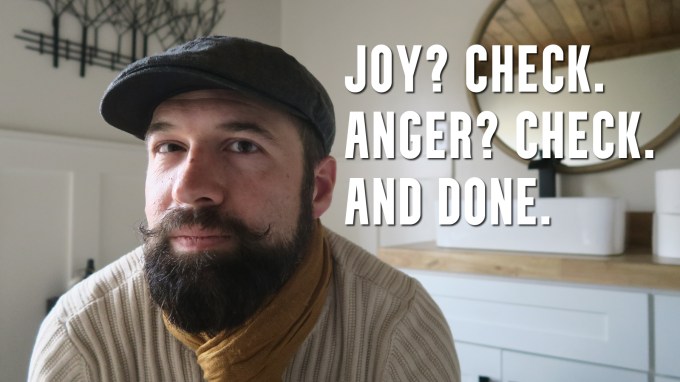
But the part about getting in touch with my emotions… well, it immediately became confusing to me. Only two emotions came to mind, regarding what I actually feel on a daily or weekly basis: Joy and anger.

Those two have seemingly gotten me through my adult life just fine… right? I’m just being “emotional efficient”… right?

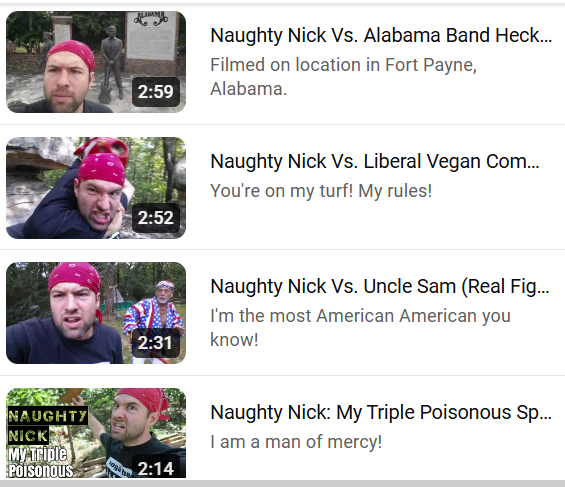
Even going back a decade on my YouTube channel, I see that even the silly fictional characters I created for myself were running on nothing but joy and anger:

“Green Meanie”, the antagonist from my Jack-Man superhero series; and “Naughty Nick”, who regularly found himself initiating street fights with strangers.

I had to do a Google search: “What are the emotions?”

The only other ones that I connected with were passion and creativity, which I found on the most amazing emotions chart I have ever seen, on Abby Vanmuijen’s website.

She has a category called “Genius” that I immediately respected; which interestingly enough, is found sandwiched between the categories of “Joy” and “Anger”.

I felt a sense of accomplishment. It was confirmed that I most certainly am driven on a daily basis by the emotional categories of joy and anger; as well as genius; specifically, being passionate and creative.

But that only accounted for half of the emotions wheel. As I read through all the emotions on the other half, I instinctively felt rage inside of me; as if I was about to physically fight someone.

I was undeniably triggered by simply the sight of the very words found in the categories of sadness, fear, and disgust. My subconscious clearly felt “attacked” by even just the thought of ever attempting to connect with these ideas:

Overwhelmed, anxious, heartbroken, lonely, jealous, self-conscious- and yes, vulnerable.

Here is apparently the discovery: I refuse to associate with any word I deem as “weak”. I have formed my identity around being strong and capable; not just physically, but mentally- and therefore, emotionally.

This is how I am intrinsically wired; even if it’s not a sustainable functional model for most human beings on the planet. Imagine having no sense of smell. Well, that’s sort of like how it is for me; except basically I have no conscious access to the vulnerable emotions in the categories of sadness, fear, and disgust.

Recently, I proclaimed that I win the award for the “Least Emotional” person in my house. Based on my discovery about only “allowing” half of the existing emotions, that seems like a fair assessment.

It is my observation that for other men who are like me, having extremely limited access to the vulnerable emotions, they choose to seek access to experiencing sadness, fear, and disgust by watching sports; specifically when their team isn’t doing well. This escalates around the time of the Super Bowl and March Madness.

Just today on the radio at the gym, I heard the classic Hootie & the Blowfish song, “Only Wanna Be with You,”… as Darius Rucker proclaims, “I’m such a baby ’cause the Dolphins make me cry.”

As for me, I’ve openly never been a sports guy. However, I recently realized that a major motivation to regularly write new songs is because it reveals what emotions I am experiencing on a hidden level.

For example, the opening line of the first song I have recorded this year for my YouTube channel is this: “Feels like a former life I still have memories from, but I’m not done – Where did everyone go? Divinely disconnected, I can’t be the only one, missing out on something – Where did everyone go?”

This is the emotion of sadness. The very first phrase of the very first song I shared with the world this year so far… began with the phrase “feels like”. I wrote that song last summer when I left Tennessee and rebooted my life here in Alabama. Apparently, during that time, I was experiencing some sadness but didn’t realize it.

But beyond the songs I write, I pretty much never even hint at being sad or fearful or any emotion I feel would link me to identifying with “weakness” in my end.

So that is my synopsis. Am I on to something here?

What I don’t know yet is if as a man, I am a bit of an extreme exception…

Or if indeed most men avoid the emotional categories of disgust, fear, and sadness in an effort to maintain a mindset and reputation of being strong and in control… while most women need to have access to all of the emotions in order to feel human?

I mean, after God created Adam, He immediately acknowledged, “It is not good that the man should be alone; I will make him a helper fit for him.”

Perhaps one of the ways women help men is by giving them access, even if indirectly, to a much wider array of emotions to balance out the men’s tendency to depend so heavily on logic.

So yeah… there’s some supreme irony in regards to my joke of a New Year’s Resolution about becoming more vulnerable and more in touch with my emotions.

The joke was on me: As I successfully began achieving my goal, I discovered something sobering, confusing, and relieving:

I have lived my entire life trying to “just be myself”, while never truly understanding the actual “self” buried deep in layers of attempts to be anyone except my actual self. Until this year.

To be continued…click here to read the other half.


Dr. Joshua Straub Actually Agrees with My Theory That You Get to Decide Whether Others Control Your Emotions?

One of the most fundamentally important parts of my identity is a theory that I discovered on my own, a few years back: That I alone get to decide and determine whether or not other people have the ability to offend me, insult me, or hurt my feelings.

I even tested my theory out with a blog post and video where I invited the free world to say anything they wanted to me in attempt to negatively emotionally affect me. You can imagine the results:

No one was successful in offending, insulting, or hurting me with anything they said.

Why not?

Because I had already made it my mission to stop allowing other people to “hurt my feelings”. I realized that no one could make me feel insecure or inferior unless I gave them the green light for it.

So whether it was someone flipping me off on the Interstate as they perceived I cut them off, or a co-worker implying that I was not doing my job right, or even a member of my own family that I perceived brushed me off when I was telling them a story that was important to me.

I realized, I am the one in control of the lever that determines whether or not I get offended. It’s an on/off switch that most people never take advantage of.

Most people, I have learned, refuse to take ownership over their own emotions; when it comes to other people. By default, they allow the entire free world to potentially offend, insult, or hurt them at any given moment.

I challenge that concept. I choose to be victorious over my own emotions, not a victim by default.

It’s a journey, for sure. I admit it. The easiest place to start though, is with people who you don’t actually personally know, but who still have the power to offend you; like other drivers on the road or people who disagree with you on social media.

I would have to imagine that if we’re honest, we can realize how foolish it is to let someone like that ruin our day. That’s where I started.

From there, I practiced my theory of “not giving other people control over my own emotions” to co-workers. And then to my own family.

Granted, trying to keep your own spouse from offending you is probably the most challenging, as it’s important you don’t build an emotional wall which keeps them from emotionally connecting to you.

Still though, I can say from personal experience, the less I allowed my wife to “hurt my feelings”, the stronger our marriage has become.

I control my own emotions, meaning that other people don’t get to decide that for me.

See, most people live with Identity Protective Cognition, believing this:

“But I’m a good person!”

So when one another person says something that could be perceived as an attack on their identity as a “good person”, that “good person” is therefore being attacked.

The irony here is that most people think the same thing about themselves: “But I’m a good person!”

Then the paradox of a result is we have a world filled with “good people” who constantly offend each other anyway.

I made a conscious decision to unplug from that broken system.

Instead, I don’t see myself as a “good person.” I recognize that term as an illusion.

(Here’s a recent video I made about this just a few days ago, below.)

I see myself as an imperfect person who is constantly in need of improvement. I know what my strengths are, yet I know that even my strengths can be improved. I am also aware of my weaknesses, and I am quick to agree with anyone who points them out.

Without a doubt, one of the best decisions I have made in my entire life is to stop letting people offend me. However, I’ve also learned that most people would prefer to live with their victim mentality mindset which allows them to be potentially offended at any moment.

It’s just like when people learn that I’m a vegan. Most people immediately respond with, “Oh, I could never do that!” I get the same response with most people when I explain my theory about not letting other people control your emotions.

This morning, I decided to test out my theory on Dr. Joshua Straub, who has a doctorate in Counseling. He is a professional who helps people on his parenting blog and on his YouTube channel. By the way, he and his wife have a huge following on Facebook! (Whereas I have nearly 1,100 followers on my Facebook fan page, they have nearly 18,000 followers!)

To my amazement, he actually agreed with the validity of my theory. You can see the surprise on my face in the video (featured at the very top of this blog post) we recorded together today.

I feel like I’m not the kind of person who constantly needs confirmation from society, like the way Michael Scott infamously always did on The Office. So usually, I honestly don’t care if anyone else agrees or disagrees with my perspective. I am a confident person. People who are secure in their identity don’t that require confirmation as their fuel.

But undeniably, Dr. Joshua Straub is an exception to this for me. Why? Because he actually knows what he’s talking about; and not simply on a professional level, but a doctorate level.

So maybe… my crazy theory about not allowing others to emotionally control us is just crazy enough to be true.

What do you think about my theory? Is it really so far-fetched? Am I crazy for thinking this way?

Let me know in the comments. I’ve already established it’s impossible to offend me. Go ahead, give it a try…

PLEASE OFFEND ME! My Identity Protective Cognition Makes It Impossible (A Lesson on Emotional Intelligence)

I am inviting the entire world to attempt to offend me or hurt my feelings. You can attack my appearance, my personal beliefs (like religion, politics, or my crazy vegan lifestyle), or you can even question my motives for doing this in the first place.

You can accuse me of being conceited, as some might say it would take an arrogant person to claim no other person has the power of his emotions to offend him.

But I would actually submit the opposite…

I propose that pride is the root of being offended. I have learned that most people, by default, think this about themselves:

“I’m a good person.”

Therefore, a “good person” deserves (that’s a dangerous word!) to be treated better; to be treated with more respect.

So when another person comes along and implies that “good person” is not as good as they think they are in their own mind, it is an attack against their identity.

Let’s talk about Identity Protective Cognition for a moment.

It’s the concept that when a person has an idea or belief that is so well-rooted in their identity, any information that someone hurls against them will only reinforce that person’s preexisting beliefs.

So whereas the default for most people is, “I’m a good person, therefore, my identity as a good person can constantly be under attack; from anyone to strangers on the highway to my spouse…”, my identity is different:

“I’m not a good person. I’m a flawed person who is aware I’ll ultimately never please everybody on a daily basis. But I’m confident in my identity in knowing that I will always disappoint someone no matter how hard I try.”

Imagine if that were your identity.

Not to mention, I have Identity Protective Cognition on the belief that I fundamentally can not be offended and that no one can hurt my feelings.

Therefore, anyone who even tries to offend me will only reinforce what I already believe:

No one controls my own emotions but me.

But please, try. I beg you.

It will only prove my theory to everyone else reading this today.

I believe Eleanor Roosevelt said it best: ”

“No one can make you feel inferior without your consent.”