Here are 17 snapshots. Plus the 301 words in the body of this post, not including this heading. You’re dealing with around 2001 words, my friends.
Today I’m taking a break from writing to share some random items in my parents’ house in Alabama, where my wife and I spent the weekend. It’s true that every picture has a story. And these little stories make up our lives- they make up who we are. So by looking through these snapshots of the house I grew up in, you’re taking a look into my memory pool- the same one I use to write from.
This is Samantha Shell. In September, she turned 20 years old. Samantha is a Cockatiel.
This is one of two windows in my bedroom. My parents bought that little guitar for me when they went to The Philippines in 1995.
This is my sister’s bedroom, which has recently been transformed into a guest nursery for Baby Jack.
Here is my dad’s 1988 Ford Ranger he bought nearly new. It’s still his main vehicle.
You never know when you might have to blow your nose while driving to work; less than a 10 minute drive for him.
He put these plastic lizard in the dashboard several years ago. He says it successfully scares away flies.
This cross used to be dark red and white. It was crocheted circa 1993 and has been hanging on his mirror since then.
This cross is my Italian grandfather’s.
And it opens up, as my mom demonstrates.
Two monkeys and my sister the ballerina.
Yours truly, from 1986 to 1999.
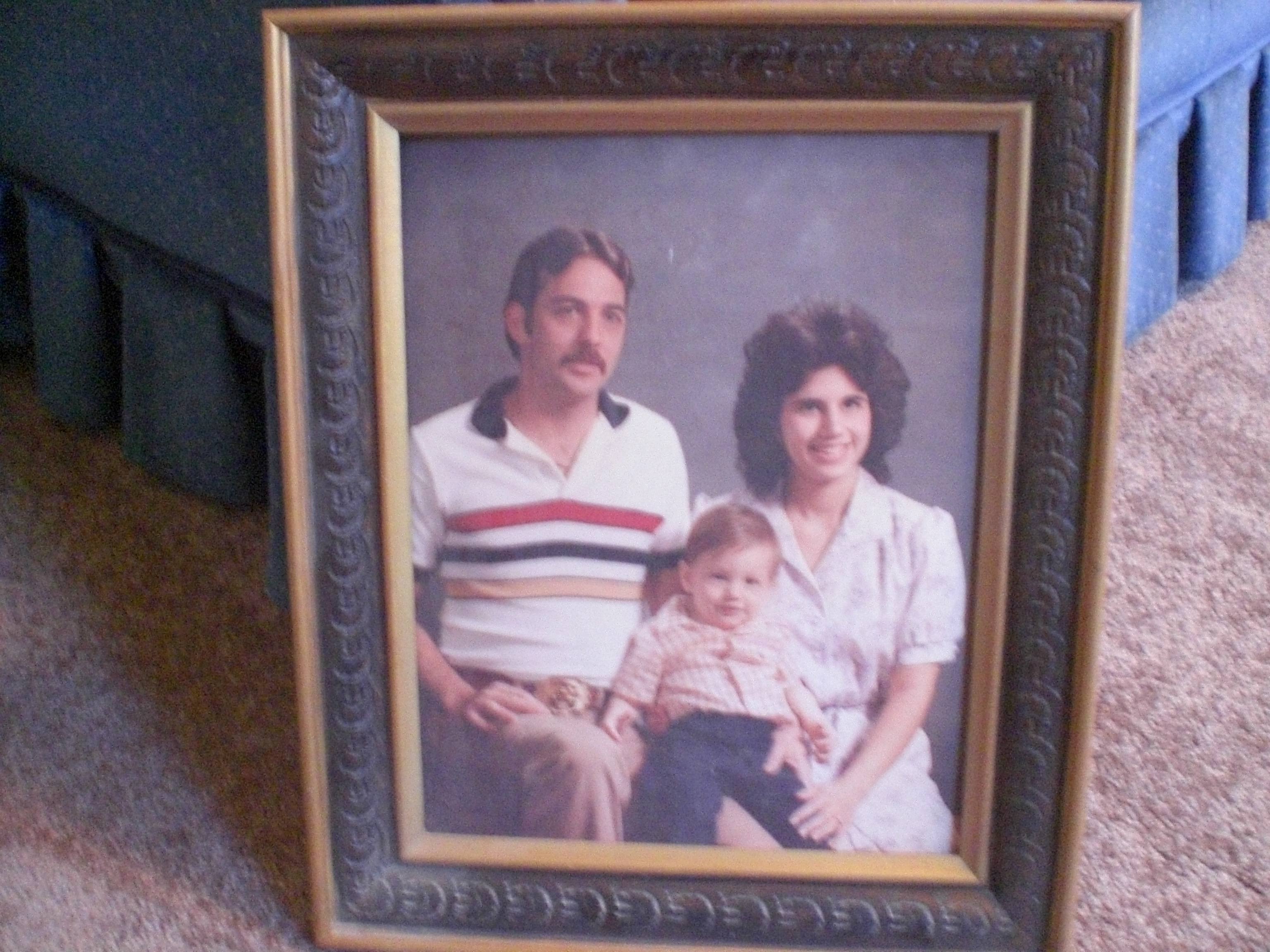
My parents and I in 1982.
My friend David Smith and I broke this Nashville mug that my dad bought for my mom when he went on a business trip. We stayed up until after 1 AM to superglue it back together. I’m not sure that it actually still holds liquid.
This is me in a video I made for you, which explains all this in a 5 and a half minute video, in case you prefer that over reading the 1378 word blog post below it, which I wrote 7 years ago.
Meet your great-grandfather Isaac. Or Ishmael. Or maybe even both…
How do you determine who ethnically is a “white person” and who is not? Are Jews considered to be white? What about Greeks and Italians? And though Central and South Americans typically have tan skin, why is it there something about them still seems sort of white, as opposed to a person from India or China? These are some of the “side effect” questions that will be answered as I explain my theory on the origin of race and religion.
No, this theory doesn’t start with Adam and Eve. Nor does it start with Noah and his family repopulating the world after the Great Flood. It starts 20 generations after Adam, and 10 generations after Noah, with Abraham (the father of the Jewish and the Arab people), being promised by God that he would have a son in his old age. After waiting and having no sign of this coming true, Abraham’s wife Sarah convinced him to sleep with their Egyptian maidservant Hagar, in order to have a son to carry on the family lineage. At age 86, Abraham goes with his wife’s plan (like the way Adam ate the fruit after Eve convinced him to) and has a son with his maidservant- the son is named Ishmael. However, 13 years later Abraham’s wife Sarah gets pregnant with a son, as God promised, and this son is named Isaac.
Abraham eventually sends away his maidservant Hagar and his son Ishmael into the wilderness (Genesis 21:14), and raises Isaac his as true first-born son. Today, thousands of years later, it is through Ishmael that Arabs and Muslims link their heritage through. Accordingly, Jews and Christians trace through heritage back to Isaac. Now we are in the meat of my theory.
As generations passed and both families migrated from their Middle Eastern homelands, the descendants of Ishmael moved south and east- to Africa, Asia, and America (becoming the Native American Indians in North America and the Aztec Indians in Central and South America). In fact, the angel of the Lord told Hagar that Ishmael “will live east of all his brothers” (Genesis 16:12). Meanwhile the descendants of Isaac moved north and west- to Europe, Russia, and eventually to America (killing off, running off, or marrying the Native American Indians).
Notice how today the countries that are represented by the descendants of Ishmael are generally practice religions that do not involve the Judeo-Christian God (worshipped by Christians, Catholics, and Jews) but instead are tied Hinduism, Animism, Taoism, Buddhism, Communism (Atheism) and Islam. And of course the descendants of Isaac are matched to the Christianized nations: For example, Scotland is mainly Protestant, Ireland is mainly Catholic, and England is mainly Anglican (Presbyterian).
Almost 2,000 years ago thanks the Apostle Paul’s missionary journeys to preach Christ where the Jews had already settled (in Europe, specifically the Mediterranean areas) and also the birth of Christianity as a whole, the countries that were already familiar with the Judeo-Christian God were basically the first to get introduced to Jesus as the Messiah. As far as all the Ishmael-descended areas, like modern day Africa and Asia that were less familiar or not familiar at all with Christianity, they were not and have not typically been as generally open and accepting to “our God” as Isaac’s descendants.
I do believe that whether or not a nation (or individual person) is a descendent of Isaac has much to do with their religion, race, and culture. However, there are obviously exceptions. One of them is Russia, which had been mainly Christian up until the point of its embrace of Communism. Another exception is African-Americans, whom most identify with Christianity, as opposed to most Africans living in Africa.
And then there’s the “half breed” nations that make up Central and South America. For the most part, their blood is mixed of Indigenous Americans (Native American, Aztec, etc.) who migrated from Asia through modern day Alaska, and European lineage from those who “discovered” America. So in essence, the inhabitants of modern day Central and South America are half Isaackian, half-Ishmaelese; though they have accepted the religious beliefs of Isaac’s descendants (largely Catholic). Read more about this here: http://en.wikipedia.org/wiki/Indigenous_peoples_of_the_Americas
Yes, I did just now make up and use the words Isaackian (to describe the descendants of Isaac who are prone to believe in the Judeo-Christian God) and Ishmaelese (to describe the descendants of Ishmael who typically do not). And now that you hopefully understand what those terms represent, I will begin using them frequently.
What started much of this thought process was when I recently began “Climbing the Family Tree” and realized that so many of my ancestors had last names that are Jewish (Schell, Klaar, Ullman, Wiseman, Vite) yet there is no solid proof that I actually am- only family rumors and tradition. If I assume that none of the people in my family tree were Jewish, well, still, I have Jewish names in my family tree. So that got me thinking, Jewish people and “white people” are essentially the same thing, coming from the same common ancestors. Whereas someone who is Japanese (Ishmaelese) wouldn’t have last names in their family tree that would resemble a Jewish last name.
So going back to one of the questions I asked in the beginning, are Jewish people considered to be white? Yes. Though their homeland is Israel and though they are a Middle Eastern people group, they blend in with us Americans so well. And that’s part of my fascination with pointing out which celebrities are Jewish. Half the casts of Friends and Seinfeld are Jewish (The Ethnic Backgrounds of the Cast of Friends and Seinfeld) as well as The Wonder Years (The Ethnicity of the Cast of The Wonder Years), but the fact that most of us don’t know which ones are or aren’t shows that despite most of us being a mix of European blood, those Middle Eastern descended Jews are still our cousins.
Of course ultimately, it doesn’t matter which of us descended from Isaac or Ishmael or how much blood we have of either (I’m around 12.5% Ishmaelese); it just predicts the tone of our skin and our traditional religion, according to my theory. By no means do I see the Isaackians as superior to Ishmaelese for the fact that I myself worship the Judeo-Christian God. But what I do recognize is what God himself proclaimed to Abraham regarding Isaac and Ishmael:
But God said, “No, but Sarah your wife will bear you a son and you shall call his name Isaac, and I will establish my everlasting covenant for his descendants after him,” (Genesis 17:19).
“As for Ishmael, I have heard you; behold I will bless him, and make him fruitful and multiply him exceedingly. He shall become the father of 12 princes, and I will make him a great nation,” (Genesis 17:20).
What’s most important from those verses I just quoted is that God promised to establish his covenant through the line of Isaac. In other words, the savior of the world would come in the form of a Jew. Not to mention that the Isaackians coincidently would hold the responsibility of sharing their God with the Ismaelese- that’s why Christian missionaries exist. That’s why Christianity is now the largest religion of the Ishmaelese country of South Korea, for example: http://en.wikipedia.org/wiki/South_Korea#Religion
We all have the same great-grandparents at the tops of our family trees. I try to imagine how different the world would be if Abraham wouldn’t have had a son with Hagar, if he just would have waited another 13 years for his own wife to become pregnant. But he jumped the gun and changed the course of history (for him, it was the future) forever. Though if he didn’t, I wouldn’t exist, being that my grandmother is Mexican. Not only would I have not written this and you wouldn’t have read it, but there wouldn’t have been any of this to write about.
“You gave your life to Jesus Christ… and you were not the same after that.” – “Not the Same” by Ben Folds
It’s interesting to see what people list as their “religious views” on their facebook profiles if they are Christians. Some just simply list “Baptist” or “Protestant”. And many, in an effort to creatively avoid a label, list something like “saved by grace” or “in Christ alone”. And that’s cool.
I’m sure for others, summing it all down to one phrase can be difficult, especially for those who believe in God but not necessarily that Jesus is the only way to Heaven as the Bible teaches and as Jesus himself proclaimed. They are not Christians. But they are not atheists either.
For me, simply listing myself as a Christian is a struggle. Because “Christian” has become somewhat of a watered-down generic term, thanks to the way many non-Christians and non-Americans perceive Christians.
I’m quite familiar with the fact that often non-Christians see Christians as selfish hypocrites, as non-Christians often use some of our worst specimens (or those who claim Christianity) as the model for all of us.
And from a non-American perspective (especially non-Catholic and non-Protestant countries), everyone in America is a Christian. They see influential American pop stars and their famous lifestyles and assume that is Christianity. Britney Spears is suddenly the epitome of what all Christians stand for.
I am a Christian. And I don’t believe that I am better than any person in this world nor do I believe that Christians are better people than any other religious group of people. If anything, I feel quite inferior to most people on this earth. I strive for a more giving spirit, like the kind I see in those who have much less than I do. I’ve got a long ways to go.
I belong to a Baptist church. That means my ultimate goal in life is to introduce others to Jesus as the only way true to eternal life, by showing them love and truth. And I believe that being baptized is an important outward symbol of the surrendering of my life to God, as Jesus did.
The Baptist denomination best resembles overall what I believe.
But there are some things about the Baptist culture I stray from. For example, I don’t oppose the reasonable consumption of alcohol or feel it’s taboo for a Christian to drink. Yet I share the all the same major spiritual doctrines as Baptists. Therefore I’m a little bit Presbyterian. (My wife and I were married in a Presbyterian church.)
And though as a Baptist I’m very aware that I can’t earn my salvation by anything I do on my own, I’m a little bit Catholic because I believe salvation in Christ is more than just saying a prayer for Jesus to save me and then saying “I got saved” and then going to church.
My faith does require “works” in order to prove my faith to be genuine and alive; by serving others- caring for the poor, helpless, lonely, and misunderstood. Because that’s what Jesus was all about.
And that’s something that perhaps has best been taught to me through some of the examples of some of the Catholic saints and missionaries I’ve heard and read about, the most obvious being Mother Teresa.
It troubles me that many Baptist churches are so good about making sure no one in the congregation leaves the service without being given the opportunity to “become a Christian” by saying “the sinner’s prayer”. But afterwards, these confused spiritual infants are often left without being nurtured through discipleship.
Not understanding that so much of their sought-after Heaven is just as much in this life as it is the next. And that it takes serving others to help bring Heaven to Earth. I really like the way that over the centuries that Catholics have chosen some of the most humble servants as their legendary heroes. Of course I don’t pray to saints, but I’ve learned to admire and attempt to mimic their lifestyles.
I’m a little bit Jewish because I share the Old Testament with the Jews. The Old Testament actually makes up around 2/3’s of the Bible’s content. And of course I don’t eat pork or shellfish (or many other kinds of carnivores, predators, and “bottom feeder” animals) as God instructed the Jews in Leviticus 11.
I’m a little bit Seventh Day Adventist. They are the health nut freaks of Christianity. Most of them are vegetarians and avoid processed foods and the consumption of sugar (except in the form of whole fruits). Seventh Day Adventists also have a better understanding of resting “on the Sabbath”. And statistics show they live around 7 years longer than the rest of us believers.
When all that is thrown into a blender, arguably it could be said I am closest to being a Baptist who unofficially converted to Messianic Judaism.
Messianic Jews are of Hebrew heritage but unlike other Jews, they accept Jesus as the Messiah. And though I have still yet to prove that somewhere back in my Italian lineage there was a Jew in there (my Mexican grandmother is convinced that’s the case), a person without Hebrew heritage can still convert to become a Messianic Jew.
Taboo is an interesting thing. As the opening line to the theme song of the classic inter-racial sitcom Diff’rent Strokes goes, “Now the world don’t move to the beat of just one drum: What might be right for you, might not be right for some.” From the society of a small family, to a town, to a nation, certain collective behavioral beliefs help unify a group of people to identify as one, bringing a sense of safety in numbers as well as vindication that their own viewpoint really is the best one.
As I researched for my epic “Beauty and Self-Worth aren’t the Real Issues, Lack of Will Power Is” last week, I learned some interesting things about food and drinks that are considered taboo by certain cultures. For example, throughout the centuries coffee has been banned by different countries (including our own) and religious groups (at one time Catholics and currently Mormons). Caffeine is an addictive drug and many people have seen coffee as a controlled substance, as it causes its consumers to become dependent on a drink that can change their demeanor simply by its consumption or lack of it, after the tolerance is built up.
It’s hard to imagine that drinking coffee (and other caffeine-laced beverages like tea and Red Bull) would be taboo to anyone. But considering its addictive qualities along with its mood-altering and heart rate changing abilities, it does have some similarities to alcohol, which is more easily condemned by religious groups. Muslims, Hindus, Rastafarians (though they encourage/require marijuana use), and Mormons are the most solid in their shunning of alcoholic beverages.
As for Protestant Christians, it’s namely Baptists and Methodists that have a stance of little to no tolerance for alcohol, often stated in their church by-laws. (Being that my hometown is almost completely represented by Baptists and Methodists, the sell or purchase of alcohol was illegal in the county until 2006.) However, because of their proximity to the Catholic Church, Episcopalians and Presbyterians tend not to look down on alcohol consumption.
Being Baptist my entire life, I always thought it was weird that Catholics actually drink wine during the service, in particular for the Lord’s Supper. Obviously Jesus and his disciples drank wine for the Last Supper, but we always used Welch’s grape juice (a company that got its start by offering non-alcoholic grape juice to the American Christians who saw drinking wine as sinful). After high school I moved away from my “dry” hometown and graduated from a one year (Baptist affiliated) Bible college in Florida then earned my English degree from Jerry Falwell’s (openly Baptist) Liberty University in Virginia, both saturated in an “alcohol is taboo and prohibited” culture.
Then I moved to Nashville.
An interesting crossbreed between churches and bars. A culture where drinking beer is in the same category as drinking soda. In other words, it’s just another beverage. Like in Europe. And I quickly learned that judgmental attitudes towards alcohol were nowhere to be found, even in Baptist circles. A person could actually sincerely love both Jesus and beer. In fact, last Fall my Sunday School class took a tour of Nashville’s own Yazoo Brewery as a fun activity.
When I finally accepted the fact that alcohol was no longer a moral issue to me, a revelation I had was this: Alcohol use does not necessarily equal alcohol abuse. Before, my mind saw any consumption of alcohol as an instant link to drunkenness and alcoholism. That is a stigma that has since been dissolved from my mind.
An interesting exception to the alcohol ban in Christian circles is best expressed in a quote I would always hear from my friends growing up: “My parents don’t drink, except for a little wine on their wedding anniversaries.” The alcoholic content of the average beer is around 5%. However, wine typically starts between 12 to 15%. Why was strong wine overlooked for special occasions but weak beer condemned?
There are several reasonable answers to this paradox, just like there are many understandable points on why certain religions prohibit alcohol. And because good cases can be made for both acceptance and rejection, it’s remains taboo for some and completely normal for others.
Ironically, the same parts of the Bible that caused me to believe alcohol consumption was wrong before, are now the same verses that give me confidence that for me, it’s no longer a moral issue. In fact, some of the best spiritual growth I’ve done in my entire life was during the time period that I figured this thing out for myself. Whereas before I was either too young to drink, banned by my college, or a part of a culture that shunned alcohol, the independence I found by sorting out my view on the issue helped me become aware of the spiritual side effect that a “no alcohol” lifestyle had on me: I was secretly judgmental of those Christians who drank.
But in the classic case of “if you can’t beat ’em, join ’em”, I realized that I had been treating the issue like some of the Jewish leaders did the law of Moses. They judged Jesus for healing sick people on the Sabbath. Even though the law more generically instructed the people to make the Sabbath day a time of rest and remembering God, the Jews stretched this and in their own interpretation added to the law, stating exactly how many steps a person could walk on the Sabbath, considering anything more than that to be work, therefore breaking the law of Moses. Judging the people by a higher standard of the law than God actually gave to the people.
I allowed myself to believe that the wine of the Bible was different than wine today. Because that excused Jesus of drinking it. And that helped me better accept the fact that Jesus’ first miracle was turning the water into wine at the wedding, and that he knew enough about wine that he might the good kind, and people at the wedding noticed it. But even if there was less alcohol content in the wine of Biblical times, it couldn’t have been much less. Jesus drank real wine. I finally stopped judging Jesus and others for it. And once I joined the crowd, not for reasons of peer pressure but because of personal conviction, I realized my walk with Christ matured.
Now I know that a person can have a daily personal relationship with Jesus, can read and study the Bible, can pray for others, and appreciate good wine and beer, because I have become that person. After daily praying for years that God would show me my flaws and my sins, my prayers were answered when I, in a sense, took real communion for the first time.
Here are some excerpts from Paul’s letters to the church in the book of I Corinthians regarding eating food sacrificed to idols. These are the quotes that have bounced around in my head as I’ve established my own beliefs regarding food and drink:
“Or do you not know that your body is a temple of the Holy Spirit who is in you, whom you have from God, and that you are not from your own? For you have been bought with a price: therefore glorify God in your body. (6:19,20).”
“But take care that this liberty of yours does not somehow become a stumbling block to the weak (9:11).”
“For through your knowledge he who is weak is ruined, the brother for whose sake Christ died. And so by sinning against the brethren and wounding their conscience when it is weak, you sin against Christ (8:11,12).”
“Whether, then, you eat or you drink or whatever you do, do all to the glory of God. (10:31).”
















 Family Friendly Daddy Blog