People are the Meaning of Life: The Rich, The Poor, and The Loved

There are three types of people in the world. The rich, the poor, and the loved.

I recently watched the deleted scenes from the holiday movie Love Actually. The camera zooms in on a poster of two African women in the hot desert. They are carrying baskets full of corn on top of their heads – a scene that would cause many viewers to assume they live a difficult live. As their camera gets closer to the shot of the women, the picture comes to life.

Through subtitles at the bottom of the screen, the viewer learns that these women are indeed quite happy. They are simply carrying food from their garden as they do each day, talking about their husbands and their children. The scene closes with one of the women with her husband, looking out across their small plot of land. They lived a simply life, but were quite content. They had each other and had enough to eat. Though it wasn’t a feast.

A few weeks ago I viewed a slide show called “What the World Eats”. Each slide featured a family from a different country pictured in their kitchen with all the food they eat in a week’s time. One of the poorest families featured was from Ecuador. Their kitchen was simply a corner of their hut. They only ate vegetables, I’m sure not by choice. But they sincerely looked happy in the picture. They had each other and enough to eat. Though it wasn’t a feast.

Here is a link to that slideshow I saw :

http://www.time.com/time/photogallery/0,29307,1626519_1373664,00.html

While much of the world experiences constants civil wars and famine and corrupt governments, not all “poor countries” are suffering. They just live on a lot less than us. And are happy. Not all cultures require a family to own a large house and a minimum of two cars.

Subconsciously, I have been pitying every foreign country poor enough not to have their own national brand of vehicles or their own equivalent to American Idol. But perhaps, they have been pitying me, the Capitalist. Living in a land where it’s easy to end up focusing on chasing money for an entire lifetime.

My church has a ministry where they take in refugees from northern Africa, Iraq, and Southeast Asia. The church helps them to find jobs and an apartment to help them “get on their feet”. Some of them have expressed that life in America is not as easy as it has been romanticized.

While it is the land of the free, it is also the land of the working. Many are surprised by how many hours Americans must work a week to support their families and keep up the maintenance of even one car, which is all but necessary in our culture.

Obviously they are glad to be here instead of imprisoned in a refugee camp in a country plagued with violence, racism, and religious discrimination. But to be an American typically means a person must work the majority of the hours of the week.

From what I’ve been hearing from people outside this country, something Americans are known for is being obsessed with their work. But I don’t know. I’m not an outsider.

I do know I only have about 3 quality hours (at very best) each weekday with my wife. Because she’s in her Master’s classes all day Saturday, the only day we really have together is Sunday. And by then, we’re exhausted from the work week. I’m realizing I envy families who actually get to spend time with each other.

My wife has said several times that she would have like to live in the pioneer days of covered wagons and schoolhouses in the West. Not me. Too hot. Too cold. Too easy to get sick. To easy to die. No thanks.

However, this is the only life I know. If I never knew the comfort of an air conditioner in a house or road trip in an SUV with a CD player, then I wouldn’t know what I am missing.

I thank God for my life in America in 2009. Such a blessed country.

But in my time of seeing happy, simple families in poorer countries I have traveled like Trinidad, Ecuador, and the northern mountainous villages of Thailand, I became aware that I wanted what they had.

A big house and trendy clothes and new cars mean working more to keep up with the high overhead. I try to imagine a life where the picture is so beautiful, even if the frame isn’t fancy. That’s the life I’m aiming for.


Red Food Dye: Red 40 Comes from Petroleum and Crimson Lakes Comes from Scale Insects

Mommy, where does red food dye come from?…

I often feel like Dr. David Banner, who theorized he needed more exposure to gamma rays in order for his body to be able to harness its superhuman strength during a time of an adrenaline-fueled crisis. He therefore took matters into his own hands by using scientific machinery to get a good dose of gamma radiation. Of course, in turn he became the Incredible Hulk.

In the way that he had to scientifically experiment with his own body to test his theory, so have I, in several cases. Today’s report: The Case of Red Food Dye.

Between the ages of 9 and 11, I was a nervous kid. I had nothing to be anxious about. Definitely a happy childhood. But for no apparent reason, at times I would break out into anxiety attacks. I didn’t know why I was so afraid or why I was crying. And I had constant stomach problems. Which helped keep me nervous all the time.

Then fortunately through my mom’s circle of Mom Friends, she heard the urban legend that red food dye in Kool-Aid and other kid’s foods was causing health problems in children. So I was banned from red Kool-Aid and any kind of candy or snacks that were the color red, or specifically contained the food dye colors Red 40 or Crimson Lake.

And what was the result?  My anxiety attacks and stomach problems cleared up.

Red 40 (Allura Red AC) has been linked to hyperactivity, ADHD, and even lower IQ’s in children. Turns out, the Red Food Dye Urban Legend is not simply an old wives’ tale. In the UK, Red 40 is planned to be officially phased out by the end of this year in children’s products, including medicine. However, in America, the dye is still approved by the FDA.

What’s so toxic about Red 40? Here’s a clue: It’s derived from petroleum.

Crimson Lake (Carmine) has been linked to severe allergic reactions, even known to cause anaphylactic shock, which is a very serious condition. Europe discourages the use of the dye in its food products, yet has no regulations against it. The American FDA will begin requiring companies to specifically label food products with the dye, starting in 2011.

What’s so toxic about Crimson Lake? It’s derived from female cochineal (scaled) insects. They produce carminic acid, which is a deterrent for their predators. That acid is where the dye gets its official name: Carmine.

We eat petroleum and insects every day.  In red licorice.  Big Red chewing gum.  Yogurt.  M&M’s.  If it’s not naturally red, it’s probably Red 40 or Crimson Lake.

But really, is knowing this going to stop us?

My Jewish Upbringing

“You’re just another face that I know from the TV show.  I have known you for so very long.  I feel you like a friend.”

– “Turn It On Again” by Genesis

When I was in 6th grade (1992-1993) my friend Chad Mathers was telling me about this funny TV show he had began watching called Seinfeld. He explained that the main character was Jewish. Then he said to me, “You’re Jewish, right? Your mom looks Jewish, so that means you are too.” I replied, “Yeah, I guess I’m Jewish.”

Most of my classmates knew my mom because she was a substitute teacher. And they knew by her physical traits she wasn’t just “American”. She was something ethnic. No one really knew exactly what nationality she was, though. Neither did I. Because I just never thought to question it as a kid.

In fact, I had every reason to believe I was Jewish. My mom was always using words like, “kosher”, “schnozzle”, “finagle”, and “hoopla”. (Though only those first two words are actually Jewish words.) And she always perfectly and naturally handled the family budget- she now works at a bank.

Her parents: My grandfather was 5’ 6”, dark-skinned, curly haired, and had the “schnozzle”. He never used the word “church”- instead he called it “tabernacle”.  The only kind of bread he ever had at his house was Jewish Rye.  He saved most of his money and when he rarely bought a new car, he paid for it in cash. My grandmother is 4” 8”, even darker-skinned, with long black hair. Neither of their accents helped- respectively Kenosha and Buffalo. Seemed Jewish to me.

Most Jews living in America have German last names, often including “sch”, “stein”, “berg”, and “man”. My last name, Shell, is German and was originally spelled “Schel”.

And my family has always been close. Every holiday and birthday was spent together. Meatballs were often a part of the meals. Only they weren’t Matzah balls.

My earliest memory of learning my true heritage was in 9th grade. Evidently it took that long for me to be self-aware enough to question my heritage.  It’s not that I actually thought I was Jewish before, it’s that I didn’t question it.  I just assumed.  But despite all the Jewish clues, I learned I wasn’t all that Jewish. My grandfather (Albert Metallo) was Southern-Italian and my grandmother (Lola Mendez) Central-Mexican. And on my dad’s side, German and English.

But after doing some in-depth some research, I learned there’s a good chance that too of my great-grandmothers were Jewish (Wiseman and Vite), not to mention a Green and an Ullman a little bit further back.

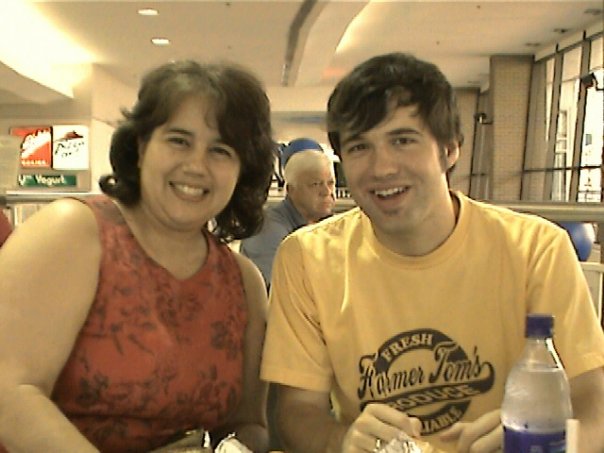
My mom and I in 2004

While I’m fully proud of my actual heritage, I feel more Jewish than I actually am. Thinking back on the last decade, the celebrities that people have said that I look like are all Jews: David Schwimmer, David Arquette, Paul Rudd, Zack Braff, and Ben Savage (from “Boy Meets World”). And I have played Jesus in more church skits and plays than any of my friends, because I always “looked the most Jewish.” I was the obvious choice.

And like the Genesis song “Turn It On Again” talks about, the characters I knew from the movies and TV shows (and even musicians) I watched growing up became like family to me, in a very cloudy, subconscious sort of way.  In particular, as I kid I thought I was Kevin Arnold (Fred Savage) from The Wonder Years.  And in talking to my sister in preparation for this post, I learned that she always thought that too.  We never knew that we both thought that until now.

The Three Stooges. Seinfeld. Friends. Pauly Shore. Bob Saget. Ben Stein. Howie Mandel. Dustin Diamond. Adam Sandler. Andy Samberg. Bob Dylan. Billy Joel. Just a few Jewish people who have surely influenced the culture of my life in some minutely tangible way.

Several years ago I stumbled across an obscure brand of wine that evidently has become my favorite.  The name caused me to think it was German.  But once I read the label carefully, I realized it is wine mainly used for Jewish services.  It’s Manischewitz brand, one of the nation’s leading brand of kosher products.

And this year I officially stopped eating pork and shellfish. Therefore the word “kosher” means something important to me. It means “hot dog I can eat”.

Some Jews actually have no Israeli blood, but they convert to the religion of Judaism. I sort of feel like that somehow. However, the only Jews that believe Jesus is the true son of God are the Messianic Jews.  Clearly put,  I feel like a Gentile (a person is not from the lineage of the nation of Israel) who has converted to Messianic Judaism. Yes, I’m a technical Messianic Jew.

Some People Never Change No Matter How Much Time Goes By, Like James Dean, For Example

Forever 24 years old.

The legendary James Dean only made three movies and then died at the age of 24. That’s how old most of the cast of Friends was when the show premiered. That’s really young. Yet James Dean lives on forever as a 24-year old young man. We never saw him begin to lose his hair.

Kurt Cobain, Jimi Hendrix, Jim Morrison (lead singer of The Doors) and Janis Joplin all died at the age of 27. They will always symbolize youthful rock-and-roll. But we never saw them in their 30’s or 40’s. We never saw them make a few flop albums or experiment with doing other kinds of music other than what they were known for. They died in their prime.


In the likeness of Barbie taking on several different personas (Beach Barbie, Nurse Barbie, School Teacher Barbie, etc.) and in the likeness of the many available different versions that Ninja Turtle action figures came in (I had three Leonardo’s: regular, hockey playing, and storage shell), all of us have lived different versions of ourselves throughout life so far- including high school version, college version, post college single version, married version, with-kids version. Then there are all the minor phases in between.


What’s funny to think about is that the people you were around only during that time of your life may only know you as that version of yourself. For better or worse, you’re still that 18-year high school senior, or the “what will I do with my life?” college student, just an enhanced version. But the perception of yourself and perception of the way others see you is often different. To some people, you may be forever frozen as a version of yourself you no longer are.

A Dream about a Bulldog with a Blowhole, Minus the Skateboard

Most nights, I have a few different dreams. But usually there’s only one I can remember the next day, if any. It would be a shame to let these dreams remain entertainment for only one person.

I was at a friend’s house and their bulldog came up to me. It put my fist its mouth. It wasn’t biting me very hard, but still, it restricted me. I couldn’t walk very far with my fist in the bulldog’s mouth. Then I realized that conveniently, this bulldog had a blowhole behind its skull big enough for my other fist to fit through. So I put my other fist in the bulldog’s blowhole. My fist was pressing against its tongue and after about 20 seconds the bulldog started gagging.

End of dream.


Follow-up Questions:

1) Was the bulldog born with the blowhole?

2) Was the bulldog a new breed of bulldogs?  Was that just the first of many bulldogs with a blowhole?

3) Would my approach to being released be effective in real life?