Most People, By Default, Choose to Focus on What They Can’t Control (The Illusion of Karma), Instead of What They Can (Their Own Emotions)

It was about three years ago, when I turned 35, that I taught myself one of the most life-changing lessons (and secrets) about the human experience:

That 100% of the time, no matter what anyone else says to me or about me, I always get to decide whether or not I will allow that person to hurt my feelings, insult me, or disrespect me. Similarly, it’s always a choice as to whether I will forgive another person, regardless of what they have done.

Imagine the freedom that I have been able to appreciate these past few years knowing this unspoken nugget of wisdom: That I alone control how I feel in relation to other people… unless I allow them to control me.

That bit of information is one of the greatest gifts I have received in my life so far. If only I could have known this all along!

Contrast that to the illusion that most people live in: Most people, by default, believe this about themselves:

“I’m a good person. Well, I may not be a saint, but at least I’m not an ax murderer.”

This mindset is generically based on the ideologies of Buddhism and Hinduism. Ultimately, people rely on the flaky concept of karma to determine what good things they do deserve in life and what bad things they don’t deserve in life.

Here’s the problem: Karma, in this understanding, doesn’t actually exist.

Children have terminal cancer. Meanwhile, white collar criminals go unpunished their entire lives because they have the luxury of being called politicians.

Most people make themselves constant easy targets to be offended or disrespected because they believe they are moral people who “deserve better”, while they ironically deny the fact that only they alone decide whether another person offends or disrespects them.

Here’s where I’m at in life:

I don’t see myself as a good person or a bad person. I am a person.

I make good decisions and I make bad decisions.

I don’t deserve good and I don’t deserve to escape bad. I ultimately can’t control those things as much as I would like to.

Instead, I can control my own emotions; especially in regards to how I react to other people.

As goofy as it sounds, being a YouTuber and a blogger for the past several years has taught me this:

People in the comments section are constantly hoping to label me as one of the following:

Wrong, ignorant, and/or immoral.

I feel that in the real world, it’s the same way. People are insecure within themselves and haven’t fully figured out their own identity, so they look for people who will get offended, insulted, or allow their feelings to be hurt when it is applied they are wrong, ignorant, and/or immoral.

So imagine the power you have when you are instantly ready to agree with a person like that:

“You’re right: I’m wrong. I’m ignorant. I’m immoral.”

Man, I wish somebody would have taught me this stuff about 30 years ago!
The Search for Wisdom, Truth, and Meaning Ends with Life’s Responsibilities; Including Marriage, Children, and a Mortgage (Or, “I Used to Be a Lot More Fun, Yet Self-Centered and Emotionally Needy”)

As my 20th high school reunion is coming up in less than a year, I think it’s funny how certain people probably remember me as a person I no longer am; for better or worse.

Sure, I used to be a lot more fun back before I was so well immersed in all my current responsibilities. But I also know for a fact that I used to let a lot of things bother me that I no longer do.

One of the least favorite years of my life was when I was 20 years old, back in 2001. And no, it wasn’t necessarily because that was the year of the September 11th attacks. It was because, at the time, my identity as an adult was still forming.

I was finishing up community college, before transferring to Liberty University where I would get my English degree. I had a part-time job as the supervisor of an after-school program. I was a Junior High Sunday School teacher and youth leader at my hometown church. And I was single.

Back then, I was still on a noble quest for things like wisdom, truth, and meaning in life.

Fast forward to present day: I’m 37, I have been married for 10 years (as of next Thursday), I have 2 kids, and I have a full time office job in the Nashville area; in addition to my 4 side hustle jobs that also generate income (this blog, doing SEO for a major university, and 2 YouTube channels).

My wife and I are on a passionate mission to pay off our mortgage early, as we’ve been otherwise debt-free for many years now; including no car payments. We are very inspired to outsmart the system of having to work our entire adult lives just to pay interest to the bank for our home loan.

That’s where I’m at in life.

So honestly, I can’t remember the last time I thought about searching for wisdom, truth, or meaning. I don’t need to.

By default, I get my daily share of wisdom, truth, and meaning through all of my many responsibilities in life; as a married father of 2, with a total of 5 income-generating jobs.

It may seem a bit anticlimactic or unromantic, but responsibility is the answer to trying to find wisdom, truth, and meaning.

Behind the Music: My New Original Song about Emotional Intelligence, “Maybe It’s a Dream” by Nick Shell

It might be easy to forget at this point in my life, but when I moved to Nashville back on September 11th, 2005, it was because I wanted to build a career in music; as I have been singing, writing songs, and playing the guitar for over two decades.

However, my focus changed about a year and a half after I moved to Nashville, when I met my wife. Two kids and a decade later, the music thing has been on hiatus.

But this week, I decided to finally record a song I’ve been working on for four years.

It’s called “Maybe It’s a Dream”. The song is about the journey of emotionally intelligence; what it’s like living in the paradox of now understanding how it’s a conscious decision to realize that other people only affect my emotions if I give them permission; and that once I began taking control over that part of my life and I unplugged from that master of puppets system, it made me feel both more alive, yet more isolated from the world.

When I started writing the song, I was 32 years old; I just beginning to learn about emotional intelligence. Now, less than a month away from turning 37, I feel like I am becoming on expert on focusing on what I can control, not on what I can not: including other people.

The opening line of the song, “I am a skeleton with meat on my bones”, is my way of acknowledging the ability to separate others’ perception of who they think I am, versus my own perception of who I think I am. In reality, my identity is somewhere in between.

Later on in the song, I admit, “My perspective of reality will die with me.”

We live in somewhat of an illusion of who we think we are, and we struggle to not worry about what other people think about us; yet in reality, how others collectively perceive us ultimately is part of who we actually are.

So it’s even more groundbreaking of a concept when a person chooses to control their own emotions exclusively; not giving permission to others to “hurt” their feelings or offend them.

This leads to a sense of a confused state of being for a guy like me: “Maybe it’s a dream. Is this even real?”

In other words, if I can control so much of my life now that I understand only I control the breaker switch of my own emotions, life starts to feel a little bit like I’m part of some grand scheme of a social experiment. Maybe this is my version of The Truman Show.

I hope you enjoy my song and I hope you can personally relate to it in some way. It is truly an extension of my identity. To understand who I am (or at least who I think I am) is to understand this song.

Nick Shell’s Simple Self-Help System in 5 Steps: Emotions, Food, Money, Time, and Creativity All Work Together for Your Failure or Your Success

Earlier this morning, I invented a concept that I feel is so relevant, it must be should shared with the free world immediately. However, I predict it will be either widely ignored or passionately panned by critics.

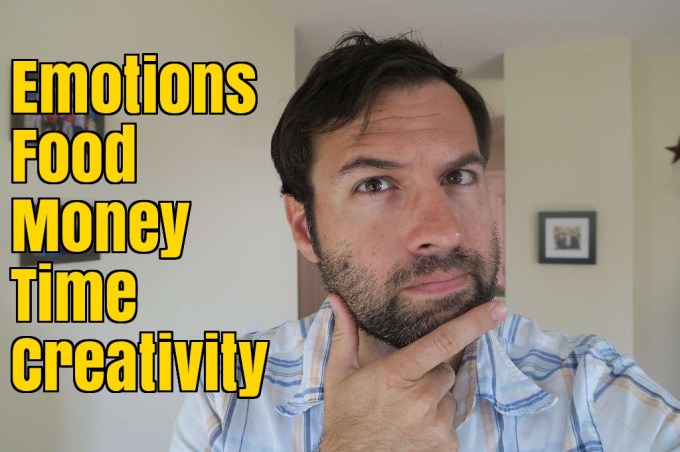
It’s this simple: In order to be in charge of your own life, and therefore your own success, you have to be in conscious control of 5 main aspects: Your emotions, your food, your money, your time, and your creativity.

If you don’t learn to directly take control of these things, they will take control of you instead.

I submit to you that each of these 5 parts of your life is undeniably intertwined. I theorize that if you’re not good at managing your diet, there’s a higher likelihood you’re not good at managing your finances. If you’re not good at managing your time, you’re not good at managing your money. And so on…

Let me continue to bring my theory to life by focusing on each of my 5 Steps to Simple Self-Help:

Emotion:

I’ve realized that one of the greatest advantages (and superpowers!) I have in my life is that I utilize a valuable secret about how the world works: That I myself get to decide who controls my own emotions. However, most people live their lives the opposite way. Instead, they live as constant potential “victims” of someone insulting or offending them. Most people think, “But I’m a good person.” So when another “good person” offends them, it’s an attack on their “good” identity. I have learned that, like choosing to forgive, being emotionally affected by other people is always a choice; though it’s often not an easy one.

Money:

My wife and I have survived some intense and trying financial times. In the first half of our nearly decade of being married so far, my wife and I made some poor decisions in our naivety. In addition to already being in tens of thousands of dollars in debt due to college loans and our wedding, we then chose to move back to my home state, without landing jobs first! Needless to say, recovering from that experience made us grow up real quick. We are now faithful followers of Dave Ramsey, having been debt-free for the 2nd half of our nearly decade of marriage, and we are continuing to grow our savings; despite me losing my job 100 days ago.

Food:

We all know that America is one of the wealthiest and most obese nations in the world. America produces enough food from plants to feed the rest of the world, yet the majority of that food is used to feed the animals that Americans eat. Our culture teaches, “You need to make sure you’re getting enough protein.” The irony is, most Americans are either overweight or obese. I submit that in reality, we are getting too much protein, along with too much fat, too much cholesterol, too much oil, and too much sugar. But to be faithfully determined to eat more whole fruits, vegetables, and grains, and less processed foods and animal products, well; that would require more discipline, education, and open-mindedness. Most people will say they have a busy schedule and there’s just not enough time for that.

Time:

It’s true, our stress levels are high and we have less time in our schedules. But ultimately, we still determine how we spend what little free and unassigned time we have. I submit we naturally place a higher value on casual entertainment (Facebook, Netflix, watching sports) for our free time, than we do on using that time to create. It’s easier to consume than to create, so that’s what most people end up doing in their free time. Just like when a budget for your income, it’s just as important to budget your time; not spend it carelessly.

Creativity:

I have learned that without focusing on being creative, we tend to to consume. That goes for ideas to solutions as well. Without using our brain muscles to find a new solution or method, we tend to continue doing what doesn’t work for us. It’s easy and natural to blame the establishment or other people when there is a problem. Instead, imagine the power and respect you gain when you make an effort to find a better way and just start doing it. And then surprise… it actually works! I guess that’s what this system of mine is all about.

As we consider all 5 of these, the initial reaction is to think, “Well that’s the problem, Nick. If only other people weren’t so rude, and if meat didn’t taste better than broccoli, and if I just made more money, and if I had more time in my day, and if I was wired to be creative like you are, then everything would be easier.”

No.

I submit that it would not.

My system teaches that it’s a conscious decision to take control of your life, regarding your emotions, your diet, your finances, your time, and your creativity.

I think my system makes life easier.

But I also think most people won’t be able to get past the first thing on the list. Most people would rather give other people control over their own emotions. It’s identity protective cognition to remain as the victim instead of choosing to be victorious. I say as long as you continue to think that way, it will inevitably affect how your control the other 4 entries on my list.

I am hereby inviting you to accept your potential superpower. It’s your call. It depends on no one else but you.

I assume this article will either be ignored and hated by the general public. I completely understand why. But in the rare event anyone agrees, I’d appreciate you letting me know; not because I need the confirmation, but because it will show other readers that I’m not as crazy as I sound!

Dr. Joshua Straub Actually Agrees with My Theory That You Get to Decide Whether Others Control Your Emotions?

One of the most fundamentally important parts of my identity is a theory that I discovered on my own, a few years back: That I alone get to decide and determine whether or not other people have the ability to offend me, insult me, or hurt my feelings.

I even tested my theory out with a blog post and video where I invited the free world to say anything they wanted to me in attempt to negatively emotionally affect me. You can imagine the results:

No one was successful in offending, insulting, or hurting me with anything they said.

Why not?

Because I had already made it my mission to stop allowing other people to “hurt my feelings”. I realized that no one could make me feel insecure or inferior unless I gave them the green light for it.

So whether it was someone flipping me off on the Interstate as they perceived I cut them off, or a co-worker implying that I was not doing my job right, or even a member of my own family that I perceived brushed me off when I was telling them a story that was important to me.

I realized, I am the one in control of the lever that determines whether or not I get offended. It’s an on/off switch that most people never take advantage of.

Most people, I have learned, refuse to take ownership over their own emotions; when it comes to other people. By default, they allow the entire free world to potentially offend, insult, or hurt them at any given moment.

I challenge that concept. I choose to be victorious over my own emotions, not a victim by default.

It’s a journey, for sure. I admit it. The easiest place to start though, is with people who you don’t actually personally know, but who still have the power to offend you; like other drivers on the road or people who disagree with you on social media.

I would have to imagine that if we’re honest, we can realize how foolish it is to let someone like that ruin our day. That’s where I started.

From there, I practiced my theory of “not giving other people control over my own emotions” to co-workers. And then to my own family.

Granted, trying to keep your own spouse from offending you is probably the most challenging, as it’s important you don’t build an emotional wall which keeps them from emotionally connecting to you.

Still though, I can say from personal experience, the less I allowed my wife to “hurt my feelings”, the stronger our marriage has become.

I control my own emotions, meaning that other people don’t get to decide that for me.

See, most people live with Identity Protective Cognition, believing this:

“But I’m a good person!”

So when one another person says something that could be perceived as an attack on their identity as a “good person”, that “good person” is therefore being attacked.

The irony here is that most people think the same thing about themselves: “But I’m a good person!”

Then the paradox of a result is we have a world filled with “good people” who constantly offend each other anyway.

I made a conscious decision to unplug from that broken system.

Instead, I don’t see myself as a “good person.” I recognize that term as an illusion.

(Here’s a recent video I made about this just a few days ago, below.)

I see myself as an imperfect person who is constantly in need of improvement. I know what my strengths are, yet I know that even my strengths can be improved. I am also aware of my weaknesses, and I am quick to agree with anyone who points them out.

Without a doubt, one of the best decisions I have made in my entire life is to stop letting people offend me. However, I’ve also learned that most people would prefer to live with their victim mentality mindset which allows them to be potentially offended at any moment.

It’s just like when people learn that I’m a vegan. Most people immediately respond with, “Oh, I could never do that!” I get the same response with most people when I explain my theory about not letting other people control your emotions.

This morning, I decided to test out my theory on Dr. Joshua Straub, who has a doctorate in Counseling. He is a professional who helps people on his parenting blog and on his YouTube channel. By the way, he and his wife have a huge following on Facebook! (Whereas I have nearly 1,100 followers on my Facebook fan page, they have nearly 18,000 followers!)

To my amazement, he actually agreed with the validity of my theory. You can see the surprise on my face in the video (featured at the very top of this blog post) we recorded together today.

I feel like I’m not the kind of person who constantly needs confirmation from society, like the way Michael Scott infamously always did on The Office. So usually, I honestly don’t care if anyone else agrees or disagrees with my perspective. I am a confident person. People who are secure in their identity don’t that require confirmation as their fuel.

But undeniably, Dr. Joshua Straub is an exception to this for me. Why? Because he actually knows what he’s talking about; and not simply on a professional level, but a doctorate level.

So maybe… my crazy theory about not allowing others to emotionally control us is just crazy enough to be true.

What do you think about my theory? Is it really so far-fetched? Am I crazy for thinking this way?

Let me know in the comments. I’ve already established it’s impossible to offend me. Go ahead, give it a try…