Whether you are motivated more by wealth or happiness, it’s still a pursuit. No guarantees for either one.
Maybe Teddy Ruxpin is the reason why today I prefer vests over neckties. Back in the Eighties, all my friends would put their fingers and pencils and crayons in their Teddy Ruxpin doll’s mouth when he talked- but my mom wouldn’t let me do that to mine because she said it would mess up his mouth. She was right. My Teddy Ruxpin worked fine for years and years after my friends’ Teddy Ruxpins ultimately broke down for good. Since Kindergarten (1986) I have been having brief flashbacks of this live-action puppet after-school special of The Adventures of Teddy Ruxpin I saw once where he and Grubby fly in an airship to find a hidden treasure and get captured by mud people.
Recently, some hero posted the one hour made-for-TV movie on YouTube. I watched it all the way through. Teddy Ruxpin and his friends discover a room full of golden treasures but choose instead to take only these crystal necklaces with words like “truth”, “honesty”, and “bravery” on them. Because “these things are the real treasures”. Right. Of course. Then the bad guys take the real treasure (gold), but because their attitudes were wrong, the tresure vanishes into thin air once they touch it.
Golden treasures are typically a let-down in movies and TV shows, for the most part at least. From what I remember about most “treasure hunt” movies, the heroes ends up choosing some kind of abstract moral principle over the actual golden treasure, which is actually a trap or illusion for the villain. The only semi-exception I know of is the movie Without a Paddle. They get the moral treasure (which in this case was “life itself”) and also $100,000 cash, which the two richer friends give to the poorer friend.
Usually I am pretty quick to pick up on recycled plots, but it’s taken me until just recently to realize this one about “the real treasure”. Interestingly, in my research about Generation Y (people born from 1982 and 2001), I learned that one of their main characteristics is that “being happy” is their main motivational drive, not money or wealth, as is the case with many of the older generations. I would have to believe it was this common “love/life/joy is better than gold” theme in entertainment during the Eighties and Nineties that has something to do with the way Generation Y is wired. Though I was born in 1981, I was still born close enough to the generational switch that I admit my main motivation in life is happiness, not material wealth. And maybe that’s dangerous- because for some people, finding financial success could actually be easier than finding perceived happiness.
“The mind is its own place, and in itself, can make a Heaven of Hell, a Hell of Heaven.” –John Milton
*While this entry is actually the 5th chapter of my series entitled “God-Nudged Leap of Faith”, it is just as relevant to “dad from day one” as well. Therefore, I consider it a cross-over episode.
A few weeks from now, on April 4th, it will be four months since my wife and I took our God-nudged leap of faith. We carefully planned and prayed over our decision to leave our secured careers behind in Nashville to live in a small blue collar town in Alabama where my family lives. Having our first child, a son named Jack who was born on November 16, 2010, was a big part of the motivation to move. It made sense to slow down our pace of life, not only for ourselves, but for him. We wanted Jack to be surrounded by his grandparents, aunt, and uncle.
My wife and I both were born in 1981. As children of the 1980’s, we were always told that you can do anything if you really believed in your dreams. Maybe that’s why we were brave enough to take this leap of faith. Maybe that’s what got us into this situation: Having almost depleted our savings and unable to land the right jobs back in my small hometown, we are now at a breaking point.
But in this moment, I don’t feel brave. Perhaps there’s a thin line between bravery and foolishness. The way I see it, that thin line in my case is actually having a steady job. It’s not a matter of the choice that we may have to move back to Nashville- it’s simply the only option if at least one of us doesn’t get a job within the next 2 and a half weeks. We need to make the most responsible decision at this point.
That 2 and a half week deadline is both how long our savings will last us as well as how long it should take to know if the most recent job I applied for will be mine or go to someone else. I can’t say that there were truly no job opportunities for me here. The first week we were here, I interviewed and was offered a job that was similar to my one in Nashville for the past five years- however, I found out during the interview that it meant working every Saturday and three nights a week. So I turned them down. Looking back, it’s easier to say I should have jumped at the chance. But at the time, I felt that it defeated the purpose of moving here if I couldn’t spend Saturday’s and many evenings with my family.
And the day I published the last chapter of this series, I interviewed and was offered a job as an account representative. It seemed like the perfect fit at first, but soon I realized I was the wrong guy for the job- like an accountant trying to do a computer administrator’s job or a forklift operator trying to work in a cubicle on the phone. I was very appreciative, and maybe too honest to not waste their time, but after a week and a half, I had to face the inevitable and re-entered the gloomy world of “much qualified but unemployed”.
My heart was set on raising my son in the same small town I loved while growing up. But it’s starting to seem like I’m playing Red Rover and I just can’t break through the other side. And while all of my family’s lives and futures will change if end up moving back to Nashville, I think of how Baby Jack’s life will be the most effected. Nashville is a wonderful city; after all, it’s where my wife and I met and got married. But his grandparents (my parents) had set their hearts on seeing him nearly every day (the house we live now in is barely a half a mile from them). And Jack won’t get to grow up with his cousin (my sister is due with her first child in July, who will be in the same school grade as him) as closely.
We chose love over money. We chose faith over security. I would love to believe that this story ends the way I intended. But unless God provides a miracle, because that’s the only saving option, then we have to count our losses (emotional, physical, and financial) and abandon our simple dream.
In Nashville, Jack will have to be raised by babysitters while my wife and I work. As compared to living in Alabama, my sister was going to babysit him since she is going on maternity leave for awhile. That’s hard for me to grasp. It makes me think of a divorce in that Jack will only see his family (other than my wife and I, of course) on most weekends. That’s not what I had my heart set on.
My intentions were good. My heart was right. My faith was real. My God can still intervene.
One of the main reasons I decided to write this God-nudged leap of faith series was to show how God would provide for my family. He has always provided for me before. I just can’t imagine this story ending with this all being for just character building experience. Not that God’s faithfulness and providence depends on my story. So to be fair, no matter how this story ends, I will continue writing it- even if we have to pack our lives back up and return to Nashville (where I could go back to my gracious former employer).
I realize that our willingness to move back to Nashville away from family could simply be like Abraham being willing to sacrifice his son, Isaac. Maybe it’s simply a test of our faith. But I also fully realize that despite all it took to get here, we may be required to actually make the sacrifice. For the next two and a half weeks, I will be looking for that ram caught in the bushes, like Abraham was given. I’m counting on a miraculous whirlwind to catch me and carry me either to safety on the ground, or back up to where I leaped from in the first place.
Like Bruce Springsteen said in the first track of my favorite album of his, The Rising: “In God’s hands our fate is complete… I’m countin’ on a miracle to come through.”
While it is a bummer that the classic American father has become a bit of myth these days in popular culture, I can serve as a representative in “dad from day one” as one myself.
I would like to begin with the discernment of a female comedian named Sarah Haskins; I highly recommend watching this humorous 3 minute video clip regarding the following quote of hers:
“Single men in commercials look good, drive fast, and drink beer. Then they meet women, get married, and become good-for-nothing doofy husbands. And what happens if the husband tried to plant his feet and not get bullied in real life? Divorced, money split, wife takes the kids, forever in debt.”
It’s strange how I never gave it too much thought before: How so many commercials and sitcoms really do revolve around a funny yet overweight and slightly incompetent man who happened to score a thin and hot wife who overlooks his bumbling and pathetic behavior. From Kevin James to to Homer Simpson. (Of course, I fully realize the annoying irony of the fact that it is mainly men who are writing those commercials and sitcoms.)
Yes, they makes us laugh. But in some subconscious ways, these stereotypes of men also take power (and more obviously, respect) away from men, in general. Does anyone really care whether or not men are portrayed positively in sitcoms and commercials? Or are we just content to just ignore the occasional facebook status hype that “all men are jerks”, or best, the subliminal message that men are jokes?
As a man with solid moral principles and a backbone, I know the truth: Good men still exist. We’re embarrassed by the worst examples of men; the ones who make the most noise and the most messes. The truth is, being a good man is everything to me. I live for being a good husband and a good father. It’s crucial that I earn respect from those who know me.
Fortunately, my obsession of being respected as a father and husband isn’t simply my own personal quirk. I was so relieved and encouraged when I read the book For Women Only. Here’s an insightful quote from female author Shaunti Feldhahn, explaining a major difference in the wiring of men and women:
“Notice that one of the main biblical passages on marriage- in Ephesians 5- never tells the wife to love her husband, and it never tells the husband to respect his wife (presumably because we each already tend to give what we want to receive). Instead, over and over, it urges the husband to love his wife and urges the wife to respect her husband and his leadership. Women often tend to want to control things, which, unfortunately, men tend to interpret as disrespect and distrust (which, if we’re honest with ourselves, it sometimes is).”
Shortly after getting married, I read both that book and its counterpart, For Men Only. Thank God for those books! Marriage makes so much more sense after learning the unspoken things that men and women assume the other already knows on a daily basis. But if I had to pin it down to one major thing I learned from reading them, it was that men want to be respected by their wives and that women want to feel loved by their husbands. And more importantly, these books clearly explain to a man how to successfully express his love to his wife and they explain to a woman how to successfully express respect to her husband.
By going against so many of the negative stereotypes about men, I can truly show my wife and son that I love them. I can’t express the value of the reward of feeling like a respected husband and father. So I think if a man proves himself to be respected by people, then people should respect him enough to tell him they noticed his “goodness”, in some way. There’s not a whole lot of that happening these days.
So I do. I take the time to tell good men that they are good. Even coming from me, another guy, I know it means something. Because subconsciously, though we men would never admit it, we appreciate being noticed for being the good men of this world.
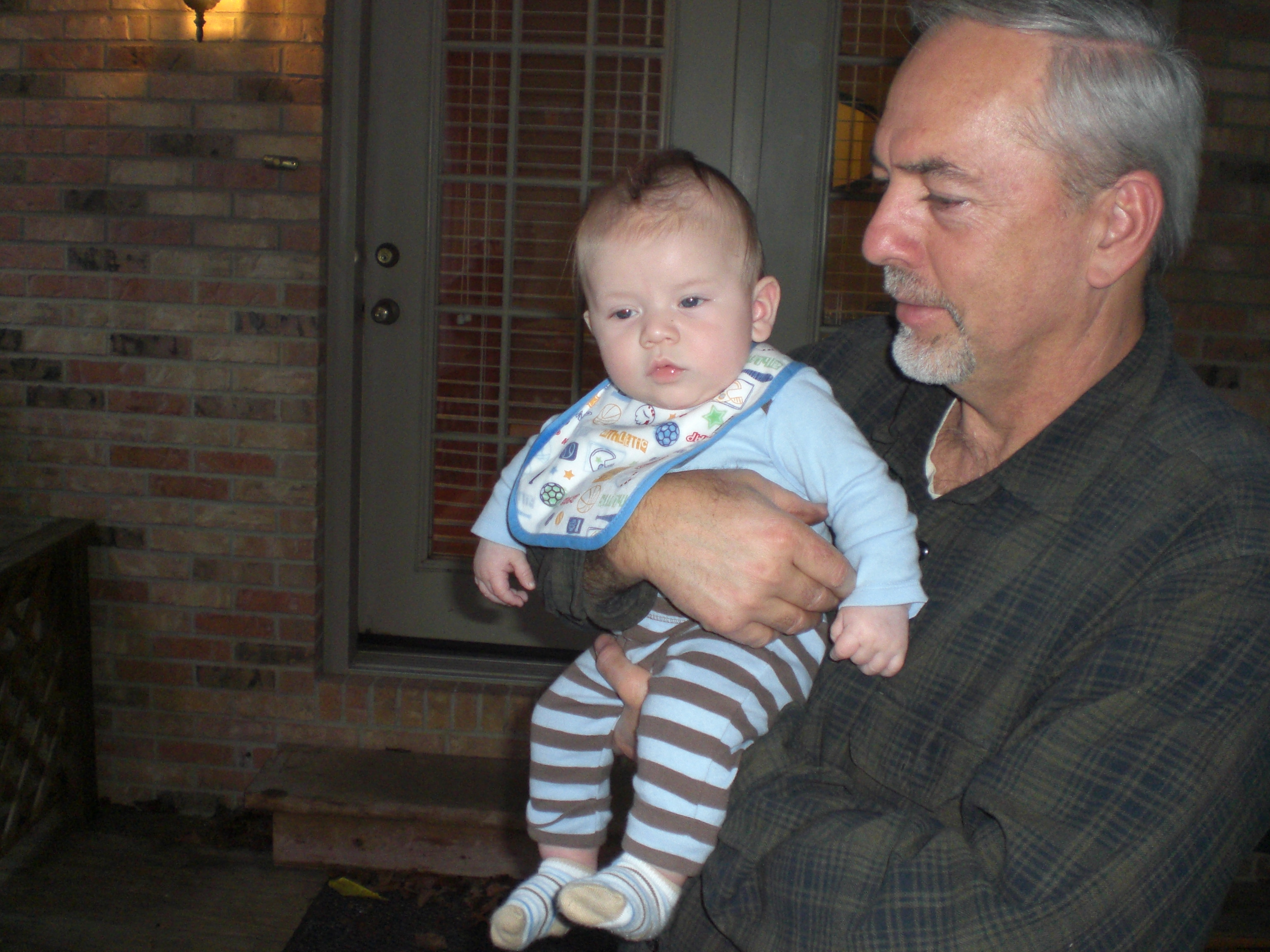
I embark on a mission each new day to be the best good man I can be. And I know that the little things are the big things: Helping take care of my 3 month old son in every way I can, not leaving all or most of it on my wife, is a daily staple for me in my effort to be a good man. I don’t want my wife to be able to joke with her friends about my shortcomings or shortcuts as a dad and husband. Instead, I live to give her every reason not to ever be tempted to do that, even for an innocent laugh. And despite my constant strive and desire to be funny, when it comes to being a good father and husband, I want to be taken seriously. It’s not a joking matter.
Admittedly, my skills regarding home repairs and car maintenance are lacking- big time. But I know that being able to fix a car or a garbage disposal doesn’t ultimately prove my manhood. Being an active, supportive, responsible father and husband does. Man was created in God’s image. Not Charlie Sheen’s. Not Archie Bunker’s. Not Peter Griffin’s.
Recruiting the help of my facebook friends, I tried to come up with an example of a popular American father on TV, who is recent (in new episodes since 2004) and not a widow, a martyr, a robot, or an alien. Turns out, there was no real, obvious winner. So instead of naming who the modern day Ward Cleaver is in the title of this entry, all I could do was just generically say “the modern day Ward Cleaver”. And while it is sad that the classic American father has become a bit of myth in popular culture, I can do my part outside of my home life:
By writing “dad from day one”. I can continue making a positive presence in the gorilla marketed world of “baby blogging”. So it may not be as big as TV, but I still count this blog as contributing to the entertainment industry. Not that I am THE classic American father, but that I am simply a clearly communicating representative of us all. It may be nearly impossible to think of a respectable TV dad these days, but I know so many in real life- and that’s what actually matters.
If the respectable American father won’t show up on TV, he can more importantly show up in the real world.
Bonus:
Just to show you an example of the way it has become normal to stop taking men seriously, check out my challenge below.
Give me an example of a popular and current father/husband on TV who is respected and loved by his family and is NOT known for constantly making comical messes- especially when it comes to goofing up home repairs or misbehaving in social outings. *Bonus points if the guy is not shlubby and overweight yet married to a thin wife who is smart-witted, as to humorously contrast the father/husband’s character.
Examples of who I AM NOT looking for:
Fred Flintstone, Homer Simpson, Peter Griffin of “Family Guy”, Kevin James of “King of Queens”, and Jim Belushi of “According to Jim”.
Remember, I’m looking for a current example, so Ward Cleaver from “Leave It to Beaver” or Mike Brady of “The Brady Bunch” would be disqualified. I will define “current” as “since 2004″, which is the year Friends went off the air and Lost began.
Also, he has to be a popular character on a decently cool and relevant show. No ABC Family or Hallmark stuff.
He must be intelligent as well as faithful to his family, but he can’t be nerdy either. So Ned Flanders from “The Simpsons” won’t work. Also, he can’t be a widow who is overcoming his wife’s death. He has to be currently married to his wife on the show, giving an ongoing example of what a good husband and father is.
And… he can’t be killed off the show or marginalized in any way. He has to be a solid, consistent character.
He is not perfect; he does make mistakes. Therefore he is a real man and human being; he is not an alien or a robot.
The winning example will be published in the upcoming “dad from day one” post (possibly as part of the title itself) for thousands to see.
Answer the question: “Who is the modern Ward Cleaver?”
Impress me, friends. Because in all my creativity the only example I can come up with is Adam Braverman on the series Parenthood.
At point does “real” become imaginary? Or does “real” never become imaginary, but instead, is “real” sometimes unseen and not yet understood?
What initially begins as blue skies which we can literally see above us does eventually become the dark, black, mysterious outer space where we assume God and the angels are. And maybe even aliens and time traveling holes in the universe. While the past simply begins at one second ago, which we all can verify quite easily, if we continue going back in time, we eventually find ourselves in stitched-together memories of high school and even childhood. Keep going, and we were not even born yet. Travel further back in time, and we would see Abraham Lincoln, whom we all agree was a real person. Go still further back to the life of Jesus, whom some proclaim is the Son of God, some proclaim was simply a great teacher, and some proclaim was never actually a real person. Go back to the days of Abraham, the earthly father of Judaism, Christianity, and Islam. Finally, we get to Adam and Eve and before that, the beginning of the Earth and the Universe. But at what point in reverse time do you stop believing in reality? At what point does it become hard to believe?
What started out as simple look around us ended up becoming one strange trip. It’s easy to recognize what exists right before us in our own time and space. But very quickly as we extend the frame of perception, we have to admit we can not literally prove anything. Faith is unavoidable, for every single person alive today and every single person who has died in the history of the world.
While I am definitely a self-proclaimed black and white kind of guy, as I love things to be simply laid out before me in a practical way I can follow and understand them, I am just as equally an abstract, neon colors kind of guy as well. I am a cross-breed. I am a hybrid. And I believe that life is as well.
We can not separate the mostly relatable first episode of the TV show LOST from its spiritual, heavenly series finale. Our existence is both real and a dream. It is both tangible and invisible. It is both reality and a fairy tale. Until we reach the limits of outer space, and until we travel completely back and forwards in time, life is something we can not truly begin to figure out or understand in the smallest degree.
Life is both black and white and color. Life is both real and a dream.
Seems like a strange pair, but we born-again Christians love our movies and TV just as much as everyone else. But where do we draw the line?
One of my favorite TV shows during 4th and 5th grade was surprisingly The Dick Van Dyke Show as it was featured in syndication on Nick at Nite. It was while watching that show (I was around 9 or 10) that it occurred to me, “Dick Van Dyke is kissing Mary Tyler Moore, but in real life, they may both be married to someone else who has to watch them kiss another person.” To me, that would just be too weird… and wrong. As much I fantasize about being an actor in a flash-sideways version of my life in some alternate path I could have chosen for myself a decade ago, I have to acknowledge that as a born-again Christian, there would be an exhaustive list of limitations for me as a legitimate actor. (Granted, Kirk Cameron got around the “have to kiss another woman” dilemma when he used his own wife as a stand-in at the end of the movie Fireproof.)
That’s not to say that there aren’t born-again Christians who act in mainstream media. For example, there’s the often-mistaken-as-a-Jew-but-actually-just-Welsh-American actor Zachary Levi, who is the protagonist of the hit show Chuck. He has been outspoken about his relationship with Jesus Christ. Click here to see what he said in one of his interviews with Relevant magazine. I am fascinated by his Hollywood success and his commitment to his faith. I would love to ask him about this very topic today; specifically this question, “As a Christian, what won’t you do in a role?” (Zachary Levi, if you’re reading this, feel free to comment and help me out. Thanks.)
Where does a Christian draw the line when it comes to acting? I would say kissing another person on stage is harmless except when either or both of them is married. And what about “love scenes” (scenes that involve sexual activity, with or without nudity)? What about profanity? Are there any words you just shouldn’t say? Personally, I could easily curse on camera before I could say, “oh my God”; because to use God’s name in vain is breaking one of the Ten Commandments, while cursing is simply a fading taboo of shifting rules set by the expectations of culture. To me, there are plenty far more destructive ways that words can be used that go against the Kingdom of God, like gossip, malicious sarcasm, and belittling.
Here’s where it gets really tricky. If you think it’s wrong to curse in a role or play a character who has premarital sex, how is that so different from playing a character who is a murderer? At least by playing a killer, you’re truly just pretending to play a character who is obviously in the wrong. But by being filmed semi-nude under covers in a bed, you’re sending a subconscious message that sex between two consenting adults doesn’t necessarily have any spiritual concerns attached to it.
So in theory, in 1983, as a born-again Christian, if given the opportunity to have Al Pacino’s lead role in Scarface, would I, should I, could I? For it’s time, the movie Scarface contained more profanity than any other film in history. It was originally rated NC-17 for its violent content. But in the end, (sorry if you haven’t seen the movie but you’ve had 28 years to see it so I feel okay about giving away the ending) all of Scarface’s sins find him out. It’s obvious that his life of violent crime led to his own demise and in the end, it wasn’t worth it. Does that mean that this movie teaches its viewers not to waste their lives in a mob, getting involved with violence and cocaine? In theory, yes. In theory, it has positive, redeeming value because in the end, crime doesn’t pay.
That’s something I’ve observed about Christian culture. It seems most Christians are okay with a character doing obviously un-Christian things if in the end they repent: Unlike the character of Stacy Hamilton, played by Jewish actress Jennifer Jason Leigh in the 1982 movie Fast Times at Ridgemont High, who decides to have an abortion and seemingly goes on to live a completely normal life, never regretting her decision. I contrast that to the song “Red Ragtop” by Tim McGraw, whether the 20 year-old protagonist gets his 18 year-old girlfriend pregnant and together they decide to have an abortion.
However, by the end of the song, though it’s not explicitly stated, the melancholy mood and subtle lyrics of the song itself convey the message “we can’t undo what we’ve done or beat ourselves up over it, but we do regret and it’s definitely a sad thing that happened”. Rightly assuming that Country music fans are mostly Christians (simple demographics), they helped the song rise to the #2 position on the Country charts.
Entertain this thought: Ask yourself privately, as a Christian, whether or not you would play the role of a character in a play, musical, TV show, or movie who would do any of the following things:
-use minor profanity
-use stronger profanity including racial or gender slurs, up to the “f-word”
-use God’s name in vain, whether it’s by saying “oh my God” or “G.D.”
-play a character who has premarital sex and never encounters any real negative consequences
-play a gay character who never actually kisses another actor
-play a gay character who does kiss another person of the same gender
-play a heterosexual character who jokingly kisses a person of the same gender on the lips, which happens quite often on Saturday Night Live
-play a serial killer and rapist, though no explicit violence is ever shown on screen and who never curses or participates in any pre-material sexual relationship
-play a serial killer and rapist, though no explicit violence is ever shown on screen and but does participate in some premarital sex and who does some cursing
-play a serial killer and rapist, though no explicit violence is ever shown on screen and but does participate in some premarital sex and who does some cursing, but at the end accepts Jesus Christ as their Savior and from that point on lives a life in accordance to the teachings of Jesus
How is it any more wrong to play a homosexual actor than it is to play heterosexual actor who has premarital sex? Though both situations are perceived much differently by the general population, when it comes to my understanding of the Bible’s teaching of righteousness, I don’t see how one is any different or worse than the other. The way I understand it, Jesus died for all sin. Sin is sin is sin. No matter what kind it is, it separates us from God and causes every single one of us to need His grace.
Where do you draw the line as a Christian actor? Obviously to be involved in straight-up porno-graphy is out of the question for any sincere Christian. But there are so many millionths of the scale to get to that extreme. On the much slighter end of the scale is a man with his shirt off showing off his six-pack while he rides a horse bareback. Further down the scale is that same man passionately kissing a woman while in a hot tub, both in their swimsuits. Next is the same man and woman acting out a love scene in bed and though they are actually naked, they aren’t acting having sex underneath the blankets which strategically cover up certain parts of their bodies.
I remind myself that outside the culture of conservative Christianity, in reality the rest of the world behaves its own way regardless of our censorship. To imagine a real life group of people who in their everyday lives never cursed or had premarital sex (outside of the conservative Christian world) is to me, simply unbelievable. Taking away the elements of entertainment that are unChristian-like either makes the TV show or movie either A) unrealistic or B) a Christian movie like Facing the Giants.
I also remind myself that the Bible itself is full of violence, premarital sex, rape, and murder. There is homosexuality. There are concubines. There are instances were people cursed (like when Peter denied Christ). The King James Version of the Bible even contains the words “piss” and “ass”. If the entire Bible were made into an epic movie, could born-again Christians play every role?
But some point, acting is no longer simply just acting. It’s doing. So here’s my final thought about all this. In some technical, annoying way, are we as conservative, born-again Christians actually hypocrites for being spectators of popular entertainment?
Imagine this: Instead of the majority of the cast of Friends and Seinfeld being Jewish, instead they were all born-again Christians. Because of their faith-based convictions, none of them were willing to use any profanity or be involved in any situations that involved premarital sex. I know how beloved these two sitcoms are among the majority of Christians I know. But imagine a world where Ross Geller saying “We were on a break!” meant nothing to us.
Two Questions for You about This Today:
A) As much as we Christians love our sitcoms and movies, would they truly exist if we didn’t support them with our viewership because we ourselves wouldn’t be willing to play those roles the same way?
B) Where would you personally draw the line in regards to what you would or would not do for an acting role, hypothetically speaking, if you were an actor?
I sincerely would love to hear feedback from you, the invisible reader, on either or both of these proposed questions, by leaving a comment below. You don’t have to leave your name; you can easily remain anonymous if you wish.
If you’re not a conservative, born-again Christian, still free to answer as well… and please know how aware I am that the content of this entire post probably seems a bit… out there. For all I know, you may find it either laughable or offensive that we believe premarital sex is wrong or that kissing someone’s spouse is both weird and taboo. But what good is a religion that has no backbone or reasonable standards, despite how counter-culture those limitations may be? Thanks for reading despite the culture shock of it.








 Family Friendly Daddy Blog