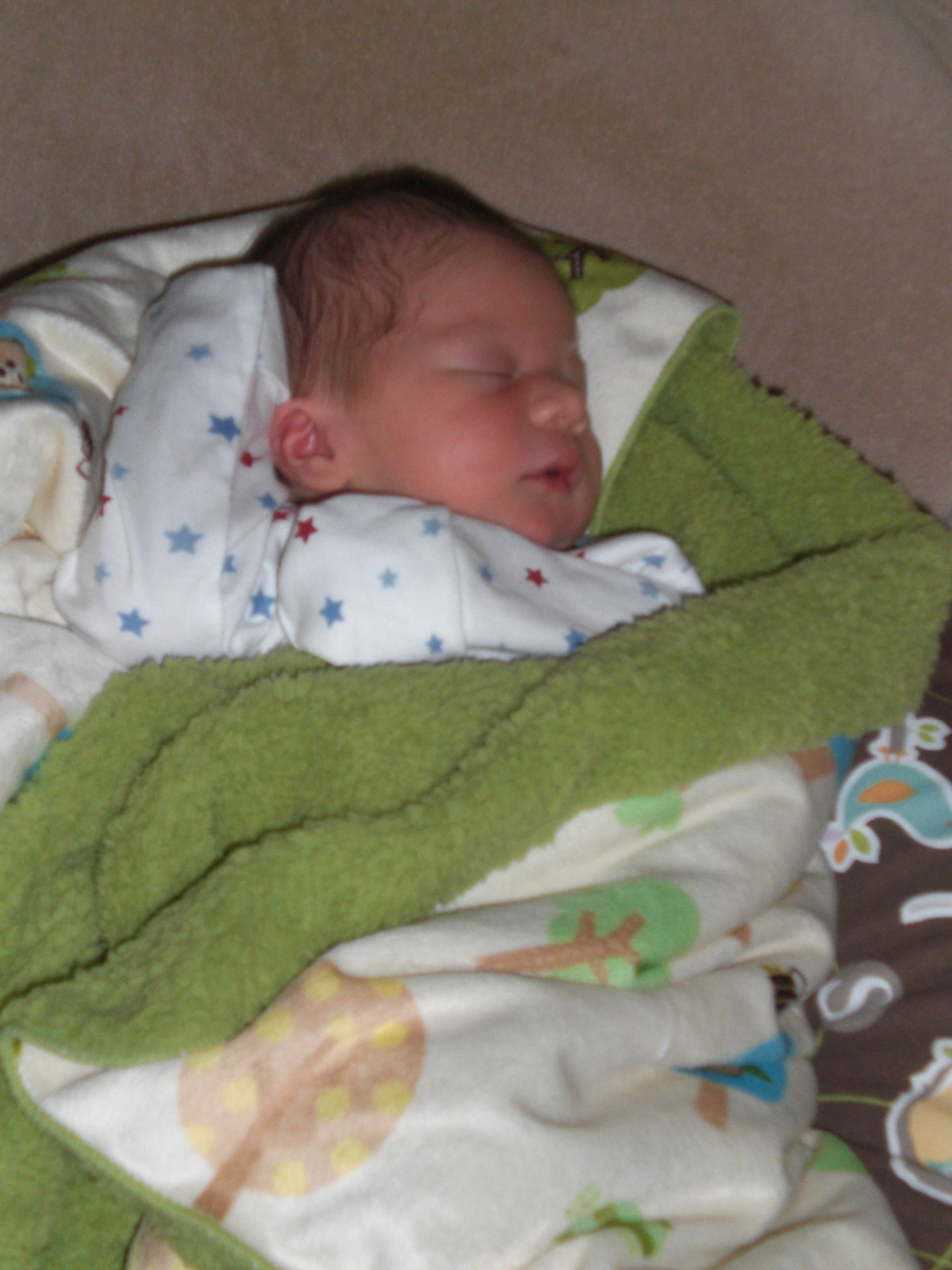
dad from day one: Playtime with an Infant

Week 1.

It doesn’t take being a full week into this to realize that there are predictable patterns of my baby: he eats, he poops/pees, he plays, and he sleeps.  Of course the word “plays”, when referring to a week-old infant, is somewhat limited being that he doesn’t really have active neck muscles yet.  I have to turn his head to show him where the action is, but that’s okay.

When he’s more awake, I like to box with Baby Jack.  He instinctively puts his hands out like a boxer- and because we keep mittens on his hands to keep him from scratching his face, it’s only natural that he makes for a perfect baby boxer.  Of course, it’s his fists versus my pointer fingers.  And I only push my fingers up against his “boxing gloves”.  We are in the beginning stages of “dad wrestles son”.

Another playtime activity is when I lay back against a wall or the bed headboard, placing him in my lap.  Then I use my legs as a sort of elevator/recliner, which serves as a fun ride for him.  Something else I can do in this position is to flex my stomach muscles very hard, straining hard enough to cause my stomach to vibrate or shake quickly.  That makes Jack vibrate and shake too- it’s an easy way to get him to smile.  When playing with him, I basically just think to myself: “What are all the ways I would like to annoy a cat if it would let me?”  It gives me good direction as a dad.

dad from day one: Feng Shui Dad

Week 1.

Being that I spend most of my lunch breaks at Borders, over the past year I have been acquiring a small library of discounted books.  One of my purchases off the “five dollar clearance rack” was a huge colorful book on Feng Shui.  While I have yet to spend much time really learning these ancient Chinese secrets, I did scan through a few chapters.  One of the concepts of Feng Shui that I did pick up on warned against long uninterrupted straights, whether the layout of the house is based on one basic hallway or the driveway to the house has no turns.  Without turns and interruptions along a straight path, one might “fall out of the house and out of their own yard”.  That’s considered “bad Feng Shui”.

If you are able to grasp that concept for the most part (which I think for some strange reason I can), then maybe you can understand my recent perspective on how having Baby Jack relates back to Feng Shui, if nothing else, in my own sleep-deprived head.  Recently, some of my cosmic insecurities have been heavily resolved as I realize that by being a parent, I am forever in the middle of a generation, no longer the tail end.  I am no longer the tree itself, but instead one of the branches on someone else’s family tree.  No longer am I a coastal state like Rhode Island or South Carolina, exposed the possibility of breaking off in the Atlantic Ocean, only separated by a few thousand miles from giant Africa; instead, I am now landlocked Kansas.  Like sitting in the middle of the third row seat in a 15 passenger van on a church mission trip to Mexico; like no longer being on the outer edge in a herd of zebras escaping from a hungry lion, so am I.

As a parent, I now feel more Feng Shui.  I will not “fall out” out the universe into outer space without it being immediately noticed.  Because I am no longer simply a husband; I am a father.  And being a father doesn’t simply hold importance in the direct care of my son, but also in an undeniable eternal sense.  Baby Jack is not just simply a cute little Bambino.  He is a spiritual being who I am responsible for.

I am no longer an island of any kind.  More than ever before, I am needed and necessary in this world.  What I do from this point has potentially everlasting outcomes.  I won’t look back on my life when I’m an old man and think, “I  lived such an empty life.”  Because I will always be linked back to my son.  So cosmic, man.

“These moments, they can never last; like a sad old man with his photographs keeps wishing for the things he can not change.”

-Guster, “Architects and Engineers ”


dad from day one: Baby Boot Camp

Week 1.

Regarding immediate life in the home front and finding a method to the madness, my wife and I are starting to get things figured out.  When Jack needs a diaper change, I put in his pacifier, “shush” him, and place my right hand over his chest while my wife handles the dirty business, delicately cleaning around his healing circumcised penis and belly button (similar to playing the Operation board game by Milton Bradley).  Regarding sleep schedules, my wife has come up with this gracious plan: On weeknights, I sleep in the guest bedroom on a futon bed from midnight until 6 AM for 6 hours of uninterrupted sleep, then I get ready to leave for work.  When I arrive home 12 hours later, I do whatever my wife needs me to, including but not limited to rocking him, holding him, and helping with the feedings.  But during the weekends, I pretty much just take naps when I can.

Yes, this is my new normal.  I look at the situation for my wife and I as “baby boot camp”.  We are being broken down to the point now where we see two hour naps as a valuable prize, as sleep becomes the new currency in life.  Though so many people have told us the “sleep when the baby sleeps” rule, he inconveniently sleeps between 4:30 and 8:00 PM, a time slot where I am always widest awake and eating dinner.  Hopefully keeping him awake during this time will push back his schedule enough to ensure better sleep time for his parents.

I figure if we can make it through the difficulties of breastfeeding and learning to deal with sleep deprivation, we can officially handle all else that will come our way in raising him.  So I remind myself that every good and present father has been through this too.  I look at parenting as a necessary rite of passage for myself as a human being.  It’s something I was meant to do in order to fully serve my purpose here on Earth; never really knowing all the positive chain-reacting side-effects that my influence on him will cause in the world.  Deep.


dad from day one: We’re Moving to Alabama… Next Weekend!

Week 1 of Jack’s life.

In the Season One finale of dad from day one, I promised an interesting plot twist.  So here in this premier of Season Two, I’m letting everyone know my own meaning of the phrase “Sweet Home Alabama”.

As I explained in due date, a common trait of ‘80’s sitcoms was that a family was introduced to an outsider who suddenly moved in their home, therefore creating a new sense of “normal”.  An exception was Just the Ten of Us, where the Lubbock family moved from the state of New York (the setting of Growing Pains, which it was a spin-off from) to California.  Dad from day one will be combining both of those plot devices: the newcomer and the new setting.  Next Saturday morning, December 4th (on the 4th day of Hanukkah- for any Jewish readers out there) we will pack up our PT Cruiser and Element for the 2 ½ trip (not counting baby delays) from Nashville, TN to the small mountain/valley town of Fort Payne, AL (pop. 14,000 not including illegal immigrants) where I was raised.

Something that makes this really interesting is when I am asked: “So do you have a job lined up?”  Nope.  That’s part of the reason we are so briskly making the Hometown Migration– so I can search full time for a new job during the whole month of December while living off leftover paychecks and savings.  Despite having nearly five years of career experience involving sales, doing trade shows, hiring, and training, I am not naïve to think that a new job will magically appear the week we move to Alabama.

However, I have this belief that as a follower of Jesus Christ, God knows I will make a lot of noise and commotion honoring Him before and after He answers my prayer.  And since I believe that glorifying God in all things is the ultimate meaning of life, I am confident that at the right time, God will provide for me so that I can provide for my family.  As Jesus put it, when a child asks his father for bread or fish to eat, his father doesn’t give him a stone or a serpent instead.  I love that example.

In Fort Payne, we will be living less than three miles from not only my parents but also my sister and her husband.  We know that this quiet town will not only be the right place for Baby Jack to grow up, but also the most practical place for my wife and I to care for him- to be able to watch him grow up slowly, as compared to seeing him only a couple of hours a day in a big city life.  There is no mall in Fort Payne; only a Super Wal-Mart.  There are oddly no Italian restaurants, which will be difficult for Baby Jack, my wife, and myself who all happen to be a quarter Italian and need marinara sauce and garlic bread in order to function properly.  And sadly, for my wife, there is no Starbucks: I think the nearest one is about an hour away.

A lifestyle without malls, Italian restaurants, and Starbucks is precisely what the three of us need.  Because despite leaving all those so-called conveniences behind, we will be able to slow down the pace of life to the speed it needs to be.  My wife and I are extremely happy about the move.  In a sitcom it’s pretty normal for each new season to bring about new characters on the show.  New characters, new city, new plotlines, here we come.


How “Farmers’ Marketing” Leads to the Microtrend of “Hometown Migration”

It’s never been cooler to live a simple yet authentic life.  Let me introduce you to the new American Dream.

*New words I made up for this post, which you will want to become familiar with:

Farmers’ Marketing noun: Not the actual gathering of a community in a central location in order to buy, sell, and trade their local produce and goods, but instead a subculture or lifestyle which reflects a mindset of minimal personal possessions, busyness, and stress; therefore rejecting the traditional mainstream idea of the American Dream.

Hometown Migration noun: A movement of late twentysomethings and early thirtysomethings actually moving back their own hometown several years after establishing a career and beginning a family in a big city; therefore refreshing the town they grew up in with new ideas and in essence, “new blood”.

There was a time when bigger and flashier was better.  And while there are still people out there driving Hummers (though it’s common knowledge that people who drive them tend to be obnoxious, unlike people who drive Jeeps) and who still refuse to buy store brand products, even down to their hand soap and kitchen table condiments (like it matters that your bottle of mustard says “Kroger” instead of “Hunt’s”), I think it’s safe to say that the modern cultural movement is towards simplicity.  We as a nation are learning the meaning of “living within our means” and not consuming more than we actually need; that credit cards are the devil and that food buffets are Diabetes factories.  We get it now that money isn’t everything- and more importantly, that it in theory it’s a waste of time to chase more money our whole lives only to find by the time we retire there may be nothing left for our own social security.  Money is simply a necessary evil, as far as I’m concerned.

This shift towards simplicity also translates to the people we allow to become celebrities through our favorite reality shows.  Celebrating mediocrity mixed with absurdity has obviously become a successful formula.  We no longer need to see beautiful people living in melodramatic plotlines.  Okay, so maybe The Bachelor is an exception. But it’s pretty refreshing to see normal people any hour of the day on HGTV.

Even though it’s not actually a reality show (but instead a fake reality show), I don’t see The Office being as good if everyone in the cast were exceptionally good-looking like the cast of Private Practice, Grey’s Anatomy, or any other “provocative” show that repulses me equally.  Interestingly, The Office is more believable as a mockumentary because the plain-looking actors seem more like people we actually know in real life, instead of stereotypical stock characters we’ve already seen before in every other TV show.

It’s no coincidence that the Age of the Reality TV Show we are currently living in kicked into gear around the same time that the Internet became a standard for most middle class households (around the year 2000).  The Internet allows unqualified and unspectacular people to be seen and heard by anyone else in the world who is willing to look and listen.  We are able to, in a sense, peer into the lives of other regular people just like us.  And it’s evidently fascinating.  Simplicity translates as authenticity; and the idea of authenticity sells.

By far, the most popular and most recognizable thing I write here on Scenic Route Snapshots is my <a href=”dad from day one series.  Noted, I am not the least bit famous (that means I don’t have a Wikipedia entry).  And while having a baby is absolutely a miracle, I can’t say that my story is drastically unique compared to most people who have gone through the experience of having their first child.  So why do people love to read about the pregnancy experience, being that it’s so common and familiar? Good narration from a male perspective is a part of it, which I can thank The Wonder Years, Scrubs, and Dexter for help with that. But really, there’s a certain comfort in feeling like you’re listening to someone you personally know, even if you don’t actually personally know them.

Though I would consider myself to be a “real writer”, being that my college degree is in English and that I have been writing original web content for over 5 years now, I can’t consider myself to be a “professional writer” because writing is not literally my profession- I have yet to make one penny off of anything I’ve written here on Scenic Route Snapshots.  As a recent commenter cleverly worded it after reading “healthnutshell: What Exactly is Food These Days?”, he labeled what I do as “guerilla-style publishing”.  I am clearly not doing this for money- I am doing it for art, for entertainment, for social commentary, for experience, and for my own sanity’s sake.  And therefore what I do is “organic”.  In other words, I haven’t “sold out”.

I was talking to one of my brothers-in-law today (my wife has 7 brothers) about the farmers’ market-minded, used-car-driving, old-school-is-king culture of hipster cities like Portland, Oregon where he lived for several years.  It appears that there is a Farmers’ Marketing of current American society, especially from those in my generation.  Inevitably mimicking the frugalness of those who grew up during The Great Depression, we are finding ourselves repeating history.  We no longer impress each other with classic status symbols like expensive cars: I always think it’s hilarious when someone I know gets a brand new car (as opposed to a dependable used one) and everyone says to them: “Oh, congratulations!  I like your new ride!”

Humorously, the brand new car owner is being congratulated on incurring a huge new debt.  Dave Ramsey explains that a paid off mortgage is the new financial status symbol. As much as I have a hard time admitting it, the Eighties are over.  Just like a familiar voice is welcomed or a worn-in pair of sneakers are so comfortable, allowing myself to become Farmers’ Marketed feels, so natural, so organic, so average, yet so right.

So it only makes sense why I’ve noticed the migration of so many of my high school and college friends back to their hometown, now that they’ve had several years to establish some career experience in a large city, get married, and possibly start a family.  Instead of climbing the corporate ladder, they’re taking their big city experience back to a town with a much lower cost of living; where the word traffic is simply defined by when the train comes through twice a day, barricading cars from crossing over to the other side of town for ten minutes.  It’s not simply that these people are moving back because they are now ready to settle down; it’s also has a lot to do with Farmers’ Marketing.  In order to truly simplify one’s life, it makes more sense to strive for peace-and-quiet than hustle-and-bustle.

Can you put a price tag on “peace of mind”?  I say you can.  The cost is giving up a higher salary, but adopting a lower overhead.  And people are doing this: Renting out their town houses in the big city and moving back to their hometown.  They realize that true retirement may not be a viable option and that if they can find a less stressful job they enjoy, it’s not really “work”.  From Farmers’ Marketing to Hometown Migration, there is an undeniable movement towards simplicity that will ultimately become a common characteristic of those of us who grew up watching Transformers… back when they were simply a cartoon show and had nothing to do with Shia LaBeouf.

Here’s to authenticity.

“There’s a message in the skies and in the streets: ‘Opportunity, the American Dream’.  It’s in the radio; it’s superstars- the veins and arteries that feed your heart.  From the Dairy Queen to the head of the parade, in a blink your life could change.”

-Guster, “This Could All Be Yours”