This Dad’s Love/Hate Relationship with American Pop Culture

February 3, 2012 at 6:34 am , by 

14 months.

It’s amazing how much I don’t care about celebrities, yet I can tell you that Lady Gaga’s real name is Stefani Joanne Angelina Germanotta, that Russell Brand is 6′ 1″, that John Mayer is half Jewish, and that Beyonce is from Texas.

I don’t want to know how many girls Ashton Kutcher cheated on Demi Moore with or who Jennifer Aniston is currently dating.

Yet by proximity, I sort of do know these things because I am somehow constantly in the Thirty Mile Zone, exposed to the essence of all this useless knowledge about famous people.

Funny enough, the 2nd most popular article last month I wrote was the one talking about how I will not be watchingThe Bachelor with Ben Flajnik.

We all know that school teachers are some of the hardest working people in America, yet their earned income doesn’t support this concept. Meanwhile, the sports stars, actors, and artists we worship get paid by the millions.

The irony here is that while our government is ultimately responsible for paying our school teachers so relatively little, we as a society decide that athletes, actors, and musicians are worth the money they earn when we pay to be entertained by them.

I would love to believe I honestly don’t get all caught up in celebrity hype. Yet I think back to a few years ago when I happened to be at Whole Foods while Keith Urban and Nicole Kidman were having lunch there.

Where was I? Along with others who were trying to inconspicuously take a picture of them with their cell phones. But the picture was “for my wife.” She’s a big Country music fan…

That event showed me that I was still willing to contribute to the habit of A) worshipping famous people and B) degrading them to spectacles, rather than just another married couple that  happened to be eating lunch that day in an organic grocery store.

I’m not okay with worshipping rich and famous people.

Instead, I want to sincerely honor, both inwardly and outwardly, the people in the world who are great examples to us all. Not the people who have become millionaires by entertaining the world, but instead, the people who best demonstrate what it means to love your neighbor as yourself.

As a dad, I want my son to see that it’s the non-famous people in our lives who are most important.

It’s the people who don’t simply entertain us, but the ones who also motivate us and challenge us to become better human beings. The ones who give us direction. The ones who love us unconditionally. The ones we can never truly impress or disappoint.

Sounds like right now I’m describing the way I feel about my son. I am, actually.

The Myth That Vegetarians Don’t Get Enough Protein

January 12, 2012 at 9:40 pm , by 

13 months.

When you officially go vegetarian, the #1 response you will get from most people is, “Well, just make sure you’re getting enough protein.” I feel like it’s subconsciously assumed that vegetarians are just a few steps away from having an eating disorder.

Prepare for me to rock your world. (As if I don’t always.) The reasons people eat meat are because they like it and it’s convenient. People do not eat meat because their bodies need the protein. For any person with access to a grocery store or market that sells veggies and beans, meat is nutritionally unnecessary.

After all, I accidentally became a vegetarian. Throughout the years, as I learned more and more how to eat properly by cutting out foods with the word “high-fructose corn syrup” in them and started eating fresh fruits, veggies, and whole grains in every meal, I finally woke up and realized, “Hey, I don’t want even want meat. Why am I eating this?”

The reason was because I was already getting enough protein from everything else in my meals: in beans, whole grains, nuts, seeds, and green vegetables.

According to the fascinating documentary, Forks Over Knives, which features people who reversed their cancer and Diabetes by switching to a plant-based diet, even the vegetable with the least amount of a protein, the potato, still provides the minimal amount of necessary protein.

Twenty years ago from this very minute, I was probably at Burger King with my family, who was impressed that a skinny little 10 year-old boy like me could so easy down a Double Whopper combo meal. My catch-phrase back then was, “Meat. I gotta have more meat.”

How ironic that two decades later A) I’m a vegetarian and B) I’m never hungry after eating meatless meals.

Forks Over Knives also explains how 500 calories of vegetarian food triggers the mind and body that a person is full, both quicker and longer, than 500 calories of animal based food. Therefore, the more animal-based and processed a meal is, the more necessary it becomes to overeat in order to feel full.

Vegetarianism is considered an alternative lifestyle. But the way I see it, eating meat is the actual alternative lifestyle.

Take a fun look back to the book of Genesis in the Bible. It starts out with God telling people to eat plants and herbs. From Adam until Noah, 20 generations later, there is no mention of anyone eating animals. Then after the Flood wrecked the Earth, God allows people to start eating certain animals (not pork or shellfish.) Why? Out of necessity.

In this new version of Earth where it rained now, where Pangea had been torn apart, where peoples’ lifetimes shortened from centuries to less than a century, for many people it would become necessary, at times, for them to survive off the protein of slaughtered animals. It was scientifically a new environment; they had to adapt.

But here we are now in 2012. It’s never been easier to have access to fresh produce and whole grains. We don’t have to rely on the alternative lifestyle of eating meat.

Instead, we eat meat because it’s easy, familiar, and fun. We like it. But we don’t need it, nutritionally if we get our protein from the right places to begin with.

It’s simply a myth that vegetarians don’t get enough protein. Pretty weird, huh?

If you would like to personally ask me any questions about converting to vegetarianism, feel free to email me at nickshell1983@hotmail. Or simply check out this article I wrote a few weeks ago: Healthy Parents: 5 Steps to Planning Vegetarian MealsTrust me, if you’re attempting to go vegetarian but aren’t “feeling full,” it means you’re doing it wrong. I’ll help.

Image: “Hamburger isolated on white,” via Shutterstock.

Healthy Parents: 5 Steps to Planning Vegetarian Meals

December 20, 2011 at 6:26 am , by 

13 months.

What is the proper size portion of meat to eat in a meal? In the documentary Super Size Me, Lisa Young, PhD, RD, CDN and the Professor of Nutrition at New York University explains that the federal government defines 3 ounces of meat as a sensible portion.

I knew a guy who got an app on his iPhone that kept up with exactly how many calories he ate each day, as he wanted to only consume the appropriate amount for his age, weight, and height.

Despite being very careful about his food choices, he reported back to me after a week that he was coming up too high on his sodium count each day. I suggested he only eat meat in one of his daily meals, and that he make sure the portion was no larger than a deck of cards.

He did, and that was the only way for him to consume the proper amount of sodium.

To be clear, I am suggesting that eating meat for more than one meal a day (and/or consuming more than a deck-of-cards-sized portion of meat in that one meal) is adding too much meat (and sodium) into one’s diet. So for those who are crazy enough to follow my logic on this and actually believe that information is true and relevant, I want to explain how vegetarians plan their meals; at least how my wife and I do it.

So for the meals you don’t eat meat, you can remember what you learned here today to build a satisfying and fulfilling meal, sans the meat.

1) Half-veggie, half-whole grains, seasoned with cheese. That is the formula for how we plan our meals. No vegetarian should ever finish eating a meal and still be hungry. That’s why whole grain pasta, bread, and rice (along with beans) are crucial  for making a hearty vegetarian meal. Don’t even bother with “white bread,” which  leaves you longing for more substance unless you pair it with meat. It’s like eating a Kleenex; virtually no nutrition.

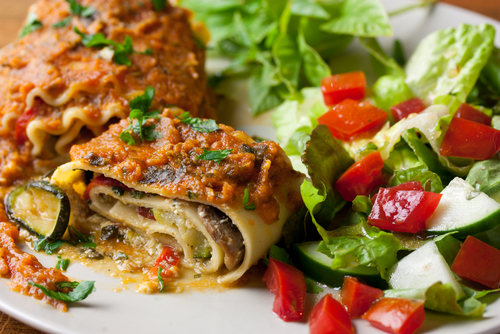
2) Think of your favorite meals that do contain meat, but remove the meat. My wife and I both love lasagna, pasta, and pizza. So we make the healthy version of these foods with whole grain pasta and whole wheat dough. We pack these meals full of veggies, like spinach and zucchini, held together with a little bit of cheese. What’s interesting is that when you use whole grain instead of white noodles or dough, you get fuller quicker on less food.

3) Put together a list of your “heavy rotation” vegetables to serve as your staples. Our list is basically this: spinach, zucchini, tomatoes, onions, garlic, carrots, cucumbers, avocados, romaine lettuce, green beans, green peppers, celery, okra, and basil (which is actually an herb.) We keep all these veggies stocked every week in our fridge to serve as the “flavor” of our meals, whereas the whole grains are the “substance.” Cheese is the “fun part.”

4) Make a distinction between your main dish and your side dish(es). Much of the time, our side dish is a salad consisting of romaine lettuce, cucumbers, carrots, and Italian dressing (full of good fats from oils.) Sometimes it’s sauteed spinach with garlic and a little bit of butter. (As you can see, we’re not opposed to a bit of dairy to make things interesting.) Meanwhile, the main dish may be veggie lasagna or bean and rice burritos stuffed with veggies and avocados in a whole wheat wrap.

5) Make sure your meal has some fat in it. If you end up making a meal that doesn’t have cheese in it, make sure you throw in a whole avocado or at least some almonds. At least for me, I got to have some fat in my meal to be full. Again, vegetarian meals shouldn’t leave you hungry. Otherwise, you’re doing something wrong.

Image: Vegan lasagna rolls via Shutterstock.


Santa Claus and Other White Lies We Tell Our Kids

December 3, 2011 at 10:34 pm , by 

One year.

With good reason, I’ve never been able to legitimately process the double standard of leading a child to believe in Santa Claus while at the same time teaching them not to lie.

It’s interesting how far we have had to stretch the lies, just like with any outrageous falsehood, in order to keep kids believing.

“How does Santa fit down the chimney? How does he fit all the toys in his sleigh? How does he travel the whole world overnight?”

(Insert ridiculous answers here.)

Yes, the legend of Santa Claus was born of Christian folklore, so as a predominately Christian nation, we can rest assured knowing that jolly ole St. Nick has accepted Jesus Christ as his personal Lord and Savior. He has been confirmed, baptized, and even has a tattoo of John 3:16 on his arm.

Yet we can’t deny that in the way John Lennon once infamously claimed that the Beatles were bigger than Jesus, the fame of Santa arguably is greater than the actual reason Christmas came to be celebrated in the first place: the birth of Jesus as the prophesied Messiah of the Old Testament.

But can we really get caught up in this particular double standard? Aren’t there other white lies we tell our kids to either A) comfort them or B) entertain them? Yup.

A very traditional white lie I’ve heard parents tell their kids is that when a loved one dies, in particular a grandparent, that person becomes an angel who watches over them in Heaven.

Sorry, the Bible doesn’t say that. I don’t know of any popular religion that actually does.

Besides, what does that even mean? How does Grandpa Murphy “watch over” your kid? Does he part the clouds, look down and see little Jaxon about to run over a stick while riding his bike, so Grandpa sends a few of his buddy angels to kick the stick out of the way just in time, saving Jaxon from crashing his bike?

Sure, the Bible says that there are guardian angels, but we don’t actually become them ourselves after entering Heaven. So it’s a white lie.

It’s a similar thing when a beloved pet dies. Yeah, all dogs go to Heaven, just like that movie that came out when I was in 2nd grade. Cats? Yeah, them too. The goldfish? That’s debatable. Now, let’s stop asking so many questions and finish eating this delicious Hamburger Helper dinner.

Don’t worry, we “helped” that cow go to Heaven quicker and meet all his cow family that were part of those burgers we grilled out last weekend.

Image: Traditional Santa Clause via Shutterstock.


8 Reasons to Raise Your Family in Nashville