Healthy Parents: 5 Steps to Planning Vegetarian Meals

December 20, 2011 at 6:26 am , by 

13 months.

What is the proper size portion of meat to eat in a meal? In the documentary Super Size Me, Lisa Young, PhD, RD, CDN and the Professor of Nutrition at New York University explains that the federal government defines 3 ounces of meat as a sensible portion.

I knew a guy who got an app on his iPhone that kept up with exactly how many calories he ate each day, as he wanted to only consume the appropriate amount for his age, weight, and height.

Despite being very careful about his food choices, he reported back to me after a week that he was coming up too high on his sodium count each day. I suggested he only eat meat in one of his daily meals, and that he make sure the portion was no larger than a deck of cards.

He did, and that was the only way for him to consume the proper amount of sodium.

To be clear, I am suggesting that eating meat for more than one meal a day (and/or consuming more than a deck-of-cards-sized portion of meat in that one meal) is adding too much meat (and sodium) into one’s diet. So for those who are crazy enough to follow my logic on this and actually believe that information is true and relevant, I want to explain how vegetarians plan their meals; at least how my wife and I do it.

So for the meals you don’t eat meat, you can remember what you learned here today to build a satisfying and fulfilling meal, sans the meat.

1) Half-veggie, half-whole grains, seasoned with cheese. That is the formula for how we plan our meals. No vegetarian should ever finish eating a meal and still be hungry. That’s why whole grain pasta, bread, and rice (along with beans) are crucial  for making a hearty vegetarian meal. Don’t even bother with “white bread,” which  leaves you longing for more substance unless you pair it with meat. It’s like eating a Kleenex; virtually no nutrition.

2) Think of your favorite meals that do contain meat, but remove the meat. My wife and I both love lasagna, pasta, and pizza. So we make the healthy version of these foods with whole grain pasta and whole wheat dough. We pack these meals full of veggies, like spinach and zucchini, held together with a little bit of cheese. What’s interesting is that when you use whole grain instead of white noodles or dough, you get fuller quicker on less food.

3) Put together a list of your “heavy rotation” vegetables to serve as your staples. Our list is basically this: spinach, zucchini, tomatoes, onions, garlic, carrots, cucumbers, avocados, romaine lettuce, green beans, green peppers, celery, okra, and basil (which is actually an herb.) We keep all these veggies stocked every week in our fridge to serve as the “flavor” of our meals, whereas the whole grains are the “substance.” Cheese is the “fun part.”

4) Make a distinction between your main dish and your side dish(es). Much of the time, our side dish is a salad consisting of romaine lettuce, cucumbers, carrots, and Italian dressing (full of good fats from oils.) Sometimes it’s sauteed spinach with garlic and a little bit of butter. (As you can see, we’re not opposed to a bit of dairy to make things interesting.) Meanwhile, the main dish may be veggie lasagna or bean and rice burritos stuffed with veggies and avocados in a whole wheat wrap.

5) Make sure your meal has some fat in it. If you end up making a meal that doesn’t have cheese in it, make sure you throw in a whole avocado or at least some almonds. At least for me, I got to have some fat in my meal to be full. Again, vegetarian meals shouldn’t leave you hungry. Otherwise, you’re doing something wrong.

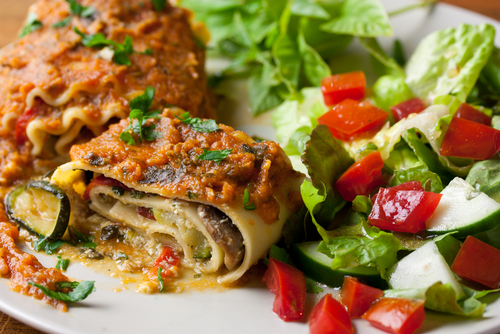
Image: Vegan lasagna rolls via Shutterstock.


Santa Claus and Other White Lies We Tell Our Kids

December 3, 2011 at 10:34 pm , by 

One year.

With good reason, I’ve never been able to legitimately process the double standard of leading a child to believe in Santa Claus while at the same time teaching them not to lie.

It’s interesting how far we have had to stretch the lies, just like with any outrageous falsehood, in order to keep kids believing.

“How does Santa fit down the chimney? How does he fit all the toys in his sleigh? How does he travel the whole world overnight?”

(Insert ridiculous answers here.)

Yes, the legend of Santa Claus was born of Christian folklore, so as a predominately Christian nation, we can rest assured knowing that jolly ole St. Nick has accepted Jesus Christ as his personal Lord and Savior. He has been confirmed, baptized, and even has a tattoo of John 3:16 on his arm.

Yet we can’t deny that in the way John Lennon once infamously claimed that the Beatles were bigger than Jesus, the fame of Santa arguably is greater than the actual reason Christmas came to be celebrated in the first place: the birth of Jesus as the prophesied Messiah of the Old Testament.

But can we really get caught up in this particular double standard? Aren’t there other white lies we tell our kids to either A) comfort them or B) entertain them? Yup.

A very traditional white lie I’ve heard parents tell their kids is that when a loved one dies, in particular a grandparent, that person becomes an angel who watches over them in Heaven.

Sorry, the Bible doesn’t say that. I don’t know of any popular religion that actually does.

Besides, what does that even mean? How does Grandpa Murphy “watch over” your kid? Does he part the clouds, look down and see little Jaxon about to run over a stick while riding his bike, so Grandpa sends a few of his buddy angels to kick the stick out of the way just in time, saving Jaxon from crashing his bike?

Sure, the Bible says that there are guardian angels, but we don’t actually become them ourselves after entering Heaven. So it’s a white lie.

It’s a similar thing when a beloved pet dies. Yeah, all dogs go to Heaven, just like that movie that came out when I was in 2nd grade. Cats? Yeah, them too. The goldfish? That’s debatable. Now, let’s stop asking so many questions and finish eating this delicious Hamburger Helper dinner.

Don’t worry, we “helped” that cow go to Heaven quicker and meet all his cow family that were part of those burgers we grilled out last weekend.

Image: Traditional Santa Clause via Shutterstock.


8 Reasons to Raise Your Family in Nashville

6 Things This Dad Got Wrong During Pregnancy

November 12, 2011 at 10:07 pm , by 

Eleven months.

Above photo credit: www.joehendricks.com

Now that my son Jack is just days away from turning a year old, I’m having these flashbacks from when my wife was pregnant with him. I remember how people were constantly asking me about our plans for his delivery and postpartum care. Looking back now, I wish I would just kept my mouth shut.

My wife and I are planners. Sure, so much of life (especially when it comes to parenting!) is unpredictable; but still, we like to be able to take control of little we can in our lives. So we had plans on how Jack would be born and raised. But as John Lennon sang in “Beautiful Boy,” “life is what happens to you while you’re busy making other plans.” And that is exactly what happened in our case.

Life (our son) happened while we were busy making other plans. Here are the Top 6 plans that didn’t work out:

1) No epidural. We watched The Business of Being Born and wanted to do this thing as naturally as possible. We knew that statistically, a woman who is given an epidural has an increased chance of needing a C-section. So my wife decided (on her own) that she would not get an epidural unless it become absolutely necessarily.

After enduring 17 and a half hours of labor naturally, we were told that if my wife didn’t get an epidural, she would definitely have to have a C-section because she wouldn’t have enough strength to deliver him.

Five hours later, our son was born. In case you’re keeping up with the math, it was a 22 and half hour labor, only five of those hours being drug-induced. Just for the record, I could never have done that! That’s why I was born a man.

2) Breast milk only; no formula.  Jack was born tongue tied, so breast-feeding wasn’t much of an option because he couldn’t latch on properly. We did have his tongue clipped when he was three weeks old, but at that point we just decided to continue pumping and supplemented with Enfamil until he was nine weeks old; at which point we switched him entirely over to formula.

3) That he would be born early or on his due date.  I knew I had to be ready, so I was; as ready as I could be. All that anticipation caused me to actually think he would come out on time. But of course, though he was due on November 11th, he was born five days later on November 16th.

4) Cloth diapers. Yeah, that would have saved us a lot of money. But I guess we’re just not disciplined enough of parents to raise an exclusively cloth diaper wearing baby. They were too bulky, they leaked if they weren’t on just right, and they made Jack smell bad by the end of the day.

5) Co-sleeping. Mainly, Jack just didn’t want to. He fell asleep better in his Pack ‘N Play, so that’s what we let him do. I admit, I’m glad I was wrong about this one. Because it sure is nice that since being seven months old, he has slept 11 hours a night in a separate room down the hall. I love my Jack-Man, but I don’t think my bed is big enough for the both of us.

6) Pacifers. Evidently, Jack thinks that pacifers suck. He experimented with one for a brief amount of time, but ultimately, he couldn’t pretend enough to even care about having it. Granted, he has put his mouth on a whole lot of other stuff, including a closed water bottle, a pumpkin, and his own foot.

In the midst of planning this blog post, Shawn Brook Williams, one of the graphic designers for Comics Buyer’s Guide magazine, sent me a copy of his graphic novel, Five Pounds and Screaming. His comic book style novel covers those subtle and understated moments a dad goes through, from the realization of pregnancy up until the child’s first birthday. So that’s why reading Five Pounds and Screaming was so perfect in writing this post; it conveniently jogged my memory.

I feel that Shawn and I share a very similar perspective and narrative on fatherhood. The book doesn’t cover being a dad in the cliche ways that Eighties sitcoms typically did. His approach is fresh, original, charming, and warmly familiar.

One of the most memorable scenes in the book, for me, is when the protagonist brags to a supermarket cashier, “I’m a dad!” This stood out to me because I remember doing the same thing the first couple of weeks after Jack was born.

From the telling of the family of the pregnancy, to the anxieties of expecting, to the frustrations of breast feeding, to the child’s first birthday party, Five Pounds and Screaming is like an illustrated version of The Dadabase.