I am not a comic book nerd. Instead, I am simply an American who is well aware of our nation’s love and fascination of super heroes. So why are we so obsessed with men who fly around with their underwear outside their clothes, while pretending to be an insect or animal? Why do their movies make hundreds of millions, thanks to both kids and adults alike? Because super heroes reflect us normal human beings: inside and out.
Here’s what you need to know (and probably already subconsciously know) about super heroes.
1- They save good people from bad people.
2- They have a mysterious and troubled past.
3- They have super powers, skills, abilities, or insight.
4- They sometimes struggle with discerning good from evil, as they realize they are in some ways evil themselves.
5- They have at least one major arch nemesis.
6- They wear some sort of costume.
7- They have an alter ego; or at least a side of them they hide from most people.
8- They find it difficult to have meaningful relationships and friendships with others. (If nothing else, their schedule does not allow for it.)
9- They have a debilitating weakness.
10- They were created by Jewish writers. (Spiderman, Superman, Batman, Iron Man, The Hulk, Wonder Woman, LOST, Dexter, and even the Teenage Mutant Ninja Turtles… It’s pretty difficult to find an exception.)
Maybe it seems a bit of a stretch to consider the characters of LOST as super heroes, but several of them had mysterious powers (at least on the island), they helped each other survive, and they all had some kind of trouble in their past that not only defined them but also that continued to be a struggle. And while that does make for good development on the show, it also is a concept that most of us can relate to. It’s not just the obvious “are they are good guy or a bad guy?” characters like Ben Linus and Sayid Jarrah who struggled with their own consciouses and gray area moral dilemmas. Even seemingly innocent characters like Sun Kwon had a hidden (but shady) alter ego.
This dichotomy of man, the “man has two sides” concept, is also very obvious in the Showtime series Dexter. Yes, he is a serial killer. But Dexter only tracks down and kills serial killers and rapists (though he eventually kills a few innocent victims by mistake). Admittedly, I myself never killed anyone, yet I relate to the show deeply. I’ve even read that males, in particular, live with a constant struggle of feeling inadequate- like an imposter who is about to be found out for who they really are. Aside from any basic religious aspects, at some point in life we end up asking and answering the question, “Am I ultimately a good person or a bad person?”
Are we simply adding to the noise? And for those who do realize that they are ultimately more bad then they are good, are they willing to change, or will they simply accept whatever eternal fate that may befall them? The concept of good versus evil is one we are subconsciously obsessed with. It’s true: We as humans are both good and bad. The same person who steals your credit card information today may thoughtlessly save life a stranger’s life tomorrow. We are both saints and sinners; but it’s ultimately the identity which we allow to consume us that is our true identity.
So it makes sense that we relate the idea of having an alter ego. We display a different version of ourselves at work for 8 hours or more each day. We have to, in order to survive in that environment. We all must have “tweakable” perspectives and personalities. You can’t treat your child the same way your treat your boss. You can’t reveal the same vulnerability to coworker as you must to your spouse.
We know we are supposed to just be ourselves and never really hide who we truly are. But that’s simply not reality. In a sense, the reality is that we are ultimately all super heroes with alter egos… Unless you are one of the true villains of the world.
Whenever I see a baby boy, I usually think of a man between the ages of 45 and 65 years old, because while taking a child psychology class in college at Liberty University, I remember seeing side-by-side photographs in my textbook which compared a baby boy and a middle-aged man. The example showed how as a man grows older, he begins to look more like he did as a baby. (Baby girls don’t look like middle-aged women, though.)
Something that has become pretty apparent this week is that Jack (my son) and Jack (my dad) have a special connection. Baby Jack gravitates his attention towards my dad if he is in the room. Not only is he fascinated by hearing his voice, but he also will get the biggest smile anytime my dad looks his way. And as these YouTube clips below will show, a certain side of Jack’s behavior only opens up for my dad. Their relationship is unmatched even to my own relationship with my son, therefore convincing me there really is something to this “baby boy/middle-aged man” deal. I think it’s really cool to see the dynamics between Baby Jack and his Pappy.
On a less sentimental note, Jack reminds me of things other than just a middle-aged man. When my wife is holding him on her shoulder, he often reminds me of a Glow Worm. And when when gets confused, he looks like Mac the alien from the mostly forgotten movie Mac and Me. And when he’s passionate about eating, he makes this grunting sound that is so similar to Mr. Peepers from Saturday Night Live: “Bah-bah-bah-bah!”
Eventually, he will make me think more of a little boy. For right now, what I am seeing in him are his attempts at being human: like his attempts to walk, his attempts to talk, and even his attempts to show affection. Whatever he reminds me of at any certain point in the day, something I am aware of is how adorable he is. Whether he reminds me of a pet, an alien, or a stuffed animal from the Eighties, I just know I can’t imagine life without him.
Things that Baby Jack reminds me of right now:
Middle-aged men, like the magnificent Phil Collins
Mac the alien
Mr. Peepers (sounds like while eating, but doesn't look like)
Albany, Georgia is the official Christian Hollywood of the Southeast.
It used to be unthinkable that a truly Christian movie could make it to the big screen. So it was even more ridiculous to think about a Christian movie making tens of millions in profit: Fireproof was made on a budget of $500,000 and had a gross revenue of $33,456,317. But now, thanks to Sherwood Pictures of the megachurch Sherwood Baptist Church of Albany, Georgia, we might as well expect a new Christian movie to hit theaters every couple of years.
On September 30, 2011, the creators of Fireproof (and Facing the Giants) will be unleashing their newest movie, Courageous. Sorry, Kirk Cameron isn’t in this one. The plot line revolves around four policemen who must learn to apply the same courage they use everyday on the work force in the delicate yet crucial situations that a parent must encounter when raising a child. I remember when Kirk Cameron’s first Christian movie came out in 2000, Left Behind: The Movie. People from my church promoted it saying, “Come on people, we need to send a message to Hollywood that these are the kinds of movies that people want to see and will pay to see.” And now, over a decade later, our culture is at a curious enough and open-minded enough point to actually support Christian cinema.
Granted, it’s safe to say that many of us who went to the theatre to see Fireproof had realistic expectations that the acting would be on an amateur level. And with the exceptions of Kirk Cameron and Erin Bethea (who played his wife), our expectations were met. Even so, I admit that the message of Fireproof really got to me, despite the “hey, you go to this church… want to be in a movie?” type of casting process. So I say if a Christian movie can make $33 million dollars despite a desperately small budget, despite using actors with basically no experience, and despite being filmed and directed by a volunteer based production company which is simply a ministry of a church, I’d say I can’t really knock it.
I might even say it’s a bit of a phenomenon. Sure, Sherwood Pictures could eventually release a real stinker of a movie and therefore end their winning streak; maybe even one so bad that people would stop going to the theatre to see their newest efforts. But considering that critics outside the church didn’t give Fireproof generally positive reviews for the most part, it’s almost as if we’re all learning that the secular critics’ reviews are simply irrelevant when Christians can make a movie which not only draws in unchurched ticket buyers, but also one that when on to become the greatest grossing independent film of 2008.
Lesson learned thanks to Sherwood Pictures: Enough people will trade top-notch production and professional acting for a movie that to them, even if in their own religious sub-culture, has a new message and is simply relevant.
Firefighters are to marriage problems as policemen are to parenthood. First Fireproof, now Courageous; what will be the next big idea in Christian entertainment? I have a few ideas…
Sherwood Pictures should try taking their talents to the small screen:
Christ’s Anatomy
What part of the body are you?
“Now you are the body of Christ, and each one of you is a part of it.” – 1 Corinthians 12: 27
In this powerful new medical drama, Kirk Cameron stars as “Dr. McBeamy”, the strongest light at Albany Baptist Medical Center. Watch as he mentors the interns in The Way of the Master while still finding time to actually care for his patients. Also stars his real life wife Chelsea Noble as his wife on the show, so that he can actually kiss her onscreen, unlike his onscreen wife Erin Bethea at the end of Fireproof.
Devoted Preachers’ Wives
You think being happily married to a pastor of a Baptist Church isn’t full of drama? Think again.
“Charm is deceitful and beauty is vain, but a woman who fears the Lord shall be praised.” – Proverbs 31: 30
From warding off church gossip to making sure her preacher husband’s pinstripe suit and tassel-topped loafers are ready for the pulpit, Candace Cameron Bure (the real life sister of Kirk Cameron) plays Eve Appleton, a faithful mother and wife who finds comfort in the Christian fellowship of her close circle of friends, all who also happen to be preachers’ wives and amazing supermoms.
The Bridegroom
Will you accept this W.W.J.D. bracelet?
“But at midnight there was a cry, ‘Behold! The bridgeroom is coming! Come out to meet him!’ -Matthew 25: 6
What happens when 25 single and virtuous Christian young women are put in a church with one single and virtuous Christian young man? Eventually marriage; between one man and one woman. They’re all looking for love, and surprisingly all for the right reasons! Watch as Ben Wilder, the Bridegroom, takes his contestants on mission trips to exotic destinations like Guatemala and Honduras in a 15 passenger bus (the budget would not allow for helicopters) to find out who shows the best example of the Christian faith, eventually winning his heart. All to the background soundtrack of Point of Grace. She who wins the bridegroom’s heart will earn the final W.W.W.J bracelet and a worthy husband.
Seems like a strange pair, but we born-again Christians love our movies and TV just as much as everyone else. But where do we draw the line?
One of my favorite TV shows during 4th and 5th grade was surprisingly The Dick Van Dyke Show as it was featured in syndication on Nick at Nite. It was while watching that show (I was around 9 or 10) that it occurred to me, “Dick Van Dyke is kissing Mary Tyler Moore, but in real life, they may both be married to someone else who has to watch them kiss another person.” To me, that would just be too weird… and wrong. As much I fantasize about being an actor in a flash-sideways version of my life in some alternate path I could have chosen for myself a decade ago, I have to acknowledge that as a born-again Christian, there would be an exhaustive list of limitations for me as a legitimate actor. (Granted, Kirk Cameron got around the “have to kiss another woman” dilemma when he used his own wife as a stand-in at the end of the movie Fireproof.)
That’s not to say that there aren’t born-again Christians who act in mainstream media. For example, there’s the often-mistaken-as-a-Jew-but-actually-just-Welsh-American actor Zachary Levi, who is the protagonist of the hit show Chuck. He has been outspoken about his relationship with Jesus Christ. Click here to see what he said in one of his interviews with Relevant magazine. I am fascinated by his Hollywood success and his commitment to his faith. I would love to ask him about this very topic today; specifically this question, “As a Christian, what won’t you do in a role?” (Zachary Levi, if you’re reading this, feel free to comment and help me out. Thanks.)
Where does a Christian draw the line when it comes to acting? I would say kissing another person on stage is harmless except when either or both of them is married. And what about “love scenes” (scenes that involve sexual activity, with or without nudity)? What about profanity? Are there any words you just shouldn’t say? Personally, I could easily curse on camera before I could say, “oh my God”; because to use God’s name in vain is breaking one of the Ten Commandments, while cursing is simply a fading taboo of shifting rules set by the expectations of culture. To me, there are plenty far more destructive ways that words can be used that go against the Kingdom of God, like gossip, malicious sarcasm, and belittling.
Here’s where it gets really tricky. If you think it’s wrong to curse in a role or play a character who has premarital sex, how is that so different from playing a character who is a murderer? At least by playing a killer, you’re truly just pretending to play a character who is obviously in the wrong. But by being filmed semi-nude under covers in a bed, you’re sending a subconscious message that sex between two consenting adults doesn’t necessarily have any spiritual concerns attached to it.
So in theory, in 1983, as a born-again Christian, if given the opportunity to have Al Pacino’s lead role in Scarface, would I, should I, could I? For it’s time, the movie Scarface contained more profanity than any other film in history. It was originally rated NC-17 for its violent content. But in the end, (sorry if you haven’t seen the movie but you’ve had 28 years to see it so I feel okay about giving away the ending) all of Scarface’s sins find him out. It’s obvious that his life of violent crime led to his own demise and in the end, it wasn’t worth it. Does that mean that this movie teaches its viewers not to waste their lives in a mob, getting involved with violence and cocaine? In theory, yes. In theory, it has positive, redeeming value because in the end, crime doesn’t pay.
That’s something I’ve observed about Christian culture. It seems most Christians are okay with a character doing obviously un-Christian things if in the end they repent: Unlike the character of Stacy Hamilton, played by Jewish actress Jennifer Jason Leigh in the 1982 movie Fast Times at Ridgemont High, who decides to have an abortion and seemingly goes on to live a completely normal life, never regretting her decision. I contrast that to the song “Red Ragtop” by Tim McGraw, whether the 20 year-old protagonist gets his 18 year-old girlfriend pregnant and together they decide to have an abortion.
However, by the end of the song, though it’s not explicitly stated, the melancholy mood and subtle lyrics of the song itself convey the message “we can’t undo what we’ve done or beat ourselves up over it, but we do regret and it’s definitely a sad thing that happened”. Rightly assuming that Country music fans are mostly Christians (simple demographics), they helped the song rise to the #2 position on the Country charts.
Entertain this thought: Ask yourself privately, as a Christian, whether or not you would play the role of a character in a play, musical, TV show, or movie who would do any of the following things:
-use minor profanity
-use stronger profanity including racial or gender slurs, up to the “f-word”
-use God’s name in vain, whether it’s by saying “oh my God” or “G.D.”
-play a character who has premarital sex and never encounters any real negative consequences
-play a gay character who never actually kisses another actor
-play a gay character who does kiss another person of the same gender
-play a heterosexual character who jokingly kisses a person of the same gender on the lips, which happens quite often on Saturday Night Live
-play a serial killer and rapist, though no explicit violence is ever shown on screen and who never curses or participates in any pre-material sexual relationship
-play a serial killer and rapist, though no explicit violence is ever shown on screen and but does participate in some premarital sex and who does some cursing
-play a serial killer and rapist, though no explicit violence is ever shown on screen and but does participate in some premarital sex and who does some cursing, but at the end accepts Jesus Christ as their Savior and from that point on lives a life in accordance to the teachings of Jesus
How is it any more wrong to play a homosexual actor than it is to play heterosexual actor who has premarital sex? Though both situations are perceived much differently by the general population, when it comes to my understanding of the Bible’s teaching of righteousness, I don’t see how one is any different or worse than the other. The way I understand it, Jesus died for all sin. Sin is sin is sin. No matter what kind it is, it separates us from God and causes every single one of us to need His grace.
Where do you draw the line as a Christian actor? Obviously to be involved in straight-up porno-graphy is out of the question for any sincere Christian. But there are so many millionths of the scale to get to that extreme. On the much slighter end of the scale is a man with his shirt off showing off his six-pack while he rides a horse bareback. Further down the scale is that same man passionately kissing a woman while in a hot tub, both in their swimsuits. Next is the same man and woman acting out a love scene in bed and though they are actually naked, they aren’t acting having sex underneath the blankets which strategically cover up certain parts of their bodies.
I remind myself that outside the culture of conservative Christianity, in reality the rest of the world behaves its own way regardless of our censorship. To imagine a real life group of people who in their everyday lives never cursed or had premarital sex (outside of the conservative Christian world) is to me, simply unbelievable. Taking away the elements of entertainment that are unChristian-like either makes the TV show or movie either A) unrealistic or B) a Christian movie like Facing the Giants.
I also remind myself that the Bible itself is full of violence, premarital sex, rape, and murder. There is homosexuality. There are concubines. There are instances were people cursed (like when Peter denied Christ). The King James Version of the Bible even contains the words “piss” and “ass”. If the entire Bible were made into an epic movie, could born-again Christians play every role?
But some point, acting is no longer simply just acting. It’s doing. So here’s my final thought about all this. In some technical, annoying way, are we as conservative, born-again Christians actually hypocrites for being spectators of popular entertainment?
Imagine this: Instead of the majority of the cast of Friends and Seinfeld being Jewish, instead they were all born-again Christians. Because of their faith-based convictions, none of them were willing to use any profanity or be involved in any situations that involved premarital sex. I know how beloved these two sitcoms are among the majority of Christians I know. But imagine a world where Ross Geller saying “We were on a break!” meant nothing to us.
Two Questions for You about This Today:
A) As much as we Christians love our sitcoms and movies, would they truly exist if we didn’t support them with our viewership because we ourselves wouldn’t be willing to play those roles the same way?
B) Where would you personally draw the line in regards to what you would or would not do for an acting role, hypothetically speaking, if you were an actor?
I sincerely would love to hear feedback from you, the invisible reader, on either or both of these proposed questions, by leaving a comment below. You don’t have to leave your name; you can easily remain anonymous if you wish.
If you’re not a conservative, born-again Christian, still free to answer as well… and please know how aware I am that the content of this entire post probably seems a bit… out there. For all I know, you may find it either laughable or offensive that we believe premarital sex is wrong or that kissing someone’s spouse is both weird and taboo. But what good is a religion that has no backbone or reasonable standards, despite how counter-culture those limitations may be? Thanks for reading despite the culture shock of it.
You are looking at a picture of our “guest towels”. If you are one of the 7 (maybe less?) males to actually be reading this, you will be just as confused as I once was to learn that despite their name, guest towels, these are not actually towels intended for guests to use. Granted, we do have extra towels for when guests do actually stay at our home- but those are in our “guest bathroom” on the other end of the house. As a guy, who is unable to see any logic in having guest towels in the bathroom attached to our bedroom that are actually only there to look nice and for decoration, not actually for guests to use, I found comfort in watching many male stand up comics who made a routine out of the same topic.
I am becoming more and more aware of how little control I actually have over my own life; much less my own house. Because another common topic that married male stand up comics talk about is the fact that they don’t know where anything in their own house belongs: like the mixing bowl, the stapler, and of course, the real guest towels that are actually intended for guests for use. And now it makes so much more sense why it is so common for the man of the house to spend time in his “man cave”, whether it is his garage, his shop, or even the yard. Why? Because while in his solitude, he has a sense of control over something on the land he owns or rents.
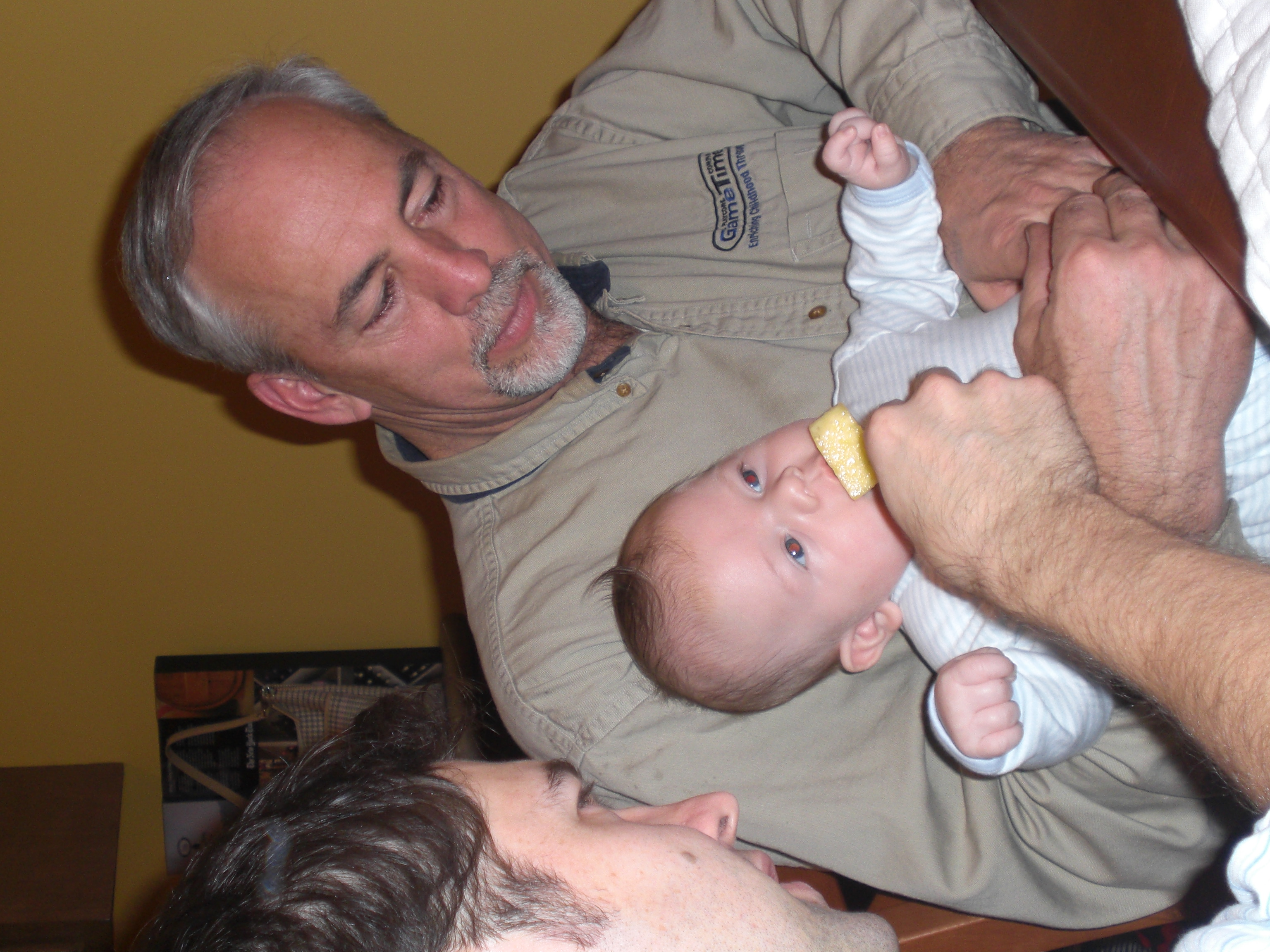
Jack’s first taste of a pineapple.
I’m at a point in my life where I am constantly reminded of what little I actually do control right now. With tomorrow reaching the 2 month mark of unemployment, the dignity of providing for my family has been surrendered. And without that, I also feel like I can’t control my time (because I feel guilty if I’m not constantly doing something constructive to find a job). Starting on Christmas Day and ending yesterday (Groundhog Day), after my wife and son went to sleep each night, I would spend an hour or so revisiting my video game past. I took take the time to go through all 3 Super Mario Bros. games on regular Nintendo, Super Mario World for Super NES, and New Super Mario Bros. for WII, and beat them without using any Game Genies or Warp Zones (which again may only interest the 7 or less men reading this). And while there is something seemingly pathetic about a jobless, 29 year-old guy cheering out loud because he beat Super Mario Bros. 3 for the first time in his life; for me, it was a major sense of accomplishment.
I controled those old-school, 8-bit Nintendo games. And in some slightly true sense, I had control over my time as well.
I think it’s easy to overlook the importance of control in life. Why is it that if you drive into certain “bad neighborhoods” that the residents stand in the road or take their sweet time crossing the street, knowing that you need to get by? It’s gives them a sense of control. Why are there rapists in the world? Well, the easy answer is “the depravity of man” or “lust” or “an unfulfilled sex drive”. But to me it’s pretty obvious that their hideous crime is also largely fueled by a lack of control in their own lives. For more times than I can remember, it seems any time I watch a story on NBC Dateline about a rapist, he was emotionally, physically, or sexually abused growing up. Some people will do anything for the sense of control in their own life.
So what can I do right now? What can I actually control in my life at this moment? I can help with the basic needs of my son. I can control whether or not he gets fed, held, played with, and nurtured. And perhaps the best part, I can make him do funny, weird stunts to be featured on YouTube. Because hey, what else am I going to do until I get a real job?



 Family Friendly Daddy Blog