Why Do People Have to Smile When They Get Their Picture Taken?

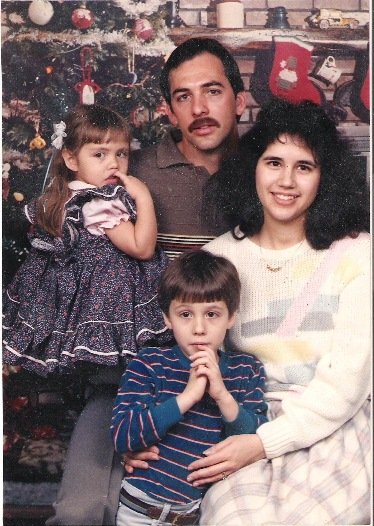
The Shell’s Christmas 1986

My sister and I weren’t good at getting portraits made when were young. I would cry because I was afraid I’d fall off the stand they put me on. And my sister would get mad at the photographer as he tried to make her laugh by waving a squeaky bunny at her.

In our house growing up, one of our family portraits hanging up in the hallway was our Christmas ‘86 picture where my sister was making a mean face at the camera. I looked sneaky and scared. My mom looked like everything was normal. And my dad looked like he was thinking, “Let’s just get this over with”. Classic.

So it was only natural after walking by that picture several times a day I would eventually ask my mom, “Why do we have to smile when we get our pictures taken?” Because all my life experience up until that point had only shown me it was a chore.

The concept of always smiling in pictures is at least a little bit goofy. While I’m sure I smile and laugh a lot during any given day, I couldn’t say that during the majority of my awaken hours I am smiling.

When a picture is taken, it is not to capture the image of a person how they are most of the time, but instead, to capture the image of a person at their best. It’s the same way that our memories tend to work, as well.

The Good Ole Days are good because we are choosing to remember them at their best. We subconsciously overlook the stressful, sad, annoying, and boring parts of the story.

We are left with only the good parts- The Good Ole Days. Like Lucky Charms cereal with just the marshmallows. So is the concept of smiling in pictures. Only the good parts are frozen in time.

The Modern Day Tortoise


The principle of “working smart” is often seen as the shaggy, scruffy twin brother of “working hard”. Working Smart isn’t actually lazy, it’s just that he earned an online Master’s degree in time management and puts it to good use. He’s good at not wasting his time on daily goose chases, but stays consistent with the mundane tasks plus gambles on high-end pay-offs on a constant basis. I am a self-proclaimed Smart Worker. That doesn’t mean I don’t work hard; it means while I’m working I may not look busy, but I still end up being just as productive (if not more) than those who look busy while working.

I see the fable of “The Tortoise and the Hare” as a visualization of Working Smart vs. Working Hard. The tortoise isn’t bothered by the hype around him; he stays on the steady path. He knows the importance of patience. He keeps his eyes on the prize as his competitors burn their best energy on passing him. And later on when they grow tired or bored, his consistent progress wins him the prize.

As Dr. Phil says, “you do what works for you.” I have been Working Smart, not hard, my whole life. It was officially 1992 (5th grade) when I realized I wouldn’t actually need math beyond basic algebra, or science beyond a baking soda and vinegar volcano, since I knew I’d never want to be an engineer or doctor. I also noticed that though I had never studied for a spelling test, every week I got “105” for my score (I always got the “challenge words” right too) and that my Reading and English classes required little effort, yet those classes challenged me in a fun way. Instead of trying to be an all around great student, why not just focus on what comes easy for me and get by on the other stuff?

Stress causes cancer, heart disease, and loss of hair. Working Smart involves avoiding unnecessary stress when at all possible.

I was the dreaded nightmare to school officials when it came to those yearly standardized tests to measure the school system’s progress; I only tried on the English and Reading sections because they entertained me. For the rest of the subjects, I either marked “C” or made a cool diagonal design down the Scantron. Then I just daydreamed afterwards. Because it didn’t effect my personal grades and I knew it. I had proven my true intelligence by knowing not to worry about a Communist test that couldn’t hurt my individual grades.

When it came to gym class, I Worked Smart too. Dodge Ball was my favorite. While all the aggressive kids ran out to the front lines when the game began (and got hit right away) and made ballsy moves like attempting to catch the opponent’s ball in mid-air (causing a higher risk of getting out if they missed the catch), I just walked around, looking busy in the back row. Ten minutes into the game, I would actually start playing. And that’s when I got aggressive. I usually at least made it to the Top 5 every time because by that point most of the biggest threats were already out of the game. Tortoise vs. the Hare. Working Smart vs. Working Hard.

When I chose my major in college, I obviously ended up being an English major. (Enter joke here that I earned a “B.S.” in English.) My first couple of years of college I got by with B’s and C’s, because I was forced to take Science and Math classes I would never use.) But I ended up graduating on the Dean’s List. Why? Because my senior year was nothing but “400 level” English classes. Nothing but my specialty. So of course I’m gonna graduate on the Dean’s List my senior year of college when I only do what I’m good at and love.

I knew that unless I wanted to work in a specialized field (like being a lawyer or banker) that my English degree would be general enough and well-rounded enough to help me get a decent job. And my plan worked. In a general sense, what I do for a living is hire clients looking for a job- a sort of staffing agency. I have a quota to meet every month. This has been my job for the last 3 ½ years and for almost every month, I’ve had the highest numbers in my department. In fact, last month I had the highest numbers ever of anyone in the recorded history of our company.

And it’s not because I’m “the best” or “really good at what I do”. It’s because I work smart. I learned the art of personality mirroring: I mimic the pace, accent, and amount of aggressiveness of the person on the other end of the phone. I look for red flags that indicate a client would be a dead end for me and if that’s the case, I get off the phone as soon as possible so I can be available to talk to the clients who are most likely to be a fit. I am painfully truthful about the pro’s and con’s as I talk to clients. And they notice it. That builds trust. It’s a formula I follow. Follow the formula and the equation will work itself out.

I see life in a unique way; there is no gray, only black and white. Either something is, or it isn’t. My subconscious has directed me to Work Smart in all I do. Every day as I drive on I-65 to work, there is a two mile stretch on the interstate that slightly curves to the right. I stay in the “slow lane” going about 67 mph, while all the drivers who want to go fast stay in the “fast lane” travelling at about 80 mph. But since I am in the inner lane, I stay parallel to the “fast” cars for the entire two miles, yet I don’t risk my safety by breaking the speed limit on a curve.

A Smart Worker is to always keep a high-end pay-off project on the backburner; a passionate hobby that one day could make income on the side. For the first 12 years of my life, I wrote and illustrated stories. For the next 13 years of my life, I wrote and performed songs. And since I’ve stopped doing that, I started writing non-fiction.

For me, I can’t escape a lifestyle of Working Smart. Looking back, it’s why I hardly ever dated in high school and college- I Dated Smart. It’s why I’m on the Dave Ramsey plan for finances (every dollar is accounted for in a budget, are credit cards are the devil) – I Spend Money Smart. It’s why I’m so strict on what I will and will not eat- I Eat Smart. It’s a matter of focusing on what is best for future, not the most fun at the present day. But a future that is better planned for, will eventually make a better present time.

I should never be a motivational speaker for school kids on this subject, granted. Just the idea of “working smart, not hard” is offensive or misunderstood by many. Working Smart isn’t superior to Working Hard, but it is my way of life. I know no different. I get bored and uninspired when I Work Hard. It seems to work for a lot of people though.

The truth is, the world is full of people who Work Smart, not hard. These are the Mark Zuckerberg’s (who created facebook at age 21 and now at age 25 is almost a billionaire) of the world.

I choose to Work Smart:

1) Focus on what comes easy and exploit it. And just BS through everything else.
2) Time is more than money- time is life, so spend it wisely on what matters.
3) Less stress equals better quality of life.

Most of Life is Just Simply Showing Up

There is an art to “being there” when it comes to discovering The Quality of Life. From gaining educational degrees, to getting a job interview, to meeting one’s future spouse, showing up is the most important part. The rest is just details.

Showing Up: 75%
Getting a person to show up for anything is a task in of itself. Because I am a first-born child and because my wife was born of both first-born parents, she and I have both been wired to be planners. There is a schedule and a calendar. When at all possible, we live by them.

It’s easy to get us to show up if we have been told two weeks in advance. But we’re bound to be no-shows when we’re told about an event the day of, via text message. Because chances are, we already have plans.

Anyone who has been married in the last several years surely has a fresh-on-the-brain story or two about RSVP’s gone wrong. Like guests who say they will be there, RSVP for guests of their own (which were not invited), then don’t know up at all. Even at just $35 a head, it still stings when the bill comes after the wedding.

Human presence at a specific event at a specific time is a flighty thing. More fickle and unpredictable than any other aspect of The Quality of Life. A person has to be there before anything else can happen. But once they’re there, things tend to work themselves out.

You show up to class, you’re likely to learn at least a little something.

Experience: 5%
How can one person qualify to relate to another without the minimal proper experience? Whether it’s enough work experience, educational experience, or just simply life experience, without a history and understanding that is similar, it’s difficult for people to be on the same page.

Appearance: 5%
Not a matter of physical beauty, but instead what a person wears when they do show up. In other words, I’m referring to the importance of “wearing the right costume.” Despite what our bodies look like underneath our clothing, what we use to cover our bodies up with is worth more than the money we spend to buy it. Just like a nice Frank Sinatra-style hat can make any slob look a little bit classier, so can a person’s well-presented wardrobe make anyone look at least a bit more attractive.

Not necessarily a matter of expensive clothing. Just simply the right “costume”. A good presentation goes a long way. Or at least 5%, according to my calculations.

A few weeks ago on the “makeover episode” of The Biggest Loser, I laughed when I saw Allen. He already was a clean-shaven, clean-cut man to begin with. They just stuck him in a nice suit and tie. That was his makeover.


Personality: 5%
People like people who remind themselves of themselves. A person is much more likely to positively respond to another person who uses the same speech patterns, who positions their body in a similar stance, who laughs and shows sympathy at the right cues, who uses the other person’s name sporadically in conversation, and who maintains good eye contact. Dale Carnegie 101.

Performance: 5%
I have a philosophy I live by at work. “Do your best constantly. That way it’s easier to have your boss never say anything negative about you during a performance meeting or mass e-mail, especially when the boss is having a bad day.” With so many slackers in the world, when a person proves that they are competent, creative, and dedicated, they automatically stick out from the crowd. Just like we are quite aware of the inflation of money in our economy, it seems the same thing is happening with work ethics.

To acknowledge I can do something better is to say that I’m not already doing my best. And sometimes, for a person to do their best means that they are meeting their co-workers’ and superiors’ reasonable expectations. Which includes not pushing the dress code, taking constant personal calls, and leaving regularly for outside appointments. And that goes back to simply showing up.


Random Chance: 5%
Right place, right time. I showed up to a random filming of the CMT show “Crossroads”. I had the life experience of a 25 year-old American guy and could relate to a 25 year-old American girl. I was dressed neatly (not wearing Bachelor Pants). I was friendly and confident, not obnoxious or desperate. I successfully entertained the beautiful girl who I noticed as soon as I walked into the room, while we waited in an hour long line.

Without random chance (divinely guided or not) I wouldn’t have met the girl I would eventually marry. On October 5th, 2006 a stranger would walk into my life who would forever change it.

But of course the “random choice” of her being there too that night only reflects the importance of the most important element of the Quality of Life: being there. She showed up.

People are the meaning of life. And most of life is just simply showing up. To work parties. Service projects. Family reunions. School plays. Church activities.  People tend to notice, remember, and appreciate the ones that are there in person, not just in spirit.


This post is based on a concept presented to me by Shawn Garbett, a guy I met at my wife’s Christmas work party. We both showed up. Our initial conversion produced this as the result.

Parks and Rec: How Growing Up Near DeSoto State Park in Fort Payne, AL Made Me Who I Am

“A crooked chimney standing in the middle of a field once surrounded by walls of work, by laughter and by love…  It once was beautiful, right here.  It still is beautiful, in here.  You once were beautiful, I hear.  I hear it can be beautiful, just remember.”

– “Just Remember” by Sister Hazel

I grew up in the wooded mountains of Alabama, a few miles down the road from DeSoto State Park and the Boy Scouts’ Camp Comer. It was only inevitable that I would forever enjoy hiking and exploring trails, well past the days of Cub Scouting. Barely marked paths are rough draft adventures that offer something more sacred and wild than any tourist attraction I could know.

Whenever I trek through new terrain, I always wonder how few people in the history of the world have stepped where I step. And I wonder how long it’s been since anyone else was there. And what kind of animals cross the path throughout each day.

Saturday my new friend Daniel is coming over. That means two things will happen. We will play New Super Mario Bros. Wii. And we will go hiking in the woods behind my neighborhood. There’s an urban legend that an Indian man has been sighted out there meditating. And wild boars.


I’m not inspired by sporting events where the players and coaches switch teams each new season. So when another guy chooses to hang out with me, I will find a way to incorporate some sort of exploration of the wild.

In 2001 my dad and I spent a Saturday morning exploring the undeveloped, unmentioned land in between the Interstate and main street of my home town. I had never talked to anyone who knew what was back there. Forty-five minutes into the hike, we found what we didn’t exactly know what we were looking for.

We looked up and it was as if it just suddenly appeared. An old abandoned house with no power poles or roads leading to it, but instead, an isolated railroad track ran right in front of the house.  Only a few miles from civilization, yet completely forsaken. The entire house was covered in moss. We dared to step inside.

The front door was already open. The couch in the living room was rotted out. The floor of the back bedroom and bathroom was gone. The only proof of recent life was in one of the kid’s bedrooms. Blue shag carpet. Tinker toys. And the local newspaper, The Times Journal, from 1986.

The year I started kindergarten was the last time a family had lived there, evidently. In a way, my dad and I discovered it. If anyone in my town wanted to know details about this forgotten house, they would have to come to us. Otherwise, for all practical purposes, it doesn’t exist.

And it’s that sort of discovery that is the motivation for my constant attraction to hiking the woods. It’s what I do. I thrive on it. Not hiking a three day excursion through Catskill Mountains surviving on Cliff Bars and filtered urine. But just finding simple forgotten pockets of wilderness wherever I am.

Today I spent my lunch break from work hiking in the woods behind my office building and found a mysterious soccer field with no parking lot or road leading to it. And an old pony stall. And a frozen baby snake. Perfect.

And as I was searching for pictures of Canyon Land yesterday I stumbled into a new discovery about myself. I am fascinated with abandoned amusement parks. While I didn’t successfully find many pictures of Canyon Land, I did come across several others that fellow abandoned amusement park enthusiasts have taken the time to post. These wonder-playgrounds that once brought thousands of people joy now sit tucked away on the corner of town.

Maybe I romanticize the situation. I see them like Cinderella waiting for someone to come along and save them, bringing them back to their full potential. Like Jim Carrey in The Majestic, I imagine bringing the lost back to life. But for now, these broken-down Ferris Wheels and rusty roller coasters sit quiet like Atlantis.

Below is a collection of the beauty and wonder I see in abandoned amusement parks.  Sometimes creepy.  But what a life they once saw.


And one more thing… Now that you’ve read my take on this, why not read my perspective on being a dad?  That’s right- parenting from a dad’s point of view.  I have been documenting my thoughts as a dad since the week we found out my wife was pregnant.  I formally invite you now to read my “dad blog” by clicking on the link below:

dad from day one


Sweaters are the Shirt

“If you want to destroy my sweater, pull this thread as I walk away.”
– “Undone- The Sweater Song” by Weezer

I have found a way to get away with wearing a sweatshirt in public and still have people think I’m dressed nicely. It’s called a wearing a sweater. While a sweater is definitely made of better quality materials than a sweatshirt and looks classy, it’s still just a classy sweatshirt at best. And no one seems to realize it but me. So I will reap the benefits.

When a sweater is worn over a tucked-in, button down, collared shirt, then I can see how it looks professional. But I’ve pushed the envelope. To work and to church I have been wearing sweaters over colored t-shirts, along with nice pants and nice shoes, and I evidently look professional. No collared shirt is necessary with the sweater.

It’s a sweatshirt, people! But fine, I’ll go along with it. In fact, I can’t wait until right after Christmas when I can buy like 6 sweaters for 70% off at Gap so I can wear a sweater every day of the week.

I really hate having to tuck in my t-shirt. With a sweater, I don’t have to. Wearing a sweater as opposed to a nice collared shirt is totally cheating the system. I love it.