Being Exotic Can Actually Mean Looking Generically Foreign

“Since many white people look alike, they are desperate to find ways to have a distinctive look.” -Stuff White People Like, by Christian Lander

What is something that’s exotic?  To me it evidently always translated as “Hawaiian” or “Asian” or “tropical”.  But when I predictably spent two summers teaching English in Thailand in 2002 and 2003 as Christian Lander, author of Stuff White People Like, said I would (“This is when they venture to Thailand… Some do it to one-up the white people who only go to Europe,” and “White men love Asian women so much that they will go to extremes… like teaching English in Asia…”), I learned pretty quickly that over there, I was the magical, exotic one.

However, I was constantly confused with the few other “white people” in the province I worked in; more than several times being confused with a guy about three inches shorter than me who had blonde hair and blue eyes (and was Canadian).

So the irony is that while my “big nose that comes out of your face” (as some of my Thai students informed me of), “light colored hair” (which is actually dark brown), “white skin”, and “hairy body” (I guess I can’t argue about those last two) were different to the Thai people, I ultimately looked like every other white guy in the world.  Despite the exciting mysteriousness, being exotic also means looking generically foreign.

And despite the various shades of eye colors and hair colors that Caucasians can have, we are ultimately the minority skin color of the world.  On a global scale, “white people” are the minority; and to the majorities, we evidently all blend together, looking alike.

We most easily identify the physical differences of the people of our own race, whatever it is, since that’s the group of people we are most familiar with.  In the end, “exotic” becomes a pretty relative word.

http://stuffwhitepeoplelike.com/


Adventures in Thailand: Live Monkey Show

Everybody’s got something to hide, except me and my monkey.

After our curiosity was peaked from seeing several signs for “live monkey shows” while driving motorcycles through the mountain city of Chiang Mai, Thailand (during the summer of 2004), my college roommate Josh and I decided to drive further up the mountain to put ourselves in a vulnerable situation: to venture into whatever a live monkey show was, up in an isolated village where we were indeed the only “white people”  (or “farang”, as the Thai natives called us, which simply translates “foreigner”) for possibly hundreds of miles.

The anticipation rose in my mind like the dust on the unpaved road leading the site, having just turned at a hand-painted wooden sign with a picture of a monkey putting his hand in a jar with the words “LIVE MONKEY SHOW”.  I imagined a sort of a toned-down Floridian Sea World time of venue, with possibly even a hundred people in the audience with us, as was the case with the live elephant show we saw (where the elephants played soccer and painted pictures).

We cautiously marched up to the front window.  With the ticket girl basically speaking no English whatsoever, she called out the manager to help answer the question, “How much does this cost?”  We were expecting around $5 per person, based on the elephant show price we paid earlier.  Instead, he grunts to us, “Ten dollars per person”.  While that may not seem like a lot in America, that’s more like fifty dollars in the U.S.

I began walking away, only half-way caring about seeing the show, partly out of the mindset: “What are we getting ourselves into, anyway?”  Josh stayed behind as the Thai man was eager to negotiate a better price.  It worked.  We got in for $4 per person.

We hesitantly paid our dues and asked if we were late or early for the next show.  The man’s response: “On time.  Show begin soon.”  He smiled.  We walk in.

Cement bleachers.  Enough seating for about 5o people.  And there was only one other person sitting there with us in the audience.  A Thai guy.

We looked around for signs of activity.  About twenty feet in front of us (we were setting about halfway towards the back of the venue) was the flat cement “stage” and a Thai girl standing, happy to be there, looking at us.  By the time I had the chance to say to Josh, “So we must be pretty early, huh?”, the other audience member began walking up to the stage.

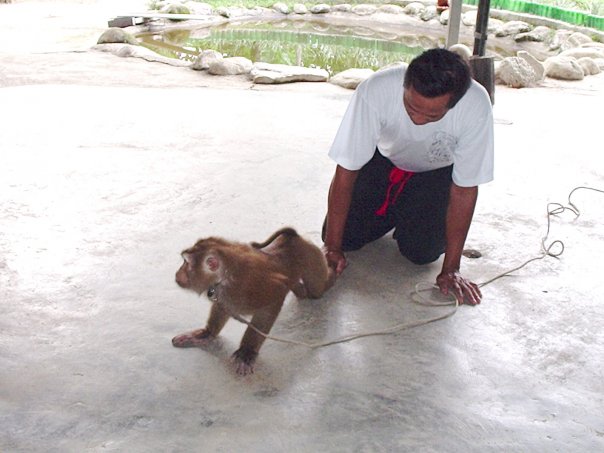
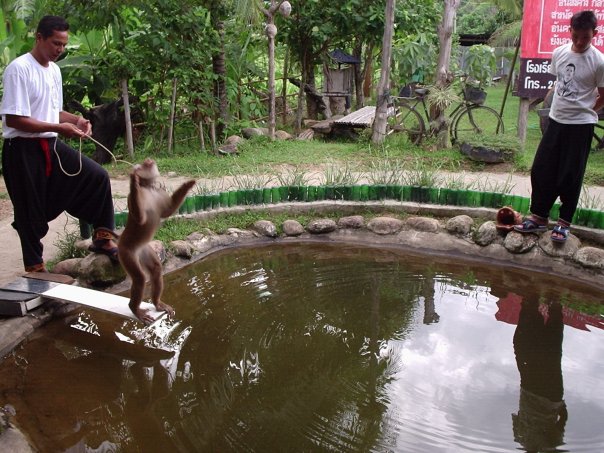
The Thai girl simply said, “Welcome… to live monkey show.”  Then the Thai guy who was just moments ago a fellow audience member, was indeed the show’s leader.  He brought out a monkey.  An impressively trained monkey, who did push-ups, sit-ups, could find the hidden key in one of five cups turned upside down and rearranged, and who dove off a small diving board into a miniature pool of water to find a coin, sometimes while blind-folded.

Of course, to make sure it would become a memory we would not forget, we both had the chance to become “volunteers” to help in the act.  It’s the only time I’ve ever had a monkey in my lap.  Fortunately, he didn’t bite me.

After forty-five minutes of live monkey antics, the show was over.  We knew this when the Thai girl walked back up to the stage and said, “Thank you” and did her Thai bow to us.  Then she walked back to the ticket booth, returning to her other job.

So that’s a Thai live monkey show.  The Thai guy who runs the place serves as an audience member and ring leader, and the Thai girl is the ticket booth operator and announcer.  And a trained monkey with a metal shackle on his foot is the star of the show.  And evidently, two white guys sitting in the bleachers constitutes as a full audience.

When does the live monkey show begin?

As soon as you show up.


The Euphoric Therapy of iTunes: Listening to Music is Like Traveling Back in Time

The only thing I really buy for myself that is not a basic need, is music.  My CD collection now contains well over 700 albums, not including the several hundreds of songs I’ve “traded” with friends via laptop swap or the “borrowing and burning” of each other’s CD collections.   The one material thing that I actually spend money on (though I often buy at a much discounted price at Unclaimed Baggage) is music.

My stereo speakers are never silent as long as I’m the only one in the car.  There are times when I actually get tired of my own massive music library, but even then, I turn the radio to a classic rock station (“I want to know what love is, I need you to show me…”) or an alternative station where I get introduced to current bands like The Avett Brothers (“In January, we’re getting married…”).

Music is therapy.  It’s invisible.  But music has a way of ministering to the soul and to the emotions.  It enhances the mood and the moment.  Music makes sad times sadder and good times greater.  And when I don’t know how I feel, I listen to the abstract vagueness of ‘90’s alternative bands like Stone Temple Pilots, Live, and Foo Fighters.

Music is euphoric. It’s not tangible.  But music has a way of lifting a person’s spirits or helping them to connect and relate to the pain they are feeling at the moment.

Music is a drug. Teenagers use it to “express themselves” (or the idea of who they think they want to be) and to get in touch with their out of control emotions.  Adults use it to relax, to escape, to take a trip to an easier time in their lives.  And yes, music is an addictive drug.

I can not hear Journey’s “Don’t Stop Believing” and not be affected.  Or Phil Collins’ “In the Air Tonight”.  Or my newest obsession, the Scottish one-hit wonder from 1983, “In a Big Country” by Big Country, with its piercing lead guitar riffs reminiscent of a bagpipe:  “In a big country dreams stay with you like a lover’s voice…”

Music is engrained into our pop culture.  It freezes a year, a moment, a memory forever.  Listening to a song can be like time travel.  It stays with us.

And it’s amazing to me how music can make nonsense words and phrases acceptable by the mainstream.  Because seriously, everybody should wang chang tonight.

I can’t imagine a world where the words “I wish I was a little bit taller, I wish I was a baller” meant nothing to me.