Why Do Bad Things Happen to Good People and Good Things Happen to Bad People?

Slight of hand and twist of fate.

One of the most frustrating questions for people who are curious, yet skeptical, about Christianity is the fact that bad things happen to good people and good things happen to bad people.  I can’t claim to have the answer to that impossible question, but I can at least take a stab at it.

Throughout the history of humanization, “man” has struggled to bring glory to himself- if it means conquering and killing, abusing others, taking them as slaves, and any other hellish action that can be filed under the category of “Greed”.  Man has become rich, by taking from others.  Man has become rich, and refused to share with others.  But in the end, it works for man.  Because he gets what he ultimately wants- glory.

Ultimately, being rich and famous isn’t about knowing that you’ll always have all your needs and wants fulfilled.  It’s knowing that you’re above others, in a carnal sense.  That you are special.  That you are envied.  That others want what you have.  That’s the glory of man.

What a waste.

I equate the glory of man with bringing hell to Earth.  Literally raising hell.  Instantly, I can think of three Biblical examples when man tried to bring glory to himself, he ultimately was cursed by God.

Adam eating the fruit from the Tree of Knowledge of Good and Evil, after Satan telling Adam that he could become like God.  Cursed.  The future of man would suffer death, evil, and pain.

Moses using his staff to draw water from the rock for all the people to drink.  Then instead of saying this miracle was by the grace of God, Moses himself took the credit.  Cursed.  He didn’t get to live in the Promised Land.

King David taking a military census with the intention of realizing how powerful and successful he was.  Cursed.  God brought a plague and hundreds and hundreds of people were killed.

In all three instances, God wanted the glory, but man took it from God.

Why do good things happen to bad people? God is blessing them (with power, wisdom, intelligence, money, health, etc.) and they are taking the glory for themselves.  By taking the glory, they are refusing God’s true blessing.  And that may mean that  instead of blessing the people that the bad person influences, the bad person now brings on an earthly curse to them instead.  Of course, in the end, the man who refused to give God the glory will be the one who is cursed in the worst way.

Why do bad things happen to good people?  Because in the end, if that person is willing to glorify God through it, the person will be blessed.  I equate glorifying God with bringing down heaven to Earth.

God wants glory.  And so does man.  Good things happen when God gets it.  Bad things happen when man gets it.  But right now, God is allowing man to do what he likes.  Yes, God may choose to intervene.  But often He does not.  Because it’s possible that through a bad person’s bad actions, God can be glorified through an affected good person’s good actions- those actions include bringing glory to God through it, however they can find a way.

This concept even sheds light on why “you shall not take the name of the Lord your God in vain” is so important that it’s one of the Ten Commandments.  We can chose to use God’s name to sound cool (“Oh my God!”, “Jesus!”, “Lordy, Lordy, Tammy’s forty!” etc.) or we can chose to use God’s name to actually reference Him in a purposeful, postive way (“The only reason the Nashville flood didn’t get my house is because God spared me”).

Because even everyday good people like us still run the risk of taking glory from God.  In our everyday, ordinary events.  I try to keep that in mind at all times.  For me right now, it’s about my wife and I trying to sell our house.

We work hard to keep our ads active on Craig’s List twice a day.  And we keep a good looking “for sale” sign out front with a plastic sleeve containing colorful, creative flyers.  We keep our house in immaculate condition.  Plus, we know for a fact that our asking price is thousands less than everyone else in our neighborhood.

Yet it’s all the other houses that are selling.  All around us.  Because they’re going through realtors and we’re not.

Everyday, throughout the day, together and while we’re apart, my wife and I pray not only for the right person to find our house, but also that God will be glorified through it.  Because as opposed to us saying, “WE sold OUR house!” we can say, “Thank God!  He brought us the right person and they bought our house!”

But even if He doesn’t bring someone to buy our house, if He doesn’t bless our solid efforts to sell our house without a realtor, and we have to throw in the towel and pay thousands to a realtor, God will still be glorified through it.

Our lives ultimately are about one of two things- raising hell (by taking the glory) or bringing heaven to Earth (by giving it to God).

LOST Recap: Finale- “The End”

I loved it.  Absolutely.  And I believe it was the best, and really, only way, to end the show.  But it just took me 24 hours after watching to understand why.

The entire show was just about Jack Shephard.  Everything else, including the island and its ability to heal people and time travel, the Smoke Monster, the Dharma Initiative, the Others, Jack’s friends, Jack’s enemies, the light in the cave… All of it were the parts of Jack’s life that ultimately mattered to his existence.

In the likeness of the movie Vanilla Sky, when you’re dead, it’s all over- so why focus on the character’s earthly life after they die?  But the writers of LOST took that concept to a new level by acknowledging that all the mysteries, actions, heartaches, and triumphs all boil down to one thing- the people that were involved in your life.

Even Vincent the dog’s best purpose on the island was to comfort Jack as he died.

I definitely plan to write much more in the near future answering the remaining questions about LOST: Why was The Man in Black never given a name?  Who was the first protector of the island?  Did it really matter that Desmond and/or Locke typed the code every 108 minutes?  What was really accomplished by Juliet sacrificing her life by detonating the bomb in 1977?

But as for today, I think it’s more important to focus exactly what happened in the finale.  The most begging question is what’s up with the flash-sideways?

The first time we saw the characters of LOST in the finale season, they were on the plane.  Note there were never flash-forwards or flash-backs during the flash-sideways, indicating no past or future in that timeline.  They weren’t reincarnated, having to live their lives all over again, in this version with the island being sunk.  The alt-reality was simply an “acknowledge your dead and that your life mattered” precursor to the afterlife, often referred to as “purgatory” or “the waiting room”; it started with the plane ride.

Keeping in mind that life on the island (and “the real world”) continued after Jack died, that Hurley and Ben served as the island’s protectors for the rest of their lives, that Claire, Kate, Sawyer, Richard, Miles, and Frank all left the island and lived normal lives back in the United States or wherever they chose to re-establish their lives… they all still died at some point.  Most of them of old age, living to be in their 70’s.

And once they died, before going to Heaven, they were reunited, having the blessing remembering how they mattered to each other.  And since time, in essence, doesn’t exist in the afterlife, they all met at the same time, since it didn’t matter that Jack died 40 years before most of them did.

But because Jack was the main character of the show, the show stopped with his earthly death.  The rest of the living characters lived their rest of their lives and eventually died, the show just didn’t continue to follow their earthly lives.

So when Jack died in 2007 (three years after originally crashing on the island), and (say, for example) that Kate died in 2051, they met at the same time in “the waiting room”.  (Because time doesn’t exist after earthly life ends.)  Then they went on to Heaven with the rest in the church.  (And Ben went once he was ready.)

The writers were clever to utilize a nearly universal belief that there is some sort of life after death.  The episode was quite saturated in Christianity (which was a smart idea since most of America identifies with some version of it), yet didn’t write off other popular international religious beliefs, thanks to the “major six religions of the world” stained glass window in the church.  The point wasn’t to depict any religion’s specific teaching on the afterlife as specifically accurate, but to instead play and expound on our perceived general ideas on life after death and the importance of the people in our lifetime after we die.

I don’t see how LOST could have ended any other way.  Yes, technically “all our questions” were not answered.  But it involves using our imaginations and clues from the show to fill in the blanks, as we as Losties have been doing the whole time.  It will bring me much joy to take matters into my own hands by filling in these blanks with many more LOST posts to come.

Comments welcome.

(They will most likely be spun off into a new post if they are interesting, insightful, or raise a good question; or instantly deleted if they are full of nerd spite: “NO!  You’re wrong!  What really happened was…  Looks like you never thought of that while trying to make your weak point, did you?…”).

http://today.msnbc.msn.com/id/37320802/ns/today-entertainment/

The Ethnic Backgrounds of the Cast of LOST

Italians?  Check.  French?  Check.  Koreans?  Check.  Jews?  Oddly, not so much.

When the creators of LOST were in the casting process, they knew they wanted an “international cast”.  Well done.  Who wants to see another show with a bunch of white people and one African-American thrown in for good measure?

The ethnic diversity on the show adds so much to the characterization and even their storylines.  I have gone through the painstaking process (for most, but for me was a lot of fun!) of searching and studying the ethnicity of the entire cast of LOST.  While I won’t bombard my fellow Losties with every single cast member ever, I will feature most of them.  The phrase in (parenthesis) tells where the actor was raised.

Matthew Fox as “Jack Shephard”: Italian-English (America)

Evangeline Lilly as “Kate Austen”: English (Canada)

Josh Holloway as “James ‘Sawyer’ Ford”: Scottish (America); rare in that he is one of the few Southerners on the show- from Georgia in real life, on the show he was born in Jasper, Alabama

Jorge Garcia as “Hugo ‘Hurley” Reyes”: Chilean-Cuban (America)

Naveen Andrews as “Sayid Jarrah”: Indian (England)

Daniel Dae Kim as “Jin-Soo Kwon”: Korean (America)

Yunjin Kim as “Sun-Hwa Kwon”: Korean (America)

Terry O’Quinn as “John Locke”: Irish (America)

Dominic Monaghan as “Charlie Pace”: English-Irish (Germany); he speaks both  English and German

Michael Emerson as “Benjamin Linus”: English (America)

Emilie de Ravin as “Claire Litteton”: French (Australia)

Henry Ian Cusick as “Desmond Hume”: Scottish-Peruvian (both Scotland and Peru)

Sonya Walger as “Penny Widmore”: Argentinean-English (England)

*oddly, married couple “Desmond and Penny” are both in real life half British, half South American

Alan Dale as “Charles Widmore”: New Zealander (New Zealand)

Ken Leung as “Miles Straume”: Chinese (America)

Francois Chau as “Dr. Pierre Chang”: Cambodian-American-Chinese-Vietnamese (America); random fact- he played “Shredder” in the movie Teenage Mutant Ninja Turtles II: Secret of the Ooze

Andewale Akinnuoye-Agbaje as “Mr. Eko”: Nigerian (England)

Nestor Carbonell as “Richard Alpert”: Cuban-Spanish (America)

Elizabeth Mitchell as “Dr. Juliet Burke”: English (America); another rare Southerner (from Dallas, TX)

Jeff Fahey as “Frank Lapidus”: Irish (America); though his character his Greek-American

Cynthia Watros as “Libby Smith”: Greek or Czech (America)

Michelle Rodriguez as “Ana Lucia Cortez”: Puerto Rican-Dominican Republican (America)

Tania Raymonde (Katz) as “Alex”: Jewish (America)

Mira Fulan as “Danielle Rousseau”: Jewish (Croatia)

Katy Sagal as “Helen Norwood”: Jewish (America); played Locke’s love interest, also known as “Peg” on Married with Children

Titus Welliver as “Man in Black (Esau): Irish  (America);  though he looks like Billy Joel, who is Jewish

Mark Pellegrino as “Jacob”: Italian (America)

Since Jews only make up 1.7% of the American population, the three confirmed Jewish actors on LOST accurately and proportionately represent themselves in the large number of actors on the show.  And that’s rare.

Of course, as usual, in the strange case there are no Jews or hardly any Jews on a show or movie (like Family Matters or Family Ties), the producers and/or writers are Jewish.  So it goes without saying, that in fact, LOST creators J.J. Abrams and Damon Lindelof are both Jewish.  Along with Jeffrey Lieber (who most likely is based on his name and physical appearance).  Same thing with LOST writer Adam Horowitz.

It’s safe to say that LOST truly has the most international, most diverse cast of any show in American history.  We as Losties have invested years of our lives in these characters.  They’ve become like real people to us.  I’m so glad this show is made up of such a randomly planned cast of characters and actors.

Read more about the astonishing number of Jewish actors in American film: The Funny Thing about Jews

And one more thing… Now that you’ve read my take on this, why not read my perspective on being a dad?  That’s right- parenting from a dad’s point of view.  I have been documenting my thoughts as a dad since the week we found out my wife was pregnant.  I formally invite you now to read my “dad blog” by clicking on the link below:

dad from day one


The First Steps on the Earth

I like to be where no man has gone before.

Ten years ago during the summer of 2000, I travelled to California for the first time in my life.  The plane landed in Sacramento (which ended up being the hometown of my wife, whom I would meet six years later), then I took a 3 hour bus ride north to Redding.  It was the token instance in my life where the airline sent my luggage to the wrong city.

Meaning that I, along with the group of ten or so others I was with, had to wait until the next day until our clothes and toiletries arrived.  Since that flight, I have always made a point not to bring on any luggage onto a plane other than my carry-on.  (I even spent an entire week in New Zealand in 2007 with just one bookbag of my belongings, which I was able to stuff into the overhead compartment for the flights.)

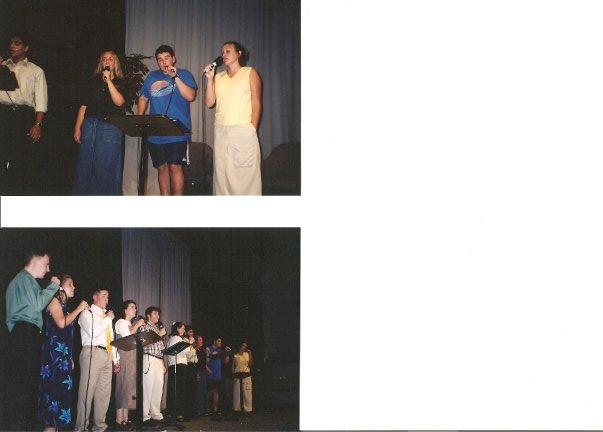
That summer, age 19, I was part of college singing group that got to spend two weeks out in the mountains of northern California as we performed songs at a summer camp and were the actual camp counselors as well.  Best I can remember, we thought we were pretty cool at the time.

Christi Soderberg, one of my friends from the group, always called me Peter Brady, because in an attempt to mock the college’s dress code, I “permed” my long shaggy hair, so that it would appear that my hair was short enough to be deemed acceptable (above the eyebrows, off the ears and collar).  And even after my hair eventually grew back straight, I was still Peter Brady.

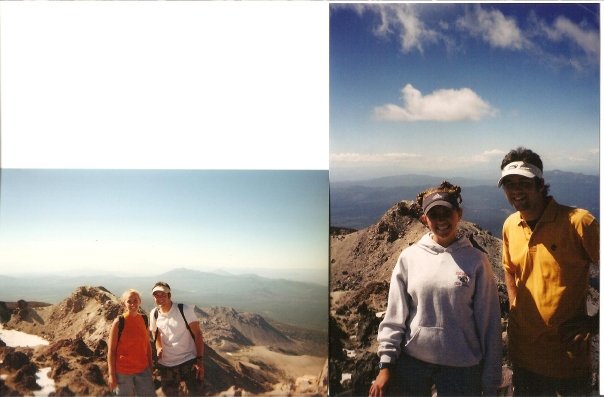
During the weekend between the two weeks of work we were rewarded with a hiking trip to the top of Mount Lassen, which is an active volcano that’s peak is 2,000 ft high.  Because the volcano is so steep, the only safe way to climb it is to hike around and up it, which takes a good two hours minimum.  We started at the bottom in the hot summer sun, but by the time we reached the top, we were marching in snow.

http://en.wikipedia.org/wiki/Mount_Lassen

It was definitely my kinda thing.  Spending a Saturday morning hiking a volcano, shimmying up and over to the most dangerous and scenic spot once I reached the top, finding some weird satellite-type device in the process and wondering how few people in the world have been at that exact spot. That’s something I often think about.

How many people have stepped on the exact spots of the Earth I am standing on right now?  How often (seldom is the better word) do I step on “unstepped” spots?  I try to visualize all the ground around me covered in blue footprints, seeing random spots that have never been stepped on.

I realize the Earth is really old and that billions of people have lived here during its lifetime, but surely sometimes I take the first step on certain corners of the world.

The Winter Olympics is coming to an end.  These athletes (and ice skaters, whom I watch mainly to see fall after they do a Triple Axel jump and also to make fun of their sequin-infused outfits) live for the opportunity to break the current record.  I’ll never know the high that Shaun White gets to experience as he flies through the air on his snowboard.  My only experience snowboarding was in Maggie Valley, NC back in 2001 and involved me constantly falling over every 4.3 seconds.

I’m not an athlete who finds freedom and thrills in breaking records of Olympic history.  Instead, I am an explorer who finds freedom and thrills in discovering new niches of the world.  I may not be able to discover something new, but I can discover something rare.  It’s nothing impressive, really, to the rest of most of the world.  But for me, I thrive on those places and those moments.  Then I can take snapshots of the scenic route.

Related Posts by the Same Author:

The Scenic Route http://wp.me/pxqBU-pL

Parks and Rec http://wp.me/pxqBU-jw

WOLBI Florida Ensemble 1999-2000

My friend Christi Mack and I at the top of Mount Lassen in 2000 and 2001

When History Becomes Folk Lore: At What Point Does Abraham Lincoln Become as Hard to Believe as Abraham of the Old Testament?


To some degree, when enough time goes by, the credibility and “realness” of a once-living person or actual event diminishes.  I was born 4 months after John Lennon died.  There’s no doubt in my mind he existed- I own most of the Beatles’ albums and my favorite song of his is “You’ve Got to Hide Your Love Away”.  However, I was never alive while he was.

But going all the way back to Abraham Lincoln, there’s less information available.  None of us were alive while he was.  Books are written every year about this interesting American hero, yet ultimately anything new we can learn about him is educated speculation.  He becomes more of a mystery as time goes by.  Did he truly derive from English Jews, as some believe?  Was he really 6’ 4”?  Despite his large stature, is it true that he had a high, squeaky voice as some historians have written?

Now go all the way back to over 2,000 years ago to the life of Jesus.  Even most atheists admit that he was a real person who actually lived.  What’s up for debate are his claims to deity and the miracles the Bible states that he performed.  If Christ had lived even 100 years ago, perhaps many people would find it easier to believe in his claims.

Go all the way back to King David and King Solomon.  The Bible records all kinds of details of their lives.  At what point in time do skeptics stop believing in historical accounts? How much does the religious association affect the credibility of their lives, when seen through the eyes of skeptics?

And if we truly rewound the history of time all the way to Adam and Eve, how many people would still be on board as far as believing they both were actual people, and not a symbolic duo representing the origins of mankind?

Time fades the mainstream belief of actual people and events, at least a little.  Once a person dies or a historical event occurs (September 11th, for example), the timer begins.  The more time goes by, the more romanticized or fantasized the person or the event becomes.  Whether or not there is written evidence.  Key example, the events of the Bible.  Or if a more recent event needs to be cited, the Holocaust.  It sickens me that there are people out there who doubt it actually happened.  Despite the video footage that is available.

For many skeptics of Christianity and the Bible, Adam & Eve and Jonah and The Tower of Babel are just moral stories.  Only as real as fairy tales.

I think the exception to the rule is the invention of video cameras.  It’s hard to deny the existence of something we can see and hear, despite it happening before our own lives began.  (Though as just mentioned, some deny the Holocaust.  And there are still plenty of old timers who believe that the 1969 moon landing was a hoax.)  But the historical content of my religious beliefs were not recorded on camera and can not be found on You Tube.

A hundred years from now, we won’t be here anymore.  And that is sad.  Our lives are most relevant to others while we are still alive.  Because a hundred years from now, what proof will be left of us other than our own ancestors?  What good will we be to some random stranger?

That train of thought leaves me with no option but to believe in a life after this.  Not only to believe in it, but to seek it out.  Not only to seek it out, but to know why exactly my religious beliefs are the most believable, the most secure, and most importantly, the only truth.  And by that point, it’s not simply a religious belief, it’s faith.

And one more thing… Now that you’ve read my take on history, why not read my perspective on being a dad?  That’s right- parenting from a dad’s point of view.  I have been documenting my thoughts as a dad since the week we found out my wife was pregnant.  I formally invite you now to read my “dad blog” by clicking on the link below:

dad from day one