Parks and Rec: How Growing Up Near DeSoto State Park in Fort Payne, AL Made Me Who I Am

“A crooked chimney standing in the middle of a field once surrounded by walls of work, by laughter and by love…  It once was beautiful, right here.  It still is beautiful, in here.  You once were beautiful, I hear.  I hear it can be beautiful, just remember.”

– “Just Remember” by Sister Hazel

I grew up in the wooded mountains of Alabama, a few miles down the road from DeSoto State Park and the Boy Scouts’ Camp Comer. It was only inevitable that I would forever enjoy hiking and exploring trails, well past the days of Cub Scouting. Barely marked paths are rough draft adventures that offer something more sacred and wild than any tourist attraction I could know.

Whenever I trek through new terrain, I always wonder how few people in the history of the world have stepped where I step. And I wonder how long it’s been since anyone else was there. And what kind of animals cross the path throughout each day.

Saturday my new friend Daniel is coming over. That means two things will happen. We will play New Super Mario Bros. Wii. And we will go hiking in the woods behind my neighborhood. There’s an urban legend that an Indian man has been sighted out there meditating. And wild boars.


I’m not inspired by sporting events where the players and coaches switch teams each new season. So when another guy chooses to hang out with me, I will find a way to incorporate some sort of exploration of the wild.

In 2001 my dad and I spent a Saturday morning exploring the undeveloped, unmentioned land in between the Interstate and main street of my home town. I had never talked to anyone who knew what was back there. Forty-five minutes into the hike, we found what we didn’t exactly know what we were looking for.

We looked up and it was as if it just suddenly appeared. An old abandoned house with no power poles or roads leading to it, but instead, an isolated railroad track ran right in front of the house.  Only a few miles from civilization, yet completely forsaken. The entire house was covered in moss. We dared to step inside.

The front door was already open. The couch in the living room was rotted out. The floor of the back bedroom and bathroom was gone. The only proof of recent life was in one of the kid’s bedrooms. Blue shag carpet. Tinker toys. And the local newspaper, The Times Journal, from 1986.

The year I started kindergarten was the last time a family had lived there, evidently. In a way, my dad and I discovered it. If anyone in my town wanted to know details about this forgotten house, they would have to come to us. Otherwise, for all practical purposes, it doesn’t exist.

And it’s that sort of discovery that is the motivation for my constant attraction to hiking the woods. It’s what I do. I thrive on it. Not hiking a three day excursion through Catskill Mountains surviving on Cliff Bars and filtered urine. But just finding simple forgotten pockets of wilderness wherever I am.

Today I spent my lunch break from work hiking in the woods behind my office building and found a mysterious soccer field with no parking lot or road leading to it. And an old pony stall. And a frozen baby snake. Perfect.

And as I was searching for pictures of Canyon Land yesterday I stumbled into a new discovery about myself. I am fascinated with abandoned amusement parks. While I didn’t successfully find many pictures of Canyon Land, I did come across several others that fellow abandoned amusement park enthusiasts have taken the time to post. These wonder-playgrounds that once brought thousands of people joy now sit tucked away on the corner of town.

Maybe I romanticize the situation. I see them like Cinderella waiting for someone to come along and save them, bringing them back to their full potential. Like Jim Carrey in The Majestic, I imagine bringing the lost back to life. But for now, these broken-down Ferris Wheels and rusty roller coasters sit quiet like Atlantis.

Below is a collection of the beauty and wonder I see in abandoned amusement parks.  Sometimes creepy.  But what a life they once saw.


And one more thing… Now that you’ve read my take on this, why not read my perspective on being a dad?  That’s right- parenting from a dad’s point of view.  I have been documenting my thoughts as a dad since the week we found out my wife was pregnant.  I formally invite you now to read my “dad blog” by clicking on the link below:
dad from day one


What Ever Happened to the Amusement Park Called “Canyon Land Park”, Near Fort Payne, Alabama?


During the early 1970’s up until circa 1983, there was an amusement park called Canyon Land, just a few miles outside of my hometown of Fort Payne, Alabama on Lookout Mountain. In ‘70’s fashion, very comparable to the Dharma Initiative on LOST, Canyon Land could best be described as “1977 carnival meets small zoo”. One of the rides was a ski lift that took people over an actual canyon, Little River Canyon.

Being that I was born in 1981 and the park closed a few years later, my descriptions aren’t based on me being there during its prime. But my parents did go on dates there as teenagers.


Fortunately in 1993 (7th grade) my church youth minister Eddie McPherson was able to rent the shut down amusement park for $4 for the Halloween season. Our youth group put on an evangelical version of a “spook house” called Hell House. We used the old roller coaster carts and its track to manually push the guests through a “no flashlights allowed tour of hell” which ended with a bright room featuring Jesus (played by my dad) who invited them to Heaven.

It was a lot of fun for a 12 year old kid to explore that old place. The grass was taller than I was, where the parking lot used to be. Much of the place had basically been frozen in time as it evidently was abruptly shut down. In a room that stored all the old ski lift chairs, I found a completely intact Mellow Yellow can from 1979 (which I still have in my old bedroom at my parents’ house.


The urban legend is that the man who ran the place just let all the zoo animals go free into the woods. Therefore, to this day, jaguars and monkeys and all kinds of exotic animals can still be spotted on a lucky day. That would be fun to believe.

Because I helped resurrect Canyon Land for a few weeks in 1993, I tend to imagine what current lively buildings and attractions would be like if they became old an abandoned. Like Starbuck’s, for example. Twenty years from now, will all those Seattle-esque building be defunct? Like the old Food World building that remained years after the Super Wal-Mart came to town.

Not so much a ghost town. But a ghost attraction. Once filled with people laughing and buying ice cream. Now, only visited by raccoons.

Canyon Land is so forsaken that not even the Internet really acknowledges it. No Wikipedia entry. The best Google was able to do was take me to Ebay where someone is trying to sell Canyon Land postcards and tickets from 1970.

http://cgi.ebay.com/Fort-Payne-Alabama-Canyon-Land-Park-Card-Tickets-1970_W0QQitemZ310185209860QQcmdZViewItemQQssPageNameZRSS:B:SRCH:US:101?rvr_id=

Also, for anyone who would like to purchase Canyon Land, it’s currently for sale. For the low, low price of $2.4 million.  http://www.mycampgroundsforsale.com/park_detail.asp?ID=11


People are the Meaning of Life: The Rich, The Poor, and The Loved

There are three types of people in the world. The rich, the poor, and the loved.

I recently watched the deleted scenes from the holiday movie Love Actually. The camera zooms in on a poster of two African women in the hot desert. They are carrying baskets full of corn on top of their heads – a scene that would cause many viewers to assume they live a difficult live. As their camera gets closer to the shot of the women, the picture comes to life.

Through subtitles at the bottom of the screen, the viewer learns that these women are indeed quite happy. They are simply carrying food from their garden as they do each day, talking about their husbands and their children. The scene closes with one of the women with her husband, looking out across their small plot of land. They lived a simply life, but were quite content. They had each other and had enough to eat. Though it wasn’t a feast.

A few weeks ago I viewed a slide show called “What the World Eats”. Each slide featured a family from a different country pictured in their kitchen with all the food they eat in a week’s time. One of the poorest families featured was from Ecuador. Their kitchen was simply a corner of their hut. They only ate vegetables, I’m sure not by choice. But they sincerely looked happy in the picture. They had each other and enough to eat. Though it wasn’t a feast.

Here is a link to that slideshow I saw :

http://www.time.com/time/photogallery/0,29307,1626519_1373664,00.html

While much of the world experiences constants civil wars and famine and corrupt governments, not all “poor countries” are suffering. They just live on a lot less than us. And are happy. Not all cultures require a family to own a large house and a minimum of two cars.

Subconsciously, I have been pitying every foreign country poor enough not to have their own national brand of vehicles or their own equivalent to American Idol. But perhaps, they have been pitying me, the Capitalist. Living in a land where it’s easy to end up focusing on chasing money for an entire lifetime.

My church has a ministry where they take in refugees from northern Africa, Iraq, and Southeast Asia. The church helps them to find jobs and an apartment to help them “get on their feet”. Some of them have expressed that life in America is not as easy as it has been romanticized.

While it is the land of the free, it is also the land of the working. Many are surprised by how many hours Americans must work a week to support their families and keep up the maintenance of even one car, which is all but necessary in our culture.

Obviously they are glad to be here instead of imprisoned in a refugee camp in a country plagued with violence, racism, and religious discrimination. But to be an American typically means a person must work the majority of the hours of the week.

From what I’ve been hearing from people outside this country, something Americans are known for is being obsessed with their work. But I don’t know. I’m not an outsider.

I do know I only have about 3 quality hours (at very best) each weekday with my wife. Because she’s in her Master’s classes all day Saturday, the only day we really have together is Sunday. And by then, we’re exhausted from the work week. I’m realizing I envy families who actually get to spend time with each other.

My wife has said several times that she would have like to live in the pioneer days of covered wagons and schoolhouses in the West. Not me. Too hot. Too cold. Too easy to get sick. To easy to die. No thanks.

However, this is the only life I know. If I never knew the comfort of an air conditioner in a house or road trip in an SUV with a CD player, then I wouldn’t know what I am missing.

I thank God for my life in America in 2009. Such a blessed country.

But in my time of seeing happy, simple families in poorer countries I have traveled like Trinidad, Ecuador, and the northern mountainous villages of Thailand, I became aware that I wanted what they had.

A big house and trendy clothes and new cars mean working more to keep up with the high overhead. I try to imagine a life where the picture is so beautiful, even if the frame isn’t fancy. That’s the life I’m aiming for.


My Jewish Upbringing

“You’re just another face that I know from the TV show.  I have known you for so very long.  I feel you like a friend.”

– “Turn It On Again” by Genesis

When I was in 6th grade (1992-1993) my friend Chad Mathers was telling me about this funny TV show he had began watching called Seinfeld. He explained that the main character was Jewish. Then he said to me, “You’re Jewish, right? Your mom looks Jewish, so that means you are too.” I replied, “Yeah, I guess I’m Jewish.”

Most of my classmates knew my mom because she was a substitute teacher. And they knew by her physical traits she wasn’t just “American”. She was something ethnic. No one really knew exactly what nationality she was, though. Neither did I. Because I just never thought to question it as a kid.

In fact, I had every reason to believe I was Jewish. My mom was always using words like, “kosher”, “schnozzle”, “finagle”, and “hoopla”. (Though only those first two words are actually Jewish words.) And she always perfectly and naturally handled the family budget- she now works at a bank.

Her parents: My grandfather was 5’ 6”, dark-skinned, curly haired, and had the “schnozzle”. He never used the word “church”- instead he called it “tabernacle”.  The only kind of bread he ever had at his house was Jewish Rye.  He saved most of his money and when he rarely bought a new car, he paid for it in cash. My grandmother is 4” 8”, even darker-skinned, with long black hair. Neither of their accents helped- respectively Kenosha and Buffalo. Seemed Jewish to me.

Most Jews living in America have German last names, often including “sch”, “stein”, “berg”, and “man”. My last name, Shell, is German and was originally spelled “Schel”.

And my family has always been close. Every holiday and birthday was spent together. Meatballs were often a part of the meals. Only they weren’t Matzah balls.

My earliest memory of learning my true heritage was in 9th grade. Evidently it took that long for me to be self-aware enough to question my heritage.  It’s not that I actually thought I was Jewish before, it’s that I didn’t question it.  I just assumed.  But despite all the Jewish clues, I learned I wasn’t all that Jewish. My grandfather (Albert Metallo) was Southern-Italian and my grandmother (Lola Mendez) Central-Mexican. And on my dad’s side, German and English.

But after doing some in-depth some research, I learned there’s a good chance that too of my great-grandmothers were Jewish (Wiseman and Vite), not to mention a Green and an Ullman a little bit further back.

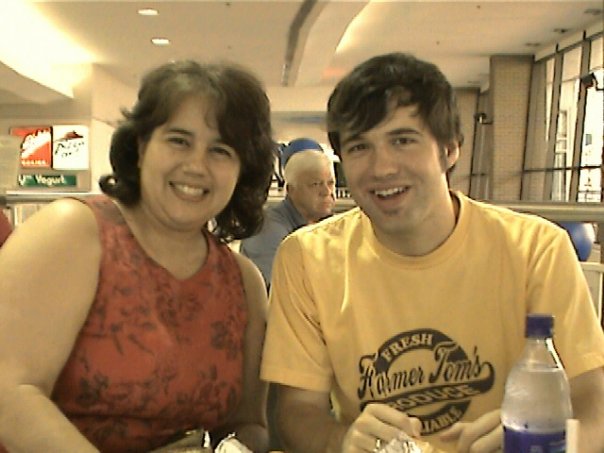
My mom and I in 2004

While I’m fully proud of my actual heritage, I feel more Jewish than I actually am. Thinking back on the last decade, the celebrities that people have said that I look like are all Jews: David Schwimmer, David Arquette, Paul Rudd, Zack Braff, and Ben Savage (from “Boy Meets World”). And I have played Jesus in more church skits and plays than any of my friends, because I always “looked the most Jewish.” I was the obvious choice.

And like the Genesis song “Turn It On Again” talks about, the characters I knew from the movies and TV shows (and even musicians) I watched growing up became like family to me, in a very cloudy, subconscious sort of way.  In particular, as I kid I thought I was Kevin Arnold (Fred Savage) from The Wonder Years.  And in talking to my sister in preparation for this post, I learned that she always thought that too.  We never knew that we both thought that until now.

The Three Stooges. Seinfeld. Friends. Pauly Shore. Bob Saget. Ben Stein. Howie Mandel. Dustin Diamond. Adam Sandler. Andy Samberg. Bob Dylan. Billy Joel. Just a few Jewish people who have surely influenced the culture of my life in some minutely tangible way.

Several years ago I stumbled across an obscure brand of wine that evidently has become my favorite.  The name caused me to think it was German.  But once I read the label carefully, I realized it is wine mainly used for Jewish services.  It’s Manischewitz brand, one of the nation’s leading brand of kosher products.

And this year I officially stopped eating pork and shellfish. Therefore the word “kosher” means something important to me. It means “hot dog I can eat”.

Some Jews actually have no Israeli blood, but they convert to the religion of Judaism. I sort of feel like that somehow. However, the only Jews that believe Jesus is the true son of God are the Messianic Jews.  Clearly put,  I feel like a Gentile (a person is not from the lineage of the nation of Israel) who has converted to Messianic Judaism. Yes, I’m a technical Messianic Jew.

Batman or Superman?

I never realized what an epic question it is. But ask someone, while being sincerely enthusiastic, and you’ll watch that question become a conversation worthy of a bonfire setting.

Not a question of who’s better, or more popular, or cooler. Just simply:
Superman or Batman? In fact, I’m learning it’s one of the best questions one human being can ask another.

What do both of these superheroes have in common? They both came out at the same time. Respectively, 1938 and 1939. They both were created by Jews. Respectively, Jerry Siegal and Bob Kane. And they both have had several incarnations of television shows and movies in their 70 years so far.

Superman Pro’s:
He can fly. He has a steady love interest. Well-balanced American values. X-ray Vision.

Superman Con’s:

Nerdy alter-ego. He has a boring day job. He’s a not even a human- he’s a freakin’ alien. Must have easy access to telephone booths.

Batman Pro’s:
Intimidating costume. He has a faithful sidekick. Billionaire. Cool gadgets and martial arts training.

Batman Con’s:
Can’t really fly. No X-ray vision. Traumatic childhood. Lives in a cave and seems to like it that way.

Major differences:
*Superman is an alien pretending to be man. Batman is a man pretending to be a bat.
*In the 70 years of existence of both superheroes, Superman tends to be more popular among who were young during the first 35 years (1938-1973), whereas those who were young during the 2nd half of the 70 years (1974-2009).
*Superman has had more positive exposure through TV shows throughout the decades. Batman has had extreme success through several movies in the last 20 years.

My first instinct was to say that Superman is better. Almost seems like the obvious choice. He’s was raised in the rural Midwest by Methodist parents. He embraces the average American image. And has perfect blue/black hair.


But Batman is more of a real person to me. With the murder of his parents when he was a young boy, he had to both deal with that and take over their empire business. (Superman’s parents were murdered too, but he was just a baby when it happened.)

He is dark and mysterious. And intentionally embraces the whole bat theme simply because he thinks it’s creepy. So he knows it will freak out his enemies. Which he has plenty of, unlike Superman.

To many, I’m sure Superman has much allure simply because he is just that- a super man. With super powers.

But I choose the underdog of the two superheroes. Batman is a real man with no special powers. He is a self-trained man who worked hard to get where he is. He just uses cool gadgets and fights in hand-to-hand combat. Oh, and he has a really cool car.