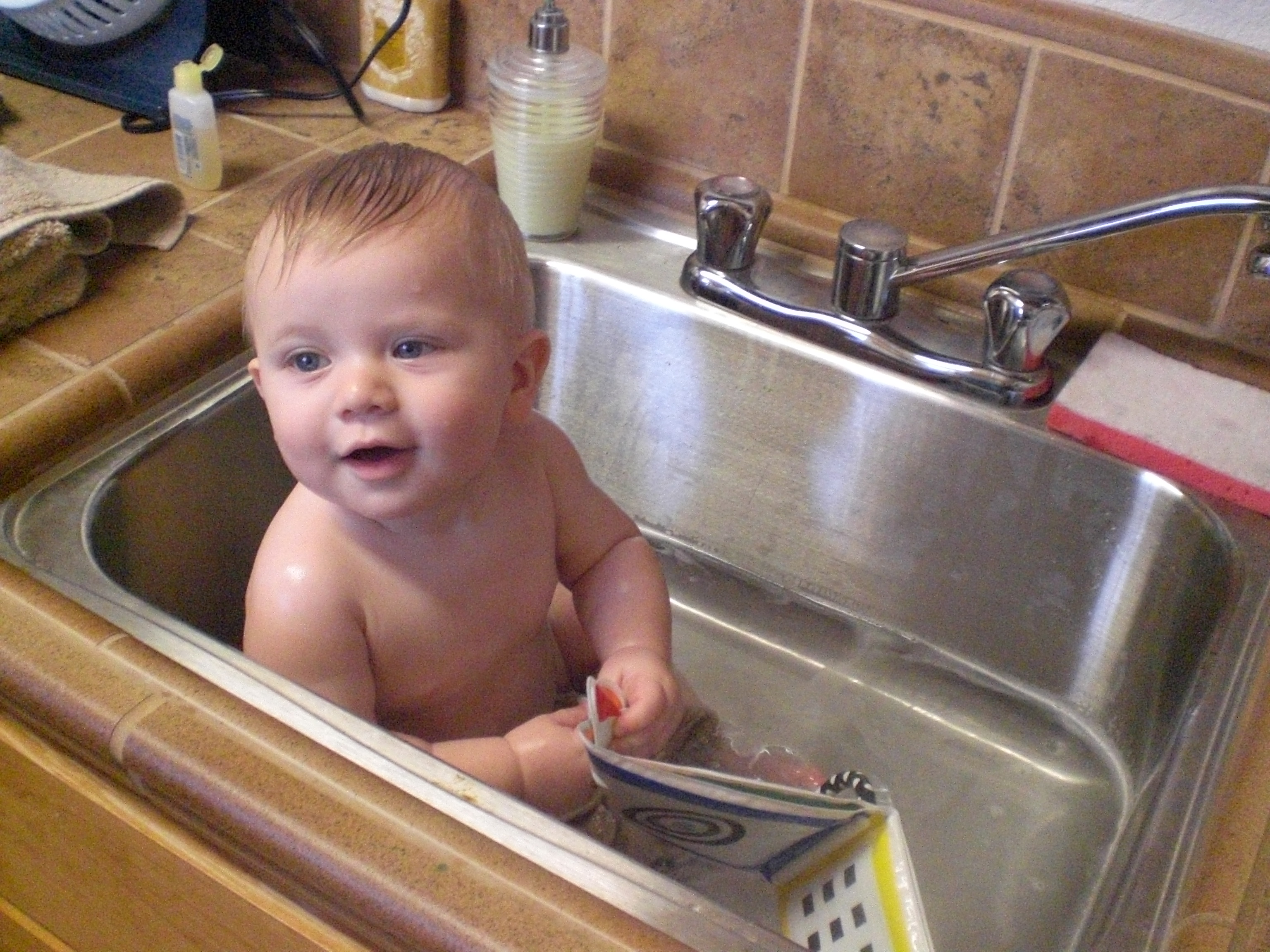
My 15 Month-Old Son’s 30 Year-Old Yellow Blazer

March 4, 2012 at 8:35 pm , by 

15 months.

Get used to seeing my son Jack in this suave, retro blazer, paired with a pumpkin-accented plaid shirt because as his dad, I’m going to get as many miles out of this outfit as I can while it still fits him.

This weekend we decided to dress him in my old jacket and shirt from when I was literally his age.

From a walk in the park to lunch at Kalamata’s Greek restaurant to a quick visit to the pet store, Jack was rockin’ the jazzy new-wave wardrobe.

Like most parents of toddlers, I am not willing to spend much money on clothes that my kid will grow out of in a few months from now.

But being that Jack’s jacket and shirt were free, because they were a gift for me three decades ago, he gets to be a baby fashion model for the time being.

In the Spring of 1981, right before I was born, my Italian great-aunt Margaret Metallo in Kenosha, Wisconsin sent my mom a yellow blazer with a “matching” shirt from Sears as a gift for her soon-to-be born bambino, Mario Eugene Shell.

Yeah, uh… that’s me. However, after I was born, my parents recognized that despite my mother being half Italian and half Mexican, I looked  ”too white” to have such an ethnic name as Mario.

So nearly 2 hours after I was born, my parents officially gave me my name: Nicholas Shane Shell.

By the time I reached adulthood, my features got darker and I finally looked more like a Mario. Though honestly, I probably look more Jewish than anything.

And now I’ve got a son who’s even whiter than I ever was: Yellow hair to match the jacket and marble blue eyes to compliment it. Honestly, Jack pulls off the yellow blazer better than I ever could.

I think it’s safe to say that jacket came before it’s time: Ultimately, it would be another 30 years for the perfect little bambino to come along to legitimately model it for the world.

You’re welcome, Sears.

Investing in the Undervalued and Underappreciated

September 3, 2011 at 7:38 pm , by 

Nine months.

On Thursday, October 5th, 2006, I looked across a large, crowded room and saw a beautiful 25 year-old girl who had no legitimate reason to be alone. In that wishful moment at The Factory in Franklin, Tennessee, I thought about how wonderful life could be if I could get that beautiful Puerto Rican stranger to fall in love with me. Turns out, she wasn’t Puerto Rican; it also turns out, she didfall in love with me- but it took exactly four months to the day for her to see me as more than just a friend.

Without knowing it, I applied a long-standing business principle of billionaire Warren Buffet, as explained in his son Peter Buffet’s book, Life is What You Make It:

“The idea is elegantly simple. Find something the world underappreciates, support it, don’t meddle, and allow time for the world to catch up in its valuation.”

I basically can’t stop obsessing over that very true concept. It doesn’t just apply to business; it appears to life in general.

How did a guy like me end up getting a girl like Jillanne Tuttle to fall in love with me? More importantly, why was this girl still even single, anyway?

Because she was underappreciated. So I supported her. And I didn’t meddle. Needless to say, it worked. That’s the only way I could have gotten a girl so out of my league like that.

I ignored the bad advice of well-meaning guy friends who tried to tell me I should come on strong and ask her out on a date from the very beginning. Instead, I privately vowed to be her friend first, not meddling with our friendship. Then interestingly, on February 5th, 2007, a switch flipped; she finally saw me in the romantic way that I had seen her from day one.

Is it crushing to my ego that she didn’t immediately fall in love with me for my weird and random conversations, not to mention my physical likeness of a plethora of Jewish actors such as Fred Savage, who played Kevin Arnold on The Wonder Years? (Featured right, with his son.)

Not really. Subconsciously I knew back then that if I were to truly capture the attention, as well as, the heart of this girl, it would take more than all the culturally valuable assets I didn’t possess.

The truth is, I happened to be the right guy in the right place at the right time, making a conscious effort to invest in a person who others foolishly overlooked. So I made the most of it. Thank God it worked.

That same principle is how The Dadabase was born. I realized there was all kinds of information for moms-to-be, but not for dads-to-be. So a few weeks after we found out we were going to have a baby, I decided to start a weekly blog from my fatherly perspective. Sure enough, that was sort of a rare thing- unique enough that  American Babytook notice in their magazine in October of last year.

And when Parents.com started asking around in their search for an official daddy blogger, I happened to be the right guy in the right place at the right time, because their sister magazine American Baby had featured my blog on page 13 of their issue just five months before.

In other words, I found something the world had underappreciated (parenting advice and narration from the dad’s perspective), I supported it, I didn’t meddle, and the world began to catch up in its valuation.

As for using this concept in parenting, I’m already seeing how it translates. No other humans can see more value in my son than my wife and I can. So we will reasonably support him, do our best not to meddle in ways we shouldn’t, and wait for the world to catch up in his valuation.

It’s wild to think that we are surrounded by underappreciated things in this world everyday, just waiting to be supported and valued. What great things are we missing out on simply because certain rocks haven’t been turned over and certain doors have never been opened?

Some possible answers could include “flying cars like in Back to the Future, Part II,” “cell phone watches like Penny and Brain had on Inspector Gadget,” and “the comeback of Pepsi Clear.”




Effectively Communicating in Marriage: The Jack Tripper Version

August 24, 2011 at 10:45 pm , by 

Nine months.

For certain, I am overly aware of all the things I’m not good at; a few of which include math and anything involving numbers, all home repairs, anything to do with cars, anything requiring athletic talent, navigating without getting completely lost, knowing when to say “my wife and I” versus “my wife and me,” and pretending to care about the newest “shocking” thing that Lady Gaga did, said, or wore.

But I do think one of my strengths is communicating and empathizing with other people; or at least it’s something I’ve gotten a lot better at in recent years. I keep in mind that when it comes to relating to others, it’s not a matter of “do unto others as you would have them do unto you.”

Instead, the rule is “do unto others as they would want you to do to them.” Because I can’t assume the other person is inspired by the same things I am. Instead, I have to put myself in their shoes.

It’s a matter of knowing what motivates and discourages other people.  It’s a matter of reminding myself that listening is typically more effective than speaking. People often need to be and feel understood before they will want to receive advice or instruction.

Despite me being hard-wired to always want to “fix the problem,” I have definitely improved my ability to sincerely listen to my wife when she airs out what is going through her head, without trying to save the day by providing a reasonable and logical solution; or even asking “what can I do to help?”  But I still have to remind myself that 99.987% of the time, listening itself is the best way to fix the problem.

But there are certain times where there actually is a legitimate issue that needs to be handled and my wife actually does need my help to fix it. She is keen and conspicuously clued in enough to know how to present the problem to me in a way that doesn’t come across as “nagging.” Instead, she knows that the best way to effectively communicate with me, in that instance, is to literally ask for my help. Because I always want to help her.  It makes me feel good as her husband.
We are not manipulating each other but instead are simply acutely aware of the way we need to be communicated with. And this concept doesn’t just apply to my marriage; it works for all relationships in my life: friends, family, coworkers, and even people I don’t even know that well.

Do I need to issue an obligatory disclaimer admitting that my wife and I have only been married for three years and therefore I have not earned the right to give out marriage advice? Am I only triggering some readers to respond with, “Well you just wait until you’ve been married longer…”?

I admit; I have far to go and much to learn. If I am an expert of any kind, it’s in not being an expert.

So I am just a normal guy having to figure out these things as I go, especially when it comes to marriage and fatherhood. Constantly I am realizing that if I only knew yesterday what I just learned today, things would be a lot less complicated and frustrating.

As a husband and father, I have a tendency to be as clumsy and misunderstood as Jack Tripper fromThree’s Company. Similarly, I also unintentionally make a habit of stumbling my way out of the current crisis within 30 minutes, right before “Come and knock on my door…” starts playing again for the closing credits. Maybe my life is just one big sitcom!

(Cue the laugh tracks.)

Little Boys Live in Their Own Little World

How Teddy Ruxpin Subliminally Taught Me the Generation Y Trait of Being Motivated By Happiness, Not Money

Whether you are motivated more by wealth or happiness, it’s still a pursuit.  No guarantees for either one.

Maybe Teddy Ruxpin is the reason why today I prefer vests over neckties. Back in the Eighties, all my friends would put their fingers and pencils and crayons in their Teddy Ruxpin doll’s mouth when he talked- but my mom wouldn’t let me do that to mine because she said it would mess up his mouth. She was right. My Teddy Ruxpin worked fine for years and years after my friends’ Teddy Ruxpins ultimately broke down for good. Since Kindergarten (1986) I have been having brief flashbacks of this live-action puppet after-school special of The Adventures of Teddy Ruxpin I saw once where he and Grubby fly in an airship to find a hidden treasure and get captured by mud people.

Recently, some hero posted the one hour made-for-TV movie on YouTube. I watched it all the way through. Teddy Ruxpin and his friends discover a room full of golden treasures but choose instead to take only these crystal necklaces with words like “truth”, “honesty”, and “bravery” on them. Because “these things are the real treasures”. Right. Of course.  Then the bad guys take the real treasure (gold), but because their attitudes were wrong, the tresure vanishes into thin air once they touch it.

Golden treasures are typically a let-down in movies and TV shows, for the most part at least. From what I remember about most “treasure hunt” movies, the heroes ends up choosing some kind of abstract moral principle over the actual golden treasure, which is actually a trap or illusion for the villain. The only semi-exception I know of is the movie Without a Paddle. They get the moral treasure (which in this case was “life itself”) and also $100,000 cash, which the two richer friends give to the poorer friend.

Usually I am pretty quick to pick up on recycled plots, but it’s taken me until just recently to realize this one about “the real treasure”.  Interestingly, in my research about Generation Y (people born from 1982 and 2001), I learned that one of their main characteristics is that “being happy” is their main motivational drive, not money or wealth, as is the case with many of the older generations.  I would have to believe it was this common “love/life/joy is better than gold” theme in entertainment during the Eighties and Nineties that has something to do with the way Generation Y is wired.  Though I was born in 1981, I was still born close enough to the generational switch that I admit my main motivation in life is happiness, not material wealth.  And maybe that’s dangerous- because for some people, finding financial success could actually be easier than finding perceived happiness.

“The mind is its own place, and in itself, can make a Heaven of Hell, a Hell of Heaven.”  –John Milton