Baby-proofing the House: What Would Jack Do?

June 28, 2011 at 10:27 pm , by 

Seven months.

The Dadabase

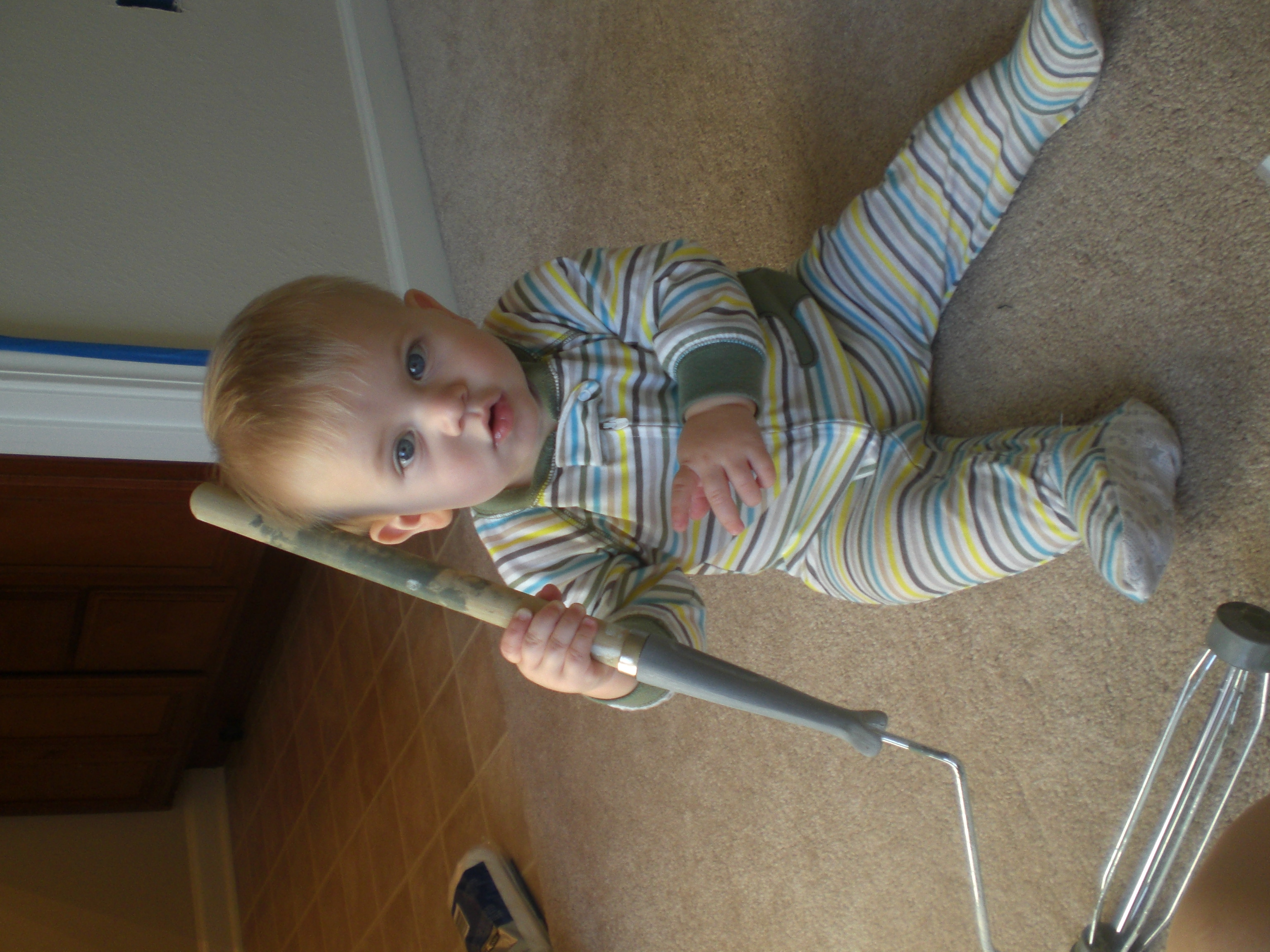
In every situation, before every action, I must ask myself, “W.W.J.D?”  No, I don’t need a bracelet to remind myself to consider what Jack would do.  Now that he is crawling, and therefore exploring the new world, I am overly aware of all the trouble that Jack can get himself into.  Because granted, by law of babyhood, a baby boy will without exception gravitate towards the item of the most potential danger.

Why would Jack want to be entertained by an age-appropriate singing toy when he can get his hands into my laptop cords?  Why would he choose to simply play with a paper towel roll when he could eat it (!) instead?  Yeah, needless to say, after one solid week of enjoyment, Jack’s beloved paper towel roll as made its way into that glorious toy box in the sky.  He only ate part of it, but still, he ate part of it!

The Dadabase

Jack with his Pappy and Nonna (my parents) on Memorial Day 2011.

By default, Jack chooses the most dangerous option over any safe one every time.  Therefore, I must do his decision making for him.  Not only must I intervene on a moment-to-moment basis, but I must also put my future-predicting skills to good use.  I must prevent the accident before it happens.  And I must do this constantly.

We recently had to officially lower his crib because not only did he begin bumping his head on the rail by pulling himself up, but also because we wouldn’t put it past him to be able to climb up his crib and fall out on the ground.

One morning last week, Jack and I were awake before Jill.  As a joke, I lifted him out of the crib and let him start crawling. He crawled out of his bedroom and past the doorway of our bedroom. Jill’s instincts kicked in: She instantly woke up when she heard him crawl up to the doorway.

My plan worked: She thought Jack actually escaped the crib on his own! The prank was successful and boy was I cool.

But while it was a tad far-fetched that Jack would escape his crib unharmed, it’s not that impossible knowing Jack.  He’s sort of an escape artist.

I know every parent believes their kid is the smartest ever; and I’m no different.  But the boy seriously impresses me in his ability to figure stuff out without assistance from his parents. He’s large for his age, he’s strong, and he loves to explore.

Lesson learned: Never underestimate the ability of Jack. That includes him eating cardboard.

In Memorandum

Jack’s paper towel roll toy

June 16, 2011 – June 24, 2011

The Buddy Factor of Being a Dad

June 27, 2011 at 10:59 pm , by 

Seven months.

The Dadabase

I believe everyone has multiple personalities and different versions of themselves that they reveal based on their environment.  But these multiplicities of ourselves ultimately are still built on top of one default personality.  My default personality is amazingly similar to the character of Peter Klaven (portrayed by Paul Rudd) in my favorite movie ever, I Love You Man.

The movie focuses on Peter’s lack of ability to make and keep strong male friendships and the difficulty that means for him in trying to find groomsmen and most importantly, a best man, for his upcoming wedding.

Most of my guy friends are scattered across the country; instantly available via text message, but not for hanging out with on a regular basis.  And I’m completely okay and comfortable with that.  And interestingly enough, whether it was my female-orientated major in college (English), or every work environment I’ve been in since then, I’ve constantly been surrounded by women instead of men.  And again, I’m completely okay and comfortable with that fact.

Even here on Parents.com, I’m the only male parent blogger.  It is simply my life’s destiny to be a guy who relates to women almost as well as I relate to men.  Need I remind you, it’s mainly women reading The Dadabase.

(Granted, my wife edits out anything too masculine or overly male-driven.  Recently, she had me delete several paragraphs which went on way too long about the details of a Nintendo game.)

But now I have a son.  A baby boy who will eventually grow into a big boy who will eventually grow into a teenage boy and eventually a man.  This means that I will ultimately have a buddy.

I will always have a reason to get to do what I want to do with my free time, as long as Jack is with me.  Because I will be spending quality time with him while I do what I enjoy anyway (or at least enjoyed in my youth).

Already, I’m mentally working on a list of things I will enjoy doing that also will serve as good male-bonding, quality time with my son over the next 2 to 20 years:

1)     Watch the entire series of the following movies and TV series: Rocky, Star Wars, Harry Potter, Band of Brothers, and Lost.

2)     Go hiking and exploring in the woods on the weekend.

3)     Build awesome Lego sets.

4)     Take our bikes for a long ride in a new neighborhood.

5)     Have old school Nintendo game marathons.

6)     Blow stuff up with fireworks.

7)     If ever can ever afford it, take him on a trip to Thailand.

The Dadabase

Of course, this is only the beginning of my list.  But I really look forward to the underlying male friendship in my father-son relationship with him.

I am adamant on being Jack’s father, not his friend.  However, just like how I mentioned in the beginning that we all have different personalities, I know that a father is not simply the paternal figure of his son’s life.  Being a good dad means being someone to relate to and it involves a lot of mentoring.  It requires good communication and quality time.

Being a father is like being a friend, but it’s so much more than that.  Yet it’s paradoxically both more casual and more demanding of respect than simply being a friend.  But even though I won’t refer to my son as my friend, I will gladly call him my buddy.

Man, now I’ve got the jingle to the 80’s toy, My Buddy, stuck in my head:

“Wherever I go, he goes… My buddy, my buddy, my buddy and me!”

All pictures taken courtesy of Dave Stanley at Little River Falls in Fort Payne, Alabama.

The Difficulty in Men Truly Being Honest

June 26, 2011 at 8:47 pm , by 

Seven months.

blue eyes baby

The main way to be honest is to refrain from lying.  The other way is to refrain from hiding your true thoughts and feelings.  The latter is so much harder than the former.

Something I’ve never been good at, nor cared to improve, is the ability to use the #1 traditional American greeting: “Hi, how are you doing?”

Because even as a young kid, I have questioned the practicality and sincerity of that extremely personal question which acquaintances use to greet each other with.  I remember when I started pre-school (in 1985), asking my parents how I was supposed to answer that question. They  told me to say, “Just fine.  How are you doing?”

So that’s how I would respond to being asked how I was doing.  By the time I got to Middle School, I got so lazy at it that I just began simply answering with a mumbled “Doing good, doing good.”  Conveniently for me, I learned that people were so used to having the questioned returned on them, that they assumed I was saying, “Doing good, and you?”

And at age 30, that’s still what happens to me on a daily basis.

I just can’t take something seriously if I find it to be anything less than sincere. Sure, I’m definitely over-analyzing our traditional American greeting.  But to me, I feel that most of the time, we’re not actually asking the other person how they are doing.  Why?

Because I’ve observed that so much of the time when people ask me how I’m doing, they don’t even look me in the eyes, and they just keeping walking past me as they say it.

For me to honestly answer that question, the person asking it A) has to be someone I know well and be able to be vulnerable enough to tell them how I am really feeling and B) has to show me with their body language that they actually care about the answer.

Am I being too honest by admitting that when I ask someone how they are doing, after they have just asked me the same question, that nine times out of ten I’m not really concerned with their answer?  The exception is if the other person was being so open with me that their answer was anything different than perfectly positive:  If the other person is admitting they are having a tough day or that something interesting (good or bad) was going on in their lives, I would jump on the chance to explore what’s going on in their lives.

Why?  Because when it comes to relating to people, I am action-based, not emotion-based.

I understood this concept much more clearly when I spent the summer of 2003 (and 2004) in Thailand teaching at a Christian school.  As I was immersed in Thai culture, it didn’t take me long to realize that I was hardly ever asked by the Thai people how I was doing.  Instead, they asked me what I was doing, what I did earlier that day, or what I would be doing later that day.  If I was holding a bag of snacks I had just bought from the store, they would reach for my bag, asking about my recent purchases.  For that reason alone, I felt so at home and so connected with the Thai people.  It felt so natural and real.

My belief and history with starting conversations is that if I start talking to someone by asking a personal question that intrudes on their emotions, unless they really know me, they will put up their guard and give me a generic answer.

So instead, whenever I greet a person, it is never with an emotional question.  I always ask a question based on that person’s daily activities or make a positive observation based on their appearance.

Or if I can’t think of something to say, I’ll propose this one: “What was the most unique thing that has happened to you so far today?”  I love to engage people in thought.  I can’t handle talking about the weather.

I want real human connections with the people in my life.

It’s important to me to be as honest as I can be to people, without being inappropriately revealing.  It’s a fact that as a man, I would be foolish to “wear my heart on my sleeve.”  I learned very quickly after entering the work force not to reveal my insecurities and emotions to my coworkers.  Because I observed that the men I respected in the work place kept their personal life private.  I also noticed that women in the office who acted more like men, who suppressed emotional urges, were more likely to be successful.

So what does all this have to do with parenting and being a husband?  After all, that is what this blog is all about.

Here’s how.  Men are often known for hiding the way they really feel.  They are known for holding in their emotions. Why do they do that?

The vulnerable answer is that we men are expected to be strong and in control. Expression of emotions and admittance of feelings compromises that image.  And the truth is, the perception that we are in control is just as important as being in control, a lot of the time.  That’s undeniably important for men to live by in the work place.

But not at home.  Men must be able to separate the two versions of themselves: the work version vs. the home version.

While I may spend most of my day time hours turning off my emotions in the office, when I get home, it’s important for me to express how I feel to my wife.  I must remind myself to flip the switch back to “home life” from “work life.”  I know that it’s important for her to know what’s going on inside of my head.   Sometimes it’s good, sometimes it’s bad, sometimes there’s just nothing really floating around in my head- just a blank screen.

I only get vulnerable about my emotions and insecurities with those who I am really close to.  The rest get random conversation starters from me.  But it’s those random conversation starters that can help build actual relationships.  And that’s the reason I don’t ask people how they are doing.  Instead, as they tiredly hold a warm mug, they unexpectedly hear from me, “What flavor coffee creamer did you go with today?”  I’d rather start in the middle of a conversation than a stage prop beginning.

Jack’s New Cousin has Arrived!

June 23, 2011 at 11:01 pm , by 

Seven months.

A new character joined the cast of The Dadabase this week…

I’ve been mentioning that my sister, Dana, and her husband, Andrew, have been expecting their first child: due July 2nd.  Well, July 2nd came early this year… because at 2:07 AM this Tuesday morning (June 21st), my sister gave birth to her baby girl.  She weighs 6.1 pounds and is 19.5 inches long.

Jack has always been a big boy and he’s all I know when it comes to babies.  After seeing and holding my sister’s newborn daughter, it is apparent she will always be a petite little girl.  How appropriate- she will have a strong, protective cousin to watch out for her; even if the two cousins never really look anything alike.

On my side of the family, the only cousins Jack will have are through my sister and her husband, since I don’t have another sibling.  (Of course, this is not the case with my wife’s side of the family, since she is number 9 of 10 kids!) So this is Jack’s first cousin through the Shell side of the family and this means I am officially an uncle, through blood.

For the past seven months, my brother-in-law Andrew has filled the typical uncle role.  He knows how to make Jack laugh better than anyone else. He’s the fun uncle.  Now, I get to be a fun(ny) uncle to his daughter.

Have you noticed yet that I haven’t given the name of Jack’s new cousin?  If not, that means I’m doing a good job of my goal.  Whereas I plaster Jack’s name all over every post I write and have no reservations in making it public, I respect my sister and her husband’s decision to keep their daughter’s name semi-private; meaning I don’t include it on The Dadabase.

It makes me wonder, though, in the likeness of the name “Emma” gaining popularity because of the sitcom Friends, if the name would at all increase in popularity if it was featured in a Parents.com blog.  Because right now the name is virtually unused- the last time it even made an appearance on any kind of popularity chart was the 1880’s.

“Emma” was the 13th most popular girl’s name in 2001.  Then the following year Rachel named her daughter Emma on Friends.  Unsurprisingly, Emma was the 4th most popular girl’s name of 2002.  And every year since then, it has either been the 1st, 2nd, or 3rd most popular girl’s name.

Well I know I can pull this off.  I can feature Jack’s new cousin in my stories without ever saying her name or even using her initials.  It wasn’t until I had seen the movie Fight Club about a dozen times before I realized that you never actually know the narrator and main character’s name.

So this won’t be the first time a story is told without revealing a main character’s name.  What actually matters are the stories.  And for a guy who never suffers from writer’s block, I know I can provide the stories.

Unnecessary Bonus:

To cut down on reader confusion in regards to the resemblance that my brother-in-law Andrew (featured two pictures above this one) and I share,  I shaved my head this week. People are constantly mistaking us for each other.  So I hope the buzz cut helps.

That’s not really why I did it.  I mainly just liked the idea of saving 15 bucks instead of paying for a real haircut.  Plus, I probably subconsciously wanted to be as cool as Bachelorette contestant J.P. Rosenbaum.

A Parent Obsessed with Constructive Criticism

June 22, 2011 at 10:24 pm , by 

Seven months.

I am fixated on being the best version of myself I can be; especially when it comes to being a parent.  So I seriously wonder if anyone else in the world is as excited as I am to receive constructive criticism?

baby hat Good HousekeepingIt’s nearly hilarious how in the unsupervised playground of the blog comments world, some adults instantly become childish.  Some are only there to pick fights with either the author or other commenters, trigger-happy to name-call a random stranger; including but not limited “idiot,” “moron,” and “naive.”  If these blog comment snipers can find an angle to make another person look less intelligent than they are, it evidently gives the blog comment sniper a feeling of superiority.

There is a school of thought among some blog authors that by allowing these dog fights to occur in the comment section of their post, it will at least help drive traffic to their site- therefore, nearly anything in the comments section is allowed.  Well, I am not one of those blog authors and this is not one of those kinds of blogs.  If a comment is malicious, condescendingly sarcastic, or deconstructive, I simply won’t approve it.  Just because we are in the seemingly imaginary avatar world of the blogosphere, it doesn’t mean that the tradition of treating people with respect should disappear.

Note: So far, out of 102 posts here on The Dadabase, no one has left an inappropriate or disrespectful comment, so thanks for being cool!

I do allow comments with constructive criticism; just not deconstructive criticism. In fact, as the title’s message conveyed, I love and appreciate constructive criticism.

Constructive criticism truly never hurts my feelings or makes me feel bad about myself.  I never take it personally.  Because I am constantly overly aware that in each area of my life, there is still room for improvement.  I depend on people telling me exactly how to improve- whether it’s what I do at work, at home, relationships with people, etc. So while I don’t go around fishing for constructive criticism, I always am excited to hear it. Because it means I get to become better at something.

baby in overallsHowever, constructive criticism means giving specific advice.  If I am told, “You need to work on this,” without being given exact instruction on how to get better, I will in that case, get offended and frustrated. That would be an insult because the person is not respecting me enough to tell me exactly how to help myself.

I live by the belief that if you’re willing to bring up a problem to another person, you need to A) provide a proposed solution and/or B) ask that person to help you find one.

The way I see the world, everyday is filled with constructive criticisms anyway- whether or not it is spoken to me directly by another person.  In fact, much of what I deem “constructive criticism” is actually just daily observational self-teaching. Sometimes it’s little things I observe in my social interactions; like what not to say in a conversation, after receiving a weird look from another person, or an awkward moment of silence. Sometimes it’s learning a better way to interact with my son as he is going through a new phase.  Or learning a quicker way to rock him to sleep.

Each morning when I wake up, it’s like there’s an invisible scorecard that pops up in my head.  It consists of a dozen little empty boxes, ready to be checked off each time I learn something new about myself.  If I don’t learn anything constructive that day, then subconsciously I feel that day has been wasted.  I thrive on constructive criticism; it gives me a sense of validation.

baby puppyWhen someone has the guts to be bold enough to teach me how to improve at anything, I feel an enormous amount of respect for that person.  Why get offended if someone tells me that I have a black bean skin stuck on my tooth?  Instead, I would thank them and respect them for letting me know.  But the importance of constructive criticism doesn’t just apply to after-lunch moments. For me, it applies to all situations in which my world can be improved.

Call it a superhero type of ability, but I literally am immune to being hurt by any criticism that’s constructive.  There is not one tiny fiber anywhere in my body that is the least bit injured when I learn to do something better than the way I’ve been doing it.

I’ve asked other people about how they perceive constructive criticism and some have told me though it would be unwise to ignore good advice, they feel disappointed in themselves for not already doing it the best way to begin with. While I do recognize that as a valid way to feel and while I try to empathize, I simply can’t relate to that mindset.  Because I evidently am wired weird and it seems most people I’ve talked to can not relate to how my mind works regarding this issue.  So I fully acknowledge that I’m weird for thinking the way I do.

Yes, it’s an obsession of mine, but I have to know that I am the best man I can be. I see it as a frivolous goal to try to be better than any other person.  So as a father and husband, I’m not competing with other men.  I am competing with myself.  I am in competition with tomorrow’s version of myself, because tomorrow’s version is more improved than today’s version.  So the one person I am trying to better than is me.

I’m not a perfectionist.  That to me, would be a waste of my energy.  I’m not chasing that magical unicorn of perfection.  I just want to be better than myself and I refuse to let any amount of pride or self-conservation get in the way of that.

BONUS- Wikipedia’s definitions of the two major kinds of criticism:

Constructive criticism aims to show that the intent or purpose of something is better served by an alternative approach. In this case, the target of criticism is not necessarily deemed wrong, and its purpose is respected; rather, it is claimed that the same goal could be better achieved via a different route.

Negative criticism (or deconstructive criticism, as I call it) means voicing an objection to something only with the purpose of showing that it is simply wrong, false, mistaken, nonsensical, objectionable, disreputable or evil. Negative criticism is also often interpreted as an attack against a person.