
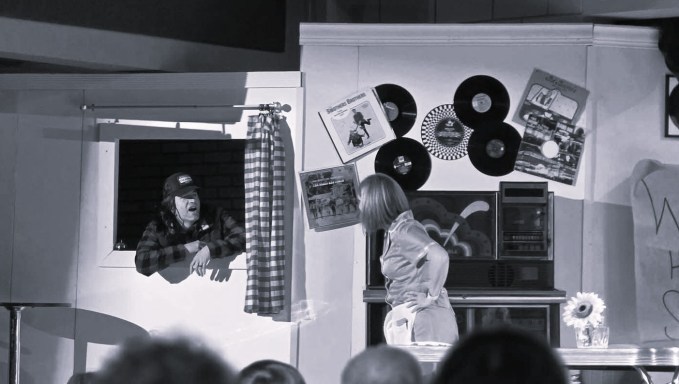
One of the things that has been defining my 40s has been to dive deep into the psychology of what makes all of us tick, as individuals. I love being able to explore and sort out the chaos of how amazingly different we are fundamentally are and how we live our lives because of and in spite of those differences.
As a curious experient last Fall, I went around asking people who know me well a very simple question, “Am I funny?”
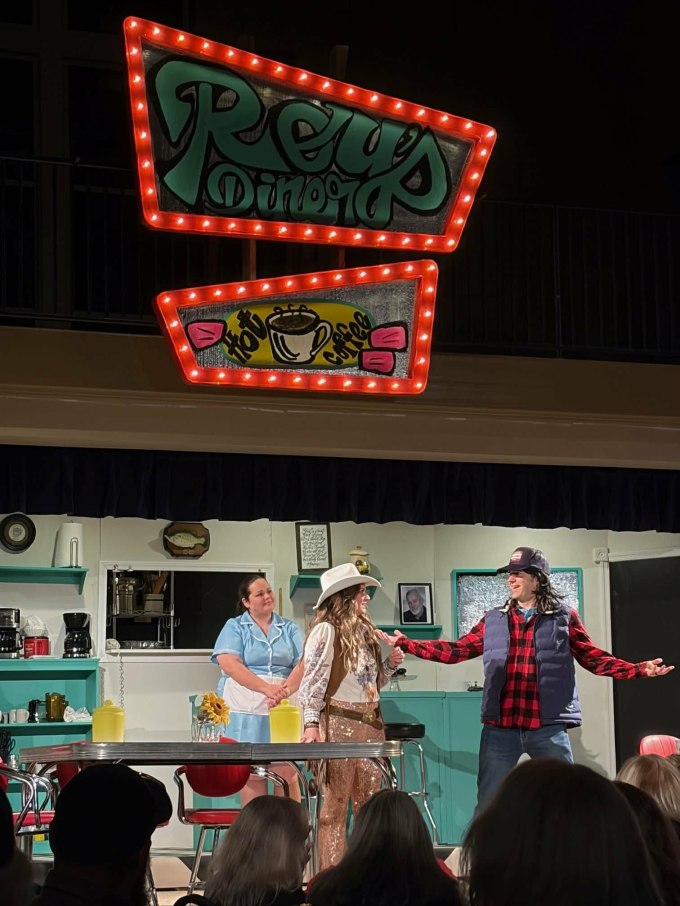
In my own perception of myself, I am “low key hilarious”…. obviously! But I learned that when people think of me, “funny” is not the first word that comes to mind for anyone. Instead, the word tends to be “intense” or something close to it; like passionate or even… dramatic.
So it would not be a surprise to share that my biggest learning curve in bringing my two characters to life in the DeKalb County Children’s Advocacy Center play has been to… take myself less seriously?
“Jukebox Diner” is the definitition of what a comedy is- ultimately to the point where literally every single line spoken is either a set-up for a punchline, or it is the punchline. And if you’re not constantly laughing, it’s simply because you missed the joke.
I spent my Christmas vacation learning all my lines before our first practice. In the process, I did research on the psychological motives of both characters I would be playing:
-An overeager romantic who is on the search for his 4th wife, having just finished a brief stint in prison.
-A grumpy old man who is well-informed of what’s going on in town, thanks to regularly monitoring everyone’s posts on “the Facebook”.
It was important to me that the audience saw depth and developed a sense of empathy for them. But that changed the more we practiced as a group at rehearsals.
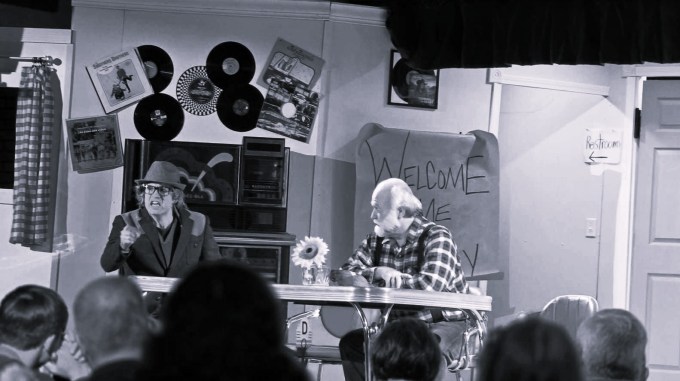
And now that we are nearing the end of our 7 performances, I have now completely gone full “cartoon mode” as I portray these characters in front of the audience each night. This AI description of comedy helps to put into words what I have learned over the past 2 months:
To understand the essence of comedy through absurdity, consider these key points…
- Exaggeration: Amplify ordinary situations to ridiculous extremes.
- Illogical Scenarios: Present scenarios that defy common sense or reality.
- Unexpected Twists: Introduce surprising outcomes that challenge expectations.
- Character Absurdity: Create characters with exaggerated traits or behaviors.
- Satire: Use absurdity to critique societal norms or behaviors humorously.
- Physical Comedy: Employ slapstick elements that highlight the absurdity of actions.
I tell myself backstage before each show begins: “You’ve got one job. Make people laugh.”
So the irony is not lost on me: By default, I am not seen as a “funny” person. It’s as if I see comedy through the lens of a person looking in from the outside.
Each night on stage, when I experiment by taking a slightly longer dramatic pause for the joke to land better, or when I experiment by ad-libbing a few more words to amplify the actual scripted line I am about to deliver, what I am actually doing is improving the comedy experience for the audience through analytics and logic.
That is a fascinating discovery: I have the skill of making people laugh, without necessarily being a naturally funny person.
Instead, I simply pour all of my intensity into comedy. And it works.
 Family Friendly Daddy Blog