When Real Life Feels More Like Purgatory

September 20, 2011 at 8:22 pm , by 

Ten months.

Purgatory is the condition or process of purification or temporary punishment in which, it is believed, the souls of those who die in a state of grace are made ready for Heaven.” -Wikipedia’s definition of “purgatory”
I’ve never actually met anyone who truly believes in purgatory, yet I feel that the general population is familiar with the idea of it.

On the final episode of Lost, the people from the Island who had ultimately lived their lives for the goodwill of others instead of greed and selfishness, reunited and reminisced in purgatory before entering Heaven together.

For those who are not Lost fanatics but like the band Coldplay, in their song “42,” some of the most memorable lyrics include the refrain, “You thought you might be a ghost; you didn’t get to Heaven but you made it close.”

Most of us don’t believe in the actual place, but for me at least, there is something pretty fascinating about the concept. I think it’s so easy in this life, in this culture, in this country, to feel like we are lost, or at least that we don’t belong wherever “here” is. We want to think that we deserve to transcend this lowly and boring situation, asking the question:

“What am I supposed to learn from this? Why am I here?”

My life has been filled with stretches like that. Even right now, my wife and I are having to adjust back to the busyness of our full-time jobs in Nashville, this time with a kid; which is a completely new balancing act for us. We are having to figure out and work out our new lifestyles and schedules, making time not only for the three of us, but for the two of us, as well.

It’s a purification process that is not easy; but it is necessary. We can see how natural it can be to let your kid consume your leftover energy and thoughts, slacking on making conscious efforts to keep the marriage relationship fresh and engaging. But we don’t want our lives to end up like Everybody Loves Raymond.

Ultimately, we are being forced to mature our marriage relationship. This “forced maturity” is sort of the whole point of purgatory. You suffer until you overcome.

Not that I am constantly immature or naive, or maybe I am (?), but I am always needing to grow in a way that I never could have without entering my newest purgatory.

But really, the more I think of the literary device we know as purgatory, the more it just seems like a straight forward yet abstract way to describe life itself; the condition or process of purification or temporary punishment in which, we are made ready for Heaven, at best.

We may figuratively compare our lives to hell at times, but really, hell is an eternal end; it’s never-ending loneliness and destruction. Purgatory is temporary.

I don’t mind viewing life as purgatory. Until I pass on in to the afterlife, I will always have much more growing up to do, more necessary suffering, and one more level of maturity to reach- even if I live to be 80.
The Trifecta of Hard Work, Consistency, and Creativity

September 12, 2011 at 6:57 pm , by 

Nine months.

As a husband and dad, it’s important to me that I am inspiring and engaging to my wife and son. So I have adopted an assumed business model to do just that: to be not only hardworking and consistent, but also creative.

A lot of people in this world are hard working and consistent, but many of them lack that third element of the trifecta: creativity. A man can work hard and consistent his whole life but never really break a certain point in his career because of a lack of it.

Hard work and consistency are what keep the conveyer belts going. But being creative is what puts new products on that conveyor belt, maybe even replacing the conveyor belt itself with something better.

New ideas are what advance the world; new ideas are born out of creativity.

So how does this business model of the “creativity, hard work, consistency” trifecta have anything to do with marriage and parenting? For me, a whole lot.

As a husband, it’s important that I take the initiative to think of fresh ideas to make my wife feel special and loved. And as a dad, I’ve  learned the necessity of inventing all kinds of weird voices and games to entertain my son in an effort to keep him engaged, or at least distracted when he’s being really clingy with my wife while she’s trying to get dinner cooked.

This week I happen to be reading the book Parenting with Fire, by Rabbi Shmuley Boteach, who explains the importance of creativity in his family:

“The answer is for us to start thinking of ourselves as camp counselors, and our homes as bunks, and for us to fill family free time with activities that captivate and entertain all its members.”

Ultimately, I think as a parent it can be easy to find myself in a mindset where I am so focused on figuring out how to be a “normal” parent, that I forget part of being normal is being weird; in other words, being creative.

I Don’t Want to Die Right Now

September 8, 2011 at 10:59 pm , by 

Nine months.

I’ve only got about 50 years left to live, if that.

Most nights as I fall asleep, I can’t help but think how sleeping through the night is sort of like checking out of reality, reminding me of the lyrics to Tom Petty’s classic song, “Freefalling”: “I want to leave this world for a while.”

Though I’m overly aware that at any given second I could die of any random cause, like instantly turning into a pillar of salt, I’m never more aware of the inevitability of death than when I am fading and falling into the dream world.

Sleeping is the closest thing I know to having an understanding of what it’s like to be dead. It’s the closest concept I have of understanding what it’s not like to live in this world, confined to rules of practicality and common sense.

Sure, it’s an understatement to admit that I don’t want to die right now. But I’ve never been more caught up in life than I am at this very moment, so it’s really on my mind.

After all, I have made a covenant before God to love my wife for as long as we both shall live. Then the two of us brought another life into this world. That’s pretty dang epic. That’s deep.

So now that I have involved myself this drastically in the course of history (and therefore, the future), I’m just dying to stick around. It’s not simply that I want to see what happens next; not simply that I want to see how the story unfolds with my wife and son. But I want to literally be here, as part of their story.

Without a doubt, it’s sad to think that the story could go on without me. It’s sad to think that has been reality for so many people who “died before their time.”

I’m not afraid of death. I couldn’t be any more confident of what happens to me the second after I die. But while I’m not afraid of death, I am pretty fascinated by it.

It amazes me that millions of people alive today in this world could take life (and therefore, death) so nonchalantly: That despite all the miracles in their lives, they never see a need to think past this life, and to consider how the people they interact with each day can be affected eternally by their words and actions.

How can a person not think about eternity, or convince themselves it doesn’t exist? The irony: that life itself distracts a person from thinking about death.

I can’t imagine not taking enough time to pause and wonder about what happens when the lights finally go out for good and what this life was for. I do it on a daily basis.

So it’s not that I ever wanted to die, or wouldn’t mind dying, but now more than ever, if I have any say in the matter, it’s as simple as this:

I don’t want to die right now.

And if I shall continue waking up alive each day, as I have done for 30 years so far, then I shall continue to live to the best of my ability. I’m the kind of guy who takes life way too seriously, but in a good way, I would like to think.

Intelligent Design: Love from a Scientific Perspective

September 7, 2011 at 7:35 pm , by 

Nine months.

If we were restricted to only see the world in terms of science, where would love fit into that picture? I guess it could be said that love, along with all other human emotions, is ultimately necessary for not only procreation but also the desired human interactions that help move us forward as a society. Carpenter ants and sea horses do not need to feel anything emotionally in order to survive and multiply, but we humans, being much more complicated, are not devoid of personalities or the need to feel needed by others. We need love.

So somewhere in the evolution from fish to ape to man, love randomly showed up in the genes and proved to be fit for survival? It sounds pretty miraculous to me…

That’s why, along with the Jewish actor/political commentator Ben Stein (The Wonder Years and Ferris Bueller’s Day Off) and the Christian actor/evangelist Kirk Cameron (Growing Pains), I am a devout advocate of Intelligent design.

In other words, I reject the popular and politically correct theory of evolution and/or The Big Bang Theory. Instead, I believe that man was literally created by God, from dust, as it is explained in the book of Genesis- in six literal 24 hour days.

What about dinosaurs, though? After all, men could not have survived alongside vicious, giant lizards.

Interestingly, The Book of Genesis explains that in the beginning, God gave the herbs and plants for the people to eat. It wasn’t until ten extremely long generations later (people lived centuries long back then) when Noah and his family exited the ark that God told mankind A) that animals would begin fearing man and therefore, B) that people should now starting eating animals as part of their diet.

Therefore, I believe for ten long generations, people and animals of all kinds coexisted, all living on a vegetarian diet. Radically, I believe the world is around 10,000 years old; not millions or billions. That’s just the Cliff Notes version of Intelligent design. Feel free to read another blog post I’ve written on it; or google “Intelligent design” to learn just how “out there” I really am.

Simply put, I believe that love is just simply too miraculous to have randomly showed up on its own. I believe that love did not evolve, but instead was created and given as a gift from God to man; so that man would share it. For me, thinking about love from a scientific perspective only points me to one simple idea: love is part of God’s intelligent design.

The love I share for my wife and son comes from God; not chance.

Unexpected Bonus!


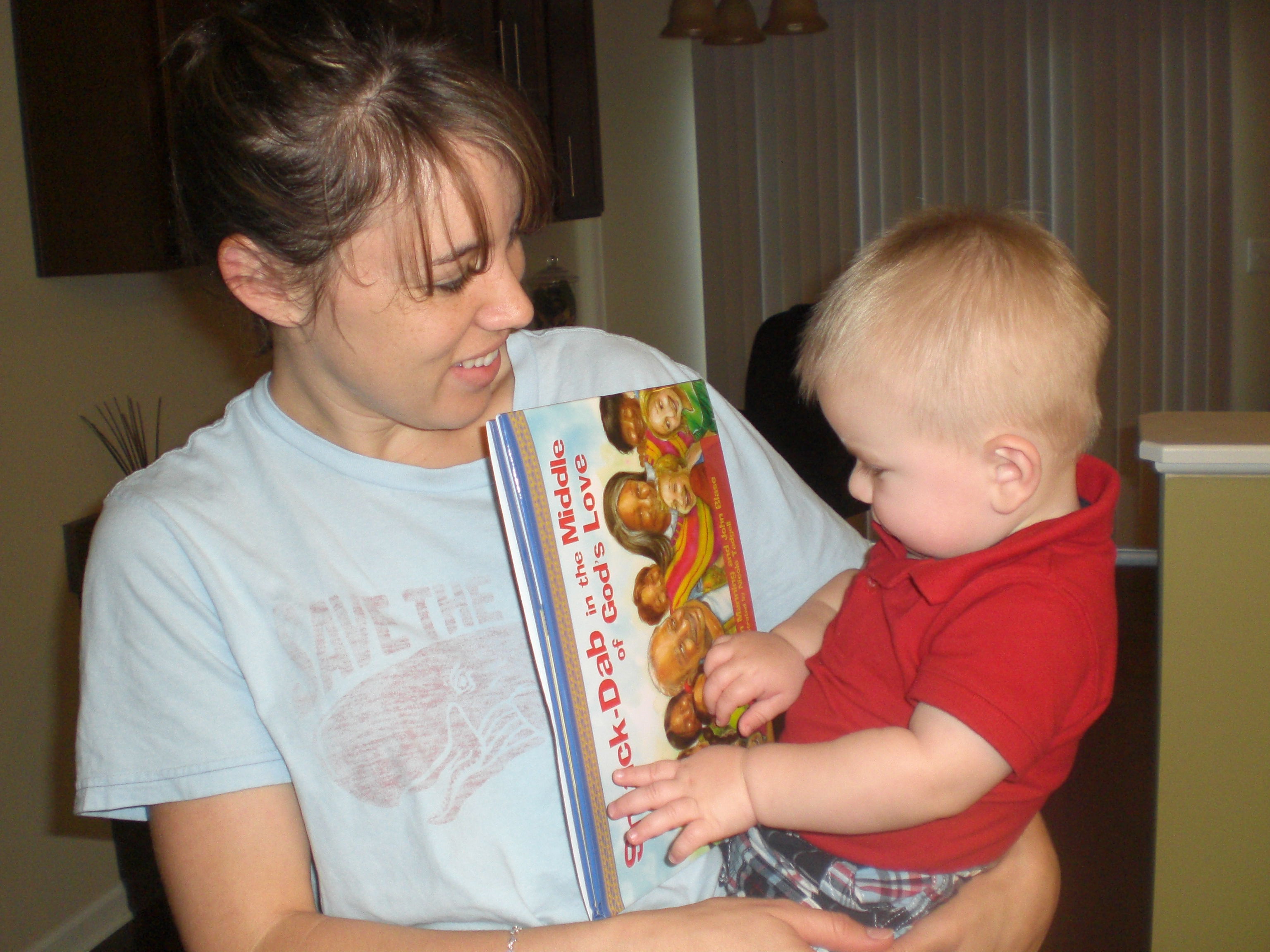
It has never been more appropriate than right now for me to give away a free copy of the brand-new, just released, children’s book, Smack Dab in the Middle of God’s Love.

The book seems to encompass the artistic sophistication of a classic Caldecott Medal winning book along with the multi-ethnic oneness of Sesame Street. It’s a nostalgic return to the good children’s books I read as a child growing up in the Eighties, but with a modern accent. I believe this book would especially be ideal for parents who have not yet raised their children in a particular religious household, but who are now more interested in doing so; the book would serve as a great transition into teaching them about God’s love.

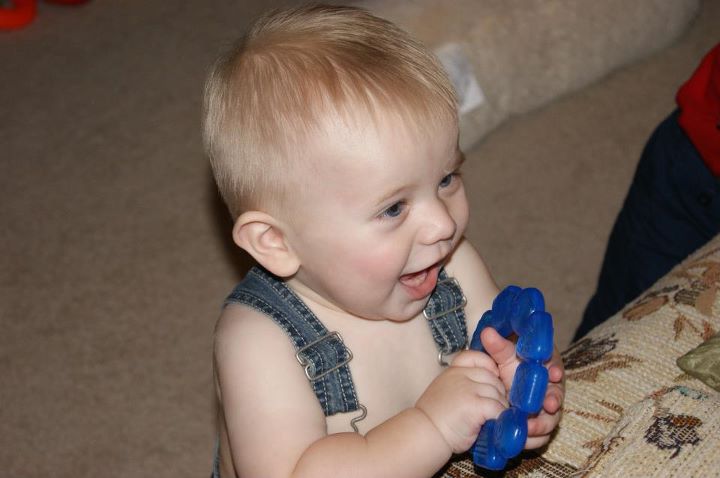
Now, as to the one lucky winner who will be mailed a copy of this book, just be the first person to leave a comment on this post telling me how many weeks old my son Jack was when we gave him his first haircut. Make sure you send me an email (nickshell1983@hotmail.com) with your name and mailing address so I’ll know where to mail it.

Need a hint? Use the search box on the right side of this screen.

Excerpt from the back cover of Smack Dab in the Middle of God’s Love:

“Willie Juan and Ana’s home is always full of neighborhood children, laughter, and love. One day, while enjoying Ana’s most delicious sopapillas, Willie Juan asks a most curious question:

‘Little friends, what is one thing you think Abba will ask you someday when you are in heaven?’.

Through their answers, Willie Juan’s guidance, and a few giggles, the children learn that God cares about the details of their lives and that all good gifts- from hummingbirds to homemade sopapillas- come from Him.

This book will help kids discover how deep and wide and endless is the love of God. A love so BIG that no matter what, they will always be smack dab in the middle of it.”

Add a Comment

Why We are a Kosher, Gentile Family

August 27, 2011 at 8:44 am , by 

Nine months.

It’s weird, but true: There are more non-Jewish Americans who are kosher-abiding than those who are actually Jewish. Last October, a book by Sue Fishkoff came out that I would love to read. It’s called Kosher Nation and it explains why America has gone kosher. Fishkoff shares:

“More than 11.2 million Americans regularly buy kosher food, 13 percent of the adult consumer population… There are about six million Jews in this country. Even if they all bought only kosher food, which is not the case, they would not be enough to sustain such growth. In fact, just 14 percent of consumers who regularly buy kosher food do so because they follow the rules of kashrut. That means at least 86 percent of the nation’s 11.2 million kosher consumers are not religious Jews.”

My wife and I, along with our nine-month old son, are among that 86 percent. We are not Jewish, or even Seventh Day Adventists (who also do not consume pork or shellfish). But we are adamant about our kosher diet.
So is it a religious thing for us at all? Not really, but sort of.  We just kind of stumbled into it.

Through the Mexican bloodline in my family, I have adopted eczema- a vicious skin disease. My mom has it on her neck. One of my uncles has it on his knuckles. And I had it on the palms of my hands; in particular, I had dyshidrosis, where tiny clear blisters form, then pop, and dry out the skin- basically burning it.

For several years during my 20′s, I had what I call “Freddy Kruger hands.”  It was embarrassing, overpowering, and even depressing to live with. I was desperate to figure out what exactly it was and more importantly, how to cure the “incurable” disease.

And so began my journey into the world of natural cures and holistic living.

My skin problems peaked shortly after getting married. My wife and I took our honeymoon in New England, eating pretty much nothing but shrimp, scallops, and lobster the entire time. It was good eatin’.

When the week ended, I got back and realized that my entire body had broken out.  I found myself in a cloud of despairing depression for no good reason.

I learned that the bottom-feeder shellfish that I consumed were full of heavy metals, including nickel.  On top of that, my tungsten wedding ring also contained slightly toxic metals.
Eventually, I remembered that somewhere in the Old Testament of the Bible (Leviticus 11 and Deuteronomy 14) God instructed the Jews not to eat certain animals. I was always under the misconception that those food laws were simply there for a certain group of people to show their obedience to God.  Now I realize that those random food laws were God’s way of helping people to know what foods to eat- even as a way of avoiding cancer and disease.

By not eating the animals that are lowest on the food chain, along with all carnivores, the human body is exposed to much less toxins.

And the whole thing about not mixing dairy products with meat? Simply put, that combination prevents food from digesting through the body too slowly. Otherwise, the undigested food remains in the body for too long, potentially causing health problems.

Needless to say, as I converted to a kosher diet, my eczema gradually disappeared; as a side effect, I also lost 25 pounds in the process. So I became inspired to invent The Shell Diet, which is basically the kosher version Mediterranean Food Pyramid.

And that’s how we became a kosher, Gentile family.

Granted, I’m not saying it was an easy transition. It’s still tempting to smell crispy bacon that a co-worker is heating up in the microave or dine at a seafood restaurant where I lust for buttery scallops. But for me, it had to be all or nothing. Anything was worth getting rid of my eczema.

Even for our son, it’s not necessarily easy to keep him kosher. For example, most infants’ pain relievers contain Red Dye 40, which is derived from petroleum; while others may contain Crimson Lake, which is made from scale insects.  (The only insect permitted to eat by kosher law is the locust.) When I was a kid, I had a lot of stomach problems, as well as, anxiety attacks- that is, until my parents stopped allowing me to have foods with red dye in them.
It’s strange that I would become the least bit of an expert on being kosher; especially for the fact that I don’t really have any Jewish friends.