
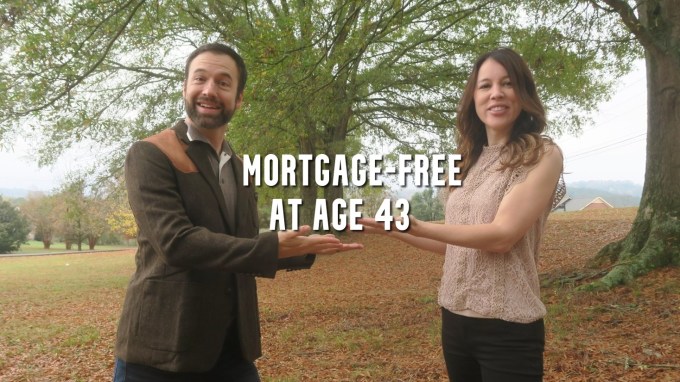
I will never forget this day in history: November 6th, 2024.
That’s the day my wife and I paid off our mortgage.
What you are about to read is the classic story of the underdog. We as a human civilization are naturally fascinated to see individuals overcome the odds placed against them and actually reach a seemingly impossible goal.
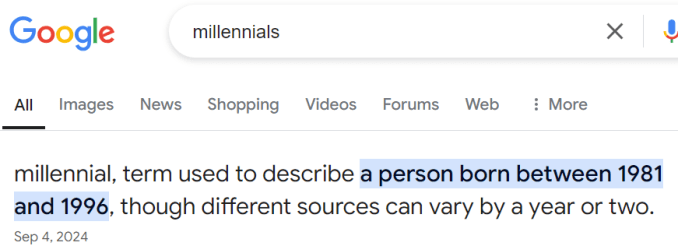
This is the story of how at age 43 (we were both born in 1981), my wife and I have now reached our goal of being not only debt-free, but also mortgage-free; despite the odds and despite remaining in the middle class.
To be clear, this is not a sexy story. We did not win the lottery. We did not inherit a million dollars. We did not invest in Bitcoin.
How we did it is the boring equivalent of someone you know losing 50 pounds and when they are asked how they lost the weight, they respond by saying they started exercising everyday, they reduced their daily calories, and increased their protein and fiber intake.
It’s not exciting to learn that people reached a challenging goal through hard work, dedication, and sacrifice… especially when it took years to get there.
Similarly, our underdog story is equally boring…
During my final year of college, my sister (who is 3 years younger than me) and I shared an apartment. The way our schedules lined up, when one of us was away at campus either in class or working, the other one would squeeze in an hour or two of playing Animal Crossings on the Nintendo GameCube back at our apartment.
In case you’re not familiar, the ultimate point of Animal Crossings is to work as efficiently as possible so that you pay off your mortgage.
(For the record, my sister ended up paying off hers before I did.)
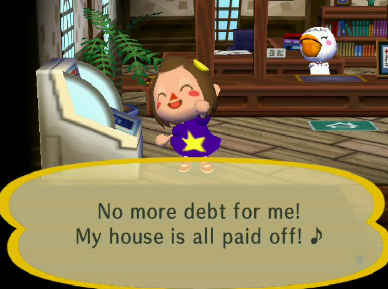
As silly as it is, playing that video game for the course of my senior year of college fundamentally inspired me for my actual “real life” ahead. I was determined: I will be part of the rare minority of Americans to pay off my mortgage “early”; well before it was time to retire. (The average age to pay it off is 62.)
Despite the modern marketing attempts of banks and credit unions to convince me otherwise, the truth was obvious to me: “No. You are not like family and you are not my friend.”

But from the beginning, my strategy was not entangled with the idea of “getting rich first”. Instead, my plan would be to exploit the concept of maintaining a low overhead while finding ways to multiply my sources of income.
Fundamentally, the speedrunning aspect of paying off our mortgage early would focus on paying extra each month on the mortgage payments, so that it would pay off the principal of the loan quicker; preventing us from paying more in interest over the years.
Fortunately, I was naturally attracted to a woman who had the same intrinsic desire. As a team, we have worked together for many years to reach our goal; from the moment we got married. Because apparently, nothing is more romantic than mutually aspiring to be debt-free and mortgage free as a couple?
To be clear, our path to reach this goal was never easy. (Neither of us “came from money”.) Instead, much of our 16 years of marriage has been riddled with financial setback after financial setback.
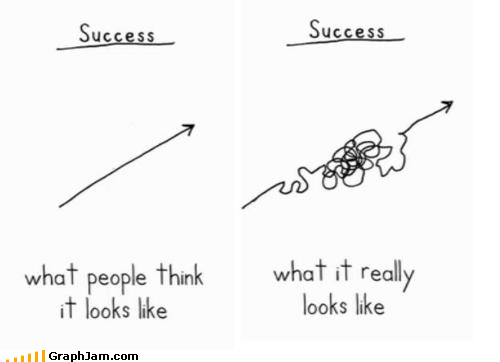
I remember years ago, seeing a meme that gave an honest visual of what the path to success actually looks like. It helped prepare my expectations.

- Opportunity.
- Timing.
- Upbringing.
- Effort.
- Meaningful work.
- Legacy.
One that stands out to me from this list is Upbringing. One set of my grandparents were 1st generation Americans; meaning their own parents immigrated here from other countries. Specifically, I grew up up curiously observing my Papaw Metallo, who ultimately grew up in an orphanage in Kenosha, Wisconsin.
I watched him work an average job, live in a decent-sized home on a few acres, never buy a new vehicle, and he always had money in the bank.
Undoubtedly, his habits were adopted by my parents, and passed on to my sister and me. (Not only did my younger sister pay off her mortgage in Animal Crossings before I did, but she also did in real life a year and a half ago.)
I also see how Opportunity and Timing played into our ability to pay off our mortgage at age 43. Had the Covid Crisis of 2020 not happened, my wife and I would not have been able to start working remotely, allowing us to “cash in” by selling our Tennessee home (which doubled in value over the 9 years we lived there) and then move to Alabama again where the cost of living is much lower.
So I suppose I shall quote the 2004 rom com starring Brittany Murphy, Little Black Book: “Perhaps luck exists somewhere between the world of planning, the world of chance, and the peace that comes from knowing that you just can’t know it all.”
Undeniably, my wife and I have been (imperfectly) following the teachings of Dave Ramsey since 2008 when we got married; which eventually led to us becoming debt-free (other than our mortgage) five years later in 2013.
That means it took us 11 years to pay off our mortgage after becoming debt-free. It was around that time that I consumed the book, Rich Dad Poor Dad, by Robert Kiyosaki. From there, I became obsessed with creating “passive incomes” on the side; what most people know as “side hustles”.
I started two different YouTube channels, creating content exploiting topics that people were already searching for (men’s hair loss and DNA test results) as opposed to what I actually wanted to talk about.
I began using my blog (Family Friendly Daddy Blog) as a SEO platform to implant Amazon links; which generate commission for me when readers click on them.
My work as a blogger led to me becoming the official daddy blogger of Parents Magazine. During those 4 years, I was sent new vehicles to “review” each week, which included a full tank of gas. (This was officially ironic because we have never actually owned a new vehicle.)

I used my accidental knowledge of SEO to become an independent contractor for other businesses, in addition to my full-time job.
All of these side hustles generated hundreds of dollars each month; which ultimately went towards paying the principle of our mortgage. Admittedly, I still generate passive income from my YouTube channels and Amazon links, though it is much less than it was back in the years I needed it so badly.
So yes, certainly Effort has been important; going back to Malcom Gladwell’s 6 Unexpected Outliers to Success.
Something possibly surprising about this journey, from the very beginning, we have been committed to tithing and charitable giving: Even during our lowest financial point.
This is consistently taught throughout the Bible, as well as being continually endorsed by Dave Ramsey and Robert Kiyosaki, author of Rich Dad, Poor Dad.
As for the future, we shall continue our lifestyle of keeping a low overhead. The income that used to go to our mortgage will now being going towards investments and savings.
I also recognize that when you overcome a major obstacle, it requires you to recalibrate your process; as a new obstacle will present itself to replace the last one.
Without the constant burden of “must pay off mortgage” hanging over my life, what will I do with that space in my brain?
I refuse to see “work” as a negative thing that I am suppose to graduate from. I find ways to make the challenge of work exciting and rewarding. Work means that I continue to create and contribute; whether or not it means I am an employee of a company.
The thought of retirement is not exciting to me. I’m convinced that I’m that guy who if I stopped “working”, I would die a few months later.
Keep working. Keep creating. Keep living.
 Family Friendly Daddy Blog